
Summary
Editor's rating
Value for money: not cheap, but you do get real capacity
Design: looks like a small appliance, not a gadget
Comfort and noise: big unit, surprisingly quiet most of the time
Build quality, filters and long-term use
Performance: strong airflow and fast reaction to pollution
What you actually get out of the box
Pros
- Very high airflow and fast reaction to pollution, suitable for large rooms
- Quiet and low power use on Eco/low modes, easy to leave running all day
- Simple plug-and-play operation with clear air quality ring and no app hassle
Cons
- Very bulky footprint, hard to hide and not ideal for small spaces
- Replacement filters are expensive and add to long-term cost
- Gets noticeably loud at maximum fan speed when dealing with heavy pollution

Specifications
View full product page →| Brand | Coway |
A giant purifier that actually makes a difference
I’ve been using the Coway Airmega 450 for a while in a big open-plan living room plus kitchen, roughly 55–60 m² with high ceilings. I bought it mainly because smaller purifiers I tried before were clearly struggling: they’d show “good” air while cooking smells were still hanging around, and they only really worked if you sat right next to them. With this one, I wanted something that actually has the airflow to handle a large room instead of yet another compact gadget.
First thing to know: this thing is big. The photos on Amazon don’t really convey the size. When you unbox it, it feels more like a small portable AC unit than a typical air purifier. If you live in a studio or already hate having appliances visible, you’ll notice it. But in my case, I preferred something oversized that actually cleans the whole space rather than a cute little tower that barely moves air.
In day-to-day use, the main thing I noticed is the air “feel” and smell. After a few hours of running it on Auto and Eco, the room smells less stuffy, especially in the evening when we’ve had cooking going on and doors closed. I’m not going to pretend I can measure PM1 by nose, but there’s clearly less lingering odour from frying and the musty smell near the windows is reduced. It’s not magic, but it’s a step up from the cheaper purifier I had before.
Overall, my first impression is: big unit, serious airflow, and surprisingly quiet when it’s not at full blast. It’s not perfect, and it’s definitely not for people who are tight on space or want app control, but if you’re actually trying to handle a big room, it finally feels like the specs line up with reality instead of marketing numbers on a tiny device.
Value for money: not cheap, but you do get real capacity
On value, this is clearly not a budget purifier. You’re paying for a high CADR, a big filter, and decent engineering. Compared to small units that cover 20–30 m², the price jump looks steep at first. But if you actually need to handle a big living room or open-plan space, buying two or three smaller purifiers can end up costing the same or more, and they still might not move as much air as this one does on its own. So it really depends how big your space is and how serious you are about cleaning the air.
Where I think the Airmega 450 makes sense is for people who have: a large room, allergies/asthma, pets, or issues like damp/mould smell or smoke from neighbours or outside. In those cases, the performance gap vs cheap purifiers is noticeable. The sensors react quickly, the airflow is strong, and the Eco mode keeps energy use pretty low when the air is already clean. If you only want something for a small bedroom or office, it’s probably overkill and you’d be better off saving money and buying a smaller Coway or another solid mid-range unit.
The running costs are the main downside for value. Big filters cost more, and you can’t avoid that. On the other hand, the 12‑month filter life claim and the efficient low-power modes help soften the blow. Also, you’re not paying for cloud services, apps, or other gimmicks that can break in a few years. The product is pretty straightforward: hardware, sensor, filter. For me, that’s a plus because less software usually means fewer headaches later.
If I had to sum it up: good value if you genuinely need high airflow in a large space and plan to use it daily. If you just want to freshen up a small room now and then, it’s too much money and too much size for what you’ll actually use. So it’s not universally good value, but for the right type of home and user, it’s a solid investment rather than a random gadget purchase.
Design: looks like a small appliance, not a gadget
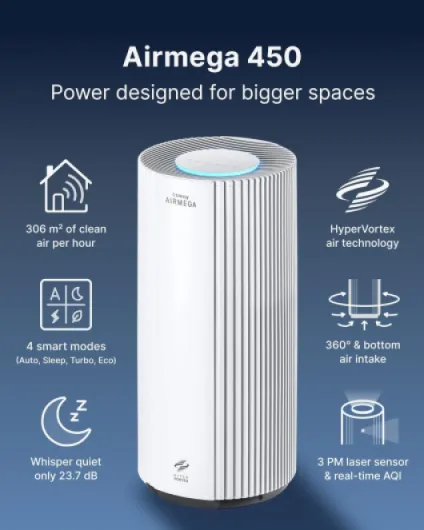
Design-wise, the Airmega 450 is more like a compact appliance than a little desktop purifier. It’s about 75 cm tall and 34 cm wide and deep, so it’s basically a chunky white column. The style is pretty neutral: white body, perforated front, and a light ring on the front. It doesn’t scream “tech toy”, but it’s definitely visible in a room. In my living room it sits against a wall near a power socket and it kind of blends in like a small dehumidifier or air conditioner. If you’re expecting something slim and discreet, you’ll be surprised when you unpack it.
The build feels solid enough for home use. The plastic doesn’t feel luxury, but it doesn’t feel cheap either. The front panel snaps off with a bit of force, which at first feels like you’re going to break it, but after a few times you get used to it. The top touch panel is clear and the icons are simple. The ambient light ring is actually useful to glance at from across the room: blue for good, green, yellow, red as it gets worse. You can dim or turn off the lights if they annoy you at night.
One detail I liked: it uses a standard figure‑8 power cable (C7), so if the cable is too short or you need to run it differently, you can just use a longer one from another device. The power socket is a bit recessed under the unit, which is annoying the first time when you’re trying to plug it in while it’s already in place. Best trick is to connect the cable before you slide it into its final spot.
Overall, the design is functional more than pretty. It’s clearly built around airflow and a big filter rather than being decorative. I’m fine with that because it’s supposed to clean air, not be a piece of furniture. But if you’re super picky about interior design or you have very little space, the footprint and height are something to think about before buying. It’s not the kind of thing you can just hide behind a plant.
Comfort and noise: big unit, surprisingly quiet most of the time
Comfort-wise, I was mainly worried about noise, because a big fan usually means you end up with a constant hum that drives you mad. On this one, the low and medium levels are actually very reasonable. The spec says 21.6 dB at the lowest setting, and while I don’t have a meter, it’s basically a soft background airflow, quieter than my fridge. In Eco or Sleep mode in the living room, we forget it’s on unless the room is totally silent. For a bedroom, I’d say it’s fine in Sleep mode if you’re not ultra sensitive.
When it jumps to high speed, you do hear it. It’s not a jet engine, but it’s clearly present, like a big fan or a small AC on high. The difference is that it usually only does that when the sensor sees a spike in particles: cooking, smoke, sprays, vacuuming, etc. In my case, it might go loud for 5–10 minutes and then drop back down once the air is cleaner. If you hate any kind of noise change, this might annoy you, but at least you know it’s reacting to something real and not just randomly cycling.
Physically moving it around is doable but not super fun. It’s about 11.3 kg, so not crazy heavy, but with the bulk and height it’s a bit awkward to carry if you have to go up and down stairs. In one flat, it’s fine to drag between rooms if you really want to, but realistically, you’ll park it in one big area and leave it there. There are no built-in handles on the sides, which would have helped. Some units in other markets have wheels; if yours doesn’t, just assume it’s semi-stationary.
From a usability point of view, the fact that it has no app is either a plus or minus depending on your style. Personally, I liked the “set and forget” angle: no account, no Wi‑Fi pairing, no random notifications. Just walk up to it, press Auto or Eco, and that’s it. If you like to check graphs on your phone or control it from outside, you’ll miss that here. For me, comfort means I don’t have to think about it too much, and on that front it does the job pretty well.
Build quality, filters and long-term use
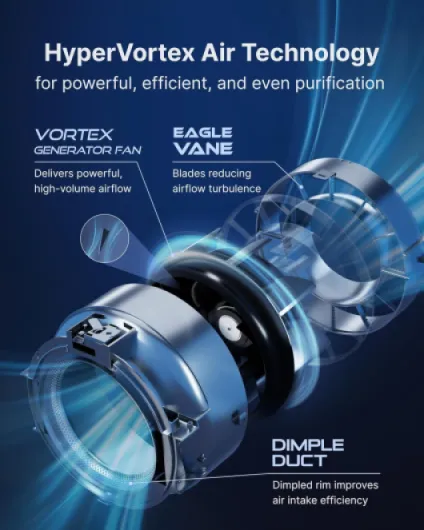
On durability, I obviously haven’t had it for years yet, but there are a few things that give a decent idea of how it’ll hold up. The housing feels solid and doesn’t flex easily. The front panel clips are firm, and the filter bay is simple with no weird moving parts that could break. The motor and fan sound smooth, with no rattling or vibration even at higher speeds, which is usually a good sign for long-term use. Coway also gives a 3‑year warranty, which is more than some cheaper brands that only offer 1 or 2 years.
The filter is a big 3‑in‑1 cartridge (pre-filter, HEPA, and activated carbon). They claim up to 12 months of life, which obviously depends on how dirty your environment is and how much you run it. In a city flat with daily use on Auto/Eco, I’d expect somewhere between 8 and 12 months. There’s a filter indicator that tells you when it’s time to change it, so you don’t have to guess. The pre-filter layer will need occasional vacuuming or brushing if you have pets or a lot of dust; that’s a 5‑minute job once a month.
Long-term cost is worth mentioning. Replacement filters for big units are not cheap. You need to check the price of the AM 450 filter in your country before buying, because it’s part of the real cost of ownership. The upside is that a large filter generally clogs slower than the tiny filters in small purifiers, so you’re not changing it every few months. Also, the Eco mode helps because the fan isn’t blasting at high speed 24/7, which should reduce wear on the motor and extend filter life.
Overall, I’d say build and durability seem pretty solid, but it’s still an appliance with a consumable core. If you’re okay with the idea of buying a new filter roughly once a year and doing basic cleaning, it feels like something that can easily run for several years. If you’re the type who never wants to think about maintenance or doesn’t like ongoing costs, you might get annoyed when it’s time for that first filter change.
Performance: strong airflow and fast reaction to pollution
In terms of performance, this is where the Airmega 450 actually justifies its size. The fan can push a lot of air. On the highest levels it’s basically like standing near a strong desk fan, so you really feel the airflow. In my roughly 55–60 m² open-plan space, if I fry something or open the door to a smoky stairwell, the ring goes yellow or red in seconds and the fan ramps up quickly. Within about 10–15 minutes, smells are mostly gone and the ring drops back to blue. With my previous smaller purifier, I’d still smell food an hour later unless I fully opened windows.
The Auto and Eco modes are the ones that matter in daily use. Auto constantly adjusts the fan speed based on the sensor readings. Eco goes a step further: if the air stays clean for 10 minutes, it actually stops the fan, then checks again every 30 minutes and restarts if needed. With my smart plug, I saw it idling at around 2 W and about 7–8 W in Eco when it’s running gently, which is pretty low for a unit this size. When it kicks into higher gears, obviously the power draw and noise go up, but it doesn’t stay there long unless you’re constantly generating pollution (cooking, smoking, DIY, etc.).
On air quality, I can’t lab test it, but daily stuff is clear: less lingering cooking smell, less musty odour from damp corners, and my partner with dust and pollen allergies says mornings feel a bit easier when we’ve had it running the evening before. It doesn’t remove all dust from surfaces (nothing will), but airborne dust seems reduced: there’s less of that visible beam of dust in sunlight after a good cleaning session plus running this for an hour.
For smoke, I tested by burning a bit of paper and also lighting incense. The sensor goes red very quickly and the fan ramps to max within about 10–20 seconds. After 10 minutes at high speed, the smell is heavily reduced and the ring usually goes back to blue or green. It’s not instant, but it’s clearly doing something. So in practice: strong performance, especially in big spaces, as long as you accept the size and the occasional noise burst when it has to work hard.
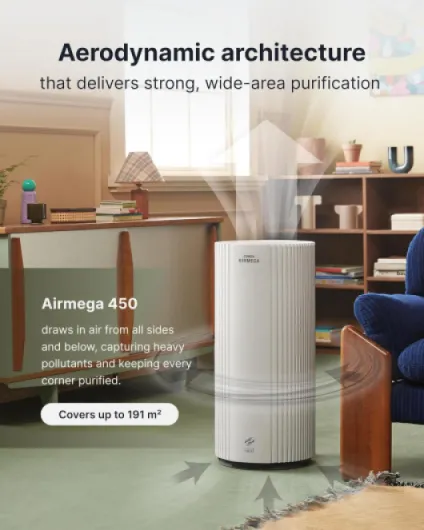
What you actually get out of the box
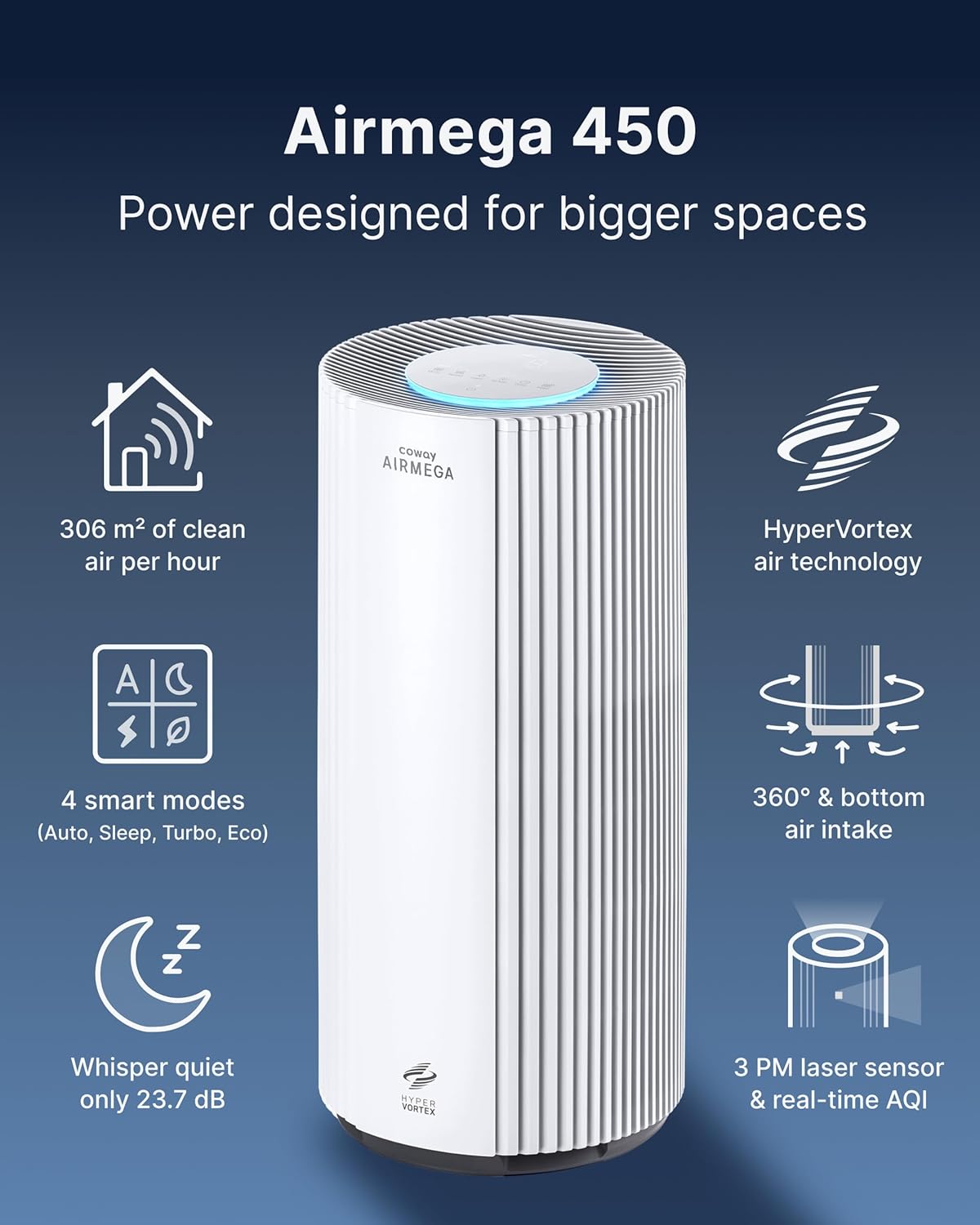
Out of the box, the Coway Airmega 450 is pretty simple: the main unit, the big cylindrical 3‑in‑1 filter already installed (but bagged, so you have to unwrap it), a standard figure‑8 power cable, and the manual. No remote, no app, no extra filter set. Setup is basic: pop off the front panel, pull the filter out, remove the plastic, put it back with the open side up, close the panel, plug it in and you’re done. It’s the opposite of all those smart Wi‑Fi gadgets that force you into an app before you can even turn them on.
The control panel is on top with touch buttons. You get buttons for power, fan speed, Auto, Eco, Sleep, light, and a filter reset. There’s also a numeric/LED style display for PM1/2.5/10 plus a colour ring that changes from blue to red depending on air quality. In practice, I mostly just leave it on Auto or Eco and forget about it. The sensors react pretty fast: cooking, spraying deodorant, or even shaking out a blanket makes the ring jump to yellow or red within seconds.
The specs are pretty aggressive: CADR 734 m³/h and “cleans up to 306 m² in an hour” (which is marketing speak for one air change per hour at that size). In a real house, think more like very solid coverage for one large room or maybe two smaller ones if doors are open. It’s rated for particles down to 0.01 micron, with HEPA and activated carbon, so in theory it handles dust, pollen, smoke, VOCs, and odours. I can’t verify the 0.01 micron claim, but practically speaking, it does deal with visible dust and smells better than the smaller HEPA unit I had before.
The main thing to understand: this is clearly built as a “whole big room” machine, not a bedroom toy. No app, no fancy voice control, just a fairly serious fan, a chunky filter, and laser sensors that ramp the speed up and down. If you want something you can put on a bedside table, this is the wrong product. If you want something to park in a living room or open-plan area and just leave running, this fits that use case better than most mid-size purifiers I’ve tried.
Pros
- Very high airflow and fast reaction to pollution, suitable for large rooms
- Quiet and low power use on Eco/low modes, easy to leave running all day
- Simple plug-and-play operation with clear air quality ring and no app hassle
Cons
- Very bulky footprint, hard to hide and not ideal for small spaces
- Replacement filters are expensive and add to long-term cost
- Gets noticeably loud at maximum fan speed when dealing with heavy pollution
Conclusion
Editor's rating
The Coway Airmega 450 is basically a serious air purifier for people with big rooms and real air quality issues. It’s large, it’s not cheap, and it’s not trying to be a stylish little gadget. In return, you get strong airflow, quick sensor response, and a simple automatic system that actually feels like it’s doing something: less cooking smell, less musty odour, and a generally fresher feel in big spaces. Noise is well managed on low and Eco modes, and the fact it idles at only a few watts is a nice bonus if you plan to leave it on most of the day.
It’s not for everyone though. If you live in a small flat, care a lot about discreet design, or want full app control and graphs on your phone, this won’t be the best fit. The size is hard to ignore, filters aren’t cheap, and at full power it does get loud, even if only for short bursts. I’d recommend it to people with open-plan living areas, high ceilings, pets, allergies, or mild damp/smell issues who want a “set it and forget it” purifier that actually has the capacity to clean a big volume of air. If you just want to tidy up the air in a bedroom or small office, a smaller and cheaper unit will make more sense.