Summary
Editor's rating
Is It Worth the Money?
Design: Big Box of Air, But Not Ugly
Noise, Daily Use and Living With It
Build Quality, Filters and Long-Term Use
Performance: Does It Actually Clean the Air?
What You Actually Get Out of the Box
Effectiveness for Allergies, Smells and Everyday Use
Pros
- Very quiet on low and night modes, easy to sleep or work next to it
- Noticeably reduces cooking smells and general stuffiness in a medium room
- Simple controls and useful app with filter tracking and scheduling
Cons
- Replacement filters are quite expensive over time
- PM2.5 sensor and auto mode can be too insensitive during light pollution events
Specifications
View full product page →| Brand | BLUEAIR |
Why I Bought Yet Another Air Purifier
I picked up the Blueair Blue Max 3350i because my flat gets a mix of traffic pollution, cooking smells, and a fair bit of dust. I also have mild dust and pollen allergies, so I was looking for something for a medium-sized living room that could actually run daily without sounding like a vacuum cleaner. I’d already tried a couple of cheaper purifiers from random brands, and they either got too noisy on the higher settings or felt like they weren’t doing much beyond blowing air around.
I’ve been using this Blueair unit for a few weeks, basically running it on auto most of the day and then night mode in the bedroom. I moved it between rooms to see how it handled different situations: cooking, cleaning, and just general everyday use. I’m not a lab, so I can’t tell you exact particle counts, but I can tell you whether the air feels better, whether smells linger, and if it’s annoying to live with.
Right away, the thing that stood out was how quiet it is on the low settings. Compared to the cheaper units I had before, this one blends into the background much more. I can work, watch TV, or sleep with it on without feeling like I’m in an airplane. On the flip side, once you start looking at the filter prices and some of the smart features, you realise it’s not a budget product at all, so I went in with higher expectations.
So this review is basically: does it clean the air in a noticeable way, is it actually quiet, is the app useful or just a gimmick, and is it worth the price plus filters. It’s not perfect, there are a couple of things that annoyed me, but overall it’s a pretty solid unit that actually feels like it’s doing something, especially for smells and general stuffiness.
Is It Worth the Money?
On the value side, the Blue Max 3350i sits in that middle zone: not cheap, not ultra-premium. You’re paying for quieter operation, a known brand, and the smart features. If you just want a basic purifier to run occasionally in a tiny room, this is probably overkill and you can get something cheaper. But if you actually plan to run it daily in a medium room and care about noise levels and decent odour control, then the price starts to make more sense.
The main hidden cost is the replacement filters. They’re on the pricey side, and you’ll likely need one roughly every 6–12 months depending on how hard you push the machine. Over a couple of years, those add up. So if you’re comparing this to a cheaper brand, don’t just look at the purifier price – check filter prices and replacement frequency too. Blueair is pretty upfront about it, but it’s easy to ignore when you’re excited about clean air.
In terms of what you actually get for the money: solid build, quiet fan, effective odour reduction, decent particle filtering, and a usable app. The sensor and auto mode could be better, but they’re not useless. For me, the comfort of being able to run it in the bedroom without a loud hum already justifies part of the price compared to cheaper noisy boxes I’ve used before. Also, the coverage (up to 86 m² on high) means you’re not buying something underpowered for a normal-sized flat.
So, is it good value? I’d say yes, if you’re the type who will actually use it a lot and you’re okay budgeting for filters. It’s not a bargain, but it’s not a rip-off either. If you want silent-ish operation, smart control, and you care about brand reliability, it’s a reasonable buy. If you’re just curious about air purifiers and not sure you’ll stick with it, you might want to start with something cheaper and simpler first.
Design: Big Box of Air, But Not Ugly
Design-wise, the Blue Max 3350i is basically a rounded square tower: 31.8 x 31.8 cm footprint and 48.4 cm tall. So it’s not tiny; it’s about the size of a small side table. I went for the “Stockholm Fog” colour, which is basically a soft grey that blends in pretty well with neutral furniture. It doesn’t scream “medical device” like some purifiers do, which I appreciated. You can park it in a corner of the living room and it just looks like a modern appliance, not a noisy fan from the 90s.
The intake is around the sides with that fabric pre-filter, and the clean air comes out the top. This layout means you shouldn’t push it right up against a wall; it needs a bit of breathing room. I kept it around 20–30 cm from the wall and that seemed fine. The top touch controls are simple, no clutter, and the air quality light is not blinding, which is important if you plan to keep it in the bedroom at night. There’s also a night mode that dims everything, so you’re not sleeping with a blue LED lighthouse next to you.
At 3.53 kg, it’s pretty light for its size. You can easily pick it up with one hand and move it between rooms. I did that quite a bit: living room in the day, bedroom at night. There are no wheels or handle, but honestly it doesn’t really need them at this weight. The plastic feels decent, not high-end but not cheap either. I didn’t notice any rattling or weird vibrations, even on high fan speed.
My only real gripe with the design is that it is a bit bulkier than you expect from the product photos. When you see “medium room” you might think it’s compact, but it’s closer to a large desktop PC tower than a small gadget. Also, the side panels for the filter are easy to open, which is good, but they feel a bit light and I wouldn’t slam them around. Overall though, the design is practical and fairly neutral. It fits in most rooms without drawing too much attention, and the size is the trade-off for decent airflow.
Noise, Daily Use and Living With It
Comfort-wise, this is where the Blue Max 3350i does a good job. On the lowest fan speed and in night mode, it’s genuinely very quiet. They claim around 23 dB on low, and I’d say that matches my experience: it’s basically a soft airflow sound that disappears into background noise. I’ve slept with it right by the bed and had no problem drifting off. It’s definitely quieter than the cheaper purifiers I’ve tried, which often had a faint but annoying hum even on their lowest settings.
On medium, you can hear it, but it’s still fine for watching TV or working. It’s like a gentle air conditioner noise. On high, you do notice it a lot more – closer to a small fan – but that’s expected. I only use high mode when I really want to clear a smell quickly or after cleaning. The good thing is you don’t need high all the time; for normal background use, low or auto is enough most of the day. The noise profile is smooth; no whistling or rattling, which makes a big difference in how tolerable it is.
Day-to-day use is simple: tap the top to change modes, or use the app if you’re lazy on the sofa. The app is handy to check if the filter needs replacing and to set a schedule. I set mine to go into night mode automatically at a certain time so I don’t have to think about it. You can also hook it up to voice assistants, but honestly, I barely used that – pressing a button is just as quick.
One comfort downside is that the unit does take up floor space. If you’re in a tiny room, you’ll notice it. Also, while the fabric pre-filter is washable, you still have to remember to clean it now and then, otherwise dust builds up. But overall, in terms of noise, ease of use, and living with it daily, it scores pretty high. It’s something you can actually leave on most of the time without it driving you nuts, which is kind of the whole point with an air purifier.
Build Quality, Filters and Long-Term Use
I haven’t had the Blue Max 3350i for years, obviously, but after a few weeks of daily use, I can at least comment on build quality and how it feels for long-term ownership. The plastic shell feels reasonably sturdy, no creaks when you pick it up, and the top panel doesn’t flex when you press the touch buttons. The side panels that hide the filter are the only parts that feel a bit lighter, but they click in securely and haven’t shown any signs of loosening yet.
The filter system is where long-term costs come in. You’ve got a combination HEPASilent + activated carbon filter, plus the outer fabric sleeve that acts as a pre-filter. The fabric part is washable, which is actually quite useful. Every couple of weeks, I noticed it catches a surprising amount of visible dust and fluff. A quick vacuum or wash keeps it looking decent and probably helps extend the life of the inner filter. Blueair recommends filter changes roughly every 6–12 months depending on use. Realistically, if you run it a lot, expect closer to the 6–9 month mark.
The downside: filters are not cheap. This is the classic story with air purifiers – the device itself is one cost, the filters are the ongoing subscription. If you’re tight on budget, this will sting a bit, especially if you compare to no-name brands with cheaper filters. On the other hand, at least the filter change is dead simple: open side panel, pull out filter, slide new one in. No tools, no weird clips. The app tracks filter life, so you don’t need to guess.
In terms of reliability so far, I’ve had no random shut-offs, no error lights, and no weird smells from the unit itself. The motor sound is consistent and doesn’t change pitch randomly, which is usually a good sign. Obviously, I can’t guarantee how it will hold up in three years, but it doesn’t feel flimsy. If anything, the main “durability” concern is just accepting that you’re signing up for regular filter purchases. As long as you go in with that in mind, the hardware itself seems built to last a decent while.
Performance: Does It Actually Clean the Air?
In daily use, the performance is pretty solid, especially for odours and general stuffiness. After cooking something strong like fried fish or curry, I put it on a higher fan speed or just left it on auto, and within 20–30 minutes the cooking smell was noticeably reduced. Not magically gone, but much less heavy. Compared to my old cheap purifier, this one clears smells faster and more consistently. The activated carbon part of the filter seems to actually do its job for everyday odours.
For dust and pollen, it’s a bit more subtle but still noticeable. During a dusty cleaning session (vacuuming, moving boxes), the air doesn’t feel as thick, and I sneeze less. I also noticed less fine dust floating in sunlight near the window after running this for a few days almost nonstop. That said, it does not remove 100% of dust from surfaces, obviously. You still need to clean normally. It just seems to reduce the amount of stuff hanging in the air and settling as quickly.
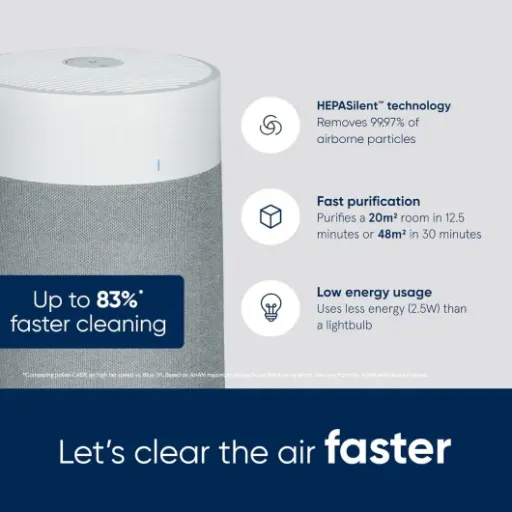
The claimed coverage is up to 86 m² in 30 minutes on high. In my real use in a roughly 25–30 m² room, high power felt more than enough. The air felt fresher in about 10–15 minutes, matching their 36 m² in 12.5 minutes claim fairly well. I don’t have a separate PM2.5 meter, but I did notice that the built-in sensor can be a bit lazy. When I cooked without the hood, the air quality light sometimes stayed blue (good) even though the room clearly smelled of food. It reacts better to smoke (like if you burn something or use incense) than to just steam or mild cooking fumes.
Overall, for everyday air cleaning, it does what I bought it for: less smell, less stuffiness, fewer allergy symptoms. It’s not some magic box that makes your house sterile, but compared to having nothing or a cheaper unit, the difference is there. The only real downside on performance is that the PM2.5 sensor isn’t super sensitive, so auto mode sometimes stays too relaxed when I’d prefer it to ramp up. You can fix that by manually setting the fan higher, but then it defeats a bit of the point of having an “auto” mode. Still, for a medium room, it gets the job done reliably.
What You Actually Get Out of the Box
Out of the box, the Blue Max 3350i is pretty straightforward. You get the purifier already assembled, the combination HEPASilent + carbon filter pre-installed in the side compartments, a basic quick-start guide, and that’s it. No remote, no extra filters, no fancy accessories. It’s very much plug in, open the side panels, remove the plastic from the filter, close it up, and you’re ready. Setup took me maybe 5–10 minutes, including downloading the app and connecting it to WiFi.
The unit is rated to clean up to 86 m² in 30 minutes on high, which on paper is more than enough for a typical flat living room or bedroom. In reality, I used it in a roughly 25–30 m² room and on high it does feel like it refreshes the air fairly quickly, especially after cooking. They claim it filters at least 99.97% of particles down to 0.1 microns and handles pollen, dust, mould allergens, pet dander, and light odours. I obviously can’t verify the exact numbers, but I did notice less dust floating in the light and fewer sneezing fits during peak pollen days.
Controls on the top are touch-based and pretty simple: power, fan speed, auto mode, and a light indicator for air quality (blue for good, etc.). There’s also WiFi, so you can hook it to the app and even a voice assistant if you’re into that. The app lets you tweak fan speeds, set schedules, check filter life, and see basic air quality readings. It’s not super advanced, but it covers what most people will actually use.
Overall, in terms of presentation and features, it feels like a mid-to-high range purifier: quiet operation, smart control, and a combo filter that handles both particles and smells. It’s not overloaded with weird modes you’ll never touch, but it’s also not barebones. The main downside I noticed early on is that the filters are not cheap, and Blueair wants you to swap them roughly every 6–12 months depending on usage, so you need to factor that into the long-term cost. Still, as a package, it feels more serious than the generic brands you see at half the price.
Effectiveness for Allergies, Smells and Everyday Use
In terms of actual effectiveness, I mainly judge it on three things: allergies, smells, and how the room feels after a few hours with windows closed. On the allergy side, I’ve got mild issues with dust and pollen. During a week of high pollen, running this almost continuously in the living room and at night in the bedroom, I did notice fewer morning sneezes and less itchy eyes. It’s not like my allergies disappeared, but I didn’t feel as clogged up. Compared to not using any purifier, the difference was clear enough for me to keep it running.
For smells, this is where it really proves its value. Cooking smells, pet odours, and light smoke from outside (I live near a busy road) are definitely reduced. One specific example: I cooked bacon without using the extractor fan just to test it. The smell was pretty strong at first, but with the purifier on a higher setting, after about 30–40 minutes the lingering smell was much weaker than usual. Same thing after a guest smoked on the balcony with the door half open – the room didn’t hold onto that stale smoke smell as long as it normally would.
As for general “feel” of the air, after a few days of continuous use, the flat just feels less stuffy, especially in winter when you don’t want to open windows as much. The HEPASilent tech is supposed to combine mechanical filtration and electrostatic charging to catch small particles while staying quiet. I can’t verify the tech claims, but in practice, the balance of quiet operation and noticeable effect is there. It’s not just a noisy fan pretending to filter.
Where it falls a bit short is the built-in sensor and auto mode. Like some Amazon reviewers mentioned, the PM2.5 sensor seems a bit conservative. When cooking or doing light cleaning, it often stays on blue (good) and doesn’t ramp up the fan, even though I’d personally prefer a boost. It does react more clearly to strong smoke or heavy pollution, but for lighter stuff it underestimates. So if you buy this mainly for auto dust detection, keep in mind you might still end up manually bumping it to a higher speed now and then. Overall though, as a day-to-day air cleaner, it’s effective enough that I keep it on most of the time without feeling like I’m wasting power.
Pros
- Very quiet on low and night modes, easy to sleep or work next to it
- Noticeably reduces cooking smells and general stuffiness in a medium room
- Simple controls and useful app with filter tracking and scheduling
Cons
- Replacement filters are quite expensive over time
- PM2.5 sensor and auto mode can be too insensitive during light pollution events
Conclusion
Editor's rating
The Blueair Blue Max 3350i is a solid, no-drama air purifier for medium rooms. It’s quiet on low and night modes, handles everyday odours and general stuffiness well, and makes a noticeable difference for mild allergies, at least in my case. The design is neutral enough to blend into most rooms, and it’s light enough to move between living room and bedroom without effort. The app is simple but useful for checking filter life and setting schedules, and the basic touch controls on top are easy to understand.
It’s not perfect. The built-in PM2.5 sensor feels a bit too relaxed, so auto mode doesn’t always ramp up when I’d like it to, especially during cooking or light cleaning. The filters are also on the expensive side, so you need to be ready for that ongoing cost. And the unit itself is bulkier than it looks in photos, so in a tiny room it will be quite present. But if you want something that you can run most of the time without a lot of noise, and you care more about real-world comfort than flashy features, it does its job well.
I’d recommend this to people with medium-sized flats or bedrooms who have mild allergies, pets, or cooking smells and are willing to invest a bit in filters over time. If you’re on a tight budget, or you just want a purifier for occasional use in a very small room, there are cheaper options that will be “good enough”. For regular, daily use where noise matters and you want a trusted brand rather than a random import, this Blueair model is a pretty solid choice.