Summary
Analysis score
Average of the criteria rated below
Price–performance balance and who gets the best deal
Design and footprint: compact rectangle for bigger rooms
Aromatherapy and odor control: what to expect
Noise, airflow, and smart modes
Key functions and what this purifier actually offers
Filtration and real-world impact according to buyers
Pros
- 3-stage filtration (washable pre-filter, True HEPA, activated carbon) with claimed 99.97% efficiency on 0.1–0.3 µm particles
- Quiet operation with sleep mode advertised at 20–24 dB and automatic light dimming at night
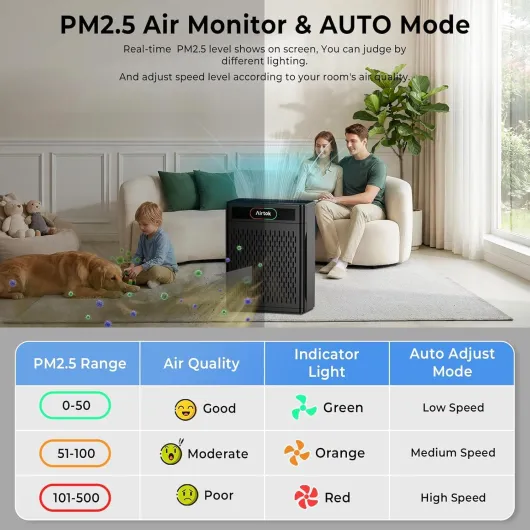
- PM2.5 sensor with auto mode and color-coded air quality indicator simplifies everyday use
Cons
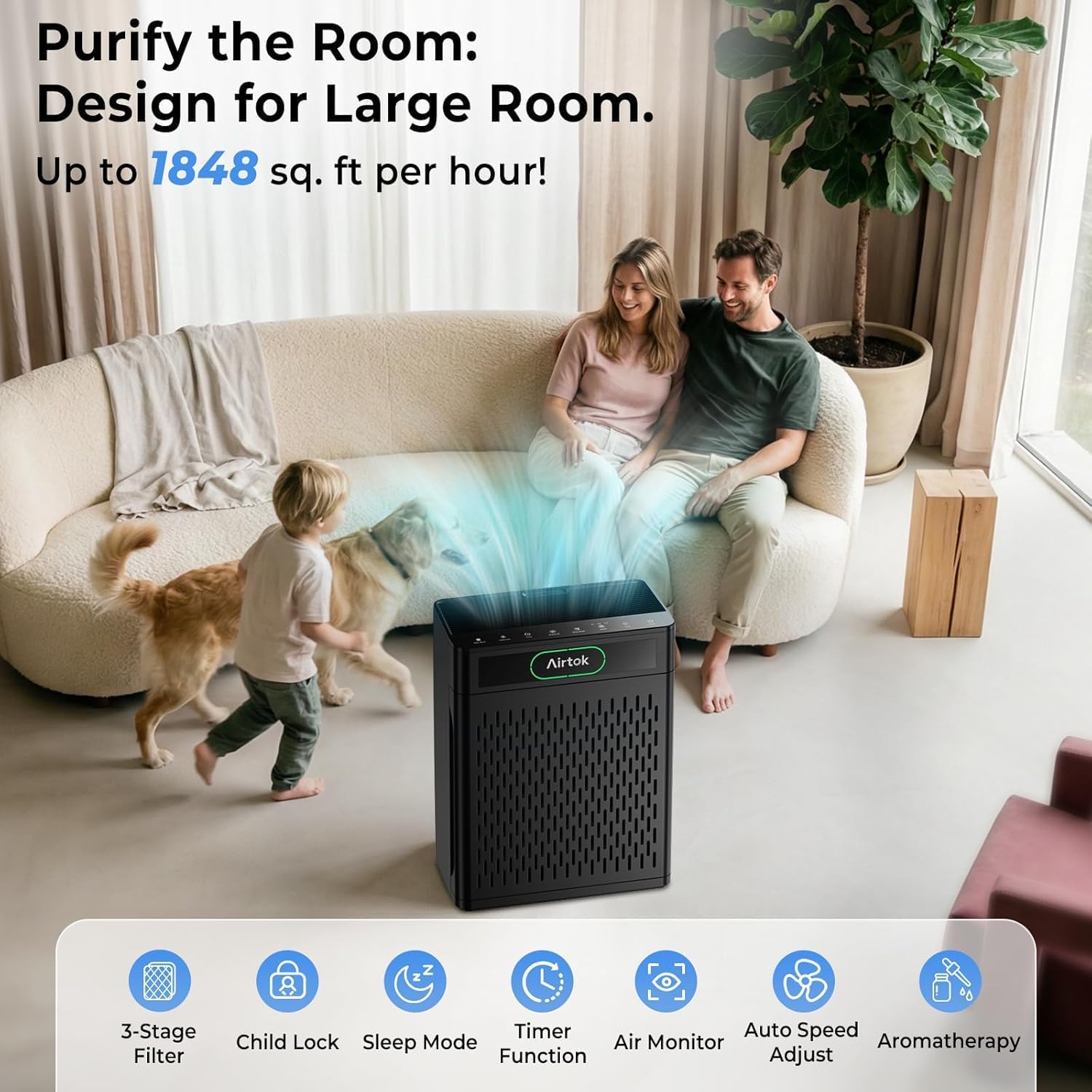
- Coverage claim up to 170 m² / 1848 sq ft is optimistic for strong air changes per hour
- No Wi‑Fi or app control for users who want full smart-home integration

Specifications
View full product page →| Brand | AIRTOK |
A big-room purifier that stays (relatively) discreet
The AIRTOK AP3001 positions itself as a large-room air purifier with a claimed coverage of up to 170 m² and a Clean Air Delivery Rate (CADR) of 280 m³/h ±10%. On paper, that puts it in the mid-range segment: not industrial-level power, but clearly above the tiny desktop purifiers. The average Amazon rating sits at 4.5/5 over around 230 reviews, which suggests most buyers feel it does the job for everyday home use: pet hair, dust, smoke, and general stale air.
Its spec sheet focuses on three key aspects: HEPA filtration, quiet operation, and extra features like a PM2.5 air quality sensor and aromatherapy. The 3-stage filter (washable pre-filter + True HEPA + activated carbon) is a classic but solid combo. The brand claims 99.97% efficiency on particles between 0.1 and 0.3 µm, which covers pollen, fine dust, and many allergens in theory. Several reviews mention noticeable improvement in air freshness and less dust in the home within a short time.
Noise is another strong argument. The purifier advertises 20–24 dB in sleep mode, which on paper is very quiet, especially for bedroom use. Many buyers call it quiet or very quiet, although at least one light sleeper still hears it on the lowest setting. The added sleep mode, timer, and auto mode give some flexibility so you don’t have to fiddle with it all day. There is also a child lock, which is a nice touch for families.
In my opinion, this product targets people who want a simple, plug-and-forget purifier for medium to large rooms, with a few nice-to-have smart features but without paying Dyson prices. It’s not a high-end connected device with Wi‑Fi and app control, but it tries to hit a sweet spot between price, performance on paper, and ease of use. It looks like a practical choice for pet owners, allergy sufferers, and anyone annoyed by dust and household smells.
Price–performance balance and who gets the best deal
The AIRTOK AP3001 sits in a mid-range segment: it’s not a budget mini purifier, but it’s also far from the premium prices of Dyson and other high-end brands. Several buyers mention that it is reasonably priced or a "great value for the price", and one explicitly calls it a good alternative to a Dyson purifier-humidifier for much cheaper. That kind of comparison is telling: people who know the expensive option feel that this AIRTOK unit delivers enough performance and features that they don’t feel the need to pay more.
On the feature side, you’re getting quite a lot for the money: True HEPA filtration, activated carbon, washable pre-filter, PM2.5 sensor with color indicator, auto mode, sleep mode, timer with scheduling, light detection for nighttime dimming, child lock, and aromatherapy. There’s no Wi‑Fi or app control, but for many users this is not a deal-breaker and can even be a plus if they prefer simpler devices. The advertised coverage (up to 170 m² / 1848 sq ft once per hour) is ambitious; in my opinion, it’s safer to think of it as well suited to medium and large rooms rather than banking on it as a whole-house solution.
Running costs are another part of the value equation. The washable pre-filter should help extend the life of the main HEPA and carbon filter by trapping hair and large dust. AIRTOK doesn’t list filter prices here, but generally, 3‑in‑1 cartridges are not free, so you’ll want to check replacement cost and recommended change interval before committing. If the filters are decently priced, the total cost of ownership should be fair, especially given the energy savings from auto mode and the relatively modest power draw typical of purifiers at this CADR level.
In my view, the AP3001 offers good value for money for people who want a quiet, reasonably powerful purifier with a few smart touches, without paying a premium for brand prestige or app ecosystems. It’s not a high-tech flagship product, and there are more powerful machines on the market, but the mix of features, user feedback (4.5/5 over 230+ reviews), and practical design makes it a sensible purchase for most households. The main reasons to look elsewhere would be if you absolutely need Wi‑Fi/app control, industrial-grade airflow, or a designer object to display in the living room.
Design and footprint: compact rectangle for bigger rooms
On the design side, the AIRTOK AP3001 keeps things fairly straightforward. The dimensions are 34 cm (D) x 19 cm (W) x 43 cm (H), which makes it a medium-sized rectangular tower, not a giant column. According to one review, the size is "just right" for a bedroom and noticeably smaller than a Dyson purifier-humidifier combo, while still being larger than many tiny desktop units. So it sits in that middle ground where it’s big enough to be useful in a living room, but not so big that it dominates the space.
The black color gives it a more neutral, discreet look that will blend into most interiors. There’s no flashy design language here, which some people will appreciate. A buyer mentions that it "looks great in the room" and that it’s lightweight and easy to move around. That matches the spec sheet that doesn’t list any heavy metal parts or big glass surfaces: this is mostly plastic, which keeps the weight down and makes it easier to reposition between rooms if needed.
The air inlet is described as wide, designed to catch pet hair and larger particles more easily. This is important if you have dogs or cats that shed a lot. Instead of tiny side vents, the AP3001 seems to favor a larger intake zone, which should in theory help the pre-filter trap more debris before it reaches the HEPA stage. The display is on the front or top with a color-coded air quality indicator, so you can glance at it and see the current status without having to read tiny numbers.
From an analytical point of view, the design is functional rather than stylish. You get a rectangular black purifier, compact enough for most rooms, with a clear display and touch controls. It won’t be a piece of decor, but it also doesn’t scream for attention. For someone who wants a low-key device that does its job in the background, the AP3001’s design choices make sense. If you’re looking for a sculptural object like some Dyson models, this is clearly more utilitarian, which helps explain the lower price point mentioned positively in several reviews.
Aromatherapy and odor control: what to expect
One of the more distinctive features of the AIRTOK AP3001 is its built-in aromatherapy function. Instead of forcing you to run a separate diffuser, there’s a compartment where you can add your own essential oils. The fan then helps circulate the scent along with the filtered air. A few reviews highlight this aspect: one buyer specifically says they "love that you can add essential oils to make everything smell great" and that the purifier helps eliminate bad odors in the house. That combination—carbon filter plus added fragrance—is clearly a selling point for them.
From a technical standpoint, the activated carbon filter is the real workhorse for dealing with unpleasant smells. It’s designed to adsorb some odor molecules and certain volatile organic compounds. This is what helps with pet smells, cooking odors, and smoke. The essential oils are more about adding a pleasant layer on top rather than truly neutralizing bad smells. If you’re sensitive to fragrances or suffer from migraines triggered by scents, you’ll have to be careful with how much oil you use, but the unit doesn’t force you to use aromatherapy—it’s an optional extra.
Among the comments, buyers generally seem happy with how the unit deals with odors. One mentions that bad smells are reduced and the option to add essential oils is a bonus. Another says the air feels cleaner and fresher, which likely also ties into reduced stale smells. None of the visible reviews complain about the aromatherapy feature being overpowering or causing issues, which suggests that, used reasonably, it doesn’t seem to be a problem for most people. Still, this is subjective: what’s pleasantly scented for one person can be too strong for another.
In my opinion, the fragrance aspect is a nice-to-have rather than a decisive feature. The real value lies in the carbon filter’s ability to handle everyday household odors, while the essential oil tray is just a convenient extra for people who like a scented environment. If you already own a diffuser, this might not change your life, but it does tidy up the setup by combining purification and fragrance in one device. For those who care about air smelling as good as it is clean, this model has a clear advantage over basic purifiers that only filter without offering any scent option.
Noise, airflow, and smart modes
Performance here is mostly about airflow vs. noise, and how smart the purifier is at managing both. The AP3001 advertises a noise level as low as 20–24 dB in sleep mode, which is comparable to a very quiet room. Several buyers call it quiet and say it doesn’t make much noise, especially on lower speeds. One reviewer, however, mentions being a light sleeper and still hearing it on the lowest setting. That’s not surprising: even low decibel levels can be noticeable in a silent bedroom if you’re very sensitive.
The auto mode uses the PM2.5 sensor to adjust fan speed according to air quality. This is a big plus compared to basic purifiers that just run at a fixed speed. In auto mode, the fan should spin faster when the sensor detects more particles (e.g., cooking, smoke, dust stirred up) and slow down again once the air clears. This not only saves energy but also reduces unnecessary noise when the air is already clean. Several comments mention the color-coded display and adjustable fan speeds as a strong point, and one buyer puts it directly up against a Dyson, saying this AIRTOK unit is a good alternative for a lower price.
The timer and scheduling features are another performance angle. You can set precise start and end times and choose which mode or fan speed applies at each period, which is more advanced than the usual simple 2/4/8-hour timer. Combined with light detection, which automatically dims the display and shifts to a quiet mode in low-light conditions, the AP3001 tries to adapt to your daily rhythm without much manual intervention. For example, you could let it run harder in the evening and then drop to sleep mode at night.
From my point of view, the performance package is coherent and practical: reasonable CADR for home use, multiple fan speeds, auto mode, sleep mode, and a quiet profile at low speed. There’s no high-tech app or Wi‑Fi, but the built-in intelligence (sensor + light detection + timer) should cover the needs of most users who just want cleaner air without constantly adjusting settings. It’s not a powerhouse machine for very polluted environments, but for typical households, the balance between power and discretion seems well thought out.
Key functions and what this purifier actually offers
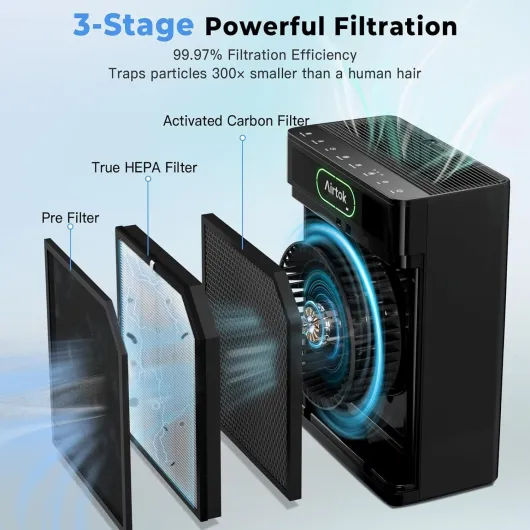
The AIRTOK AP3001 is marketed as a 3‑in‑1 device: air purifier, PM2.5 air quality monitor, and aromatherapy diffuser. At its core, you get a 3-stage filtration system: a washable pre-filter to catch larger debris (pet hair, lint, dust bunnies), a True HEPA filter for fine particles (pollen, dust, some allergens), and an activated carbon filter to deal with odors and some volatile compounds. On paper, this is a standard but solid configuration for home use.
The purifier uses a built-in air quality sensor to estimate the PM2.5 level and displays it through a three-color light ring: green for good, orange for moderate, red for poor. In auto mode, the fan speed adjusts according to the detected particle level. Several Amazon comments praise this feature, especially compared with a simple manual-only purifier. It allows you to leave the unit running and let it ramp up only when the air gets worse, which should help keep noise and energy consumption down.
Another notable feature is the aromatherapy function. Instead of forcing you to buy a separate diffuser, AIRTOK integrates a small compartment where you can add essential oils. Several buyers mention that they like being able to add a pleasant scent while the purifier runs, and one review specifically highlights that bad odors are reduced and the essential oils help the room smell nicer. Of course, the actual fragrance experience depends on the oils you use and your tolerance to scents, but the feature is there for those who want it.
Control-wise, the AP3001 uses a touch panel on the top, with options for fan speed selection, auto mode, sleep mode, timer, and child lock. There is no Wi‑Fi or smartphone app, which some people might see as a downside if they want remote control, but others will appreciate the simplicity and the fact that you’re not dealing with accounts and connectivity. In my opinion, the feature set is coherent: simple physical controls + auto mode + visible air quality indicator. Nothing fancy, but enough to make it practical in everyday life.
Filtration and real-world impact according to buyers
The core question with any purifier is simple: does it actually clean the air? On paper, the AIRTOK AP3001 uses a True HEPA filter rated at 99.97% efficiency for particles between 0.1 and 0.3 µm. That range covers many common indoor pollutants: pollen, dust, some bacteria, and fine particles from smoke. The integrated activated carbon layer handles odors and some gases, while the washable pre-filter catches hair and larger debris. Combined with a CADR of 280 m³/h, it should be able to refresh the air several times per hour in a medium room and at least once per hour in a very large space (up to 1848 sq ft / about 170 m² according to the brand, which is optimistic in my opinion but gives a ballpark idea).
Among the published reviews, several users report noticeable improvements. One buyer says the air felt cleaner and fresher within hours, another mentions that dust is no longer "all over things" after about two weeks. There is also a comment from a pet owner whose animal has an enlarged heart and was coughing; they say that after using this purifier, the coughing reduced and the pet seems more comfortable. This is of course just one person’s experience and not a medical guarantee, but it shows that some users feel a clear difference in perceived air quality.
On odors and smoke, comments are also positive. One verified purchase mentions that it helps eliminate bad odors in the house and that combined with the optional essential oils, the room smells much better. While this doesn’t prove anything scientifically, it lines up with what an activated carbon filter is supposed to do: trap some odor molecules and smoke-related compounds. A buyer also compares it favorably to a Dyson purifier, calling it a good alternative at a lower price, which suggests that for everyday dust and smell control, they didn’t feel short-changed.
In my opinion, the effectiveness looks solid for typical household needs: allergies, pet hair, smoke, dust, and general stuffiness. The coverage figure of 170 m² should be taken with caution; for genuinely high performance in a large open-plan space, I’d see this more as comfortable for 30–40 m² rooms at higher air changes per hour. But paired with the decent CADR, HEPA spec, and satisfied customer feedback, it seems like a good performer for bedrooms, living rooms, and home offices rather than a miracle solution for an entire big house with all doors open.
Pros
- 3-stage filtration (washable pre-filter, True HEPA, activated carbon) with claimed 99.97% efficiency on 0.1–0.3 µm particles
- Quiet operation with sleep mode advertised at 20–24 dB and automatic light dimming at night
- PM2.5 sensor with auto mode and color-coded air quality indicator simplifies everyday use
Cons
- Coverage claim up to 170 m² / 1848 sq ft is optimistic for strong air changes per hour
- No Wi‑Fi or app control for users who want full smart-home integration
Conclusion
Analysis score
The AIRTOK AP3001 comes across as a practical, no-nonsense air purifier that focuses on the essentials and adds a few useful extras. On paper, the 3-stage filtration (washable pre-filter, True HEPA, activated carbon) and a CADR of 280 m³/h cover the typical needs of most homes: dust, pet hair, pollen, smoke, and everyday odors. The PM2.5 sensor, color-coded air quality indicator, auto mode, and light-based sleep adjustment make it easier to just leave it running without constant manual tweaking. The integrated aromatherapy tray is a small bonus for those who like scented rooms.
The published reviews largely back this up: buyers often mention cleaner air, less dust, reduced odors, and quiet operation. Some even compare it favorably to much pricier Dyson units, calling it a good alternative for a lower price. It’s not perfect—coverage claims are on the optimistic side, there’s no Wi‑Fi or app, and very sensitive sleepers may still hear it even in sleep mode—but the overall package looks solid for the price bracket.
In my opinion, this purifier is well suited to: pet owners, allergy sufferers, and anyone who wants a quiet, straightforward device for medium to large rooms. People looking for heavy smart-home integration or very high industrial airflow might want to look higher up the range. For most households, though, the AP3001 offers a good balance of performance, discretion, and value, which explains the strong average rating and positive feedback.