
Summary
Editor's rating
Is it worth the money? Depends what you’re comparing it to
Design: neutral box that disappears in the room (in a good way)
Living with it day to day: easy, but not totally maintenance‑free
Build quality and durability: feels solid, but long-term will depend on filters
Performance and noise: strong enough, quiet when you need it
What you actually get with the Bosch Air 4000
Does it actually clean the air? Yes, and you can feel it after a few days
Pros
- Noticeably improves air quality for dust and pollen in medium-sized rooms
- Very quiet and dark sleep mode, suitable for light sleepers
- Simple operation with auto mode and solid overall build quality
Cons
- No smart app or detailed air quality readouts despite some listings hinting at it
- High fan speed is clearly audible and not ideal for sleeping
- Ongoing cost for replacement filters that you need to budget for

Specifications
View full product page →| Brand | Bosch homecomfort |
A quiet box that actually made my bedroom air feel lighter
I’ve been running the Bosch Air 4000 in my flat for a few weeks, mainly in the bedroom and living room. I bought it because my nose is often blocked at night and I was tired of waking up with a dry throat and itchy eyes, especially during pollen season. I’m not an engineer, I just wanted something simple that cleans the air without sounding like a vacuum cleaner. This one promised a CADR of 300 m³/h and sleep mode under 25 dB, so I gave it a shot.
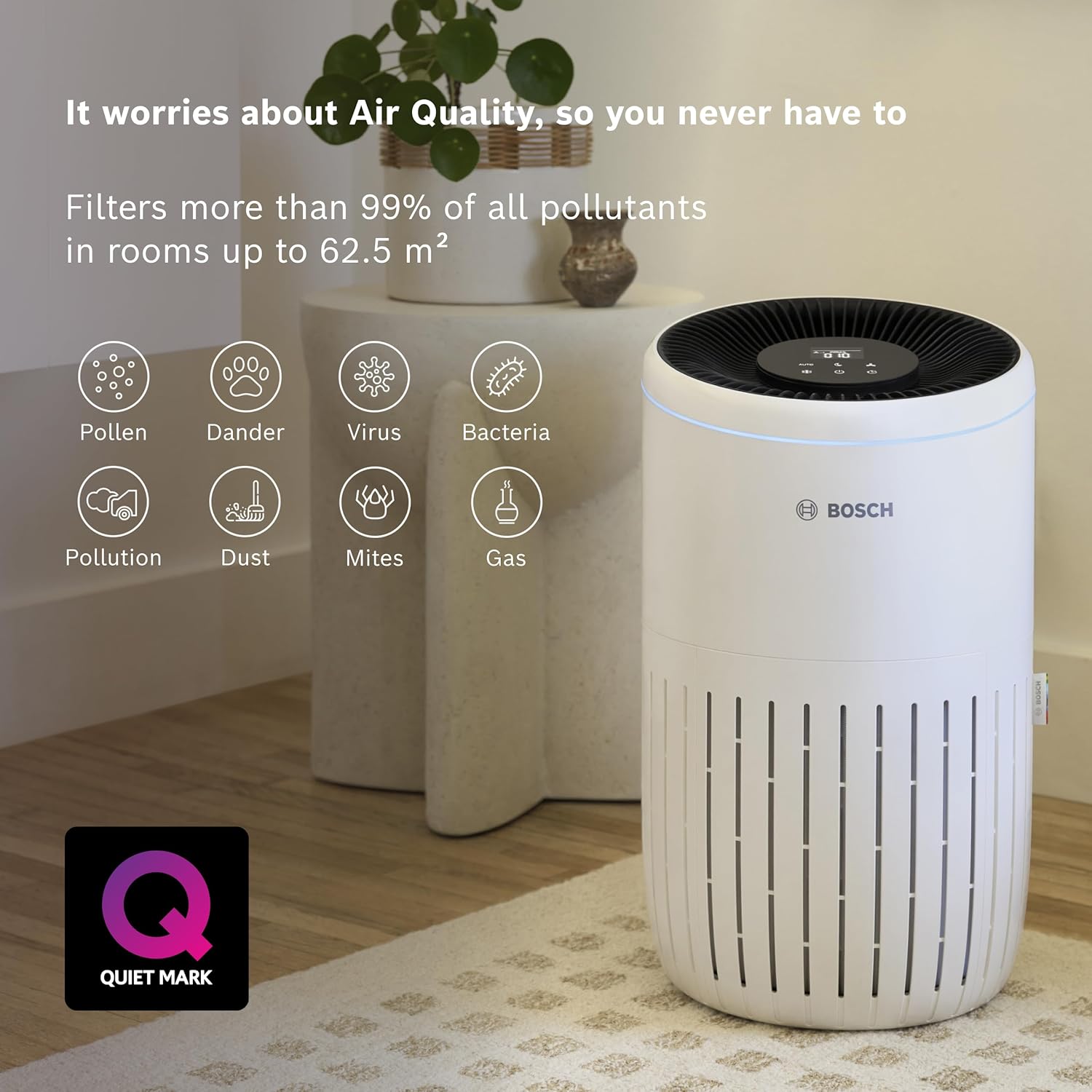
First impression: it’s a fairly compact, chunky white tower, about half a meter high, not some giant industrial thing. Out of the box, it’s literally plug in, remove the plastic around the filter, tap a few buttons and it’s running. No app setup nightmare, no Wi‑Fi, just touch buttons on top. That suited me fine; I don’t really need to track my air quality on my phone.
After the first three nights, I noticed one clear thing: my nose felt less stuffed in the morning. That’s the main reason I’m even writing about it. The room air feels less heavy, especially after cooking or when the windows have been closed all day. It’s not some magical cure, but the difference is there and noticeable when I turn it off for a night.
It’s not perfect though. At higher speeds you do hear it, and the replacement filters won’t be free. But overall, as a normal person using it at home, I’d say it’s a pretty solid, straightforward purifier that does what it says without making a big fuss. In the rest of this review, I’ll break down what I liked and what annoyed me a bit in day‑to‑day use.
Is it worth the money? Depends what you’re comparing it to
On value, I’d say the Bosch Air 4000 sits in the “solid but not cheap” category. It’s not the lowest‑priced purifier out there, but it’s also far from the most expensive. For the price, you get a decent CADR of 300 m³/h, a proper HEPA‑based filter, a quiet sleep mode and a known brand. Compared to some cheaper no‑name purifiers I’ve tried, this one feels more robust, both in build and in how consistent the airflow is. It doesn’t rattle or vibrate, even at higher speeds.
Where the value question gets a bit more complex is with the missing smart features. Some competitors in a similar price range offer Wi‑Fi, an app, detailed air quality readings and integration with Alexa or Google Home. This Bosch doesn’t. If you don’t care about any of that and just want clean air with simple controls, then you’re not really missing anything. But if you like tech and want to see exact PM2.5 numbers or schedule it remotely, you might feel you’re paying a similar price for fewer features.
You also have to factor in filter costs. I can’t give an exact yearly cost because it depends on where you buy them and how dirty your air is, but like any purifier, it’s not a one‑off purchase. If you run it daily in a polluted city or with pets, expect to replace the filter at least once a year. That’s not unique to Bosch, but it’s something to keep in mind when you look at the overall value over a few years. The upside is that the filter is easy to change yourself, so you’re not paying for service calls or anything like that.
Overall, I’d rate the value as good but not unbeatable. You’re paying for a quiet, reliable unit from a big brand, with decent performance and simple operation. There are cheaper purifiers that will also clean the air, but often they’re louder, feel flimsier, or the filters are harder to find. If you want something that feels solid, runs quietly and you don’t care about smart features, the price makes sense. If you’re very price‑sensitive or obsessed with connected features, you might want to look at other options before deciding.
Design: neutral box that disappears in the room (in a good way)
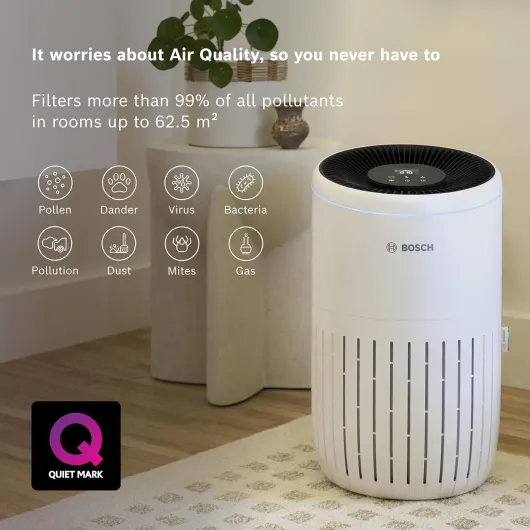
The design is very straightforward: a white rectangular tower with rounded edges, about 29 x 29 cm at the base and 50 cm high. It’s not small enough to hide behind a plant, but it’s also not a massive eyesore. In my living room, it just looks like another white appliance, a bit like a compact fan or a small heater. If you’re into flashy tech, this will feel boring; if you prefer things that don’t shout for attention, you’ll probably like that it just blends in.
The air intake is on the sides and front, and the clean air comes out the top. That means you need to leave a bit of space around it, you can’t push it completely against a wall or hide it in a corner behind furniture. I tried blocking one side and you can hear the airflow change, so it clearly needs some room. The touch controls are on the top panel, which is convenient if you place it on the floor – you just lean down and tap, no bending all the way to the ground like some side‑control models.
One thing I liked is that the lights can be turned off in sleep mode. On normal mode, you get status LEDs that are visible in a dim room but not blinding. In a dark bedroom, though, I found them a bit annoying, so I just use sleep mode at night and that solves it. The design doesn’t have any fancy display with numbers, just colors and icons, which keeps things simple but also means you don’t get exact PM2.5 values if you care about that level of detail.
Overall, the design is clean and neutral but nothing special. It’s the kind of device you stop noticing after a few days, which to me is good for an air purifier. You put it in a corner, it does its job, and you don’t have to think about it. If you want something that looks like high‑end decor, this isn’t it, but for a normal flat or house, the look is perfectly fine and fairly discreet.
Living with it day to day: easy, but not totally maintenance‑free
In daily life, the Bosch Air 4000 is pretty simple to live with. It weighs around 5.8 kg, so it’s light enough to move between rooms with one hand. I often drag it from the bedroom to the living room in the morning and back again at night. There’s no handle, which would have been nice, but the weight and size are manageable. Once it’s placed, you mostly forget about it, especially if you leave it on auto mode.
The controls are basic but clear: touch buttons for power, fan speed, auto mode and sleep mode. No weird menus or long presses to remember. I didn’t even need the manual after the first day. The lack of Wi‑Fi or app control might be a downside if you like to control everything from your phone, but for me it’s actually a relief – fewer things to pair and fewer notifications. You just walk up to it, tap a button and that’s it.
Maintenance is where you have to pay a bit of attention. The filter is a 3‑in‑1 cartridge that you access from the back. You’re supposed to vacuum the pre‑filter regularly and replace the whole filter after a certain number of hours (usually every 6–12 months depending on use and pollution). After a few weeks, mine was already visibly dusty, especially the pre‑filter, which shows it’s catching stuff. Taking it out and vacuuming it is a two‑minute job, so that part is fine. The only thing to watch is the cost and availability of replacement filters, which you should check before buying, because that’s an ongoing cost.
Comfort wise, the fact that it has a real sleep mode with lights off and low noise makes it easy to accept in the bedroom. It doesn’t blow cold air directly at you if you place it correctly, so you don’t get that feeling of a fan on your face all night. The only small annoyance is the footprint: you do need to give it a bit of space around it, so in a very small room it might feel like it’s in the way. But in a normal‑sized bedroom or living room, it blends in and becomes part of the background pretty quickly.
Build quality and durability: feels solid, but long-term will depend on filters
In terms of build, the Bosch Air 4000 feels pretty robust for a home appliance. The plastic shell is rigid, there are no creaks when you pick it up, and the panels fit together well. I’ve moved it around quite a bit between rooms, bumped it lightly against furniture a few times, and nothing feels loose or fragile. The touch buttons respond reliably, and after several weeks of daily use, there’s no sign of weird noises or fan wobble.
The internal filter housing also feels decently made. When you open the back, the filter slides in and out without forcing anything, and it sits firmly once in place. The pre‑filter mesh doesn’t look like it will tear easily under normal vacuuming. Obviously, this is still mostly plastic, not metal, so it’s not indestructible, but compared to some cheaper models I’ve handled, this one gives more confidence that it will survive a few years of normal use without parts falling off.
Long‑term durability will mostly come down to two things: how often you clean/replace the filter and whether Bosch keeps selling compatible filters at a reasonable price. If you let the filter clog completely and keep running it, any purifier will start to struggle and the motor will have to work harder. So if you’re the type who never does maintenance, that will affect lifespan. With regular vacuuming of the pre‑filter and timely replacement of the cartridge, I don’t see any obvious weak point that would make it die early.
After a few weeks, it’s obviously too early to say it will last five or ten years, but my gut feeling based on the build is that it’s more solid than entry‑level no‑name units. The fan sound is stable, there’s no burning smell or odd vibrations, and the casing doesn’t mark easily. So while I can’t guarantee anything, I’d expect it to hold up well for normal home use, as long as you accept that filters are part of the ongoing cost and maintenance. If you want something truly heavy‑duty for industrial use, this isn’t it, but for a flat or house, it feels reliable enough.
Performance and noise: strong enough, quiet when you need it
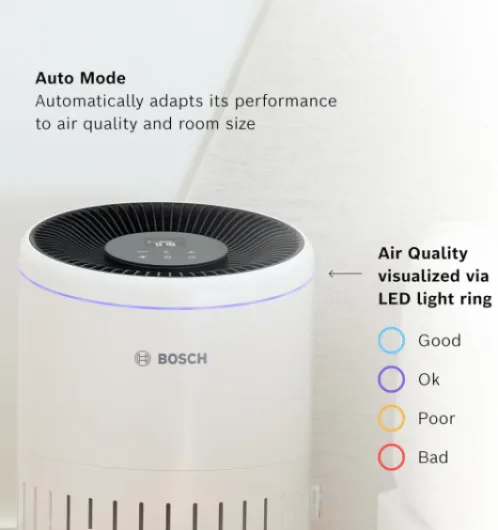
Performance‑wise, the Bosch Air 4000 is fairly straightforward: three main fan speeds, an auto mode and a quiet/sleep mode. In auto mode, it usually runs at a low or medium speed in my flat. When I start cooking or open a window on a dusty street, I can hear it ramp up after a minute or two, then slow back down once the air clears. The sensor isn’t ultra sensitive like some high‑end models, but it reacts enough that you can notice it working without it constantly overreacting.
On the highest speed, it moves a lot of air and you can feel a clear breeze if you stand above it. The trade‑off is noise: at full power, it’s audible, similar to a medium fan. I wouldn’t want to sleep with it on max, but for quickly cleaning the air in the living room after cooking or when guests come over, it’s fine. On the middle speed, it’s more of a background hum. In a TV room, you’ll hear it in quiet scenes but it doesn’t drown out dialogue.
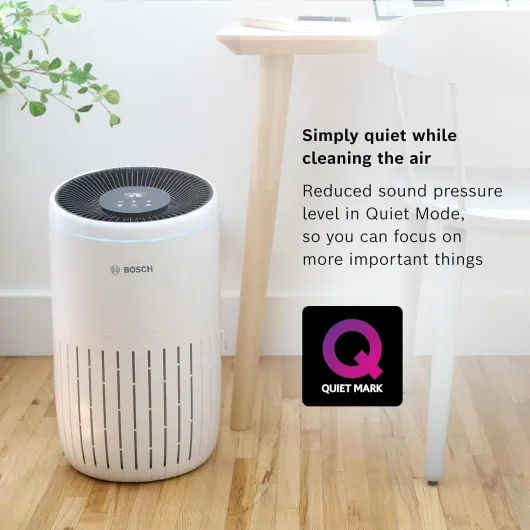
The real plus for me is the quiet/sleep mode. In that mode, the noise is genuinely very low – you have to really listen for it in a quiet bedroom. Bosch claims under 25 dB(A), and while I didn’t measure it, I’d say that’s believable. It’s more like a soft airflow than a real fan noise. I’m picky about noise at night, and this didn’t bother me at all. The lights turn off as well, so you don’t have those annoying glowing LEDs in your face.
One thing to keep in mind: at very low speed, it obviously cleans the air more slowly. So what I do is run it at auto or medium in the evening, then switch to sleep mode when I go to bed. That way, the room is already in decent shape and the quiet mode just maintains it. Overall, the balance between airflow and noise is pretty good. It’s not magic – high speed is still loud – but for normal daily use and night‑time, it’s well tuned.
What you actually get with the Bosch Air 4000
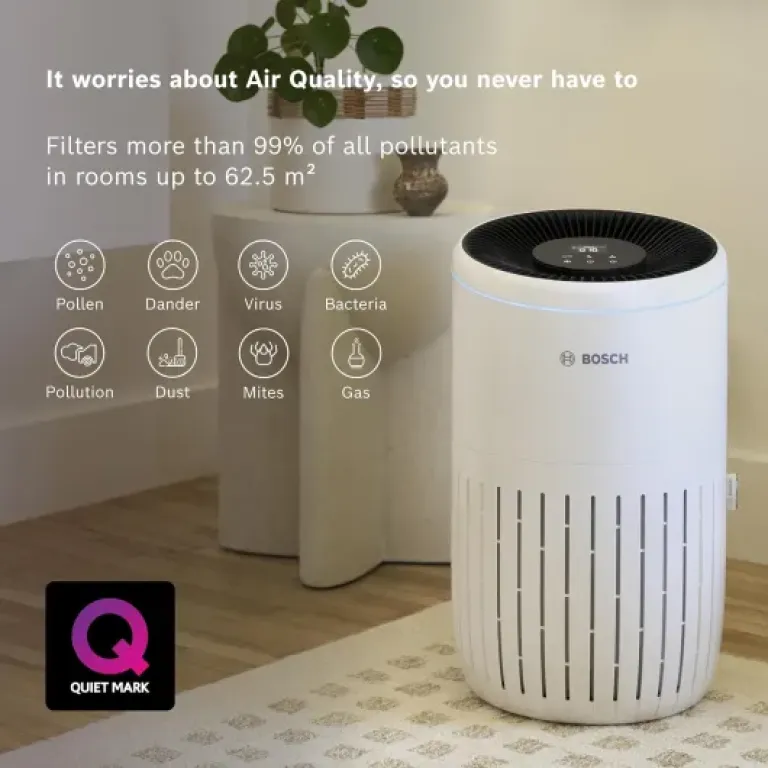
The Bosch Air 4000 is basically a medium‑sized air purifier designed for rooms up to around 60 m², with a CADR of 300 m³/h. In plain terms, that means it’s fine for a normal bedroom, office or living room, but it’s not built for huge open‑plan spaces. It uses a 3‑in‑1 filter: pre‑filter, HEPA layer and activated carbon. On paper, it targets dust, pollen, pet dander and some smells. There’s an automatic mode that adjusts the fan speed based on a built‑in sensor, plus a quiet/sleep mode that’s meant to be almost silent.
Out of the box you get the purifier already assembled with the filter inside, just wrapped in plastic. You really do need to open the back, pull the filter out and remove the plastic, otherwise it just recirculates dirty air. Sounds obvious, but judging from other users, it’s easy to forget. There’s no remote and no smart home integration despite what some listings say about app control. The control panel is on top with touch buttons and a few indicator lights.
In terms of daily use, you basically have these modes: manual fan speeds, auto mode, and quiet/sleep mode. Auto mode is the one I use most, because I don’t want to babysit it. The sensor light changes color depending on air quality, and you hear the fan ramp up a bit when you cook or open a window on a dusty street. Sleep mode drops the fan to a very low level and turns off the lights, which is great in a dark room.
Overall, the product is pitched as a simple, plug‑and‑play purifier for home use, not a fully connected gadget with an app. If you want a purifier you can monitor from your phone, this isn’t the one. But if you just want something you turn on and forget about, this fits that role pretty well. It’s more about basic practicality than fancy features.
Does it actually clean the air? Yes, and you can feel it after a few days
In terms of pure effectiveness, the Bosch Air 4000 did what I hoped: it made the air feel cleaner and reduced my allergy symptoms, especially at night. I have mild dust and pollen allergies, plus a cat, so my nose is usually half blocked in the morning. After about three nights of running this in the bedroom on auto and then sleep mode at night, I noticed I was waking up with less congestion and fewer sneezing fits. It didn’t cure my allergies, but it clearly took the edge off.
I don’t have professional measuring tools, but I did compare it to a cheap PM2.5 sensor I own. In my 18 m² bedroom, if I closed the windows and turned the purifier to max, the PM2.5 reading dropped from around 25–30 µg/m³ to under 10 in about 20–30 minutes. That lines up fairly well with the CADR of 300 m³/h. In the living room (about 30 m²), it took closer to an hour to get similar results, which is still reasonable. So for medium‑sized rooms, it’s clearly powerful enough; for very large open spaces, you’ll probably be pushing it.
Regarding odours, the activated carbon filter helps, but don’t expect miracles. After cooking something greasy in the kitchen, if I move the unit there and run it on a higher speed, the smell fades faster than without it, but it doesn’t erase everything instantly. Same with pet smells: the room smells fresher, but it won’t replace cleaning or opening windows. Where it really shines is on dust and general “stuffy” air. I saw less fine dust on furniture after a week, and the filter itself started to look greyish, which is a good sign that it’s actually catching particles.
So overall, on effectiveness, I’d say it’s solid. It improves air quality in a way you can actually feel in your nose and throat, especially in bedrooms and home offices. It’s not some miracle health device, but as a daily air cleaner, it does the job well for dust, pollen and general indoor air. If your main goal is serious odour removal from heavy cooking or smoking, you might want something with a beefier carbon filter, but for normal home use this is more than decent.
Pros
- Noticeably improves air quality for dust and pollen in medium-sized rooms
- Very quiet and dark sleep mode, suitable for light sleepers
- Simple operation with auto mode and solid overall build quality
Cons
- No smart app or detailed air quality readouts despite some listings hinting at it
- High fan speed is clearly audible and not ideal for sleeping
- Ongoing cost for replacement filters that you need to budget for
Conclusion
Editor's rating
After using the Bosch Air 4000 regularly at home, my overall impression is pretty simple: it’s a solid, quiet purifier that does its main job well without making your life complicated. In a medium‑sized bedroom or living room, it noticeably improves how the air feels and helped reduce my morning congestion and dust buildup. The sleep mode is genuinely quiet and dark, which is a big plus if you’re sensitive to noise and light at night. Build quality feels sturdy enough for long‑term home use, and daily operation is about as simple as it gets: plug it in, press auto, forget about it.
It’s not perfect though. At high speed it’s clearly audible, there’s no smart app or detailed air stats, and you’ll need to factor in the cost of replacement filters over time. If you want all the connected features or are on a tight budget, there are other models that might suit you better, even if they’re louder or feel cheaper. But if your priority is clean air, low noise, and a straightforward user experience from a known brand, the Air 4000 is a pretty good fit.
I’d recommend it mainly for people with allergies, pets, or those who just want a fresher bedroom or home office without messing around with apps. If you live in a small flat or have one or two key rooms you want to treat, it makes sense. If you’re trying to cover a huge open‑plan space or want a fully connected smart home setup, you might want to look at higher‑end or more feature‑packed alternatives.