
Summary
Editor's rating
Value for money: where it stands versus bigger brands
Design: looks fine, nothing fancy, and that’s okay
Comfort and daily use: quiet, simple, and not a fan replacement
Durability, filters, and maintenance costs
Performance: decent CADR, honest results if you don’t believe the 2180 ft² hype
What you actually get with the TENKER AP2410
Effectiveness: allergies and smells, what actually changed
Pros
- Good performance for small to medium rooms with a realistic CADR of 200 m³/h
- Very quiet Sleep mode with lights off, suitable for bedroom use
- Washable nylon pre-filter that actually catches a lot of dust and hair and is easy to clean
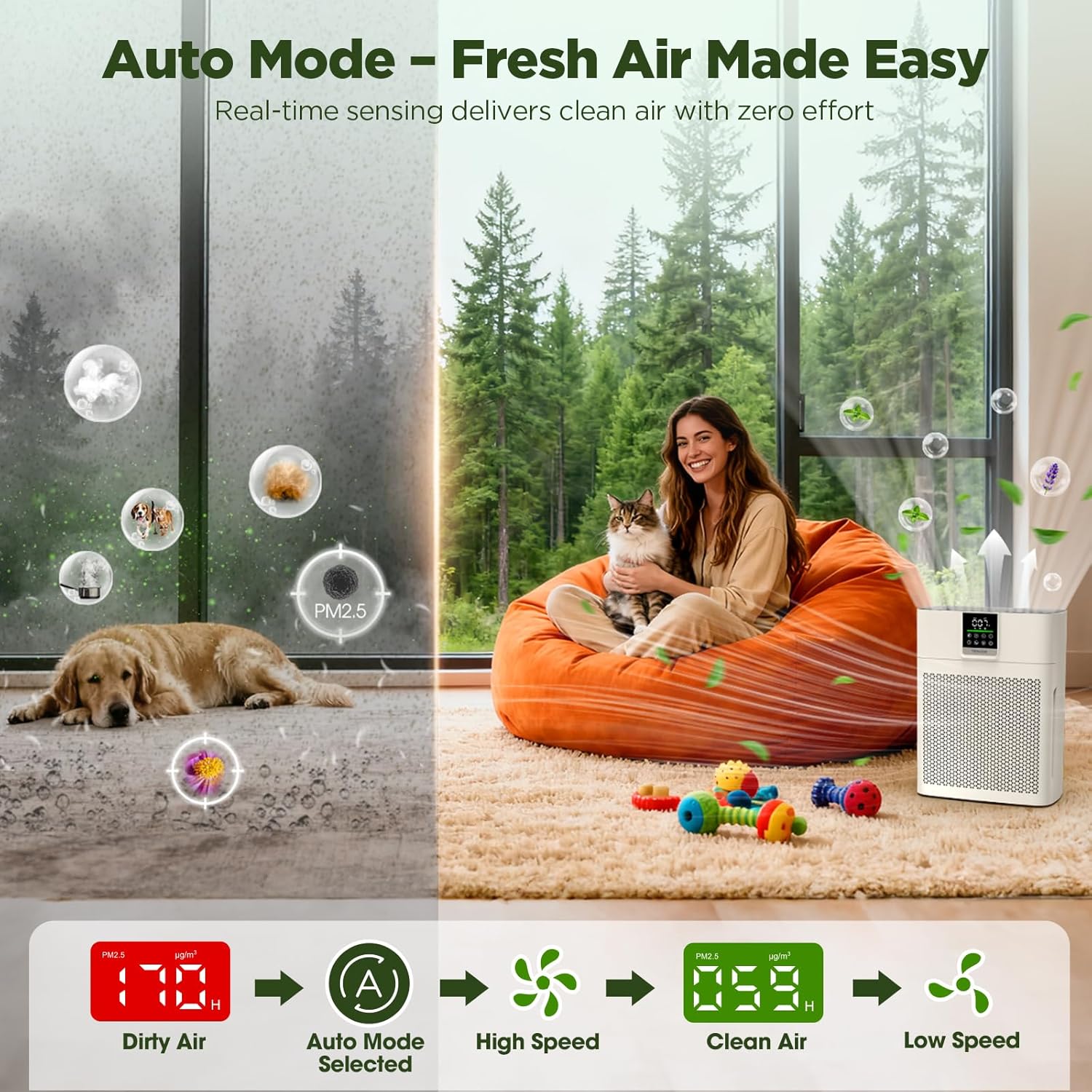
- PM2.5 sensor with colour ring and Auto mode that reacts sensibly to cooking, dust, and open windows
Cons
- Coverage claim of 2180 ft² is optimistic; realistically suited for much smaller rooms
- Ongoing cost of replacement HEPA + carbon filters every 3–6 months
- No app control or remote, basic feature set compared to some competitors

Specifications
View full product page →| Brand | TENKER |
A cheap air purifier that actually does something?
I picked up the TENKER AP2410 because I wanted something for the bedroom and living room without dropping the kind of money brands like Dyson ask. I’d never heard of TENKER before, so I went in thinking “generic Amazon gadget, we’ll see.” I’ve been using it daily for a bit now, mainly in a 20 m² bedroom and occasionally in a 25 m² living room, so well below the 2180 ft² they claim. That spec is clearly theoretical, but I’ll come back to that.
Out of the box, it’s pretty straightforward: plug it in, pull the filter out, remove the plastic, and you’re good. If you don’t remove the plastic, it makes a weird crackling noise and barely moves air, so that little note in the description is not optional. I did it right away because I’ve already messed that up on other purifiers before.
My main goal was to cut down on dust, cat hair, and the slightly stale smell that hangs around in winter when you don’t open windows much. I’m not trying to live in a lab, I just want air that doesn’t smell like litter box and fried onions mixed together. I also have mild allergies, so if it could help with morning sneezing, that would be a bonus.
Overall, after some days of use, it’s not perfect, but it does feel like it actually cleans the air. The PM2.5 sensor, auto mode, and the washable pre-filter are the things I’ve used the most. There are a few details that feel a bit optimistic in the marketing, but for a mid-range price from a no-name brand, it’s honestly pretty solid so far.
Value for money: where it stands versus bigger brands
In terms of value, this TENKER sits in that middle ground: cheaper than big names like Dyson, Philips, or Blueair, but more serious than random ultra-cheap purifiers with no CADR rating or proper sensor. You’re paying for a basic but complete feature set: HEPA + carbon, PM2.5 sensor, Auto mode, Sleep mode, washable pre-filter, and a few convenience extras like timer and child lock.
Compared to more expensive brands, what you’re mainly missing is app control, more advanced sensors, and maybe slightly nicer materials. But for air quality itself in a normal room, the gap is not as huge as the price difference suggests. If your main goal is “cleaner air in the bedroom and living room” and you don’t care about smart home integration, this makes more sense than overspending.
The ongoing cost is the real thing to consider. Filters every 3–6 months is pretty standard, but depending on how much they cost where you live, the total cost over 2–3 years can get close to what a more expensive purifier with cheaper filters would have cost. So it’s worth doing that quick calculation before buying. The washable pre-filter helps, but it doesn’t remove the need for regular main filter changes.
Overall, I’d say the value is good if you use it in rooms that fit its realistic capacity (bedroom, office, medium living room) and if you accept that you’re paying a bit of a “no-name tax” in terms of long-term filter costs. For someone who wants a simple, functional purifier with a real sensor and auto mode without paying brand-name prices, it’s a reasonable deal. If you want full-flat coverage, app control, or ultra-low long-term costs, you might want to look at higher-end or more established brands.
Design: looks fine, nothing fancy, and that’s okay
Design-wise, this thing is very standard: white plastic, rectangular, about 31 × 16 × 40 cm. It’s not stylish, but it doesn’t look ugly either. It blends in next to a bedside table or a TV stand. If you’re expecting some fancy design statement, this isn’t it. It’s the kind of device you forget is there, which for an air purifier is actually what I want.
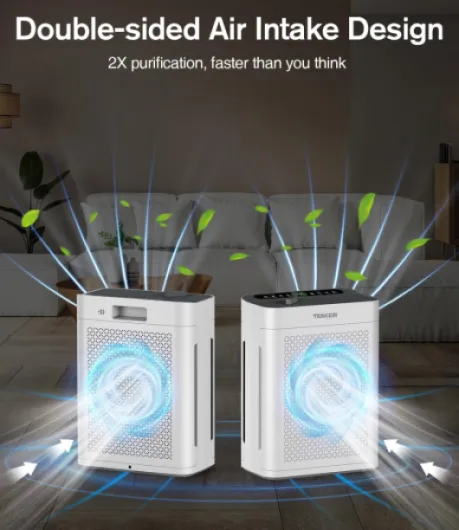
The air intake is on the sides, and the air blows out of the top. That setup works well if you don’t push it against a wall. I had it too close to a wall at first and the air circulation wasn’t great; once I pulled it 10–15 cm away, the airflow felt more consistent and the PM2.5 reading dropped faster after cooking. So placement does matter a bit.
The touch controls on top are simple: power, fan speed/auto, sleep, timer, child lock, and the light for filter replacement. The icons are clear enough, and you start to remember which is which after a day or two. There’s no physical remote or app, so if you like controlling everything from your phone, you won’t get that here. Personally, I didn’t miss it for this kind of product.
One thing to note: the LED ring and display are quite visible in a dark room. In sleep mode, the display turns off, which is good because I hate glowing gadgets at night. In normal mode though, if you’re sensitive to light when sleeping, you’ll want to use sleep mode every time. Overall, the design is basic but functional, and it feels thought out enough for everyday home use without trying to be fancy.
Comfort and daily use: quiet, simple, and not a fan replacement
In everyday use, the comfort level is good. The fan doesn’t blast air like an actual fan, and the brand even warns about that. If you’re expecting a strong breeze in your face, this is not it. The airflow is more like a gentle column of air going up. You feel it if you put your hand over the top, but it’s not going to cool you down in summer. Personally, I prefer it that way; I hate having air blown directly at me when I’m trying to sleep.
Sleep mode is genuinely quiet. I’m pretty sensitive to noise at night, and I can sleep with this on about 1–2 meters from the bed without it bothering me. The fact that the display turns off in sleep mode is a big plus. I’ve had other purifiers where you had to tape over the LEDs because they lit up the whole room. Here, once you hit sleep, it basically disappears in the background.
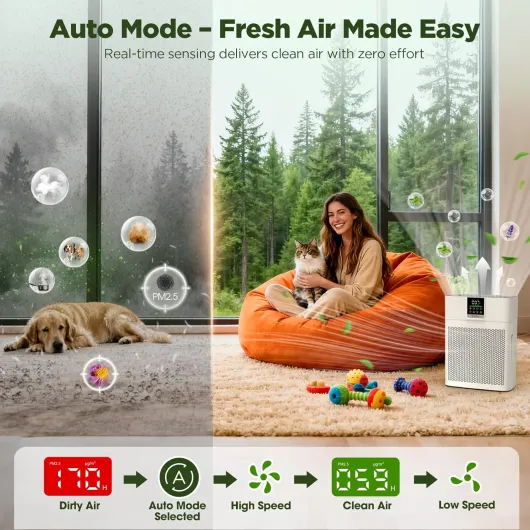
The Auto mode is handy if you don’t want to think about it. I mostly leave it on Auto during the day. It speeds up when I cook or open a window to the street and then slows down again on its own. That means you’re not constantly fiddling with buttons. The child lock is simple but effective: one touch and the buttons are blocked. If you’ve got kids who love to press anything that lights up, this will save you some frustration.
In terms of maintenance comfort, the washable pre-filter is actually useful. You just pop off the front, rinse the nylon pre-filter in the sink, let it dry, and put it back. It catches a surprising amount of hair and dust, which means the main filter doesn’t clog as fast. Overall, using it day to day is pretty painless. Set it, clean the pre-filter from time to time, and wait for the filter reminder light to tell you when to spend money again.
Durability, filters, and maintenance costs
Build quality is okay for the price. The plastic doesn’t feel premium, but it doesn’t feel flimsy either. The front panel clips on and off easily for filter access, and the clips don’t feel like they’ll break after two uses. At around 3.65 kg, it’s light enough to move from room to room without feeling like you’re carrying a brick. It’s clearly not built like a tank, but for a home gadget that mostly sits in one place, it’s fine.
The washable nylon pre-filter is the main durability win here. Sponge pre-filters tend to tear or warp after a few washes; this nylon one is more like a mesh that stays in shape. Rinsing and reusing it is quick and helps stretch the life of the main composite filter. That’s important because the HEPA + carbon filter itself is not washable and needs replacing every 3–6 months depending on usage and how dirty your environment is.
The downside is filter cost and availability. They really push using the original TENKER filters (they even give the Amazon reference). That’s normal, but you’ll want to check the price of those filters before committing to this model, because over a couple of years, that’s where the real money goes. If you actually replace the filter twice a year like they suggest, that adds up. That’s not specific to this brand though; it’s just how air purifiers work.
As for the sensor durability, they mention that the PM2.5 sensor is cleanable with a cotton swab. That’s a small but important detail: dust in the sensor can make readings useless over time, so being able to open it up and wipe it is good. Long term, I can’t say yet if it will last years without issues, but the design doesn’t scream “cheap disposable gadget”. If you’re okay with regular filter changes and a quick pre-filter rinse now and then, it should hold up fine for normal home use.
Performance: decent CADR, honest results if you don’t believe the 2180 ft² hype
Let’s talk real-world performance, not just the big “2180 ft²” claim. With a CADR of 200 m³/h, this is realistically suited for small to medium rooms if you want fast cleaning. In my 20 m² bedroom with a normal ceiling height, running it on Auto or Medium keeps the PM2.5 reading in the green most of the time, except when I open the window to a busy street or stir up dust while cleaning. When that happens, the sensor usually jumps, the ring turns yellow/orange, and the fan speeds up within about a minute.
In the 25 m² living room, if I cook something smelly (like frying), I can literally see the PM2.5 value spike and the colour go orange or red. If I put it on High, the smell and reading go down noticeably in 20–30 minutes. It doesn’t erase strong cooking smells instantly, but the difference between having it on and off is clear. Same thing with cat litter: the smell doesn’t vanish completely, but it’s less present in the room when the purifier has been running for a while.
Noise levels are fine: Sleep mode is very quiet (the 20 dB claim doesn’t feel exaggerated; it’s basically a light hum). On Low and Medium, it’s background noise you forget quickly. On High, you definitely hear it, but it’s still less annoying than a cheap fan at full blast. If you’re watching TV, you’ll hear it but it won’t drown out dialogue.
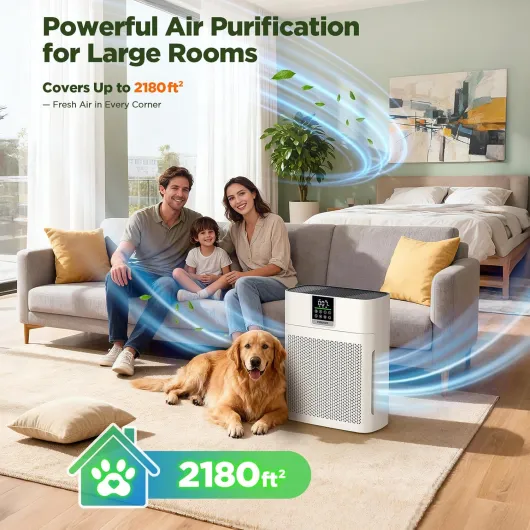
About the 2180 ft² number: technically, yes, it can “cover” that area in the sense that air will eventually pass through it, but if you have a big open-plan space, don’t expect miracles. For a typical bedroom, office, or medium living room, it gets the job done. For a whole big flat, you’d either need more units or a stronger model. So performance is solid for modest room sizes, as long as you ignore the marketing range and think more realistically.
What you actually get with the TENKER AP2410
On paper, the AP2410 is a HEPA air purifier with a 3-stage filtration system: washable nylon pre-filter, a composite filter with a True HEPA layer on the front and a honeycomb activated carbon layer on the back. They claim it filters particles down to 0.3 microns, which is pretty standard for HEPA. The CADR is listed at 200 m³/h, which is decent for small to medium rooms, not a full 200 m² flat like the 2180 ft² figure might make you think.
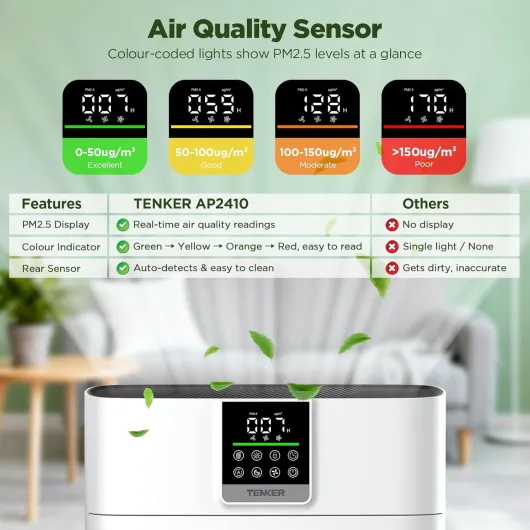
You’ve got five modes: Low, Medium, High, Auto, and Sleep. There’s a PM2.5 sensor that shows a number and a colour ring (green, yellow, orange, red) depending on air quality. In daily use, that’s the feature I glance at the most: if it’s green, I leave it alone; if it goes orange or red, I know something in the room is off (cooking, open window to a busy street, vacuuming, etc.).
It also includes a child lock, a 1–12 hour timer, a so-called essential oil diffuser (basically a pad where you drop oil), and a filter change reminder. The power draw is 22 W, so even if you leave it running a lot, it’s not going to destroy your energy bill. They say around 0.53 kWh per day, which seems about right if you don’t run it on max 24/7.
In practice, what you really use is: auto mode, sleep mode at night, and occasionally bumping it to high when you’ve been cooking or when the litter box smells stronger. The rest (timer, child lock, oil pads) are more “nice to have” than essential. It’s clearly built to be a family-friendly, set-and-forget purifier rather than some super configurable tech toy.
Effectiveness: allergies and smells, what actually changed
On the allergy side, I noticed a small but real improvement. I usually wake up with a bit of a stuffy nose, especially in pollen season or when the windows stay closed for days. After running this in the bedroom on Auto during the evening and Sleep mode at night, the morning congestion was less frequent. Not gone, but clearly reduced. That lines up with what you’d expect from a True HEPA filter handling fine dust and pollen.
For dust and pet hair, it doesn’t magically make the house dust-free, but surfaces stay clean a bit longer. When I cleaned the pre-filter after about a week, it already had a nice layer of fluff and hair on it. Before, all that ended up on furniture and floors. So again, not a miracle, but it definitely helps keep things under control between vacuum sessions.
For smells (cooking, pets, general stale air), the activated carbon layer does its job, but you have to be realistic: it reduces smells, it doesn’t erase them instantly. If I fry food and then run it on High, the strong smell drops a lot faster than without it. Same with the litter box in the same room: the smell is less sharp when the purifier has been running. If you expect total odour removal, you’ll be disappointed; if you just want “less gross”, it does that.
The PM2.5 sensor is a nice way to “see” the effect. After vacuuming or cooking, the number goes up and the ring changes colour, then over 15–30 minutes it goes back to green as the fan runs faster. You don’t need the numbers to know it’s working, but it’s reassuring and stops you from thinking it’s just a noisy box doing nothing. Overall, the effectiveness is good for everyday use: less dust, slightly better allergy mornings, and reduced smells. Not magic, but clearly doing something useful.
Pros
- Good performance for small to medium rooms with a realistic CADR of 200 m³/h
- Very quiet Sleep mode with lights off, suitable for bedroom use
- Washable nylon pre-filter that actually catches a lot of dust and hair and is easy to clean
- PM2.5 sensor with colour ring and Auto mode that reacts sensibly to cooking, dust, and open windows
Cons
- Coverage claim of 2180 ft² is optimistic; realistically suited for much smaller rooms
- Ongoing cost of replacement HEPA + carbon filters every 3–6 months
- No app control or remote, basic feature set compared to some competitors
Conclusion
Editor's rating
The TENKER AP2410 is a no-frills but competent air purifier. It doesn’t try to be a design piece or a smart-home gadget. It just moves a decent amount of air through a HEPA + carbon filter, monitors PM2.5, and adjusts the fan speed automatically. In real use, that means less dust floating around, milder smells after cooking or from pets, and slightly calmer allergy mornings. Noise levels are low enough in Sleep mode to keep it running at night without it driving you crazy.
It’s best suited for people who want cleaner air in small to medium rooms—bedrooms, home offices, or a normal-sized living room—and who don’t care about app control or fancy extras. If you’ve got pets, mild allergies, or live near a busy road, it’s a decent tool to improve daily comfort without spending a fortune. On the other hand, if you’re trying to purify a huge open-plan space, or you want deep smart features and top-tier build quality, this isn’t the right model. Also keep in mind the filter replacement cost; like all purifiers, that’s where the long-term money goes.
Bottom line: for a lesser-known brand, the AP2410 is pretty solid. It’s not perfect, some specs are a bit optimistic (the 2180 ft² claim especially), and the brand doesn’t have the same track record as the big names. But if you treat it as a mid-range purifier for normal-sized rooms, it gets the job done without too much hassle and without making your wallet cry.