
Summary
Editor's rating
Value for money: is the Winix 5300-2 worth it?
Design, size, and how it fits in a normal room
Daily comfort: noise, sleep, and ease of use
Build, filters, and how it should hold up over time
Performance: allergies, dust, smoke and that auto/sleep behavior
What you actually get and how it’s set up
Pros
- Strong filtration with HEPA + carbon and good CADR, clearly reduces dust and smells
- Quiet and discreet in sleep mode, suitable for bedroom use
- Simple controls, real auto mode with sensor, and 3-year warranty with certified performance
Cons
- Automatic night mode based on room darkness cannot be overridden, limiting performance at night
- Highest fan speed is fairly loud, similar to a floor fan on medium-high

Specifications
View full product page →| Brand | Winix |
An honest take after living with the Winix 5300-2
I’ve been using the Winix 5300-2 in my flat for a few weeks, mainly in the bedroom and sometimes dragged into the living room on bad pollen days. I bought it because my hay fever has been getting worse, and we also have a cat that sheds like crazy. On paper the specs looked strong: HEPA filter, carbon filter, PlasmaWave, decent CADR, and all the usual badges (AHAM, Allergy UK, ECARF, etc.). I wasn’t expecting miracles, just something that actually helps me breathe and sleep better.
In day-to-day use, it feels more like a practical appliance than a gadget. You plug it in, pick a mode, and mostly forget about it. I’ve had cheaper purifiers before that sounded like a hairdryer and barely moved any air. This one definitely pushes more air and you can see the dust building up on the pre-filter pretty fast, which is both satisfying and a bit gross. The auto mode reacts when I cook or open the window on a busy road, so the sensor isn’t just for show.
The main thing I noticed after a few nights is that my nose is less blocked when I wake up. I’m not magically cured of allergies, but I sneeze less in the morning and my eyes itch less when pollen is bad. Compared to running no purifier, the difference is clear. Compared to a small cheap desktop purifier I had before, this feels like going from a desk fan to a proper room fan. It actually manages to handle a whole bedroom and even part of the hallway if I leave the door open.
It’s not perfect though. The biggest annoyance is the way sleep mode kicks in automatically when the room goes dark and you can’t override it. That means if you want strong filtration at night, you have to trick the light sensor or leave a light on, which is silly. Noise-wise, the higher speeds are noticeable, like a floor fan on medium-high. I personally don’t mind a bit of fan noise, but if you’re very sensitive to sound, you’ll probably only tolerate sleep mode at night. Overall, it gets the job done and feels pretty solid, but it has a couple of design decisions that feel more like marketing than real-world thinking.
Value for money: is the Winix 5300-2 worth it?
On price, the Winix 5300-2 usually sits in the mid-range compared to other HEPA purifiers with similar CADR. It’s not the cheapest, but it’s also not in the premium Dyson/IQAir territory. For what you pay, you get:
- Decent CADR (390 m³/h) and coverage suitable for real bedrooms and living rooms
- True HEPA filtration down to 0.1 microns, plus carbon filter
- Auto mode with sensor, sleep mode, and PlasmaWave (if you want it)
- 3-year warranty and certified performance (AHAM, Allergy UK, ECARF)
Compared to the really cheap purifiers I’ve tried, the difference is obvious. Those budget units usually have lower airflow, louder motors, and questionable filters. This one actually moves air and you can see and feel the impact. On the other hand, if you already have a good purifier from a known brand, this isn’t some magical upgrade; it’s just a solid option in its price bracket.
You do have to factor in filter costs. If you replace the filter set once a year, that’s an ongoing expense that adds up over several years. That said, this is the same story with almost every proper purifier. At least here, filters are easy to find and you’re not stuck with a discontinued model with zero support. Power consumption at 50 W max is also reasonable. If you run it a lot in auto/sleep modes, your electricity bill won’t explode.
For someone with allergies, pets, or a flat near traffic, I’d say the value is good. It does what it says, has proper certifications, and doesn’t feel like a toy. The only thing that drags down the value a bit is the forced night mode that limits performance in the dark. If they allowed full manual control at night, I’d rate the value even higher. As it stands, it’s a practical, mid-priced workhorse that makes the indoor air noticeably better without going into luxury territory.
Design, size, and how it fits in a normal room
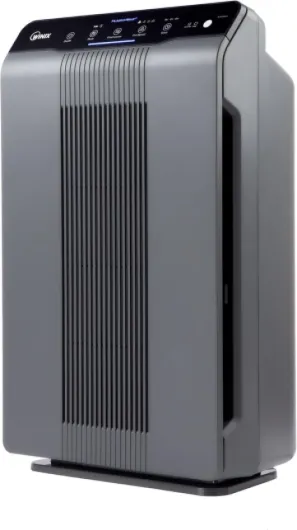
Design-wise, the Winix 5300-2 is pretty neutral. It’s a grey box with rounded edges, about 60 cm tall, 38 cm wide, and just over 20 cm deep. So it’s not tiny, but it’s slim enough to sit against a wall without taking over the room. At 6.7 kg, you can move it around easily with one hand, though it doesn’t have wheels. I’ve dragged it between bedroom and living room without any drama.
The air intake is on the front and sides, and it blows clean air out the top. That top vent is angled slightly backwards, which helps avoid blasting air directly at your face if it’s near the bed. On the other hand, if you want to use it as a sort of fan, like one reviewer mentioned, you’ll feel the airflow if you’re within a couple of metres. The build feels solid enough for the price: plastics don’t creak too much, the front panel clips on firmly, and the buttons respond without lag.
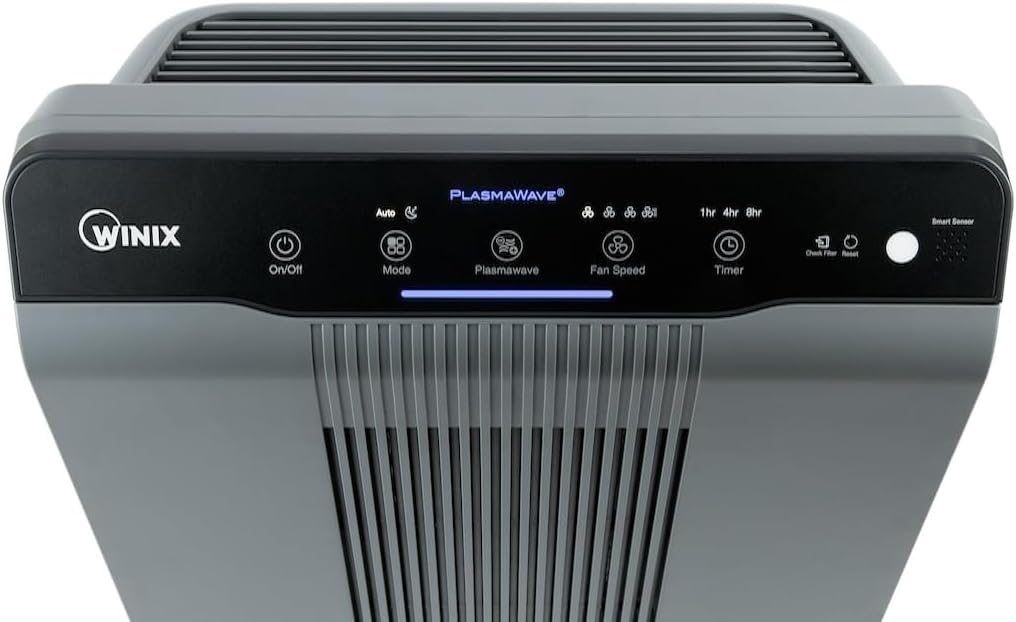
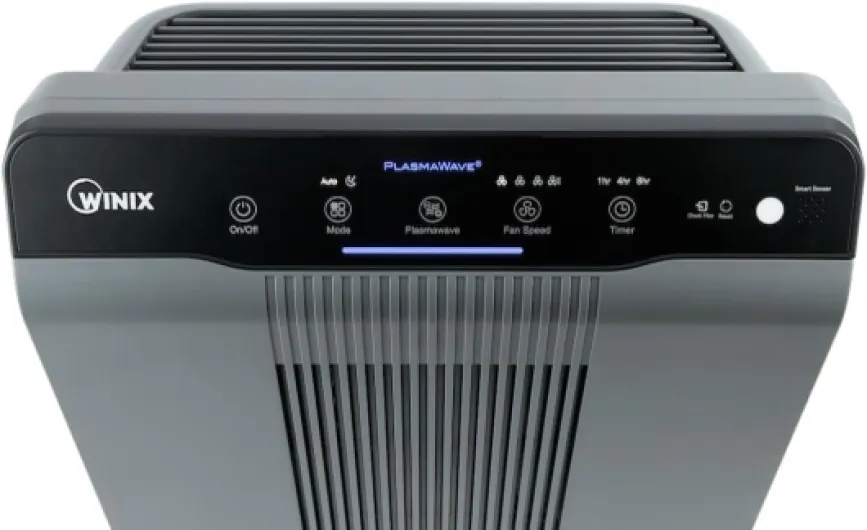
The control layout is basic but clear. Icons and labels are easy to understand: fan speed, auto, sleep, PlasmaWave, timer. There’s an air quality indicator light that changes colour depending on pollution level. It’s useful during the day, but at night it can be a bit bright if you’re sensitive to light. In sleep mode, the lights dim, which helps, but the catch is you can’t force high speed at night without also having more light. That’s where the design choice around auto sleep mode gets a bit annoying.
From a practical standpoint, you need a bit of clearance around it so it can breathe. I kept it about 20–30 cm from the wall and away from curtains, and that seemed fine. It’s not the prettiest object in the room, but it doesn’t scream “industrial machine” either. In a modern flat it blends in; in a small bedroom it’s noticeable but not ridiculous. If you want something that disappears visually, this isn’t it, but it’s decent. The design is more about function than style, and that’s probably the right call for this kind of device.
Daily comfort: noise, sleep, and ease of use
Living with the Winix 5300-2 every day is mostly easy, with a couple of small irritations. On the comfort side, the big win is sleep mode. In that mode, it’s genuinely quiet enough to forget about, and all the lights dim. If you’re used to sleeping with a fan or some white noise, this is no problem at all. I’m a light sleeper and I had no trouble leaving it on all night right next to the bed.
The noise jump between sleep mode and the next fan speed is quite noticeable though. The first two manual speeds are acceptable as background noise during the day, but the top speed is loud enough that you know it’s working. I use that high mode when I’ve been cooking or when I open the windows on a busy road, and then drop it back to auto or sleep. If you’re expecting it to be whisper-quiet on max, you’ll be disappointed. It’s basically a trade-off: more airflow means more noise.
One thing I liked is that the controls are dead simple. No app, no pairing, no hidden menus. You press a button and it does what you expect. The timer is handy if you want it to run for a few hours and then switch off, for example after cooking or when drying laundry indoors. The filter access is also straightforward: front panel pops off, filters slide out, no tools. Cleaning the pre-filter with a vacuum takes a couple of minutes.
The main comfort downside, as mentioned, is that automatic night mode based on room light. If the room is dark, it decides you must want quiet, not performance. In my case, I can live with it, but if you have serious allergies or live in a very polluted area and want full power at night, this will annoy you. Apart from that, day-to-day comfort is good: it doesn’t get hot, power use is reasonable at 50 W max, and you can run it all day without thinking about it.
Build, filters, and how it should hold up over time
I obviously haven’t had this for years, but based on the build and the specs, I can give a fair idea of durability. The unit feels reasonably sturdy: the casing doesn’t feel cheap-thin, the front panel clips on firmly, and the buttons don’t feel like they’re going to fall apart after a few months. It’s made in Thailand and comes with a 3-year warranty, which is decent for this type of product, not just one year like some cheaper brands.
Filter-wise, Winix says the filters can last up to a year, which sounds realistic if you’re in a normal environment and clean the pre-filter regularly. If you smoke indoors, have pets, and live on a dusty road, expect to replace sooner. The good part is the pre-filter is washable and easy to remove, so you can extend the life of the more expensive HEPA and carbon layers. There’s a filter change indicator so you don’t have to track dates manually.
Another durability aspect is spare parts availability, which they list as 5 years in the EU. That means, in theory, you’ll be able to get official filters for a while and not just throw the unit away when the originals wear out. Winix has also been around since the 70s making air purifiers and dehumidifiers, so it’s not some random no-name brand that disappears after a year. That doesn’t guarantee perfection, but it’s reassuring.
In daily handling, nothing feels particularly fragile. I’ve moved it around, banged the side lightly on a doorframe, no rattles or loose pieces. The only thing I’d be careful with is the front panel clips; like any plastic panel, if you’re too rough, you could probably snap them. Treat it like a mid-range appliance, not like a rugged tool, and it should be fine. Overall, I’d say durability looks good but not bulletproof: solid consumer-grade gear with a proper warranty to back it up.
Performance: allergies, dust, smoke and that auto/sleep behavior
This is the part that actually matters: does it clean the air or not? In my case, yes, it does a pretty solid job. I noticed three main things after running it almost constantly for a couple of weeks:
- Less morning congestion and sneezing on high pollen days
- Less visible dust on furniture near the unit
- Cooking and smoke smells clear out faster
I’m not measuring particles with a fancy meter, but you can feel it. When I cook something greasy or slightly burnt, the air quality light goes from blue/green to orange or red within a minute, fan ramps up, and the smell fades noticeably faster than before. Same when I open the window onto a busy road; the sensor reacts and the fan speed jumps. That tells me the auto mode is actually linked to the sensor, not just cycling randomly.
For allergies, it doesn’t “cure” anything, but it takes the edge off. I used to wake up with a blocked nose most mornings during pollen season. With this running in the bedroom all night (sleep mode), I’m still a bit stuffy sometimes, but it’s clearly better. Also, my partner, who is more sensitive to the cat, said their eyes itch less when the purifier has been running in the same room for a while. So for pet dander and pollen, I’d rate it as effective, not magical.
Noise is where you need to be realistic. Sleep mode is very quiet (27 dB on paper, and it does feel like a soft hum you forget about), but the higher speeds are much more noticeable. On the strongest normal mode, it sounds like a floor fan on medium-high, which lines up with what one of the reviewers said. If you’re trying to watch TV with it on max in a small room, you’ll hear it. During the day, I don’t mind; at night, I stick to sleep mode. The problem is that when the room gets dark, it automatically goes into that reduced night mode and you cannot override it. That means if there’s a lot of pollen or smoke and you want full power while you sleep, you’re out of luck unless you trick the light sensor.
As for PlasmaWave, I used it for a bit then turned it off. You can switch it off easily, which I like, because some people don’t want any ionizing feature. I didn’t notice a huge difference with it on or off in normal use, so I just leave it off to keep things simple. Overall, performance is strong for dust, smells, and general air freshness, but the forced night mode limits how hard it can work exactly when some people might want full power.
What you actually get and how it’s set up
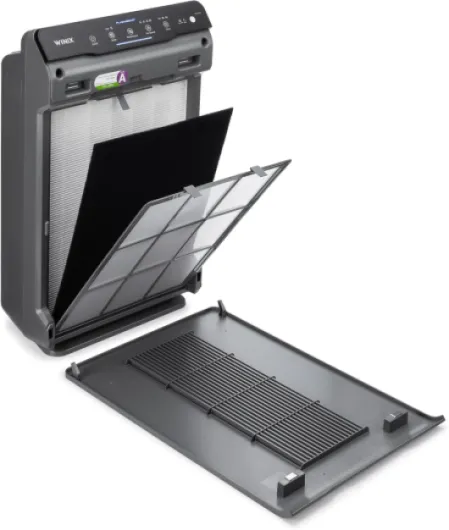
Out of the box, the Winix 5300-2 is pretty straightforward. You get the unit, the combined filter pack already inside (pre-filter, carbon, HEPA), and a basic manual. No app, no remote, no smart home nonsense. You control everything from the touch buttons on top. Setup is basically: remove the plastic from the filter, close the front, plug in, hit power. Took me under 5 minutes and didn’t require any guessing.
The control panel is simple: power, fan speed, auto mode, sleep mode, PlasmaWave on/off, and a timer. There’s also a coloured air quality light that changes depending on what the sensor reads. In practice, auto mode + PlasmaWave off is what I use during the day, and sleep mode at night. You do have manual fan levels (4 speeds including sleep), so if auto mode annoys you, you can just set it and forget it. The sensor reacts when I spray deodorant, cook something smoky, or open the window to traffic, so you can see it ramp up pretty quickly.
Coverage-wise, the brand claims up to 99 m², which is honestly optimistic if you want strong filtration. In a real home, I’d say it’s very comfortable in a 15–25 m² bedroom or living room. I tried it in an open-plan area and it helped, but it felt more like it was fighting a losing battle with constant new air coming in. Where it shines is in a closed room: bedroom door shut, it cycles the air quickly and the smell of food or smoke clears much faster than without it.
Filter life is advertised up to a year, which lines up with what I’ve seen on similar Winix models. The pre-filter is washable, so if you rinse or vacuum it regularly, you’ll probably stretch the life of the main filter. There’s a filter change indicator, so you don’t have to guess. Just keep in mind that replacement filters aren’t free; you should mentally add that to the long-term cost. Overall, the presentation and basic features are practical and clear, not fancy, which I actually like. It feels like a home appliance, not a toy.
Pros
- Strong filtration with HEPA + carbon and good CADR, clearly reduces dust and smells
- Quiet and discreet in sleep mode, suitable for bedroom use
- Simple controls, real auto mode with sensor, and 3-year warranty with certified performance
Cons
- Automatic night mode based on room darkness cannot be overridden, limiting performance at night
- Highest fan speed is fairly loud, similar to a floor fan on medium-high
Conclusion
Editor's rating
After using the Winix 5300-2 for everyday life – sleeping, cooking, dealing with pollen and a shedding cat – my take is pretty straightforward: it’s a reliable, effective purifier with a couple of design quirks you should know about. It noticeably cuts down on dust, smells, and allergy symptoms in a normal-sized bedroom or living room. The airflow is strong, the sensor-based auto mode actually reacts to changes in air quality, and sleep mode is quiet enough not to bother most people at night.
The downsides are mainly around noise on higher speeds and that forced night mode based on room light. On max, it’s not subtle; it sounds like a decent floor fan. That’s fine for daytime cleaning, less ideal if you’re very sensitive to noise. And if you want full power at night in a dark room, you’re stuck, because the unit automatically drops to a quieter mode and you can’t override it. For some people that won’t matter; for others, it’s a deal-breaker.
If you have allergies, pets, or live near traffic and you want a purifier that gets the job done without being overcomplicated, this is a good fit. It’s especially suitable if you’re okay with running it in auto during the day and sleep mode at night. If you need very quiet operation at all times or total manual control at night, you might want to look at other models or brands that don’t force sleep behavior. Overall, it’s a solid, no-nonsense choice that improves air quality in a clear, noticeable way, just not a perfect one.