Summary
Analysis score
Average of the criteria rated below
Value for money of this 2‑in‑1 unit
Compact tower design and 360° air intake
Durability, maintenance and long‑term use
Daily performance: noise, automation and humidifier combo
What the ROUNY R‑T2 actually offers
Air cleaning effectiveness on paper
Pros
- 2‑in‑1 design with detachable humidifier module, purifier works independently
- H13 HEPA plus activated carbon filtration with 360° air intake and air‑quality sensor
- Very quiet advertised 25 dB sleep mode and low 24 W power consumption
Cons
- No published CADR/airflow data, claimed 20–50 m² coverage likely optimistic for larger rooms
- Only 1‑year warranty and relatively unknown brand
- Long‑term availability and cost of replacement filters and humidifier parts are uncertain

Specifications
View full product page →| Brand | ROUNY |
2‑in‑1 unit that promises cleaner, less dry air
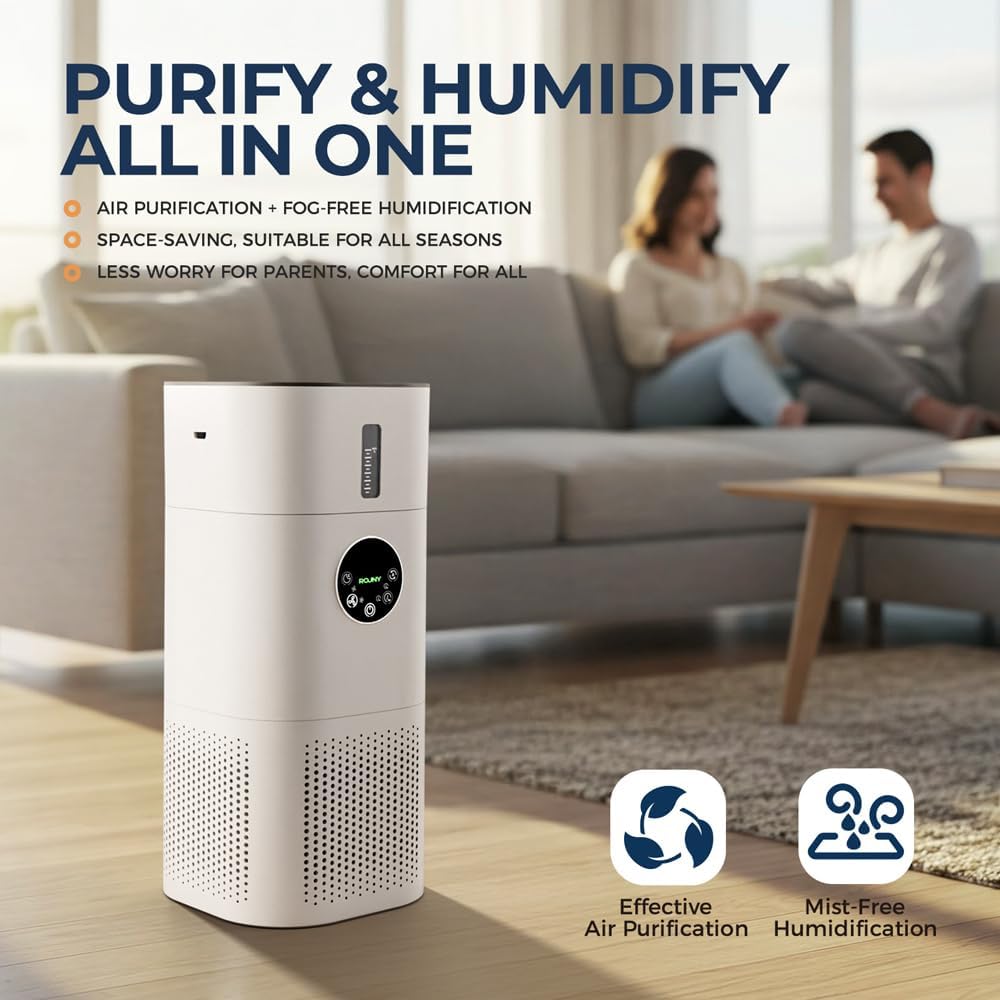
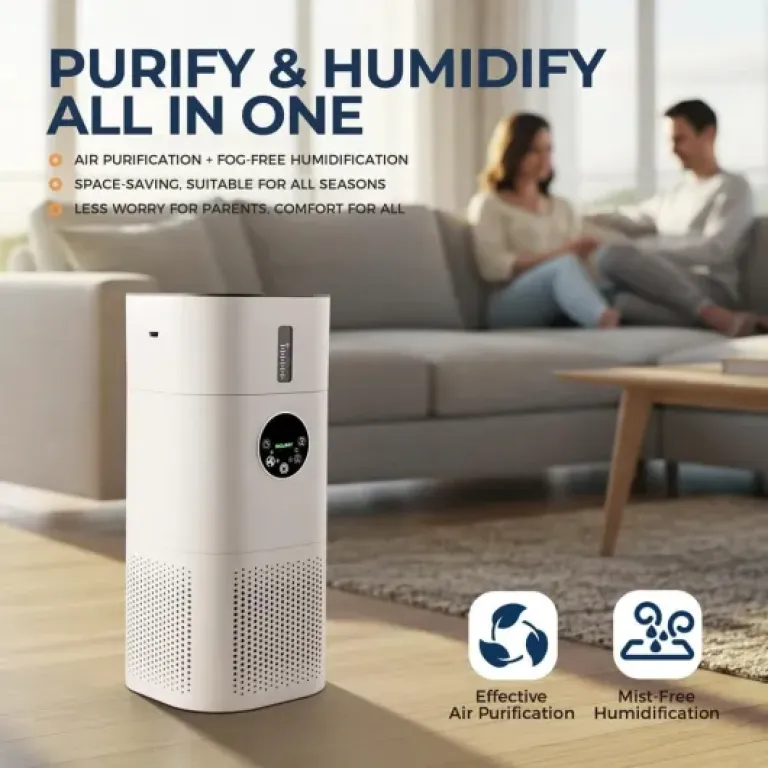
The ROUNY R‑T2 is a compact 2‑in‑1 device that tries to handle two everyday annoyances at once: stale, dusty air and dry indoor air. On paper, it combines an H13 HEPA filter, an activated carbon stage and a detachable humidifier module in a 46 cm tall tower that weighs just 2.6 kg. The brand targets bedrooms and small living spaces between 20 and 50 m², with an advertised noise level as low as 25 dB in sleep mode, which should be very quiet for night use.
What stands out immediately is the idea of a fully independent humidifier module that clips onto the purifier. The main body remains a classic air purifier, and you can remove the humidifier part without affecting filtration. That makes this product interesting for people who only need humidity at certain times of year, or who want to simplify maintenance by separating water handling from the electronics and filters.
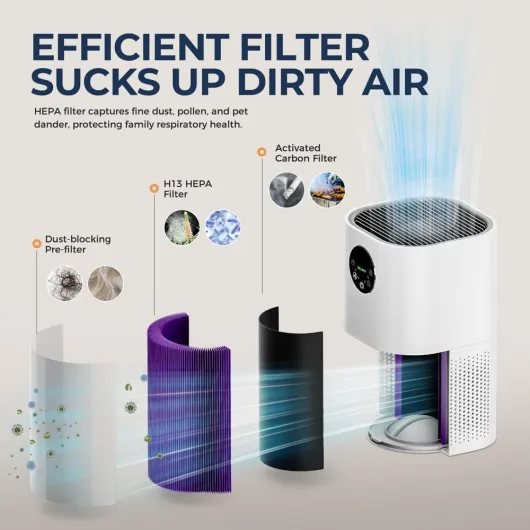
On the technical side, the R‑T2 leans on a three‑stage filtration system (pre‑filter + H13 HEPA + activated carbon, according to the description) and a 360° air intake layout. The HEPA stage is announced as capable of trapping particles down to 0.3 microns and PM2.5, which covers common indoor pollutants like fine dust, pollen and pet dander. The carbon part is supposed to deal with odours and smoke. A smoke sensor, colour air‑quality indicator and automatic fan mode complete the package.
However, the brand is relatively unknown and the unit’s ranking in the air purifier category suggests it is more of a niche or budget option than a reference model. There is a 1‑year warranty, a modest 24 W power draw, and a recommended filter change every 3–6 months. In my opinion, this is the kind of product that can be interesting if the price is low enough and your expectations are realistic: a practical, small purifier–humidifier combo for one room, not a high‑end machine for a whole apartment.
Value for money of this 2‑in‑1 unit
From a value perspective, the ROUNY R‑T2 tries to stand out by combining air purification and humidification in one compact device. Instead of buying two separate machines, you get a modular system where the humidifier clips onto the purifier and can be removed whenever you don’t need it. If the selling price is competitive, this combo approach can make financial sense for people who want both functions but have limited space and budget.
Looking at the spec sheet, the R‑T2 includes several features usually found on more expensive models: H13 HEPA + activated carbon, a 360° air intake, a smoke sensor with colour air‑quality display, Auto mode based on air quality, a 25 dB sleep mode, and touch controls with timers. These are not basic features; they place the unit in a slightly more advanced category than the cheapest single‑button purifiers. On the other hand, the absence of clear CADR/airflow data and a relatively short 1‑year warranty show where the brand has likely cut costs.
Running costs are another part of the value equation. With a 24 W power draw, electricity consumption should stay low even if the purifier runs many hours per day. Filter replacement every 3–6 months is standard, but the real impact on budget depends on how much ROUNY charges for genuine cartridges and whether third‑party options exist. Since the brand is not a household name, replacement filters might be more expensive or less widely available than those for big brands, which could reduce long‑term value if the device is used heavily.
In my opinion, this model offers decent value for someone who specifically wants a quiet purifier for a bedroom and occasionally needs a small humidifier. The main selling points are the quiet sleep mode, automatic operation and modular design. People who only need a purifier and don’t care about humidification might find better airflow or longer warranties at similar prices from more established brands. Conversely, if you are short on space and appreciate the idea of a 2‑in‑1 tower with reasonable features, the R‑T2 can be a sensible compromise, as long as you accept the unknowns about long‑term support and consumable costs.
Compact tower design and 360° air intake
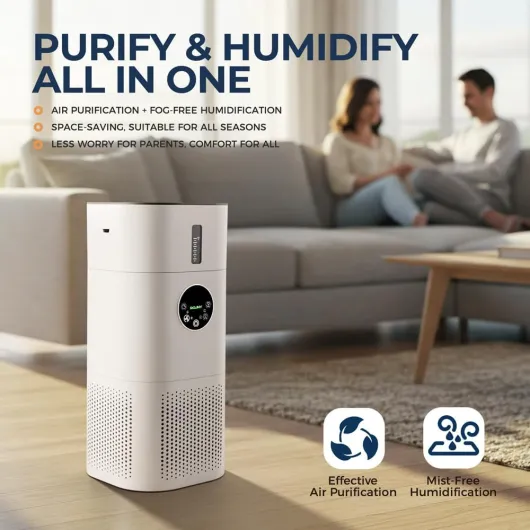
From a design standpoint, the ROUNY R‑T2 plays it safe: white plastic tower, rounded edges, and a vertical cylinder format. With dimensions of 21 cm in diameter and 46.1 cm in height, it stays relatively slim and should fit easily next to a bed, under a desk or in a corner of a living room. The neutral white colour is intended to blend into most interiors without drawing much attention, which suits people who just want an appliance that disappears in the background.
The functional part of the design is the 360° air intake around the base. Instead of a flat front grille like many cheap purifiers, this layout lets the machine pull air from all directions in the room. On paper, this helps avoid dead zones and should improve how fast the air in a small room is mixed, even if the total airflow is not specified. Clean air is then expelled upward, which can help distribute it more evenly and avoid blowing directly into someone’s face.
The top hosts the touch control panel. While the exact icon layout is not described in detail, the listed controls include power, speed selection, Auto mode, timer (1h/4h/8h) and probably a sleep mode button. A colour indicator ring or light for air quality is also mentioned. That colour feedback is useful in daily life: you can see at a glance whether the sensor thinks the air is clean or polluted, and you don’t have to guess if Auto mode is doing anything.
The detachable humidifier module is what really differentiates this model’s design. It mounts onto the purifier and locks via serrations at the bottom. When removed, the purifier stays fully functional, which makes the overall design more flexible than an all‑in‑one sealed unit. In my opinion, the design logic is sound: compact footprint, vertical airflow, simple white finish and modular humidifier. It’s not a stylish object, but for a bedroom or office it should be visually discreet and practical to place, especially given the low 2.6 kg weight that makes it easy to move between rooms as needed.
Durability, maintenance and long‑term use
Durability for devices like this depends more on filter availability, motor quality and maintenance habits than on raw materials. The ROUNY R‑T2 comes from a lesser‑known brand and is manufactured in China, with a stated 1‑year warranty. That warranty period is typical for budget appliances but shorter than the 2–5 years some bigger brands offer on their better models. In my opinion, this signals a product aimed at the entry‑ to mid‑range segment where expectations on long‑term robustness should stay moderate.
On the maintenance side, the brand highlights a ROUNY filter indicator that alerts users when replacement is needed. Recommended replacement interval is every 3–6 months depending on use and air quality. This is in line with what many compact purifiers suggest. The spec sheet also mentions that general maintenance can be done with a vacuum cleaner, which likely refers to cleaning the pre‑filter to extend the HEPA cartridge’s life. If users actually vacuum the pre‑filter regularly, they can reasonably expect the internal filter to last closer to the 6‑month mark, especially in less polluted environments.
The detachable humidifier module has pros and cons for durability. On the plus side, making it independent and removable means that any future failure or lime‑scale issue in the humidifier part does not automatically condemn the purifier itself: you can simply detach the module and keep using the core machine as a standard air purifier. On the downside, more mechanical interfaces (serrations, seals, water tank connections) mean more potential points of wear or leakage over time. People in hard‑water regions usually need to pay attention to descaling and cleaning any humidifier to avoid mineral build‑up, but the spec sheet does not go into cleaning instructions.
Given the modest 24 W power draw and compact fan, the motor is unlikely to be heavily stressed in normal use, which is good for longevity if the unit is not constantly run at maximum speed in a very dusty environment. In my view, the realistic scenario is a device that can last several years in a bedroom or office if the owner keeps up with filter changes and basic cleaning. The main long‑term question mark is availability and price of replacement filters and possibly humidifier parts. Without strong brand presence, there is always a risk that consumables become harder to find after a few years. Anyone buying should check in advance whether spare filters are easy to order and factor that into their decision.
Daily performance: noise, automation and humidifier combo
On daily performance, the ROUNY R‑T2 leans heavily on quiet operation and automation. The manufacturer advertises a minimum noise level of 25 dB in sleep mode. For reference, that sits around the sound of rustling leaves or a very quiet library. If this figure is accurate, the unit should be suitable for light sleepers who run it at night, especially since sleep mode usually means reduced fan speed and dimmed lights. There is no maximum noise level given for higher speeds, so it is unclear how loud it gets when running at full power.
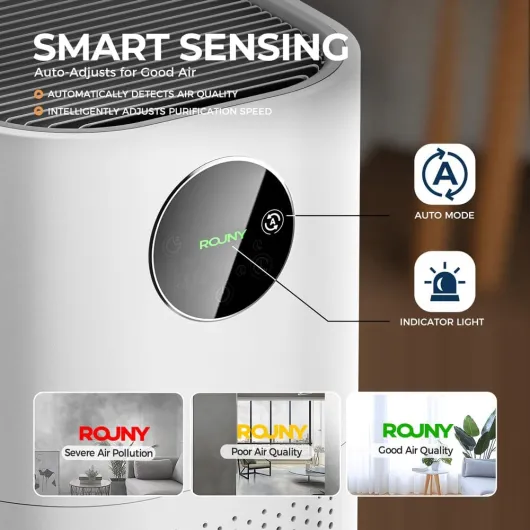
The Auto mode uses the smoke sensor to adjust fan speed according to air quality. In practice, this kind of system tends to stay at low speed most of the time in a clean room, then briefly ramp up when someone opens a window to a polluted street, smokes, or stirs up dust. This can be efficient in terms of power and noise: the R‑T2 draws only 24 W, so even if it runs continuously, energy consumption remains low. The 1h, 4h and 8h timers give extra flexibility for people who want it to shut off automatically after they fall asleep or leave the room.
The humidifier module adds another performance dimension. By attaching it to the purifier, the unit can blow slightly moistened air, which is appealing for people suffering from dry throat, dry skin or nosebleeds in winter. The interesting design choice is that the humidifier is an independent and detachable module: if you remove it, the purifier continues to work normally. That means you can simply skip the humidifier in summer, reduce cleaning chores and avoid unnecessary water handling. The spec sheet does not provide a humidity output figure (ml/h), so one should assume this is a modest‑capacity humidifier suitable for a bedroom rather than a whole flat.
In my opinion, the overall performance picture is solid but not spectacular for a small 2‑in‑1 unit. Quiet night mode, sensor‑based automation and combined humidification are real strengths in everyday use, especially for allergy‑prone users or those bothered by dry air. The main limits are the unknown airflow, no clear data on maximum noise, and the likely modest humidifier power. If someone expects industrial‑level air cleaning or strong humidification, this machine will probably feel underwhelming. For a single bedroom or small office where you want set‑and‑forget operation and a bit more comfort, the performance profile makes sense.
What the ROUNY R‑T2 actually offers
The ROUNY R‑T2 is positioned as a 2‑in‑1 air purifier and humidifier designed for rooms from 20 to 50 m². The core of the device is the air purifier: a cylindrical tower (21 × 21 × 46.1 cm) with 360° air intake at the base, a vertical airflow path through the filter cartridge, and clean air blown out at the top. The humidifier module is a separate attachment that fixes onto the purifier via bottom serrations. The key point: the purifier works fine without the humidifier, but the humidifier cannot be used on its own.
Filtration is described as a three‑level system: a pre‑filter (not heavily detailed), an H13 HEPA filter that targets particles as small as 0.3 µm, and an activated carbon layer for gases and odours. The manufacturer claims it can tackle cigarette smoke, dust, pollen, pet hair, pet dander and general odours. There is an air‑quality sensor (semiconductor smoke sensor) that feeds a colour indicator and controls the fan speed in Auto mode, which is relatively advanced for a small 24 W unit.
For controls, the R‑T2 relies on a touch panel on the top. The main functions listed are: fan speed selection, Auto mode, sleep mode, and timers at 1 h, 4 h and 8 h. The noise level is announced at 25 dB in sleep mode, which on paper is comparable to a very quiet bedroom. Power comes from a standard mains cord (no battery), which is typical for this product category. The unit weight of 2.6 kg makes it easy to move between rooms.
Maintenance is supposed to be straightforward: the brand mentions a filter indicator (called ROUNY filter indicator) that alerts you when the cartridge needs replacement. Recommended replacement interval is 3–6 months depending on air quality and usage time. They also suggest that day‑to‑day maintenance can be done with a vacuum cleaner on the pre‑filter to extend the life of the main filter. In my view, the overall feature set looks coherent for a small domestic purifier, with the added bonus of the detachable humidifier. The main unknowns remain real‑world airflow (no CADR figure is given) and the long‑term availability and cost of replacement filters and humidifier parts.
Air cleaning effectiveness on paper
The ROUNY R‑T2 relies on a three‑stage filtration system with an H13 HEPA filter and an activated carbon layer, which is standard for serious entry‑level purifiers. H13 HEPA is rated to capture at least 99.95% of particles down to 0.3 microns under lab conditions, so on paper it should be capable of handling fine dust, pollen, pet dander and part of the smoke particles present in indoor air. The product explicitly mentions PM2.5 filtration, which covers a good share of urban pollution and tobacco smoke residue.
The carbon stage is announced as able to handle odours and some gaseous pollutants: cigarette smoke, general odours and VOC‑type smells. As usual in this price segment, there is no quantitative data on how much carbon is used or how long it remains effective, so expectations should stay moderate. Carbon filters in compact devices typically help reduce light smells in a bedroom or office, but they rarely remove strong cooking odours in a large open kitchen. In my opinion, this model fits the pattern: decent for mild smells in a closed room, not a miracle solution for heavy smoke or strong chemical fumes.
The semiconductor smoke sensor and Auto mode are interesting for day‑to‑day effectiveness. The sensor continuously checks particle concentration and adjusts fan speed, while a colour indicator shows air quality. In theory, that makes the purifier more reactive: it should ramp up when someone smokes or opens a window to a busy street, then slow down again once the air is clean. Buyers often appreciate this feature because it avoids running the fan at full blast all the time, which reduces noise and power consumption.
However, a big missing piece is any CADR (Clean Air Delivery Rate) or explicit airflow figure. Without that, it is hard to estimate how quickly the R‑T2 can clean a 20–50 m² room. The spec sheet claims coverage up to 50 m², but with a 24 W motor and compact size, it is reasonable to assume that it is best suited to the lower end of that range (bedrooms, small offices) rather than a large living room. In my view, if someone expects it to fully handle a big open‑plan space, they may be disappointed. Used in a closed bedroom or small office, the filtration specs look solid enough to noticeably reduce dust and pollen levels, as long as the filter is replaced regularly.
Pros
- 2‑in‑1 design with detachable humidifier module, purifier works independently
- H13 HEPA plus activated carbon filtration with 360° air intake and air‑quality sensor
- Very quiet advertised 25 dB sleep mode and low 24 W power consumption
Cons
- No published CADR/airflow data, claimed 20–50 m² coverage likely optimistic for larger rooms
- Only 1‑year warranty and relatively unknown brand
- Long‑term availability and cost of replacement filters and humidifier parts are uncertain
Conclusion
Analysis score
The ROUNY R‑T2 positions itself as a compact, practical solution for people who want cleaner air and a bit more humidity in a single bedroom or office. On paper, it checks the key boxes: H13 HEPA plus activated carbon filtration, 360° air intake, quiet 25 dB sleep mode, automatic fan control based on a smoke sensor, and a modular humidifier that you can attach or remove as needed. For day‑to‑day comfort, that combination is attractive, especially if you are sensitive to dust, pollen or dry winter air and you prefer a set‑and‑forget device.
It is not without compromises. The brand is relatively unknown, the warranty is limited to 1 year, and no CADR or airflow figures are given, which makes the claimed coverage up to 50 m² optimistic in my view. Realistically, this looks best suited to smaller, closed rooms. Long‑term value will depend heavily on how easy it is to find replacement filters and, if needed, humidifier parts. If those remain accessible at a reasonable price, the low 24 W consumption and modular design should keep running costs manageable.
In my opinion, the R‑T2 is a good fit for users who want a quiet 2‑in‑1 unit for a bedroom or small office, care about automatic operation, and don’t want multiple separate appliances cluttering their space. People who need strong air cleaning for large living rooms, want a long warranty, or prefer a big‑name brand ecosystem should probably look elsewhere or consider a dedicated higher‑capacity purifier plus a separate humidifier. As a compact combo with sensible features, the ROUNY R‑T2 is decent, as long as expectations stay aligned with its size and brand positioning.