
Summary
Editor's rating
Price, filters and whether it’s worth the money
Compact white box that disappears in a corner
Noise, daily use and how it fits into normal life
Packaging, setup and first contact
Real-life performance with allergies, dust and everyday smells
What you actually get out of the box
Does it actually help allergies and air quality day to day?
Pros
- Very quiet in sleep mode (around 20.5 dB), easy to use at night
- Low power consumption (about 21–23 W) so you can run it for long periods
- Effective HEPA + carbon filtration that clearly reduces dust, smells and allergy symptoms
Cons
- Filter replacements (FY0910) add a noticeable yearly cost
- Coverage up to 65 m² is optimistic for a single large open room
- No built-in handles or remote, and design is quite plain

Specifications
View full product page →| Brand | Philips |
A small purifier for real-world allergy problems
I picked up the Philips Air Purifier 900 Series (AC0950/10) mainly because my spring allergies were getting out of hand and my old cheap purifier sounded like a hair dryer. I wanted something that could stay on all day in the living room without driving me mad with noise or spiking the electricity bill. This one kept popping up with decent reviews and a CADR of 250 m³/h, which is supposed to be enough for up to 65 m². My flat is around 50 m², so on paper it fit pretty well.
After a few weeks of use, I can say it’s not magic, but it clearly helps. I sneeze less in the morning, and the air doesn’t feel as stuffy, especially when we cook or when the windows stay closed. The main thing that surprised me is how quiet it is in sleep mode. I leave it on at night in the bedroom and I basically forget it’s there. That was one of my main fears because I’m a light sleeper.
Another point that pushed me to try this model is the smart filter indicator and the app. I’m lazy with maintenance, and with my old purifier I always forgot to change the filter and ended up running it half-clogged for months. Here, the machine tells you when it’s time, and the app shows the filter life in percentage. It’s a small thing, but in daily life it’s handy because you don’t have to guess.
Overall, my first impression is that it’s a practical, no-drama device. It’s not the cheapest purifier on the market, and it’s not some fancy design piece, but it fits easily in a corner, doesn’t draw much power (around 20–23 W max), and seems to actually improve the air. It’s not perfect, there are a few annoying points, but if you’re like me and just want cleaner air without turning your living room into a server room, it’s a pretty solid candidate.
Price, filters and whether it’s worth the money
On the value for money side, this Philips 900 Series sits in the middle. It’s not a budget purifier, but it’s also not in the crazy expensive range. For what it offers (HEPA + carbon filter, app connectivity, low noise, ECARF certification), I’d say the price is fair, but not a bargain. You pay partly for the Philips brand and the smart features. If you just want a basic mechanical purifier with no app, you can find cheaper options, but you’ll probably give up some comfort and maybe noise levels.
The running cost is mostly about the filter. The compatible filter is the FY0910, and Philips says it lasts up to a year, depending on usage and air quality. The smart indicator calculates the filter life and tells you when to change it, which is nice because you’re not just changing it based on a random schedule. In my use (several hours a day, in a city but not right on a main road), I expect to change it roughly once a year. The replacement filters aren’t cheap, but they’re not outrageous either. Still, you need to factor that into your budget.
Energy use is one of the strong points. At around 21–23 W at max, it uses less than a classic light bulb. I’ve left it running a lot and didn’t see a noticeable spike on my electricity bill. So from a power consumption perspective, it’s pretty economical. If you like the idea of leaving a purifier on most of the day, this low wattage really helps keep costs down over the long run.
Overall, I’d say the value is good but not mind-blowing. You get a reliable, quiet, smart purifier from a known brand, with decent running costs and proper filtration. If you’re on a tight budget and don’t care about the app, you can probably find cheaper units that still clean the air. If you want something you can trust, that’s easy to live with and doesn’t eat power, this Philips makes sense, as long as you accept the ongoing filter cost.
Compact white box that disappears in a corner
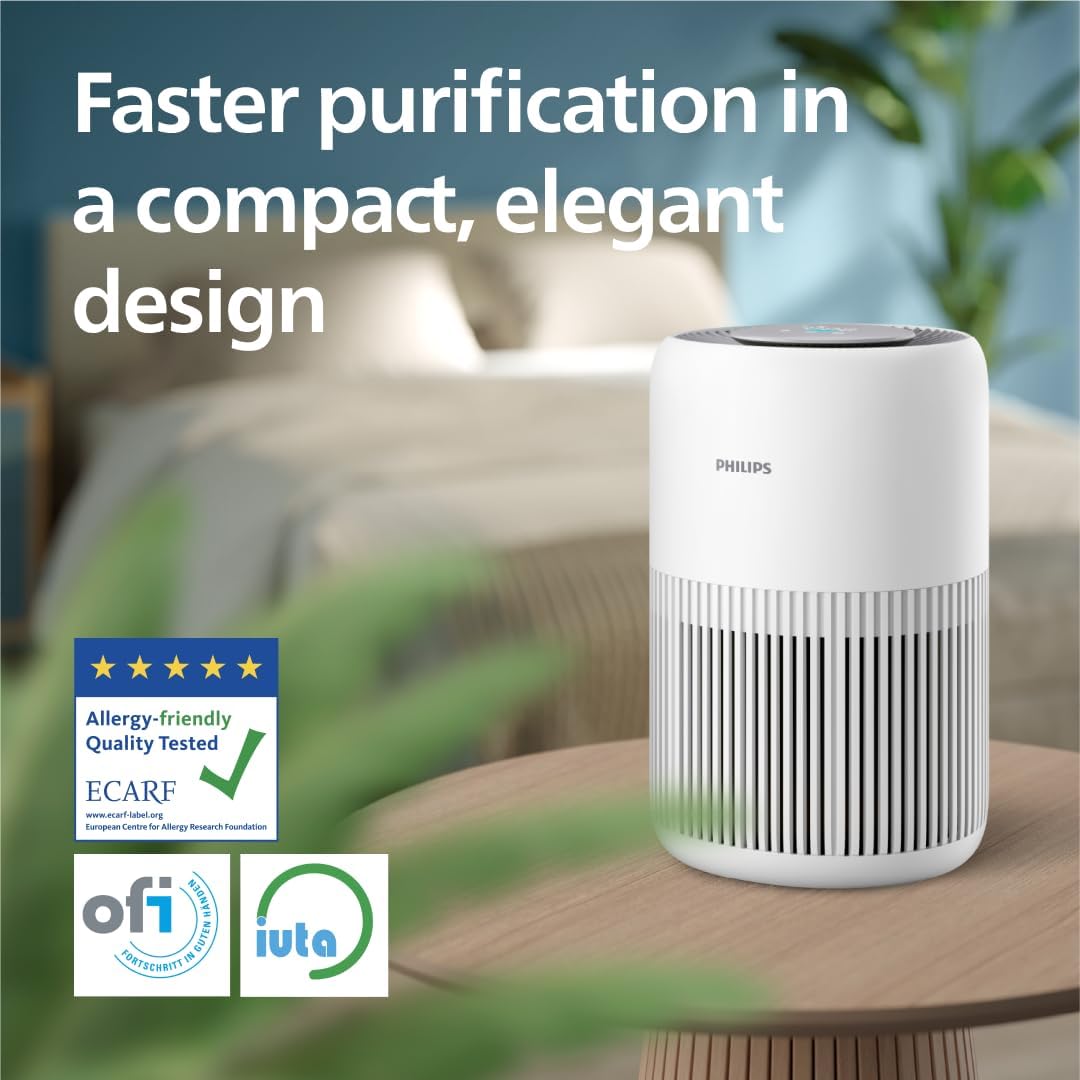
Design-wise, this Philips purifier is pretty neutral. It’s a small white box with rounded corners, perforated sides for air intake, and a flat top with the control panel and air outlet. It’s not ugly, it’s not stylish, it’s just… there. In my living room, it sits next to a shelf and honestly I forget it most of the time, which is exactly what I wanted. It doesn’t scream “medical device” and it doesn’t try to be a piece of decor either.
The compact size is a real plus. At around 36 cm tall, it’s lower than most side tables, so you can tuck it between furniture without blocking the airflow. I’ve moved it between rooms quite a bit, and because it only weighs 3.5 kg, it’s easy to grab with one hand. There are no dedicated handles, though, which is a small downside. When you pick it up, you just grab it from the sides, and if your hands are wet, it can feel a bit slippery.
The top control panel is clear and simple. Touch buttons respond well, and there’s a small display for air quality and mode indicators. In sleep mode, the lights dim, which is critical in a bedroom. I’m sensitive to light at night, and I appreciate that it doesn’t turn the room into a disco. One thing I’d have liked is a physical button lock or child lock, because if you have kids, they can easily start pressing everything. For me it’s not a big issue, but it’s worth mentioning.
Build quality feels solid enough for the price range. The plastics don’t feel premium, but they don’t feel cheap either. The filter compartment opens easily from the back, and changing the filter is straightforward: pull the old one out, slide the new one in. No screws, no tools. Overall, the design is practical and discreet, not something you buy to show off, but something that blends in and does its job without drawing attention. If you’re picky about aesthetics, you might find it a bit plain, but for everyday use, it’s fine.
Noise, daily use and how it fits into normal life
Comfort-wise, this purifier is one of the more pleasant ones I’ve used. The big plus is the noise level. In sleep mode, it’s rated around 20.5 dB, and in reality it’s barely audible. It’s more of a soft airflow noise than a fan. I’m a light sleeper and usually any constant hum annoys me, but with this one, I can leave it on all night in the bedroom without it bothering me. On higher speeds, you do hear it, obviously, but it’s still far from the “vacuum cleaner” vibe of cheaper models.
In everyday use, the auto mode is quite handy. You just turn it on and let it adjust the fan speed based on air quality. When I cook or open a window on a dusty day, you can hear it ramp up a bit, then slow down when things improve. The transitions are smooth, not sudden jumps in noise. I mostly leave it in auto during the day and switch to sleep mode at night. That way I don’t have to think about it much, it just runs in the background.
The light management is also decent. In normal mode, you have a clear display, but in sleep mode the lights dim, which is great for the bedroom. It’s not 100% blacked out, but it’s low enough that it doesn’t light up the room. If you’re extremely sensitive to light, you might still want to angle it away from your face, but for me it’s fine. There’s no loud beep every time you touch a button, which I appreciate a lot.
The only comfort downsides for me: there’s no remote (you use the app or the top panel), and moving it around doesn’t feel as ergonomic as it could because of the lack of proper handles. These are small annoyances, not dealbreakers. Overall, in terms of noise, ease of use, and how it fits into daily life, it’s a pretty comfortable device to live with. You turn it on, forget about it, and it doesn’t drive you mad.
Packaging, setup and first contact
The packaging is pretty standard but functional. The purifier comes in a cardboard box with foam and cardboard inserts holding it in place. Nothing fancy, but it arrived without a scratch. Inside, the unit is wrapped in plastic, and the filter is already installed but also wrapped in plastic that you have to remove before first use. Important detail: if you forget to take that plastic off (easy to miss if you’re rushing), the purifier will run but obviously won’t filter anything properly. So take the two extra minutes to open the back and double-check.
Setup is straightforward. You plug it in, press power, and it starts in auto mode. The top controls are intuitive enough that you can figure them out without the manual. For the Air+ app, you scan a QR code in the manual, download it, and then follow the steps to connect the purifier to Wi‑Fi. It took me about 5–10 minutes including a firmware update. Once it’s done, you can turn the purifier on/off, change modes, and see the filter status from your phone.
The app itself is decent. You get basic air quality info, filter life in percentage, and control over the modes. It’s not the most polished app I’ve ever used, but it works and hasn’t crashed on me so far. It’s handy when you’re in bed and want to switch to sleep mode without getting up, or when you forget if you left it on in another room. If you’re not into apps, you can completely ignore it and just use the physical buttons; you’re not forced to connect it.
In short, the first contact with the product is pretty smooth: simple packaging, quick setup, and a clear user experience. No unnecessary plastic mountains, no complicated assembly. The only real risk is forgetting to remove the filter’s plastic bag, but that’s mentioned in the quick start guide. For a home appliance, that’s about as painless as it gets.
Real-life performance with allergies, dust and everyday smells
In daily use, the air cleaning performance is pretty solid for a small unit. I mainly tested it in a 20–25 m² living room and a 12 m² bedroom. In the bedroom, on auto or sleep mode, I noticed fewer morning sneezes after about 3–4 days. I usually wake up with a blocked nose in pollen season, and it dropped from “I can’t breathe” to “slightly stuffy but manageable”. That’s not scientific, but for me it’s a clear sign it’s doing something with the pollen and dust.
On dust, I’ve seen a difference on surfaces. Before, I had to wipe the TV stand and shelves every 3–4 days or they looked grey. Now, with the purifier running several hours a day, I can stretch that to about a week before it looks the same. So it’s not magic, but it reduces the amount of dust floating around. Also, my partner has mild cat allergies, and when we had friends over with their cat, we ran the purifier on a higher setting. She still noticed the cat, but her eyes were less irritated than usual. Again, not a miracle, but clearly helpful.
For smells, the active carbon filter does a decent job. When we cook something strong like onions or fish, if I start the purifier on a higher fan speed, the smell fades faster compared to leaving the room closed. Same thing after using cleaning products with strong scent: the air clears in maybe half the time. It won’t instantly erase burnt toast smell, but it definitely shortens how long odors hang around. For everyday kitchen and living room use, that’s good enough for me.
The CADR of 250 m³/h is realistic for small to medium rooms. For the full 65 m² stated on the box, I’d say that’s more like “entire flat over time” than “one big open space cleaned super fast”. If you have a big open-plan living room of 50–60 m² and expect it to scrub the air in minutes, you’ll probably be underwhelmed. It works best when left running for hours in the background, not as an emergency smoke remover. Overall, performance is good for its size and power, but don’t expect industrial-level power in one little unit.
What you actually get out of the box
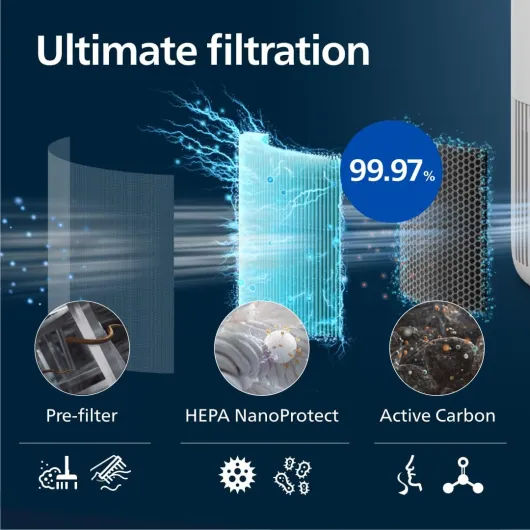
When you unbox the Philips 900 Series, you get the purifier itself, already fitted with its combined HEPA NanoProtect and active carbon filter, the power cable (fixed to the unit), and the usual paper manual. No remote, no extra filter, no fancy accessories. It’s basically plug, remove the plastic from the filter, and go. Setup took me less than 5 minutes, including downloading the Air+ app and pairing it with Wi‑Fi.
The device is pretty compact: roughly 24 cm deep, 23.8 cm wide, and 36.4 cm high. It weighs about 3.5 kg, so you can easily move it with one hand from the living room to the bedroom. I’ve done that a lot the first week, just to see where it made the biggest difference. On the top, you’ve got a touch panel with the essential controls: power, modes (including sleep), and fan speed. No crazy learning curve, I didn’t even really need the manual apart from the QR code for the app.
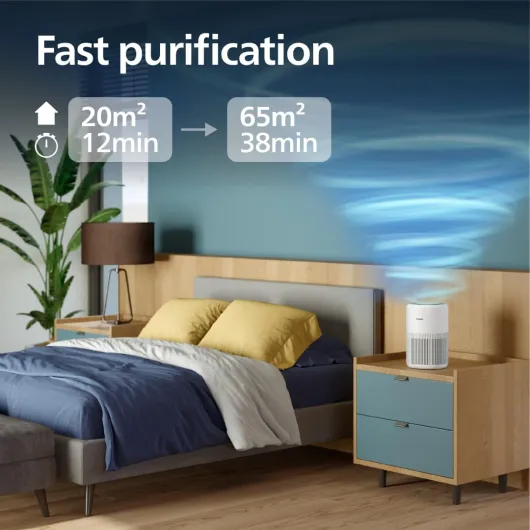
In terms of specs, it’s rated with a CADR of 250 m³/h, which means it can clean 20 m² in under 12 minutes according to Philips. I didn’t stand there with a particle counter, but in practice, when we cook something smelly (fish, for example), the smell does fade faster when I put it on higher speed. It’s also ECARF certified for allergy sufferers, and the filter is supposed to catch 99.97% of tiny particles and also deal with odors and gases thanks to the carbon layer. Again, I can’t verify the exact percentages, but dust buildup on shelves and sneezing have clearly gone down.
Overall, the presentation is pretty straightforward: this is a simple, app-connected purifier with a 3-layer HEPA system, low power consumption (around 21–23 W max), and a claimed coverage up to 65 m². No built-in battery, it’s corded only, so don’t expect to move it around wire-free. It’s built for people who want something they can leave running quietly in the background, not a gadget you constantly fiddle with. If you’re after dozens of modes and colored light shows, this isn’t it. If you just want cleaner air with minimal fuss, it covers the basics well.
Does it actually help allergies and air quality day to day?
This is where I was the most curious: is it actually effective for allergies, or is it just a fancy fan with a filter? After a couple of weeks, my answer is: it helps, but it won’t replace your meds if you’re really sensitive. I’m in the medium allergy camp (pollen, dust mites), and with this running several hours a day, especially at night, I’ve noticed fewer sneezing fits and less of that itchy throat feeling in the morning. I still get symptoms when I go outside, but at home it’s calmer.
The HEPA NanoProtect filter is supposed to catch 99.97% of small particles and down to 0.003 microns. I obviously didn’t measure that, but I did pay attention to how I felt when I skipped using it. One weekend I turned it off by accident for a whole night, and the next morning my nose was more blocked and I sneezed more. When I turned it back on the following nights, things improved again. Not a controlled experiment, but enough to convince me it’s doing a real job with fine particles and allergens.
Another point is virus and bacteria removal, which Philips claims at 99.9% for airborne stuff. I can’t verify that, and I’m a bit skeptical about any exact number here. What I can say is that the air feels fresher in closed rooms, especially in winter when you don’t open the windows much. Less “stale air” feeling, and the room doesn’t smell like a locker room after several hours. For me, that’s already a good sign of effective filtration and circulation.
Overall, I’d rate its effectiveness for allergy sufferers as good but not miraculous. If your allergies are moderate and you want to reduce symptoms at home, it’s worth it. If you’re extremely sensitive or live right next to a busy road with constant pollution, you might need a stronger unit or more than one. It clearly improves comfort, but it’s not a magic shield. Think of it as a helpful tool, not a cure.
Pros
- Very quiet in sleep mode (around 20.5 dB), easy to use at night
- Low power consumption (about 21–23 W) so you can run it for long periods
- Effective HEPA + carbon filtration that clearly reduces dust, smells and allergy symptoms
Cons
- Filter replacements (FY0910) add a noticeable yearly cost
- Coverage up to 65 m² is optimistic for a single large open room
- No built-in handles or remote, and design is quite plain
Conclusion
Editor's rating
After using the Philips Air Purifier 900 Series (AC0950/10) for a while, I’d sum it up like this: it’s a quiet, efficient, no-drama purifier that fits well in everyday life. It doesn’t try to impress with flashy design or crazy features, it just cleans the air reasonably well, uses very little power, and doesn’t make a racket. For allergy sufferers with moderate symptoms, it genuinely helps reduce sneezing and that heavy air feeling, especially at night. The HEPA + carbon combo also deals pretty well with everyday smells and dust.
It’s not perfect. The coverage claim up to 65 m² feels a bit optimistic if you’re thinking of one big open room, the filters aren’t cheap, and there’s no battery or remote. The design is quite plain and there are no handles, which makes moving it slightly less convenient. But if you want a reliable, compact purifier from a known brand, with low noise (around 20.5 dB in sleep mode), low power usage (around 21–23 W), and a handy app to track the filter, it’s a solid choice.
I’d say it’s ideal for: small to medium flats, bedrooms, and living rooms up to around 25–30 m² where you want something quiet you can leave on most of the day. If you’re extremely allergic or need to cover a huge open space, you might want a more powerful model or a second unit. For most people who just want cleaner air without turning their home into a lab, this Philips does the job without fuss.