
Summary
Editor's rating
Is it worth the money compared to other purifiers?
Compact and neutral, but a bit plasticky
Power use and running it 24/7 (no battery, but low wattage)
Build, filter life and how it feels after a few weeks
Real-world performance in a dusty room with a cat
What you actually get with the Philips 600 Series
Allergies, dust and what actually changed for me
Pros
- Very quiet sleep mode (around 19 dB) and low 12W power consumption, easy to run 24/7
- Effective at reducing dust and easing mild allergies in small to medium rooms
- Compact size with useful air quality feedback (PM2.5 number and colour ring) and simple app control
Cons
- Plasticky build with no real handle and a slightly “budget” feel for the price
- Filter replacements add ongoing cost and it’s less effective for strong smells or very large rooms

Specifications
View full product page →| Brand | Philips |
A small purifier that actually changed my bedroom air
I’ve been using the Philips Air Purifier 600 Series (AC0651/10) for a few weeks now, mainly in my bedroom and sometimes in my home office. I bought it because my nose is always blocked in the morning and I’m allergic to dust and pollen. I didn’t want a huge tower, just something compact that could run quietly at night without sounding like a fan on full blast. This one caught my eye because of the low power consumption (12W), the HEPA filter, and the fact that it’s supposed to be quiet in sleep mode.
In everyday use, I’ve basically left it on almost all the time, switching between auto mode during the day and sleep mode at night. My room is about 14–15 m², so well below the 44 m² it claims to cover. That means I’m kind of using it in a best-case scenario, not pushing it to the limit. I also have a cat, so there’s fur and dander floating around, plus some litter dust.
Compared to before, I do notice less dust on surfaces and I wake up with less of that scratchy throat feeling. It’s not magic – I still sneeze when pollen is really high outside – but indoors it feels more stable. The air also smells less “stuffy” after keeping the windows closed for a few hours, especially when I’ve been working all day in the same room. I still open windows, but I don’t feel forced to air out as aggressively as before.
Overall, my first impression is that it’s a pretty solid little purifier for small to medium rooms, especially bedrooms. It’s not perfect: the app is a bit basic, the plastic feels a bit cheap, and it’s not going to fix very strong smells or smoke on its own. But for dust, pet dander and general air quality, it gets the job done without using much power or making a lot of noise. The rest of the review goes into the details of how it’s built, how it runs day to day, and where I think Philips cut a few corners.
Is it worth the money compared to other purifiers?
In terms of value, I’d say the Philips 600 Series sits in the “good but not dirt cheap” category. You’re paying partly for the Philips brand and the smart features, not just for raw airflow. If you only look at CADR per euro, there are probably bulkier, noisier purifiers that move more air for the same price. But they often use more power, look worse, or don’t have an app or decent sensor.
What you actually get for the money here is: very low energy use (12W), a proper HEPA filter, a smart sensor that reacts well, quiet sleep mode around 19 dB, and app control that covers the basics. For a bedroom or small living room, that combination is pretty solid value if you care about comfort and running costs. You can let it run constantly without stressing about power, and it genuinely helps with dust and mild allergies.
On the downside, filters are not the cheapest, and the plastic build doesn’t scream “premium”. Also, if you have a large open-plan area or very heavy pollution (smokers, strong cooking every day), you might be better off with a bigger unit, possibly with a stronger activated carbon stage, even if it costs a bit more and uses more power. In that scenario, this model can feel a bit undersized.
Personally, I think the price makes sense if: you mainly want it for a bedroom/office up to around 20 m², you’re sensitive to noise at night, and you want something that just works in auto mode without babysitting it. If you’re just curious about purifiers and don’t have strong allergies, a cheaper, non-smart model might be enough. But if you actually feel the difference in air quality and value quietness and low power use, this Philips hits a decent balance between cost and comfort.
Compact and neutral, but a bit plasticky
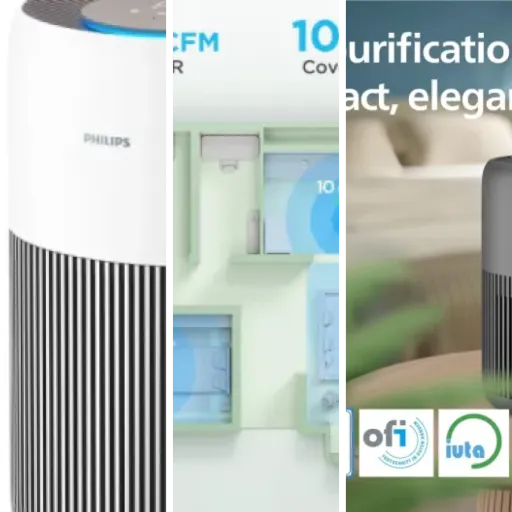
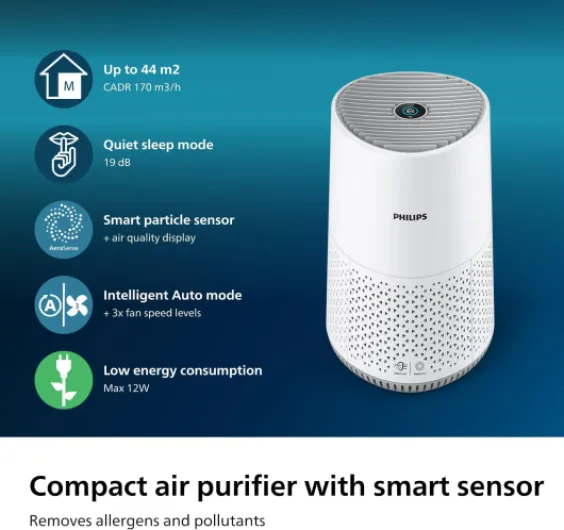
Design-wise, the Philips 600 Series is pretty neutral. The white/silk beige colour is the usual Philips look, so it blends in next to white furniture or walls. It’s not something you’d put in the middle of the room to show off, but it doesn’t look ugly either. The footprint is small, so I tucked it next to my bedside table without blocking drawers or cables. For a 44 m² rated purifier, the compact size is honestly one of the things I liked the most – it doesn’t feel like you’re adding another appliance to trip over.
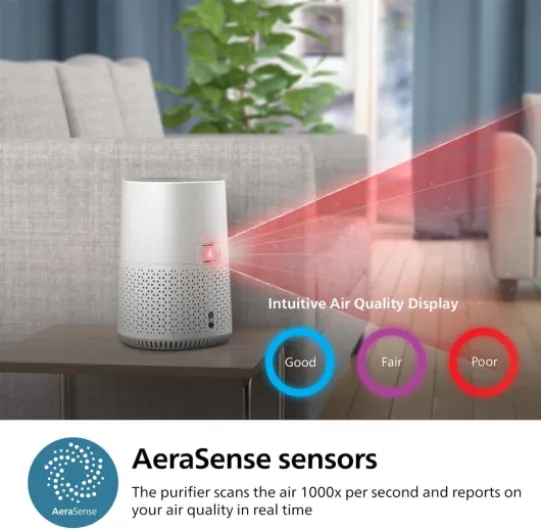
The front display is small but readable from a couple of metres away. You get a PM2.5 number and a colour ring: blue when the air is good, purple/orange when it’s medium, and red when it’s bad. I tested it by spraying deodorant on the other side of the room and the ring quickly turned purple/orange, then went back to blue after a few minutes. So the sensor and design of the feedback system are actually useful: you can see at a glance if the thing is doing something or just sitting there.
On the downside, the plastic casing feels a bit thin. It doesn’t creak like crazy, but it doesn’t give a “premium” impression either. When I grab it by the sides to move it, I can feel a bit of flex. For the price and the Philips name, I expected slightly thicker material. Also, there’s no proper handle; you just hold it from the sides, which is fine given the 2.2 kg weight, but a small integrated grip would have been nice if you move it between rooms every day.
In terms of layout, air intake is on the sides and bottom and the clean air blows out from the top. That means you should leave a bit of space around it and not push it straight against a wall. I tried it once half hidden behind a chair and the airflow and sensor response felt slower. So design-wise it’s compact and discreet, but you still need to give it breathing room. Overall, the look is fine and practical, but if you’re into very high-end materials or fancy finishes, this will feel a bit basic.
Power use and running it 24/7 (no battery, but low wattage)
Just to be clear, this purifier has no battery. It’s corded only. I’m still keeping this section because power consumption is one of the key points. The unit is rated at 12W max, which is pretty low compared to many other purifiers that can go up to 30–60W or more. In everyday use, this means you can leave it running almost all the time without worrying about your electricity bill exploding.
To give an idea: if it runs at 12W non-stop for 24 hours, that’s 0.288 kWh per day. Over a month, you’re looking at around 8–9 kWh. Depending on your electricity price, that’s usually just a few euros or pounds per month. In practice, it doesn’t run at full 12W all the time anyway. In sleep mode or low speed, it uses less. I didn’t measure exactly with a watt meter, but just based on the rating and the fan noise, it’s clearly not drawing huge amounts of power.
I’ve basically adopted the habit of leaving it on auto during the day and sleep mode at night. That means the fan only ramps up when the sensor detects more pollution (doors opening, dust, cooking smells drifting in, etc.). For someone like me who forgets to turn things on and off, this is ideal. I don’t think twice, and the impact on the bill is small enough that I don’t care. The downside is you’re tied to a socket all the time, so if you hoped to move it somewhere without power or run it on a balcony or something, forget it.
So yeah, no battery freedom, but for an indoor purifier I don’t really miss it. The low wattage is actually one of the strongest selling points in my opinion. You can treat it more like a fridge or router – always on in the background – instead of a device you have to constantly manage to save power.
Build, filter life and how it feels after a few weeks
It’s still early to judge long-term durability, but after a few weeks of daily use I can at least comment on the build and filter situation. The outer shell is basic plastic, not super thick, but it hasn’t scratched or yellowed yet. I’ve moved it between rooms quite a few times, sometimes bumping it lightly into furniture, and there’s no visible damage. The touch buttons still respond properly, and the display hasn’t shown any glitches or dead pixels.
The main wear item is obviously the HEPA filter. Philips doesn’t give a precise fixed lifespan because it depends on how dirty your air is and how much you use it, but the app gives an estimate of remaining filter life. After a few weeks of moderate use (mostly auto and sleep, almost 24/7), the app still shows a high percentage remaining, which is reassuring. When I opened the front to check, the filter was already a bit grey, so it’s clearly catching stuff. Replacements aren’t super cheap, though, so that’s something to factor in as a running cost.
From a mechanical point of view, the fan and motor haven’t developed any strange noises so far. Even at higher speeds, there’s just the expected airflow sound, no rattling or whining. I’ve had cheaper purifiers in the past where the fan started to buzz after a month; this one feels more stable. Still, because of the lightweight plastic feel, I’d be careful not to drop it or put heavy things on top of it. It’s more of a “keep it in a corner and don’t abuse it” device.
Overall, durability seems decent but not bulletproof. I trust it to last a few years if treated normally and if I keep up with filter changes. But it doesn’t give the tank-like impression some heavier, more metal-based units do. If you have kids or pets that like to knock things over, I’d place it somewhere safe. For regular home use by adults, I don’t see any big red flags so far.
Real-world performance in a dusty room with a cat
This is the part that matters: does it actually clean the air? In my case, I used it mostly in a 14–15 m² bedroom and occasionally moved it to a small living room of around 20 m². With a CADR of 170 m³/h and a claimed coverage of up to 44 m², it’s more than enough for my spaces. In the bedroom, if I close the door and run it on auto for an hour, the PM2.5 reading on the display usually drops to the low single digits (3–6 µg/m³) and stays there unless I open the window or there’s some dust stirred up.
I noticed the biggest difference in the morning. Before, I would wake up with a slightly blocked nose and dry throat, especially during pollen season. After running this purifier on sleep mode all night for several days, the blocked nose is clearly less frequent. I still get some allergy symptoms, but overall I feel less groggy and I don’t need tissues right away. For me, that’s a very concrete improvement. Also, surfaces like my bedside table and speakers collect dust more slowly. Dust still shows up, obviously, but I don’t see a visible layer in just one day like before.
I also tested it with smells and light smoke. For example, when I cooked something a bit greasy and left the bedroom door open, the air quality number went up and the fan speed jumped up in auto mode. It took maybe 15–20 minutes for the smell to noticeably fade in the bedroom, while the kitchen still smelled stronger. It’s not a miracle solution for strong kitchen smells or cigarette smoke, but it does help reduce lingering odours if you give it some time. For pet dander, with my cat sleeping on the bed half the time, I sneeze less when I shake the duvet now.
One thing to keep in mind: if you try to use it in a large open-plan area close to the 44 m² limit, it will work, but slower. I tried it in a bigger room (~30 m²) and the PM2.5 number dropped, but it took longer and the fan spent more time at higher speed, which is noisier. So performance is very good for small to medium rooms, decent but not magic in larger spaces. For its size and wattage, I’m actually impressed with how much air it cycles, but you do have to be realistic about room size and expectations.
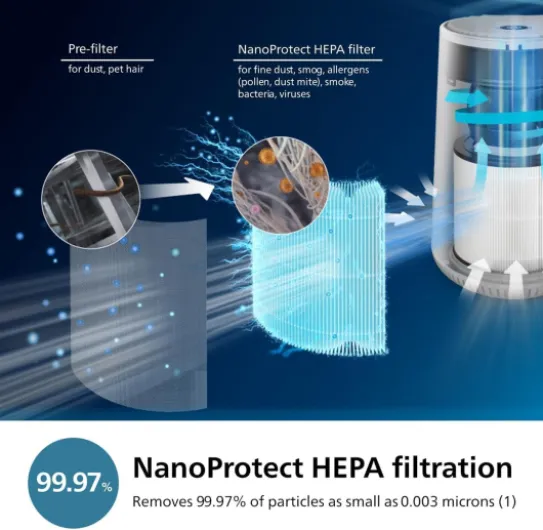
What you actually get with the Philips 600 Series
Out of the box, the Philips Air Purifier 600 Series is pretty straightforward. You get the unit itself, a combined filter already installed inside, a quick start guide and the usual paperwork. No remote, no extra filter, nothing fancy. It weighs about 2.2 kg, so it’s light enough to move around with one hand, and the size (around 24 x 24 x 34 cm) makes it easy to park in a corner without reorganising the room. It’s basically a compact cube/rectangle, not a big tower like some others.
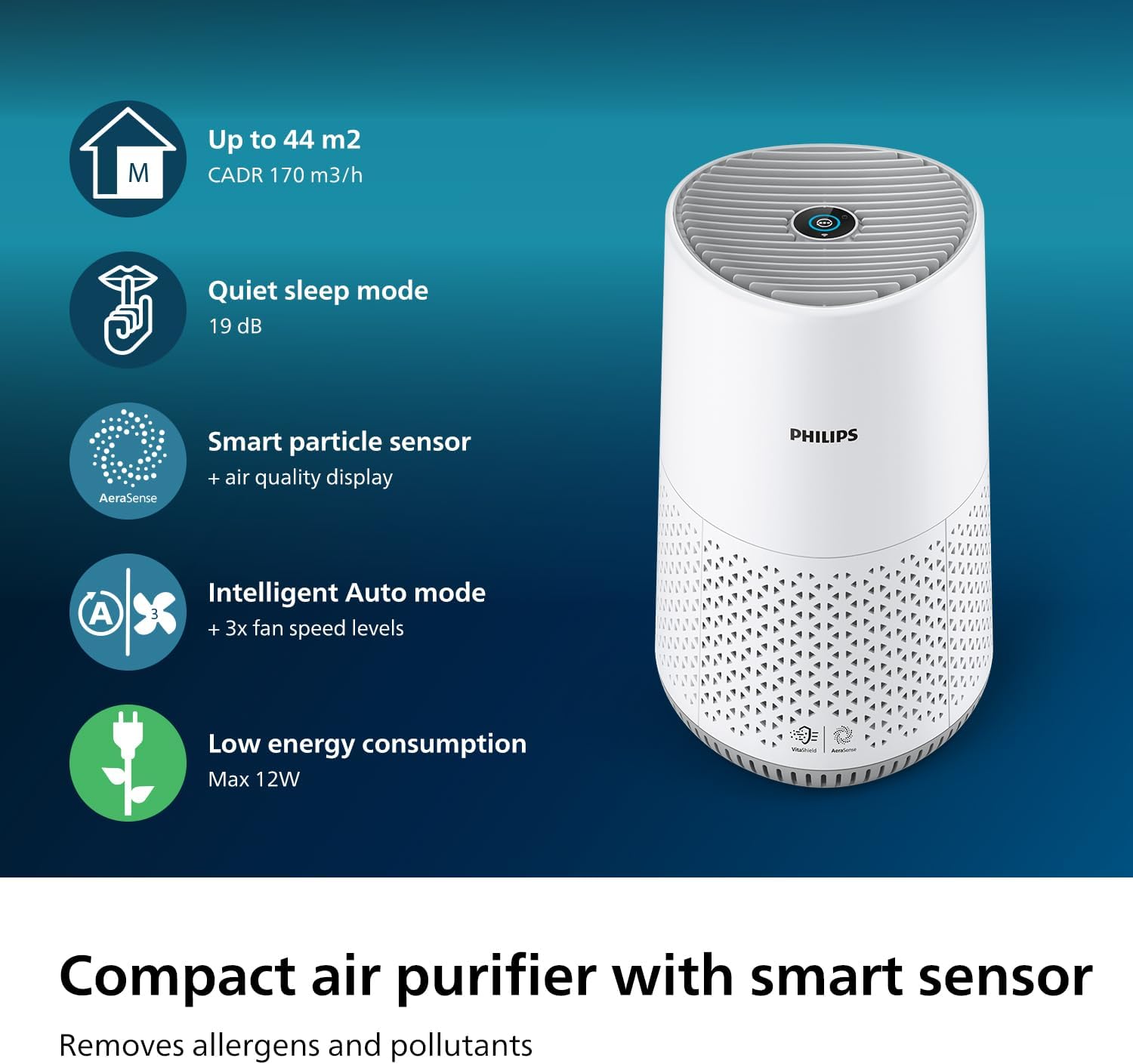
The main selling points on the box are: NanoProtect HEPA filter (99.97% of particles down to 0.003 µm), CADR of 170 m³/h, coverage up to 44 m², only 12W power draw, and a very low 19 dB in sleep mode. It’s also advertised as smart: you can connect it to the Air+ app on iOS or Android and see the real-time air quality, switch modes, and set schedules. There’s also an AeraSense sensor built in, which measures particles and adjusts speed in auto mode.
In practice, it has a few simple modes: auto, sleep, and a manual speed setting. The small digital display on the front shows a numeric PM2.5 reading and a coloured ring (blue to red) depending on the air quality. You can dim or turn off the display light, which is key if you’re sensitive to light at night. The controls on the device are touch buttons, and they’re easy enough to understand after a couple of minutes, even without reading the manual.
Functionally, I’d say it sits in the mid-range for home purifiers: not a basic dumb filter box, but not some huge connected station either. It’s clearly aimed at people who want better air in the bedroom or a small living room, are mildly tech-friendly, and care about energy use. If you expect a full smart home hub with super advanced automation, you’ll be a bit disappointed. If you just want to see a number, a colour, and let it run, it’s more than enough.
Allergies, dust and what actually changed for me
On the allergy side, I bought this mainly for dust and pollen. I’m not someone who ends up in the hospital with allergies, but I’m the type who sneezes a lot, gets itchy eyes, and wakes up congested when pollen is high or the room is dusty. After using the Philips 600 Series daily, I’d say the effect is noticeable but not life-changing. I still know it’s pollen season, but the bedroom has become a much more stable place where my symptoms calm down instead of getting worse.
One concrete example: before, if I vacuumed and changed the bedsheets in the evening, I always ended up sneezing for a good 10–15 minutes from all the dust in the air. Now, I turn the purifier to a higher manual speed about 30 minutes before doing that, leave it running during and after, and the sneezing is clearly reduced. Not zero, but less annoying. That’s the kind of small but real difference you only notice after actually living with the device for a couple of weeks.
For general dust and pet dander, the HEPA filter seems to do its job. The product claims 99.97% particle removal down to 0.003 µm and says the NanoProtect filter cleans up to 2x more air than a standard HEPA H13 filter. I obviously can’t verify the exact percentages at home, but I can see the filter starting to grey slightly after a few weeks, and the app indicates an estimate of filter life. The air feels less heavy when the windows have been closed all day, and there’s definitely less visible fluff floating in the light beam when the sun hits the room.
Where it’s less strong is with strong smells and VOCs (paints, heavy cooking, etc.). It helps, but it’s not a miracle. If someone smokes in the next room or you burn something in the kitchen, you’ll still need to open windows. So as an allergy helper and dust reducer, I’m happy. As a universal smell remover, it’s just okay. If your main problem is tobacco smoke or strong cooking smells, you might want something with a beefier activated carbon filter or a higher CADR.
Pros
- Very quiet sleep mode (around 19 dB) and low 12W power consumption, easy to run 24/7
- Effective at reducing dust and easing mild allergies in small to medium rooms
- Compact size with useful air quality feedback (PM2.5 number and colour ring) and simple app control
Cons
- Plasticky build with no real handle and a slightly “budget” feel for the price
- Filter replacements add ongoing cost and it’s less effective for strong smells or very large rooms
Conclusion
Editor's rating
After living with the Philips Air Purifier 600 Series (AC0651/10) for a few weeks, my overall feeling is positive. It’s compact, quiet in sleep mode, and efficient enough for small to medium rooms. For my bedroom (around 15 m²) and mild dust/pollen allergies, it clearly improved my mornings: less congestion, less dust build-up, and a more stable feeling air quality. The smart sensor and auto mode do what they should, and the low 12W power draw means you can leave it on almost all the time without worrying about the bill.
It’s not perfect. The plastic feels a bit cheap, the app is functional but nothing special, and it’s not the best choice if you’re mainly fighting strong smells or need to clean a huge open space. Filter replacements add to the long-term cost as well. But if your main goal is cleaner air in a bedroom or home office, with minimal noise and fuss, it gets the job done in a very straightforward way.
I’d recommend it to people with dust or pollen issues who want a quiet, low-consumption purifier they can forget about in a corner. If you’re a heavy smoker, have a massive living room, or want super premium materials and advanced smart-home tricks, you should probably look at bigger or higher-end models. For what it is – a small, energy-efficient Philips purifier with a real HEPA filter – it’s a solid, practical choice.