
Summary
Editor's rating
Is it worth the money or just a fancy fan?
Tall, slim, and looks like a Dyson… for better or worse
Noise, daily use, and living with it 24/7
Build quality, filters, and long-term costs
Air cleaning and fan performance: how it actually behaves day to day
What this thing actually does (beyond the marketing talk)
Pros
- Cleans and circulates air well in medium to large rooms with wide oscillation
- Useful app and auto mode that actually respond to cooking, pollution, and daily use
- Quiet at low speeds with a decent night mode and no exposed blades
Cons
- High purchase price plus expensive replacement filters
- Noticeable noise at higher speeds and no real cooling like an AC
- Risk of defective units and support hassles, as seen in some user reviews

Specifications
View full product page →| Brand | Generic |
A pricey fan that’s supposed to clean your air too
I’ve been using the Dyson TP07 Pure Cool in my living room/office combo for a few weeks, and I’ll be blunt: this thing isn’t cheap, and it’s basically a fan that also filters your air. So I went into it asking one simple question: does it actually make the room feel nicer to live in day to day, or is it just a tall, shiny gadget eating electricity in the corner?
The main promise is pretty clear: HEPA H13 filtration, captures 99.95% of tiny particles down to 0.1 micron, pushes out a lot of air (Dyson claims up to 290 litres per second), and you can control it with an app or voice (Alexa). On paper, that sounds great if you’ve got allergies, pets, or live near traffic. In reality, I care more about: does it reduce dust, smells, and that stuffy feeling, and can I actually sleep with it on without getting annoyed?
My setup: medium-sized flat, main room roughly 25 m², open to a small kitchen, one cat, and a fairly busy road outside. I put the TP07 near a corner, not pressed against the wall, and let it run on auto most of the time. I also have a cheap no-brand HEPA purifier in the bedroom, so I had something to compare it to, even if it’s not a lab test.
Overall, it does feel like the air is cleaner and the room is more comfortable, but it’s not magic. There are clear pros: coverage, air distribution, and the app data is actually useful. But there are also real downsides: the price, filter costs, some noise at higher speeds, and the fact that not everyone even gets a working unit judging by that 1-star Amazon review about a dead-on-arrival fan and refund hassle. So yeah, it’s good in some ways, but far from perfect.
Is it worth the money or just a fancy fan?
Let’s talk money, because that’s the sticking point for most people. The Dyson TP07 sits firmly in the high-end bracket for air purifiers and fans. You’re not paying generic-brand prices here; you’re paying a premium for the Dyson name, the design, and the smart features. For the same money, you could easily buy a decent air purifier plus a separate tower fan and still have some cash left over. So the question is: does combining everything into one neat device justify the extra cost?
If you have allergies, pets, or live in a polluted area and you actually care about air quality data, then the value starts to make more sense. The app, the auto mode, the wide oscillation, and the HEPA H13 sealing all add up to a unit that genuinely improves comfort. Compared to my cheap bedroom purifier, the Dyson covers a larger space more evenly and gives me much more information about what’s going on in the air. That part I genuinely liked.
On the flip side, filters are expensive, and you’re locked into the ecosystem. Also, as shown by that 1-star Amazon review, if you get a defective unit and the seller is unresponsive, you’ll be dealing with support headaches on top of the high price. For something this costly, that kind of risk stings more than with a budget brand. And if you don’t care about the app or the voice control, a simpler HEPA purifier with a basic fan will clean the air decently for a lot less.
So in terms of value, I’d call it good but not great. It’s not a rip-off because it does perform well and is pleasant to live with, but you are definitely paying a brand and design premium. If money is tight, I’d say skip it and go for a solid mid-range purifier. If you’ve got the budget, want one clean-looking device instead of two, and you like seeing your air quality stats, then the TP07 makes sense – just go in knowing there’s better raw value for the price out there.
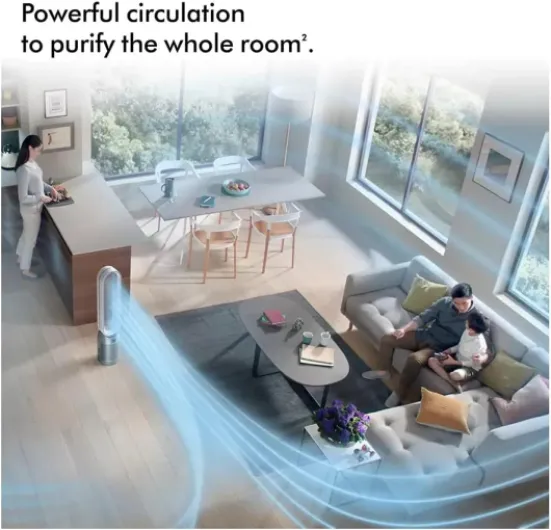
Tall, slim, and looks like a Dyson… for better or worse
Design-wise, it’s classic Dyson tower: tall oval loop on top, motor and filter base at the bottom. Size-wise, it’s about 105 cm high, 20.4 cm wide, and 12 cm deep, so it’s quite slim and tucks nicely next to a TV stand or in a corner. Mine is the white/silver version, which blends in fairly well in a neutral living room. If you like the clean, techy look, you’ll probably be happy. If you hate the whole "Dyson spaceship" aesthetic, this won’t change your mind.
One thing I do like: no visible blades. That makes it feel safer around kids and pets, and also easier to dust off. The airflow comes from the loop, and it’s pretty smooth compared to a cheap bladed fan that chops the air. The base houses the filter, and swapping the filter is literally a matter of popping off the outer shell, removing the old filter ring, and clipping in the new one. No screwdriver, no drama.
The control panel on the front is small but readable, and the remote is magnetised so it sticks on top of the loop. That sounds like a tiny thing, but it means the remote actually has a home, and you’re less likely to lose it between cushions. The remote has all the main controls: speed, oscillation, mode, timer, night mode, info display. After a few days, I barely touched the unit itself and just used the remote and app.
That said, it’s still a big object. If your room is tiny, this will look oversized and a bit silly. And the plastic is decent but not luxury-level – it feels solid enough, but for the price, I kind of expected something a bit more premium in hand. It doesn’t feel cheap, just very "appliance". So yeah, the design is practical and recognisable, but you are definitely paying for the Dyson look and not just the function.
Noise, daily use, and living with it 24/7
Comfort for me mainly comes down to noise, how it feels in the room, and whether it becomes one of those gadgets you end up turning off because it’s annoying. The official noise level is 61 dB, but that’s at higher speeds. In real life, on levels 1–3 it’s very quiet, a soft hum you forget about. On 4–6, you can hear it, but it’s still fine for TV or working. From 7–10, it’s clearly audible and can get a bit too much for a small room if you’re sensitive to noise.
For sleeping, night mode is key. It limits the fan speed and dims the display. In my bedroom test (I moved it for a couple of nights), on night mode it was perfectly okay, similar to a gentle white noise. If you’re someone who needs total silence, you might still notice it, but I had no trouble drifting off. I would not sleep with it blasting at full power though, that’s just too loud. The good news is that in night mode, it still keeps the air decent unless you’re doing something intense like burning candles for hours.
From a usability standpoint, the remote and Dyson Link app make life easier. Changing oscillation angle, speed, and mode from the sofa is straightforward. The app also lets you set schedules, so you can have it ramp up before you get home or quiet down automatically at night. The voice control with Alexa works, but honestly, I used it more as a novelty than a daily thing – the remote is faster.
One comfort downside I noticed is the airflow can feel a bit dry if you blast it at your face for hours in winter, especially in a heated room. It doesn’t humidify, so if your air is already dry, this will just move that dry air around more efficiently. Also, if you’re very sensitive to drafts, you’ll want to use diffused mode or reduce the direct airflow. Overall, living with it is pretty easy, but you do have to play a bit with settings to find your sweet spot between clean air, cooling effect, and noise.
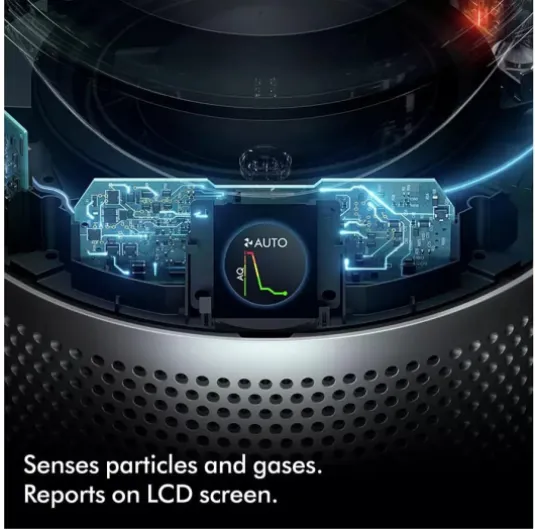
Build quality, filters, and long-term costs
In terms of build quality, the TP07 feels solid enough for a plastic appliance. No weird creaks when you move it, the oscillation is smooth, and the base feels stable. I didn’t feel like it was going to tip over unless someone actually bumps into it hard. That said, it’s still mostly plastic, so I wouldn’t treat it roughly or move it around by grabbing the loop too aggressively all the time. For the price, I’d say the build is good but nothing mind-blowing.
The big durability and cost factor here is the filter. It uses a HEPA plus carbon filter that is supposed to last around 12 months depending on use and air quality. The machine tracks filter life and warns you in the app and on the screen. Replacement filters are not cheap, and that’s something people often forget when budgeting. You’re basically signing up for an annual running cost on top of the initial hit. Compared to cheaper purifiers whose filters cost a fraction, this is a real point to consider.
From what I’ve seen and read, the sealed design is a plus for durability of performance – less chance of leaks and gaps where dirty air could bypass the filter. However, that also means you’re stuck with official or at least compatible filters, and you can’t really hack something generic in there. If Dyson or the seller is unhelpful (like that 1-star review where the buyer got a defective unit and struggled for a refund), that’s a problem because you’re tied to their ecosystem.
After a few weeks, I haven’t had any mechanical issues: no rattling, no weird grinding noises, no random shutdowns. But I have to acknowledge that not everyone gets a perfect unit out of the box, and for a product at this price point, a dead-on-arrival fan is pretty unacceptable. So while the hardware itself feels like it should last several years if treated normally, the overall "durability" experience also depends a lot on seller support and filter availability. On that front, it’s decent but there’s a risk if you get unlucky with quality control or customer service.
Air cleaning and fan performance: how it actually behaves day to day
Performance is where this thing mostly justifies its cost, at least in my case. In auto mode, it constantly monitors the air and ramps the fan up or down depending on what it detects. For example, when I cook something smoky or fry food, the app shows a spike in particles and VOCs within a couple of minutes, and the fan quickly jumps to higher speeds. Within 15–20 minutes, the levels drop back into the "good" range, and the fan slows back down. I’ve repeated this a bunch of times, and the pattern is consistent: smells and haze clear faster with the TP07 running than without it.
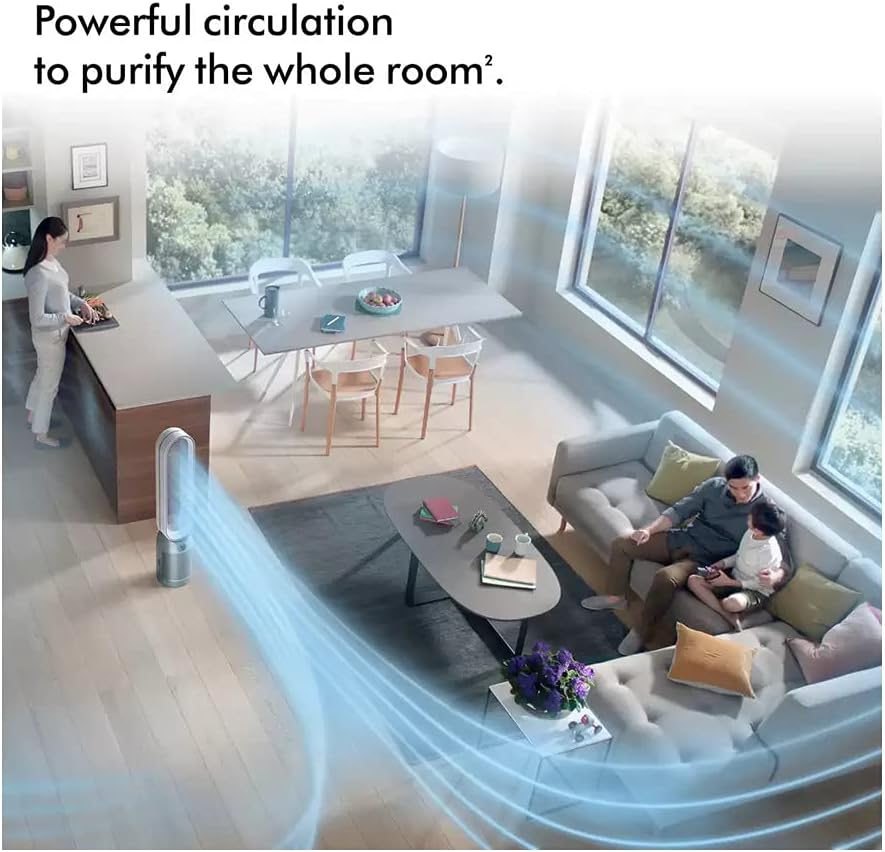
In terms of airflow, when you set it around level 4–6 in a 25 m² room with 180° oscillation, you can feel a gentle breeze almost anywhere in the room. It’s not blasting like a cheap desk fan right in your face, but it’s more of an even circulation. In summer, that’s actually nice because you don’t end up freezing on the sofa while the rest of the room is still stuffy. The 290 litres per second claim is hard to verify by hand, but I can say it moves a lot more air than my small purifiers, and it feels more balanced than a standard tower fan.
On the air quality side, I noticed less dust settling on my TV stand and shelves after about a week of running it daily, especially compared to before when I only had a bedroom purifier. That doesn’t mean zero dust, but the layer that builds up between cleanings is clearly thinner. My partner also has mild pollen allergies, and during a particularly bad day, sitting near the TP07 with it on higher speed did help reduce sneezing and itchy eyes compared to being in another room without it.
It’s not flawless though. At higher speeds (above level 7), it gets quite noticeable noise-wise, and you probably won’t want that while watching a quiet movie or trying to sleep. Also, if you expect it to instantly erase strong cooking smells or cigarette smoke, you’ll be disappointed – it helps a lot, but you still need to ventilate. Overall, performance is pretty solid across both purification and airflow, but not mind-blowing for the price bracket.
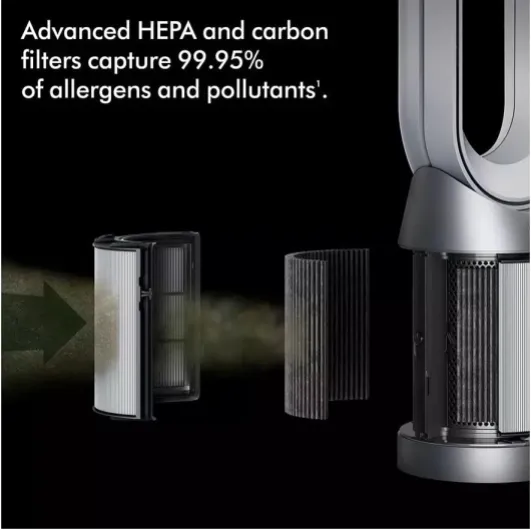
What this thing actually does (beyond the marketing talk)
On the functional side, the Dyson TP07 is basically a combo of three things: air purifier, fan, and air quality monitor. It uses a HEPA plus carbon filter, fully sealed to HEPA H13 standard according to Dyson, which means in theory what goes inside the casing shouldn’t leak back out. It’s rated to remove 99.95% of particles down to 0.1 micron, plus gases and smells thanks to the carbon part. That includes dust, pollen, pet dander, some bacteria, and some fumes from cooking or traffic.
It has 10 speed settings, oscillation up to 350°, and different modes: normal fan mode to cool you, diffused mode to purify without blasting air at your face, night mode that keeps it quieter and dims the screen, and a sleep timer. Power draw is listed at 40 watts, which is modest for something that can circulate air across a decent-sized room (Dyson says up to 81 m³). It’s corded, so no battery, and uses the Dyson Link app plus voice control (Alexa) if you’re into smart home stuff.
What I actually used the most in practice was: auto mode, 180° oscillation, and the app to check PM2.5 (fine particles) and VOCs (gases) after cooking or when opening the windows. The fan part is more of a bonus in winter, but in summer it’s handy because it replaces a separate tower fan. Compared to a basic HEPA purifier, this one does feel more like a full room device rather than something that just cleans a bubble of air right around it.
However, it’s important to keep expectations realistic. It does not cool the air like an AC; it just moves air around, so you feel cooler through airflow. Also, the specs about 99.95% filtration sound fancy, but that’s under lab conditions. In real life, if you smoke inside or cook greasy stuff all the time without a hood, this will help, but it won’t erase every smell or particle instantly. It’s a solid all-round purifier/fan, but not some magic dome of cleanliness.
Pros
- Cleans and circulates air well in medium to large rooms with wide oscillation
- Useful app and auto mode that actually respond to cooking, pollution, and daily use
- Quiet at low speeds with a decent night mode and no exposed blades
Cons
- High purchase price plus expensive replacement filters
- Noticeable noise at higher speeds and no real cooling like an AC
- Risk of defective units and support hassles, as seen in some user reviews
Conclusion
Editor's rating
After using the Dyson TP07 Pure Cool for a while, my overall feeling is pretty clear: it’s a solid all-in-one purifier and fan that genuinely improves comfort in a medium to large room, but it’s not some miracle machine and it’s definitely not cheap. The air feels fresher, dust build-up is reduced, and the fan function is actually useful, especially in summer. The app and auto mode are not just gimmicks – they help you see what’s going on in your air and let the device handle most of the work.
However, you have to accept a few trade-offs. The price is high, filters add ongoing costs, and noise at higher speeds can be annoying. Also, not everyone gets a smooth experience, as that 1-star review about a dead unit and refund issues shows. For this price, quality control and support should be rock solid, and clearly that’s not always the case. So it’s not a risk-free purchase.
Who is it for? People with allergies, pets, or city pollution who want one good-looking device that purifies, cools, and gives clear data about air quality will probably be happy with it, as long as they’re okay with the cost. Who should skip it? Anyone on a tight budget, people who don’t care about smart features, or those who just want basic air cleaning without paying a premium. In short: pretty solid performance and comfort, but the value depends heavily on how much you care about design and smart features versus raw cleaning per pound spent.