Summary
Editor's rating
Value for money: good features, but you really pay for the logo
Design: nice to look at, but not always practical
Comfort and daily use: quiet enough, but needs babysitting
Durability and reliability: solid build, but pump worries
Performance: good airflow, decent purification, mixed humidifying
What this thing actually does (beyond the buzzwords)
Pros
- Quiet and effective airflow with 90° oscillation, comfortable for day and night use
- Real HEPA + carbon filtration with live air quality data and app control
- 3‑in‑1 design (fan, purifier, humidifier) saves space and looks cleaner than multiple devices
Cons
- High purchase price plus expensive filter and potential pump replacement costs
- Humidifier function is fussy, needs regular cleaning and may be prone to pump issues
- Value for money is questionable compared to buying separate mid-range devices

Specifications
View full product page →| Brand | Dyson |
A pricey gadget that’s supposed to do it all
I’ve been using the Dyson Pure Humidify+Cool (the tall white/silver one) for a while now in my living room and bedroom, and I’ll be straight: this thing is not cheap and it takes up a real spot in the house, so you expect it to actually improve the air, not just look high-tech. I mainly bought it because my flat gets dry in winter with heating on, and in summer it’s stuffy and dusty next to a busy street. So the idea of a fan, air purifier and humidifier in one sounded practical, at least on paper.
Day to day, the main thing I noticed is that it really does move a lot of air for its size and shape. On low to medium settings, it’s pretty quiet and you kind of forget it’s running, which is good for sleeping or working. When you ramp it up, you feel the airflow across a medium room without it blasting your face like a cheap desk fan. So on the ventilation side, it’s pretty solid, no issue there. The oscillation at 90° is enough to cover my 20–25 m² room without constantly having to rotate it.
On the purification and humidifying side, it’s a bit more nuanced. I do feel the air gets less dusty and less dry after a few hours of use, especially when heating is on. My nose and throat are less irritated in the morning, and the typical radiator dryness is reduced. But it’s not some kind of magic box: if you live next to heavy traffic or have pets, you’ll still need to vacuum and air out the room. The HEPA + carbon filter does help with smell and fine dust, but you shouldn’t expect miracles just because it has an LCD and an app.
Overall first impression: it’s a clever device that actually works, but it’s not perfect and you can feel where Dyson cut corners or made things more complicated than they needed to be. Especially when you start looking at the maintenance, the pump issues mentioned online, and the fact that for this price, you’re basically betting it won’t break right after the warranty. If you’re expecting a flawless premium experience, you might be a bit disappointed. If you just want a solid, quiet fan with extra features and you accept the price, it can make sense.
Value for money: good features, but you really pay for the logo
Let’s talk money, because that’s where this product hurts a bit. The Dyson Pure Humidify+Cool is clearly positioned as a high-end device, and you feel it on the price tag. For the amount you pay, you could easily buy a separate decent air purifier, a basic but effective humidifier, and a good fan, and still have money left. So the main argument for this Dyson is having everything in one clean-looking unit that doesn’t clutter the room with multiple machines and cables.
If you actually use all three functions regularly — fan, purifier, and humidifier — the value starts to make more sense. You get quiet airflow, real-time air quality data, app control, and a proper HEPA filter in a single tower. Compared to cheap all-in-one gadgets, it’s definitely more serious and better built. But compared to separate mid-range devices, you’re mostly paying extra for design, integration and the Dyson name. The performance is solid, but not mind-blowing enough to justify the price on performance alone.
Where the value drops is with maintenance costs and potential repairs. Filters are expensive, and the pump story from the Amazon review (almost £100 to replace, right after warranty) is not reassuring. If you’re unlucky and something breaks outside the warranty, your overall cost of ownership skyrockets. Also, the Amazon rating is around 3.5/5, which shows that not everyone is fully happy, especially at this price level. For a premium product, you’d expect more consistently positive feedback.
So in terms of value, I’d call it: good but not great. If you’re already a fan of Dyson products, like the design, and you know you’ll actually use all the features, you might accept the price. If you’re simply looking for the most efficient way to improve your home’s air and humidity, you can probably build a better setup for less money with separate devices, at the cost of having more stuff in the room. It really depends on how much you care about aesthetics and having one integrated machine versus pure cost-effectiveness.
Design: nice to look at, but not always practical
Design-wise, it’s very obviously a Dyson product: tall, white/silver, no visible blades, and a kind of sci‑fi look. In a living room or bedroom, it blends in pretty well, especially if you like minimalist furniture. The footprint is about 22 x 15 cm, so it doesn’t eat much floor space, but it is quite tall at 92 cm. You definitely see it in the room; it’s not something you hide behind a sofa. For me that’s fine because at least it doesn’t look like an ugly plastic box like many humidifiers.
The LCD display is clear and bright enough to read at a glance. You get small colored rings that show air quality and humidity, plus numbers for temperature and other metrics. At night I usually turn on Night mode because the screen is still a bit bright if you’re sensitive to light. The remote is magnetic and clips onto the top of the loop, which is actually handy. That said, it’s also easy to knock off if you brush past it, and I’ve had to pick it up from the floor several times.
One thing that’s less fun is the water tank access and handling. To fill it and clean it properly, you have to remove the top part and access the base. It’s not insanely complicated, but it’s not as straightforward as a basic humidifier where you just lift a tank and fill it in the sink. Dyson clearly tried to hide the functional parts to keep the sleek look, but that also makes routine maintenance a bit more annoying. If you’re lazy with cleaning, this design doesn’t help, and you risk limescale or pump issues over time.
In terms of stability, the base is quite heavy, so it doesn’t tip over easily, even when oscillating. The plastic quality feels solid enough; it doesn’t creak when you move it around. But it’s still a lot of plastic for the price. You don’t get a metal body or anything premium like that. So, visually, it’s clean and modern, but in hand it still feels like a well-finished plastic appliance. Overall, I like the look, but some design choices clearly favor appearance over easy daily use.
Comfort and daily use: quiet enough, but needs babysitting
In terms of comfort, the main thing I noticed is that it’s genuinely quiet on low to medium speeds. In Night mode at levels 1–3, I can sleep with it running about two meters from the bed without being bothered. There’s a soft airflow noise, but no rattling or high-pitched whine like with some cheap fans. If you’re a very light sleeper, you might still notice it, but for most people it should be acceptable. The fact that it can still purify and lightly humidify at these low levels is a plus, especially in winter nights.
The oscillation at 90° gives a nice even breeze without cold spots. You don’t get that “direct blast in the face” feeling unless you sit right in front of it at high speed. I also liked the fact that the airflow is more diffuse, so you don’t end up with dry eyes like with a small desk fan pointed straight at you. In summer evenings, I often left it in Auto mode and barely touched the settings; it just adjusted itself based on temperature and air quality, which is pretty convenient.
Where comfort drops a bit is in the maintenance and water handling. To really enjoy the humidifying part, you need to be disciplined: regularly refill the tank, clean it, and follow Dyson’s descaling routine. Skip it for a while and you start to worry about limescale and the pump, especially after reading reviews about pump failures. It’s not rocket science, but it’s definitely not a plug-and-forget device. If you just want to run it as a fan and purifier, it’s much easier and more relaxing.
The app is a nice bonus for comfort: setting schedules, checking the air quality while you’re on the sofa, or turning it off from bed is handy. But to be honest, after a few weeks, I mostly stuck to the remote and the basic modes. The comfort is there, but you pay for it with a bit of mental load: filters to replace, cleaning cycles, water to manage. If you’re okay with that and like gadgets, you’ll be fine. If you want something fully carefree, this might feel a bit too demanding for daily life.
Durability and reliability: solid build, but pump worries
Physically, the device feels reasonably sturdy. The base has weight to it, the plastics don’t feel flimsy, and after moving it around from living room to bedroom several times, nothing creaks or feels loose. The oscillation mechanism hasn’t shown any weird noises or play so far. So for the external structure, I don’t have much to complain about. It’s not luxury-level materials, but for a home appliance, it’s fine.
The part that worries me more is the internal humidifying system and pump. One of the Amazon reviews clearly mentions a pump failure that happened basically right after the warranty ended, with a replacement cost of around £100 and not much help from Dyson support. That lines up with what usually happens with complex humidifiers: if you don’t clean them properly, or if your water is very hard, the pump and internal channels can clog or wear out faster. Dyson does offer cleaning cycles, but that adds one more thing you need to remember to run regularly.
Filters are another durability point. The HEPA + carbon filter will eventually need replacing, and those are not cheap either. If you use the purifier heavily in a polluted area, expect to budget for filters maybe once a year or so. If you ignore the filter change warnings, you’re basically running an expensive fan with a dirty filter, which defeats the point of the device. So the long-term cost is not just the initial price, but also filters and potentially pump-related parts if something goes wrong.
Overall, I’d say the build quality feels good, but the reliability of the humidifying system is the weak link. If you plan to mostly use it as a fan + purifier and only occasionally as a humidifier, you’ll probably be fine for years. If you want to run the humidifier heavily all winter and you’re not very disciplined with maintenance, you’re gambling a bit. For the price, I would have liked something that inspires more confidence on that front, especially given the user review about the pump failing right after the warranty.
Performance: good airflow, decent purification, mixed humidifying
On the pure fan side, performance is honestly the strongest point. The airflow of up to 350 l/s feels powerful enough for a normal flat or small house. On levels 1–5 (out of 10), it’s already enough to refresh a 20 m² room without much noise. Past level 7, you start hearing it clearly, but it’s still less annoying than a cheap fan with blades. In summer, I used it constantly at around level 4 with oscillation on, and it made the room a lot more bearable on warm evenings. So if you mainly want a quieter, more even airflow, it does the job well.
For purification, it uses a HEPA filter plus activated carbon, and you can see the sensors react when you cook or open a window on a polluted street. The air quality graph on the app spikes and then slowly goes back to normal while the fan speeds up. Subjectively, I noticed less dust settling on surfaces and fewer lingering cooking smells when it was running in Auto mode. It’s not night and day, but there is a visible difference over a few days, especially in a small flat. The filter is not cheap to replace, though, so that’s something to keep in mind for long-term use.
The humidifying function is where things get more complicated. When it works properly, the humidity level climbs steadily from, say, 35% to around 45–50% over a few hours in a closed room. You feel it mainly in your throat and sinuses: less dryness, fewer nosebleeds, less static electricity. But you have to keep the water tank clean and follow the descaling process, otherwise you risk the pump starting to act up. One Amazon user mentioned the pump failing after the warranty and needing a £100 replacement, which doesn’t surprise me given how sensitive these systems can be to limescale and lack of maintenance.
In Auto humidify mode, the device tries to keep a target level, but it’s not super precise. Sometimes it overshoots a bit, sometimes it’s slow to react. It’s fine for general comfort, but if you want strict 50% humidity all the time, you might be a bit frustrated. Also, when humidifying at higher levels, you hear more internal noises (water moving, pump sounds), which kind of kills the quiet vibe. So overall: as a fan, very good; as a purifier, decent to good; as a humidifier, useful but a bit fussy and not the most reliable part of the machine.
What this thing actually does (beyond the buzzwords)
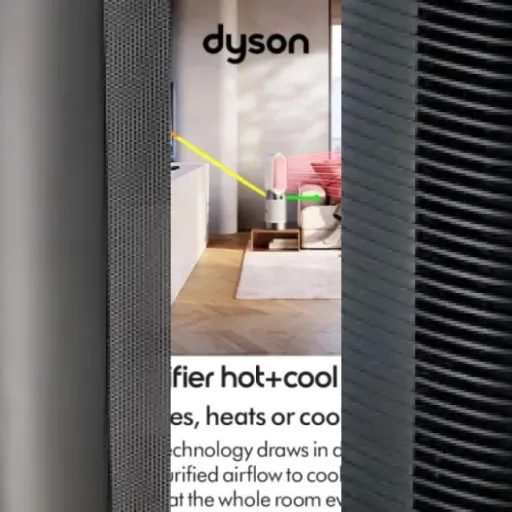
On paper, the Dyson Pure Humidify+Cool is a 3‑in‑1 device: it ventilates, purifies and humidifies. It’s a tall tower (about 92 cm high) with the typical Dyson bladeless loop on top and a chunky base that hides the water tank, pump system and filters. It plugs into the wall (no battery, just a standard corded device) and pulls up to 230 V. The airflow is given at 350 l/s, which in real life means it can easily handle a medium room, and it doesn’t struggle to circulate air if the doors are open.
You get an LCD screen on the front that shows real-time air quality, humidity level, temperature, filter status and a few icons that you get used to after a couple of days. It also connects to the Dyson Link app via Wi‑Fi/Bluetooth, so you can see graphs of air quality and control it from your phone. Honestly, the app is nice at first, but after a week I mostly just used the remote and the basic auto modes. The app is useful if you want to schedule it or check if you left it on when you’re not at home.
The main modes I used were: Auto mode (it adjusts fan speed and humidification based on sensors), Night mode (dimmer display and lower noise), and pure Fan mode without humidification when I just wanted some air movement. The purification is always working when the device is on, thanks to the HEPA and activated carbon filter. The device claims EN1822 certification for the filter, which is a proper standard for fine particle filtration, but obviously you can’t see particles being trapped, you just rely on the sensor readings and how the room feels.
In practice, the product is pitched as a kind of all-year machine: in winter you use it to add humidity and clean the air from dust and heating-related dryness, and in summer you use it mainly as a fan and purifier. That’s actually how I ended up using it. It’s not a heater, so don’t expect it to warm up your room. It’s more of a support device to make the air more comfortable rather than something that changes your whole environment. Once you accept that, the functions start to make sense, but you also realize you’re paying a lot for convenience and design, not just raw performance.
Pros
- Quiet and effective airflow with 90° oscillation, comfortable for day and night use
- Real HEPA + carbon filtration with live air quality data and app control
- 3‑in‑1 design (fan, purifier, humidifier) saves space and looks cleaner than multiple devices
Cons
- High purchase price plus expensive filter and potential pump replacement costs
- Humidifier function is fussy, needs regular cleaning and may be prone to pump issues
- Value for money is questionable compared to buying separate mid-range devices
Conclusion
Editor's rating
Overall, the Dyson Pure Humidify+Cool is a solid 3‑in‑1 device that does what it says: it moves air well, it filters it reasonably, and it can add humidity when you need it. As a fan, it’s genuinely good: quiet on low, strong enough on high, with smooth oscillation and a more comfortable airflow than cheap bladed fans. As a purifier, it’s decent: HEPA + carbon, real-time readings, and a noticeable reduction in dust and smells over time. As a humidifier, it helps with dryness, but it’s the most sensitive and fussy part of the machine.
Where it loses points is on value and long-term confidence. The price is high, filters are not cheap, and the pump/humidifier reliability is a question mark, especially after seeing user feedback about failures just after warranty. Maintenance is also more involved than many people expect: you have to keep up with cleaning and descaling if you want to avoid problems. If you’re the type who forgets this stuff, you might end up with an expensive fan with a half-working humidifier.
I’d recommend this to people who want a single, clean-looking device in their living space, who are okay with regular maintenance, and who actually care about air quality data and app control. If you just want better air on a budget, or you don’t care about design, I’d honestly look at a separate purifier + humidifier + fan combo for less money. So, good product overall, but not the best bang for your buck, especially if reliability and running costs worry you.