
Summary
Editor's rating
Is the Airmega 150 worth the money?
Looks good, but not the easiest thing to move around
Noise levels, sleep use, and daily annoyance factor
Build quality, filters, and long-term use
How well it actually cleans the air (and how fast)
What you actually get and how it’s supposed to work
Real-world impact on allergies, dust, and smells
Pros
- Very quiet on low/auto, suitable for sleeping and working
- Effective at reducing dust, light allergies, and everyday odors in small rooms
- Compact, neutral design with easy cartridge-style filter changes and washable pre-filter
Cons
- Best only for small rooms; underpowered for large spaces despite marketing claims
- No carrying handle and slightly vague manual, especially around Auto mode and filter orientation
- Deodorization filter schedule vs included filters pushes you toward buying full replacement sets more often

Specifications
View full product page →| Brand | Coway |
A small purifier I actually keep running all day
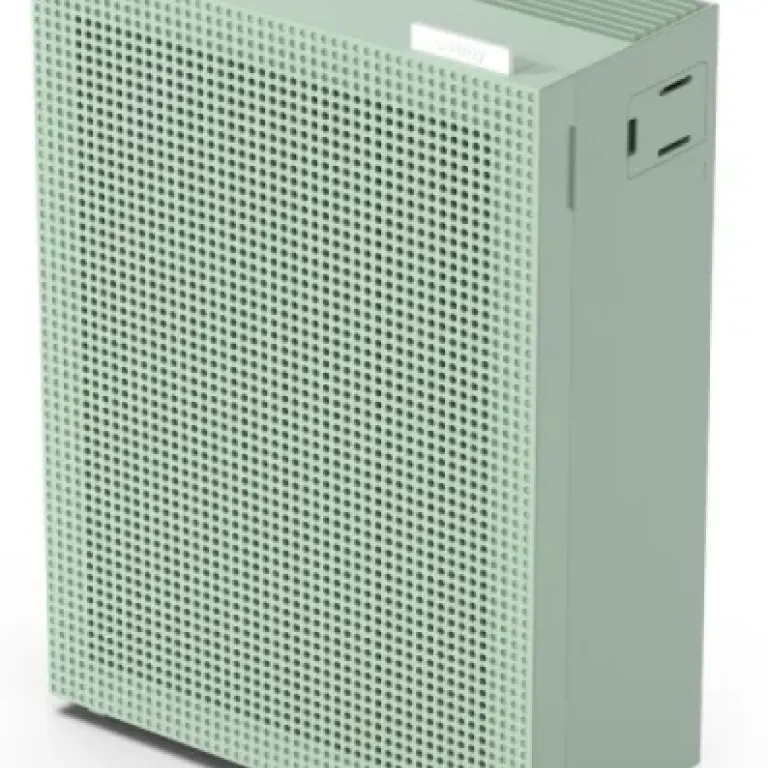
I’ve been using the Coway Airmega 150 in sage green in a small bedroom/office setup, roughly 11x11 ft, plus I dragged it into the living room and kitchen a few times to see how it handled cooking smells and pet hair. I bought it because I was tired of random no-name purifiers that either sounded like a vacuum or had filters that were impossible to find after six months. Coway kept coming up in reviews, so I decided to see if this smaller model was worth the money.
Out of the box, it felt like a pretty straightforward device: plug in, tap a couple of buttons, and it just runs. No app, no Wi‑Fi, no weird subscription. In practice, I mostly left it on Auto mode and only touched it when I wanted to clean the pre‑filter or move it to another room. The first thing I noticed was the noise level. On low/auto it’s basically background noise, quieter than my laptop fan. On high, yes, you hear it, but it’s still more like a normal fan than a hair dryer.
My main goal was to cut down dust, pet dander, and cooking smells. I have mild allergies and a shedding pet, and in a small space that gets annoying fast. After a few days with the Airmega 150 running continuously, I noticed less random sneezing and less of that stale “apartment” smell, especially in the bedroom where the air tends to get stuffy at night. It’s not magic, but it clearly does something, especially once you see how much ends up on the washable pre‑filter.
It’s not perfect, though. The coverage claims on the Amazon title (over 1,000 ft²) are frankly optimistic compared to Coway’s own numbers. This thing is good for small rooms, and that’s where it shines. If you’re expecting it to handle a big open living room or a studio with high ceilings, you’re probably going to be underwhelmed. But for a bedroom or office and for people who want something quiet and simple, it’s a pretty solid option.
Is the Airmega 150 worth the money?
On the value side, the Airmega 150 sits in that middle zone: not cheap like random brands you’ve never heard of, but not as pricey as some premium smart purifiers. You’re basically paying for a known brand, decent filters, and a design that doesn’t look ugly in your bedroom. For a small room, I think the price is fair, especially when you factor in the low noise and the Energy Star rating, which keeps power usage reasonable if you run it 24/7.
Where you do have to think a bit is filter costs. Replacement filter sets aren’t dirt cheap, and because the deodorization filter is supposed to be changed every 6 months and the HEPA yearly, you’re kind of nudged into buying the full set once a year anyway. Compared to competitors like some Levoit or Winix models, the ongoing cost is similar or slightly lower depending on deals. It’s not the cheapest to own, but it’s also not a money pit.
If you compare this to the bigger Coway models (like the 200M or 300), the 150 is good value only if your room is small and you don’t need smart features. For a big living room, I’d skip this and go straight to a larger unit instead of trying to make this work beyond its comfort zone. You’ll just end up running it on high more often and being annoyed by the noise and slower cleaning.
For someone with a small bedroom, office, or nursery who wants something quiet, simple, and decent‑looking, the value is solid. You’re paying a bit extra over mystery brands, but you get proper certifications (CARB, Energy Star, etc.), a 3‑year warranty, and filters you can actually find. If you’re on a tight budget and don’t care about brand or looks, you can get cheaper units, but you’ll probably sacrifice noise levels or long‑term reliability.
Looks good, but not the easiest thing to move around
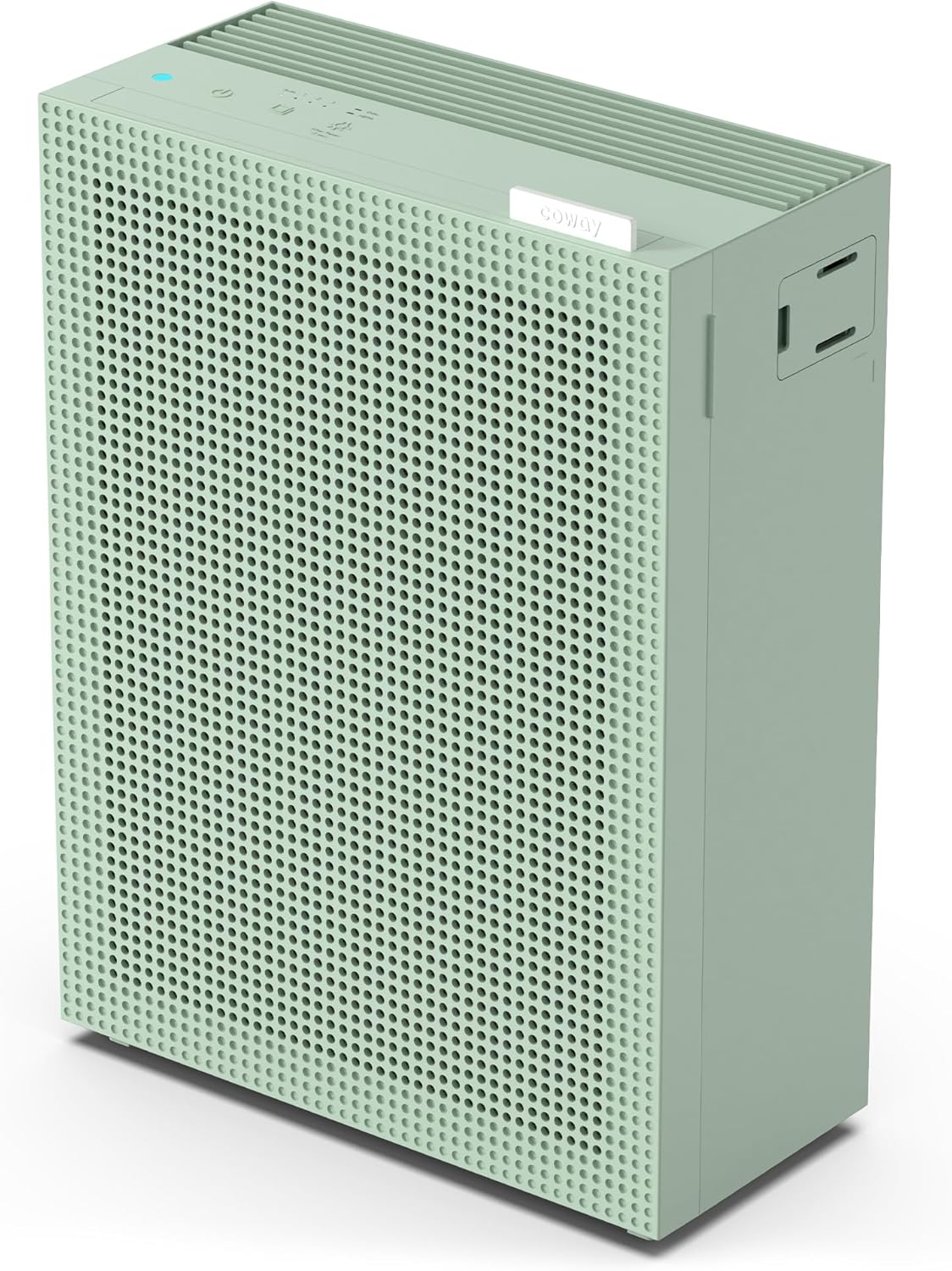
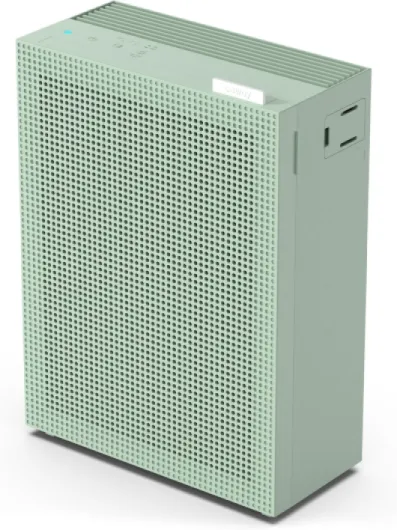
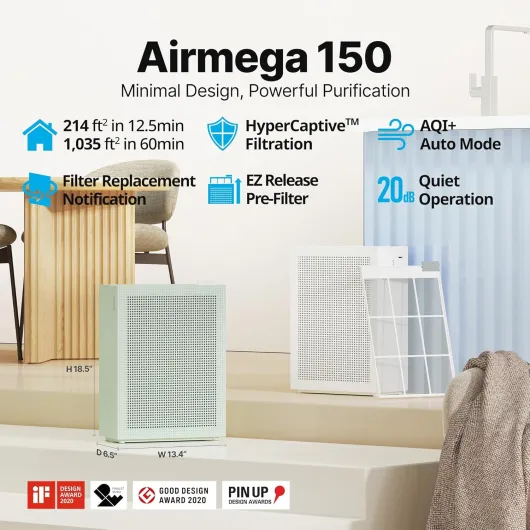
The main thing I liked about the Airmega 150 design is that it doesn’t look like medical equipment. The sage green color is muted and neutral, so it blends into a bedroom or office without screaming “air purifier.” It’s also pretty slim: about 7 inches deep, 14 inches wide, and 18 inches tall. That makes it easy to tuck next to a nightstand or against a wall without it taking over the room. If you care what your stuff looks like, this is nicer than the generic white plastic towers you see everywhere.
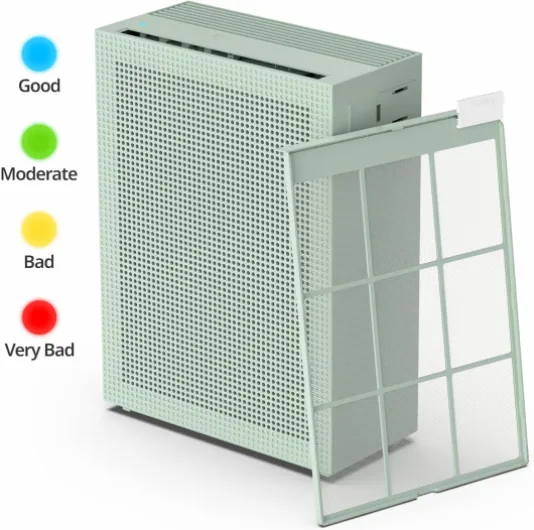
The front panel pops off easily for cleaning, and the filter cartridge design is actually smart. Instead of juggling a loose HEPA filter and a separate carbon filter, they come as one cartridge you slide in and out. That means less dust flying around when you change filters. The pre‑filter is right behind the front grill and pulls out quickly for a rinse or a wipe. After a week in a room with a shedding pet, that mesh gets visibly gross, which is satisfying in a weird way because you can see it’s catching stuff.
On the downside, there’s no handle. For something that weighs around 12 pounds and is meant to be moved between rooms sometimes, that’s a miss. You end up hugging it awkwardly or grabbing the sides. It’s not heavy, but it’s just annoying enough that you think about where to place it so you don’t have to move it often. My older Coway model has a simple built‑in handle, so they clearly know how to do it; they just skipped it here.
Another small gripe: the manual is a bit vague on a few details, especially around the Auto mode behavior and filter orientation. There’s a note on the HEPA filter that says “FRONT” but that actually points inward, which is confusing if you don’t look closely. Once it’s set up, you don’t think about it much, but the first setup could be better explained. Overall, the design is clean, compact, and room‑friendly, but Coway could have made it more practical to move and a bit clearer to install.
Noise levels, sleep use, and daily annoyance factor
For comfort, the big point is noise. Coway lists the noise range from about 19 dB to 48 dB, and in real life that matches pretty well. On low or when Auto settles down, it’s a soft airflow sound, quieter than most laptop fans and way quieter than a box fan. I can easily work next to it without noticing it after a few minutes. On medium, you hear it, but it’s still just a normal fan noise, not harsh or whiny.
On high, it’s obviously louder. If the air quality light goes red while cooking or vacuuming, the fan ramps up and you definitely hear it across the room. It’s not unbearable, but I wouldn’t want it running at max speed all night in a bedroom unless you like loud white noise. The good thing is it usually doesn’t stay on high for long—once the sensor thinks the air is cleaner, it drops back to a quieter level.
For sleep, the combo of low noise and the ability to turn off the front light is important. You can disable the air quality light so you don’t have a glowing LED in your face all night, which a lot of cheaper purifiers forget to let you do. On low or Auto in a reasonably clean room, it’s totally fine for sleeping. It becomes just a faint background hum, and if anything, it works like light white noise. If you’re super sensitive to any noise at all, you might still notice it, but for most people it’s perfectly acceptable.
In daily use, the “annoyance factor” is low. Touch controls respond well, no weird beeps every time you press something, and no random fan surges unless you actually pollute the air (cooking, spraying cleaners, etc.). The only comfort downside is having to awkwardly grab it when you move it because there’s no handle. Not a dealbreaker, but you notice it. Overall, it’s a comfortable device to live with: quiet most of the time, simple to control, and not visually distracting.
Build quality, filters, and long-term use
In terms of build quality, the Airmega 150 feels decent and not flimsy. The plastic doesn’t creak much when you move it, the front panel snaps on and off securely, and the buttons on top don’t feel like they’re going to sink into the body after a month. It’s not premium, but it doesn’t feel like a cheap gadget either. The weight (around 12 pounds) gives it a bit of stability so it doesn’t slide around every time you bump into it.
The filter system is where long‑term use matters. Coway includes the HEPA and deodorization filters in the box, and they recommend changing the HEPA annually and the deodorization filter every 6 months. One issue: you only get one deodorization filter in the box, so if you want to stick to the 6‑month schedule, you either run the carbon filter longer than recommended or you replace the whole set early. Replacement packs come as a set, not individually. It’s not the end of the world, but it’s a bit stingy and adds to the running cost if you want to follow the rules.
On the positive side, the washable pre‑filter helps extend the life of the other filters. If you keep that clean (weekly or bi‑weekly if you have pets), the HEPA won’t clog as fast. I’ve seen people run other Coway models for years with regular filter changes, and this one feels like it’s cut from the same cloth. The fan motor on mine was quiet from day one, but some users said theirs was slightly noisy at first and then settled down after a few weeks. That sounds like normal break‑in rather than a defect, but it does show there’s a bit of variation batch to batch.
You also get a 3‑year limited warranty, which is better than a lot of budget brands that give you one year or nothing clear at all. Filters are easy to find online and not insanely priced compared to other big brands. Overall, I’d say durability and long‑term ownership are pretty solid, with the only real annoyance being the carbon filter schedule vs what’s included by default.
How well it actually cleans the air (and how fast)
In terms of performance, I’d call the Airmega 150 solid for small spaces, but not magical. In my 10x10 office with a pet bed in the corner, I noticed a real drop in dust on surfaces after about a week of leaving it on Auto 24/7. I wasn’t wiping my desk as often, and my random mid‑day sneezing pretty much stopped unless I was really stirring up dust. The air quality light mostly stays blue, which matches how the room feels—less stuffy, fewer smells hanging around.
Where it really shows its work is with smoke and cooking smells. I dragged it into the kitchen while pan‑frying food and doing some light stir‑fry with oil. Within a couple of minutes, the air quality light went yellow, then red, and the fan jumped to high. It’s definitely louder in that mode, but it also clears the haze and smells faster than just opening a window. I’d say within 15–30 minutes, the room felt much fresher, and the smell was noticeably reduced. It doesn’t completely erase heavy cooking odors, but it cuts them down a lot.
For pet owners, it does a good job with dander and general pet funk, as long as you keep the pre‑filter clean. After a week near a dog bed, the pre‑filter was full of hair and fine dust. A quick rinse or wipe once a week keeps the airflow decent. The HEPA filter will obviously take the finer stuff you can’t see. If you’re expecting it to handle a huge living room with multiple pets, this model is underpowered; you’d want one of the bigger Coway units. But for a bedroom with a dog or cat, it’s perfectly reasonable.
One thing to keep in mind: the coverage numbers are honest only if you treat this as a small‑room purifier. In an open‑plan area or anything over, say, 250–300 sq. ft., it will still help, but much more slowly, and it will probably run on higher speeds more often. If your main space is big, this is better used as a dedicated bedroom/office purifier rather than your only unit.
What you actually get and how it’s supposed to work
The Airmega 150 is a compact, plug‑and‑play air purifier with a three‑stage filtration system: a washable pre‑filter, a deodorization (charcoal) filter, and a True HEPA filter. Coway claims it catches particles down to 0.01 microns and reduces VOCs and odors. On paper, it’s designed to clean up to 214 sq. ft. in about 12.5 minutes, or 518 sq. ft. in 30 minutes. The Amazon listing screaming “up to 1,035 ft²” is marketing math based on multiple air changes per hour; in real life, think small to medium bedroom, not whole‑apartment coverage.
The controls are dead simple: touch buttons for power, fan speed (low/medium/high), Auto mode, and light on/off. There’s also an air quality light on the front that changes color depending on what the sensor thinks of your air: blue for good, green/yellow for moderate, red for bad. From daily use, the sensor is pretty sensitive. It ramps up when I cook, when I spray cleaning products, or when my pet flops down near it and kicks up fur. It usually calms back down within 10–20 minutes once the air clears.
The filter system is set up like a cartridge inside the front panel. You pop off the cover, pull out the cartridge, and the HEPA and deodorization filters are together, so you don’t end up dusting the whole room when you swap them. The pre‑filter is a separate mesh you can wash or wipe. There are filter indicators that light up when it’s time to clean the pre‑filter or replace the main filters, which is way better than guessing or setting a calendar reminder.
In day‑to‑day use, you basically have two modes: either you treat it like a “set it and forget it” appliance on Auto, or you leave it on low speed 24/7. Both approaches work. Auto will spike the noise when it detects pollution, but it clears the air faster. Constant low keeps things steadier and quieter but reacts less aggressively. There’s no app, no smart scheduling, nothing fancy. If you like simple and reliable, that’s a plus. If you’re into smart home automation, you’ll need a smart plug workaround.
Real-world impact on allergies, dust, and smells
Effectiveness is what matters at the end of the day, and for me the Airmega 150 did exactly what I wanted in a bedroom/office: less sneezing, less dust, and fewer lingering smells. I have mild seasonal allergies and a pet that sheds like crazy. Before this, I’d wake up with a slightly stuffy nose pretty often, especially during pollen season. After running this on Auto in the bedroom for a couple of weeks, that morning stuffiness dropped a lot. Not zero, but noticeably better. Compared to a cheap no‑name purifier I used before, this one feels more consistent and reacts faster to whatever is in the air.
Dust control is where you really see it working. I used to wipe my desk and shelves every few days because there was always a thin layer of dust. With this running constantly, I still have to clean, but I can stretch it to once a week and the dust layer is clearly thinner. The pre‑filter and the front grill collect a lot of the visible stuff, and the HEPA filter is obviously catching the finer particles. When you pull the pre‑filter out and see how gross it gets, it’s a decent reality check that the thing is doing its job.
For odors, I’d say it’s good but not magic. Pet smell in a closed room is definitely reduced. It doesn’t feel as “stale” when you walk in after a day with the door closed. Cooking smells and light smoke get knocked down pretty well if you run it on Auto or even medium while you cook. Strong smells (heavy frying, burnt food, strong spices) still linger, but they fade faster than without it. The deodorization filter helps, but you still have to ventilate the room for really strong odors.
Overall, if your expectations are realistic—cleaner air in one room, less dust, better sleep, fewer random sneezes—it’s effective. If you expect it to clean an entire big apartment or totally erase strong smells on its own, you’ll probably think it’s just okay. I’d put it in the “quietly does its job” category rather than anything impressive or disappointing.
Pros
- Very quiet on low/auto, suitable for sleeping and working
- Effective at reducing dust, light allergies, and everyday odors in small rooms
- Compact, neutral design with easy cartridge-style filter changes and washable pre-filter
Cons
- Best only for small rooms; underpowered for large spaces despite marketing claims
- No carrying handle and slightly vague manual, especially around Auto mode and filter orientation
- Deodorization filter schedule vs included filters pushes you toward buying full replacement sets more often
Conclusion
Editor's rating
The Coway Airmega 150 is a quiet, compact purifier that does its job well in small rooms. It’s not flashy, it doesn’t have Wi‑Fi or an app, and it’s not going to clean a huge open living room. But for a bedroom, office, or nursery, it hits the right balance: low noise, simple controls, decent filtration, and a design that doesn’t look out of place next to your furniture. If you have mild allergies, a shedding pet, or just want less dust and fewer lingering smells in one room, it’s a solid pick.
On the downside, the marketing around coverage can be misleading if you don’t read the fine print, there’s no handle which makes moving it more awkward than it should be, and the filter replacement schedule vs what’s included is a bit annoying. You also pay a bit more than for generic brands, and you don’t get smart features. But you do get a 3‑year warranty, proper certifications, and replacement filters that are easy to find. I’d recommend this to people who want a reliable, quiet, set‑and‑forget purifier for a small space. If your main goal is cleaning a big living room, or you want full smart home integration, skip this model and look at a larger or smarter unit instead.