Summary
Editor's rating
Is the Blue Pure 211i Max worth the money?
Looks like furniture, not medical equipment
Build quality, filters, and how it holds up
Real-world performance: dust, smoke, and daily use
What you actually get out of the box
How well it actually cleans the air day to day
Pros
- Cleans large rooms effectively with strong airflow and good CADR ratings
- Very quiet on low and night modes, acceptable even in living areas
- Washable fabric pre-filter and smart filter tracking help extend main filter life
Cons
- Replacement filters are pricey and lock you into the Blueair ecosystem
- Bulky unit that takes noticeable floor space and has no wheels or handles

Specifications
View full product page →| Brand | BLUEAIR |
| Color | Grey and White |
| Product Dimensions | 14.4"D x 14.4"W x 22.7"H |
| Floor Area | 3048 Square Feet |
| Specification Met | AHAM Certified |
| Noise Level | 23 Decibels |
| Particle Retention Size | 0.1 Micron |
| Controller Type | Amazon Alexa, Android, Button Control, iOS |
Big purifier for big spaces
I’ve been using the Blueair Blue Pure 211i Max in a large open living room / kitchen area for a while now. I also grabbed it partly for allergy season and partly because cooking smells and dust were getting annoying. I’m not an HVAC nerd, I just wanted something that actually moves air, isn’t insanely loud, and doesn’t turn into a money pit with filters every three months.
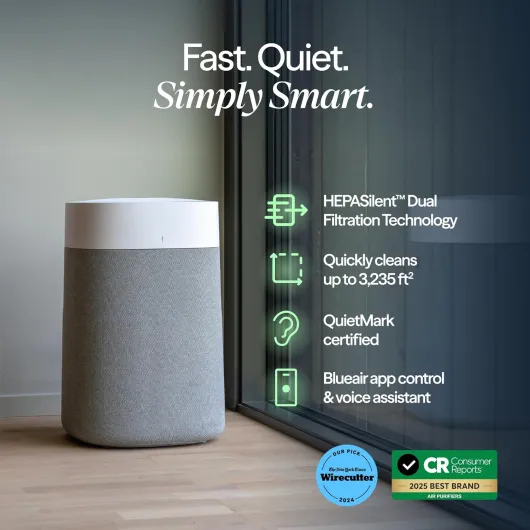
Right away, this thing feels like a serious unit. It’s not one of those tiny desktop purifiers that pretend to cover a whole house. It’s closer to a small side table in size. Blueair advertises that it cleans up to 3,048 sq ft in an hour, which honestly sounds a bit optimistic to me, but in a big open main floor (roughly 700–800 sq ft in my case), it clearly does something. Less dust on furniture, less lingering cooking smell, and the air feels less “stuffy.”
What stood out quickly is how quiet it is on the lower speeds. On the lowest setting, I basically forget it’s on unless the room is dead silent. On higher speeds, you obviously hear it, but it’s more like a steady air conditioner sound, not a whiny fan. If noise annoys you, that matters a lot, especially if you’re planning to sleep near it or work in the same room.
It’s not perfect though. The price of the unit itself is not cheap, and the replacement filters are also on the higher side. There’s also the app and smart features, which are nice in theory, but depending on your personality you’ll either enjoy checking the air quality graph or you’ll use it once and forget it exists. Overall, it feels like a solid, serious purifier for people who actually care about air quality, but you do pay for it.
Is the Blue Pure 211i Max worth the money?
Value is where opinions will split. This purifier is not cheap, and the filters aren’t either. But it’s also not in the ultra-premium price range some brands push. For what you pay, you’re getting a unit that can actually handle large rooms, with a real CADR rating, low noise, and a decent app. If you compare it to the pile of cheaper, smaller purifiers that promise “whole house” coverage but barely move air, this feels more honest and more effective.
Where the price starts to sting is the long-term filter cost. You’re realistically looking at one filter every 6–9 months depending on your usage and environment. Over a few years, that adds up. If you’re the kind of person who buys a purifier and then never changes the filter because it’s expensive, this is not for you. Running it with a clogged filter basically wastes the whole point of buying a higher-end unit in the first place.
On the other hand, if you actually care about air quality – allergies, pets, traffic pollution, smoke, or ongoing renovations – the cost becomes easier to justify. The fact that it’s Energy Star Most Efficient also means it doesn’t eat a ton of power, so at least you’re not getting hammered on your electric bill for leaving it on 24/7. And the smart features (scheduling, auto mode, air quality tracking) help you use it efficiently instead of blasting it on max all the time.
So in my opinion, value is pretty solid if you: have a big room or open layout, plan to run it regularly, and are okay budgeting for filters. If you just want something cheap to run occasionally in a small bedroom, this is overkill and there are cheaper options that make more sense. It’s more of a “serious tool for people who will actually use it” than a casual gadget.
Looks like furniture, not medical equipment
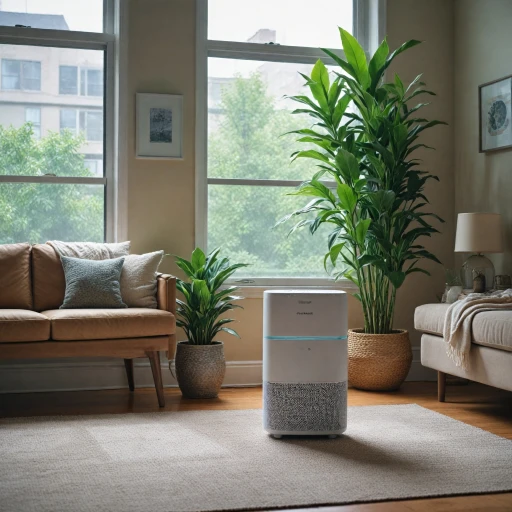
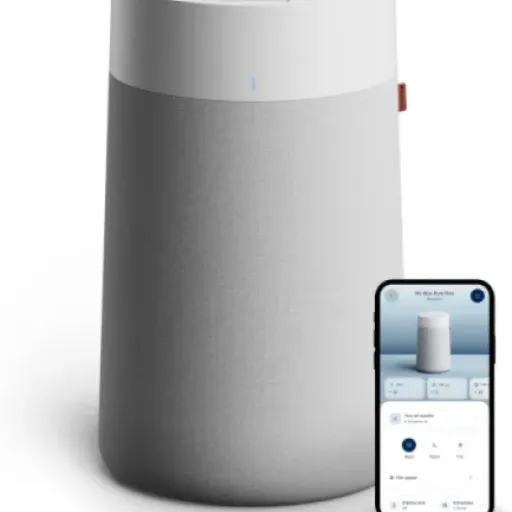
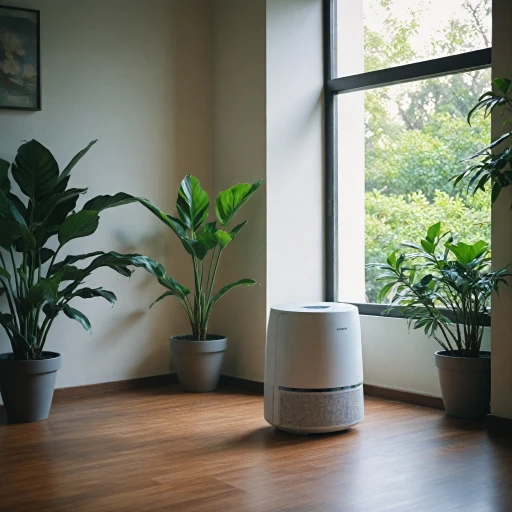
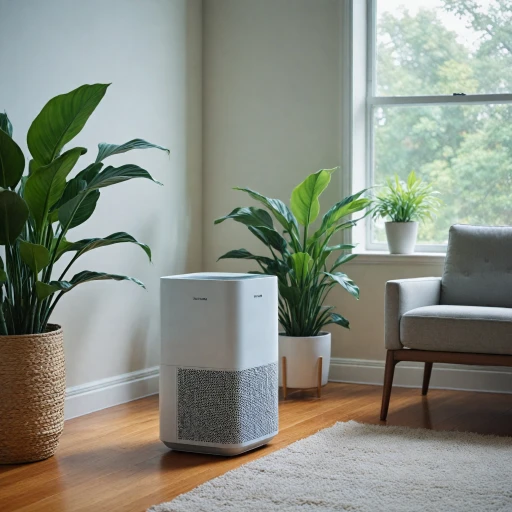
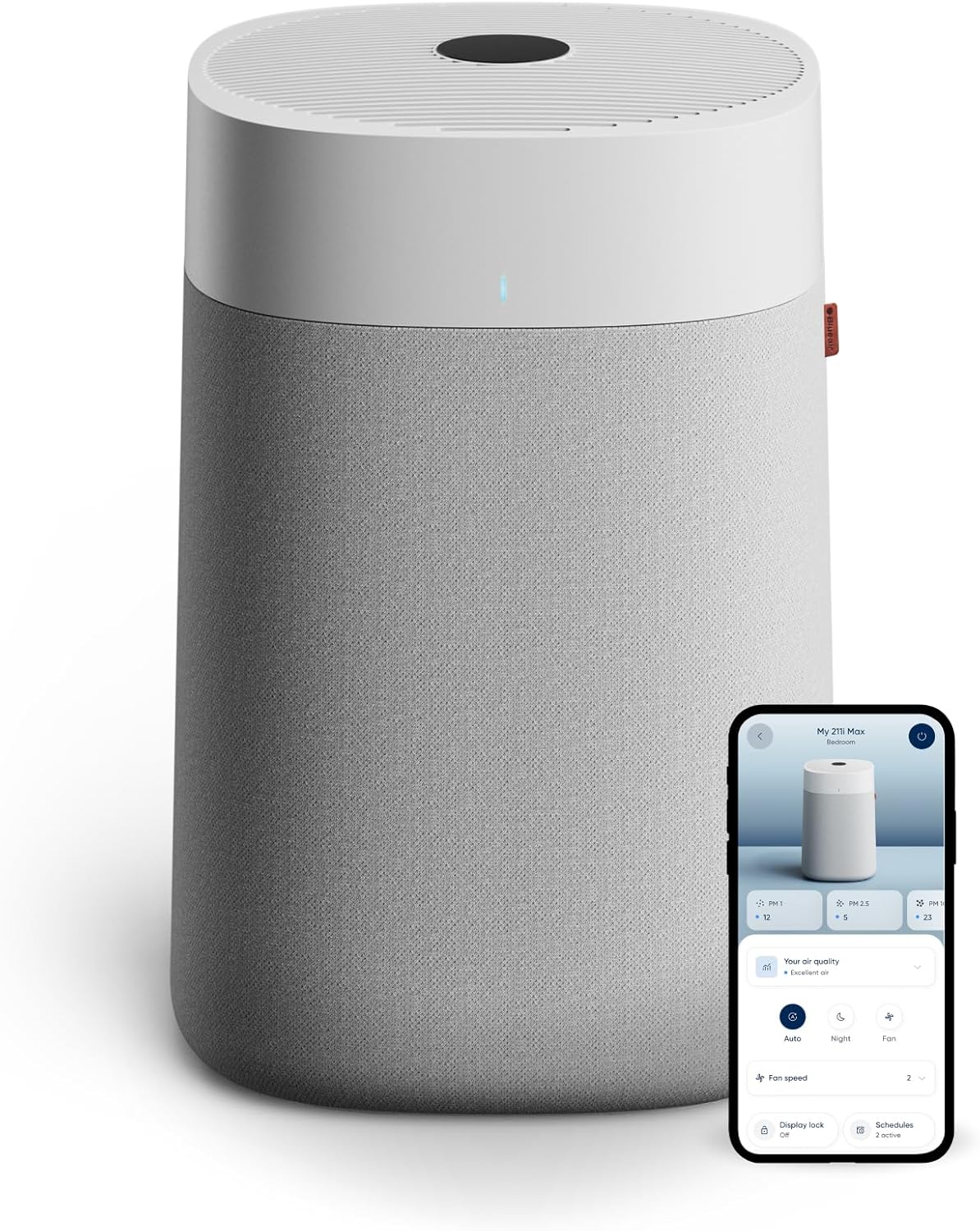
Design-wise, this is one of the few big purifiers that doesn’t look ugly in a living room. It’s a tall rectangular box, but the rounded edges and the grey/white color combo keep it from screaming “hospital.” The washable fabric pre-filter around the bottom adds a bit of texture and hides dust visually, which I appreciate because some other brands leave the filter fully exposed and it looks nasty after a month.
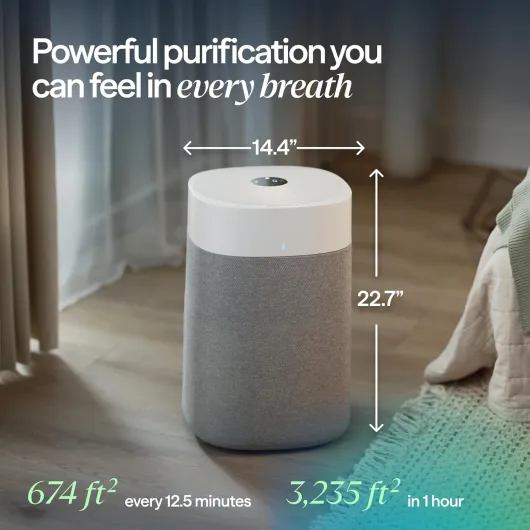
The footprint is about 14.4 x 14.4 inches and it’s roughly 22.7 inches tall. In practice, it’s like having a small side table or a compact subwoofer in the room. You do need to give it some space around it for airflow; if you jam it against a wall or sofa, you’re just choking its performance. I keep mine around 8–12 inches away from walls, in a somewhat central spot. That seems to give the best results for the whole space, especially in open layouts.
The top panel is simple: a central LED, a ring indicator, and touch buttons. No clutter, no weird chrome. The LED ring that shows air quality is genuinely helpful. When I cook something smoky or sear meat without the range hood, I can see it change from blue/green to yellow/orange within a minute, and the fan ramps up. Once the smell and haze are gone, it slowly drops back to blue. It’s a visual confirmation that the thing is actually reacting and not just pretending.
On the downside, it is a big, visible appliance. If you’re in a tiny studio apartment and you hate seeing devices, it might feel like overkill. Also, there are no wheels or built-in handles, so moving it around is basically a two-hand job, especially if you’re going up or down stairs. For me, that’s not a dealbreaker, but I do think they could have added at least some kind of grip or wheels at this price point. Still, in terms of looks, it’s one of the cleaner designs out there and blends into a modern room pretty well.
Build quality, filters, and how it holds up
In terms of build, the Blue Pure 211i Max feels solid but not luxury. The plastic casing doesn’t creak, the top panel feels sturdy, and the unit doesn’t wobble. It’s not metal or anything fancy, but it gives the impression it’ll handle years of just sitting there running. The weight (around 22–23 lbs) is actually a plus for durability because it doesn’t slide around if you bump into it lightly.
Where durability really matters on a purifier is the filter life and how annoying maintenance is. Blueair advertises around 6–9 months for the filter, and one Amazon reviewer mentioned getting about 10 months with the filter still around 15% remaining, running mostly on low with daily medium bursts. That lines up with my experience so far: on mostly low/auto in a not-insanely-dirty home, the filter percentage in the app goes down slowly. If you’re in a heavy smoke or super dusty environment, expect shorter life, obviously.
The washable fabric pre-filter is a nice touch for long-term use. Instead of having to replace a separate pre-filter every few months, you just pull the fabric off, shake it outside, vacuum it, or hand-wash it and put it back. It’s not glamorous, but it’s simple and cheap. That alone should help the main filter last closer to the higher end of their estimate. The RealTrack filter tracking (using actual fan speed and usage instead of a dumb timer) also feels more honest than a simple “change after 6 months no matter what” system.
On the downside, replacement filters are not cheap, and you’re basically locked into Blueair’s own F2MAX filters if you want proper performance. That’s the long-term cost you need to factor in. Also, if you’re rough with cables, remember this is a corded unit with no battery, so you’ll likely keep it in one spot to avoid yanking the cord around constantly. Overall, durability looks good so far, but the ongoing cost of filters is the main long-term downside.
Real-world performance: dust, smoke, and daily use
Performance is where this thing justifies its size and price, at least in my experience. In my main room (open living + kitchen, roughly 700–800 sq ft), dust buildup on shelves and TV stand clearly slowed down after a week or two of running it mostly on low/auto. I’m not saying dust vanished, but I went from needing to wipe surfaces every few days to more like once a week. The fabric pre-filter gets visibly dirty, especially at the intake sides, which is gross but also reassuring because that’s stuff that’s not floating in my nose.
For smoke and cooking smells, it does a pretty solid job. If I’m frying something or slightly burning toast, the air quality ring turns yellow/orange, and the fan ramps up on auto within a minute or two. Smells that used to linger for hours now fade a lot quicker, usually within 30–45 minutes if I leave it on a higher speed. A user review mentioned seeing it pull vape smoke from several feet away, and I’ve seen something similar with visible steam and a bit of frying smoke – you can actually see the airflow pulling it toward the unit.
Noise-wise, it’s one of the quieter large purifiers I’ve used. On low or night mode, it’s a soft background noise that I can easily sleep through. At medium, it’s noticeable but not annoying, like a small AC fan. On high, yes, you’ll hear it, and you probably won’t want that right next to your bed, but for clearing the room after cooking or during renovations, it’s acceptable. Compared to cheaper purifiers I’ve tried, the tone of the noise is less whiny and more “whoosh,” which matters over long periods.
As for filtration claims (down to 0.1 microns, 99.97% etc.), I obviously can’t measure that at home, but my allergies (dust and pollen) were slightly better when I kept it running 24/7 during peak season. I still needed meds, so it’s not magic, but mornings felt less stuffy. If you expect it to cure asthma or heavy allergies on its own, that’s unrealistic. But as part of a setup (cleaning, vacuuming with HEPA, etc.), it helps. Overall, performance is strong for dust, everyday smells, and general air freshness. It’s not a miracle machine, but it’s clearly more capable than the small, cheaper units.
What you actually get out of the box
Out of the box, the Blue Pure 211i Max is pretty straightforward. You get the main unit, the main filter already installed, and the fabric pre-filter wrapped around the bottom part. No assembly nightmare, no bags of random parts. You basically pull off some plastic, plug it in, and press the button. The manual is short and clear, so you don’t have to dig through 40 pages to figure out how to switch modes.
The product is made for North America only (110–120V), so if you’re thinking of using it elsewhere with different voltage, that’s not going to work without a heavy-duty transformer. It’s worth pointing out because this is not a cheap impulse buy. The unit is about 22–23 pounds, so you can move it around, but it’s not something you’re going to pick up with two fingers and bounce from room to room every hour. More like: you pick one main spot and maybe shift it occasionally.
Feature-wise, on paper it’s pretty loaded: HEPASilent filtration, app control, Alexa support, auto mode, night mode, child lock, and a built-in sensor that measures different particle sizes (PM1, PM2.5, PM10). The CADR numbers (around 410 for smoke, dust, pollen) are decent for this size of unit. For a normal person, the translation is: it moves a lot more air than the little purifiers that claim to do “large rooms” but really don’t.
In everyday use, the thing I actually interact with is the top panel: there’s a simple LED ring that shows air quality color (blue to red) and a basic two-button setup. I like that it’s not full of touch buttons everywhere. You can change fan speed, go into auto, and dim the lights without having to use the app. If you want the fancy stuff like scheduling or geofencing, that’s when the app comes into play. So presentation-wise, it’s simple enough for non-techy people, but the extra controls are there if you feel like nerding out.
How well it actually cleans the air day to day
Effectiveness is slightly different from raw performance numbers, at least for me. It’s about: do I notice a difference in how the room feels and how often I have to clean? Short answer: yes, but with some nuance. After a few days of continuous use, the room felt less stale when coming back from outside. That “closed house” smell you get after windows stay shut for days was reduced a lot. It doesn’t add any fragrance, obviously, but the air just feels more neutral and less heavy.
For dust, the impact is pretty clear. Like one of the Amazon reviews mentioned, the cloth pre-filter catches a surprising amount of fluff and dust clumps. I had the same thing: after a couple of weeks, you can see a grey band forming where the air gets sucked in. Rinsing or vacuuming that fabric every few weeks helps keep the main filter from clogging too fast. Compared to my older, smaller purifier, I’m cleaning that pre-filter more often, which tells me it’s actually moving more air and catching more junk.
The smart features also help gauge effectiveness. The built-in PM sensor and the app graphs show spikes when you cook, vacuum, or open a window to a busy street. During some nearby construction, I noticed PM2.5 levels creeping up in the app even though I didn’t see dust in the air. Bumping the fan speed up or leaving it on auto kept the readings in the “good” range most of the time. Is it perfect scientific data? Probably not. But it’s good enough to see trends and know when the room is cleaner or dirtier than usual.
Health-wise, I’d say it helped with two things: less irritation in my throat on heavy traffic days when I kept windows closed, and fewer sneezing fits in the morning during pollen season. It did not magically erase allergies, but it reduced the intensity a bit. If your expectations are realistic – cleaner air, less dust, faster removal of smells – it delivers. If you expect it to replace medication or fix mold problems in the walls, that’s not going to happen. As a tool to improve indoor air, it’s pretty solid, but not a miracle cure.
Pros
- Cleans large rooms effectively with strong airflow and good CADR ratings
- Very quiet on low and night modes, acceptable even in living areas
- Washable fabric pre-filter and smart filter tracking help extend main filter life
Cons
- Replacement filters are pricey and lock you into the Blueair ecosystem
- Bulky unit that takes noticeable floor space and has no wheels or handles
Conclusion
Editor's rating
The Blueair Blue Pure 211i Max is a solid choice if you actually need to clean the air in a large space and care about noise levels. It moves a good amount of air, handles dust and everyday smells well, and stays surprisingly quiet on the lower speeds. The auto mode and built-in sensor do a decent job of reacting to cooking, smoke, or outside pollution, and the washable fabric pre-filter catches a lot of the visible junk before it hits the main filter.
The downsides are mostly about money and size. The unit is big and not exactly discreet, and the replacement filters aren’t cheap. If you’re not willing to keep up with filter changes, or your space is small, you’re better off with a smaller and cheaper model. Also, the smart features and app are nice, but they’re not essential; if you don’t care about graphs and geofencing, you’re mainly paying for airflow and low noise.
I’d say this purifier is best for people with open layouts, pets, mild-to-moderate allergies, or issues with smoke and cooking odors who want a “set it and forget it” machine that just runs quietly in the background. If you’re on a tight budget, live in a tiny room, or hate the idea of buying filters regularly, skip this and look at simpler models. For everyone else, it’s a strong workhorse that gets the job done without turning your living room into a noisy wind tunnel.