
Summary
Editor's rating
Value for money: good, but filters will bite over time
Design: simple box that doesn’t scream ‘medical device’
Packaging and setup: simple and not too wasteful
Performance: how well it actually cleans the air
What you actually get with the Blue Max 3250i
Real-world effectiveness for allergies, dust and smells
Noise and energy use: bedroom-friendly, but not silent on high
Pros
- Very quiet on low and night modes, genuinely bedroom-friendly
- Effective at reducing dust, pollen and everyday odours in small to medium rooms
- Easy setup, simple filter access, and useful auto mode with responsive sensor
Cons
- Replacement filters are relatively expensive and not always easy to find
- Higher fan speeds are noticeably loud and needed to realistically cover larger rooms

Specifications
View full product page →| Brand | BLUEAIR |
Why I bought yet another air purifier
I picked up the Blueair Blue Max 3250i because my old cheap purifier was basically a noisy fan with a filter taped to it. I wanted something I could leave running in the bedroom and living room without feeling like I was sleeping next to a hair dryer. I’ve been using this one daily for a few weeks now, mostly in a 20–25 m² bedroom and sometimes dragging it into the kitchen when cooking gets smoky.
Right away, the thing that stood out was how quiet it is on the lowest speeds. On night mode, I honestly have to go close to it to check if it’s still on. Compared to my previous no-name purifier, it’s a big step up in terms of noise and general build quality. The air does feel cleaner, especially in the morning—less stuffy, less dusty feeling around the bed.
It’s not perfect though. Filters are not cheap, and if you want the official ones you’re going to feel it. Also, the coverage numbers (48 m² in 30 minutes) are a bit optimistic in real life unless you’re running it on higher speeds, which are noticeably louder. The app is handy but a bit clunky in places, especially the graphs, which look nice but aren’t super useful day to day.
Overall, after a few weeks, I’d say it’s a pretty solid mid-range purifier. It’s clearly better than basic budget models, but you do pay extra for the brand and the smart features. If you care about low noise and auto mode doing its thing in the background, it’s worth looking at. If you just want a basic dust sucker and don’t care about apps or WiFi, there are cheaper options that will still get the job done.
Value for money: good, but filters will bite over time
On value, this sits in the “not cheap, not crazy expensive” zone. You’re paying for a known brand, quiet operation, and the smart features. If you compare it to very basic purifiers with no app and loud fans, it costs more, but you do actually get better noise control and a nicer overall experience. For a small bedroom or office, it feels like a reasonable investment if you care about air quality and want something you can just leave on auto most of the time.
The big downside is filter cost and availability. Official filters are not cheap, and they’re supposed to last about 6–9 months depending on use and air quality. That means you’re adding a decent recurring cost every year. Also, availability can be patchy—some people report them being sold out in several places. There are third-party filters that are cheaper, but then you’re gambling a bit on quality and fit. If you plan to run the purifier a lot, budget for at least one filter change per year, maybe two in a dirty environment.
The WiFi and app are nice extras, but they’re not essential. If you’re not into smart home control, you might feel like you’re paying for features you don’t really need. The app is handy for scheduling and dimming lights, but once you set it up, most people will just leave it on auto and forget about it. So from a pure “clean air per pound” perspective, a simpler non-smart model might be better value if you don’t care about data and remote control.
Overall, I’d say the value is good but not outstanding. You’re getting a quiet, effective purifier from a reputable brand, which justifies the price to a point. But if your budget is tight and you don’t mind more noise or fewer features, cheaper units will still improve your air. On the other hand, if you want something bedroom-friendly that you don’t have to babysit, this hits a decent balance between performance, comfort, and running costs—as long as you’re aware of the filter bill coming down the line.
Design: simple box that doesn’t scream ‘medical device’
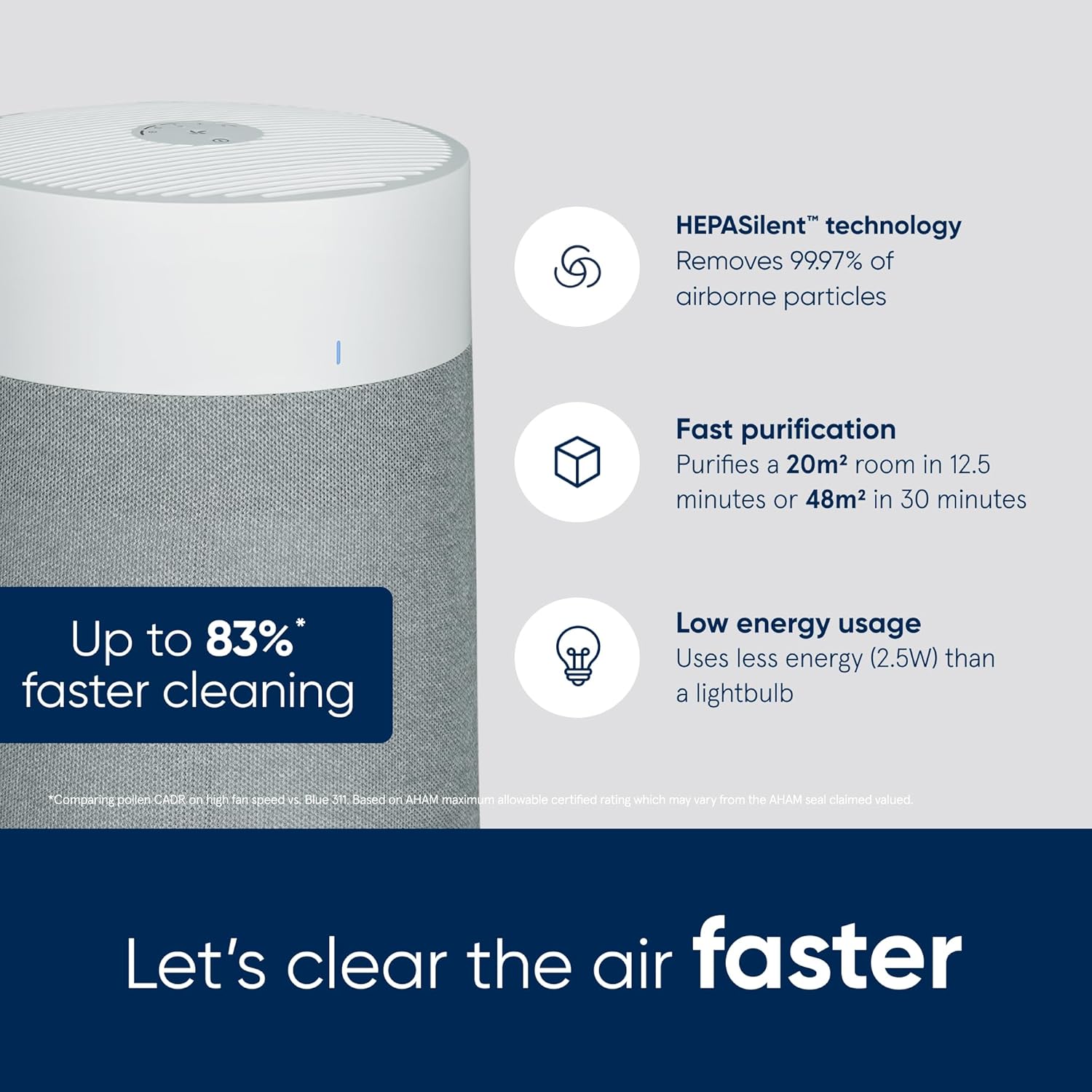
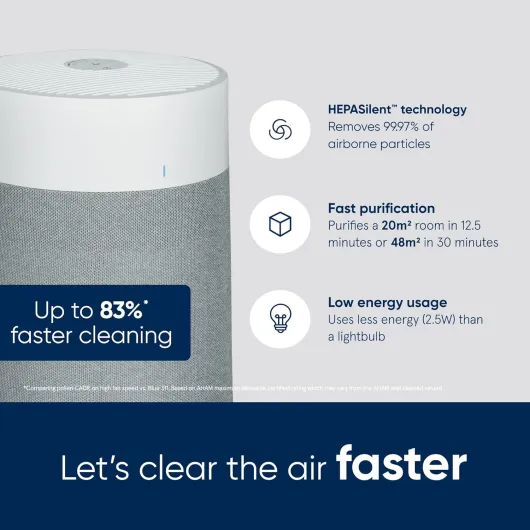
Design-wise, the Blue Max 3250i is pretty low-key, which I like. The colour I had is called Stockholm Fog, basically a neutral grey that disappears in most rooms. It’s a rounded square tower, nothing flashy, no chrome nonsense, and it doesn’t look like a sci-fi gadget. If you’re putting it in a bedroom or living room, it blends in better than the usual white plastic bricks. It’s about knee-height on an adult, so it tucks nicely next to a bedside table or desk.
The top panel has the touch controls and air outlet, and the intake is around the sides. The filter is accessed by sliding or lifting the main body off the base (depending on how you look at it), and that part is genuinely easy. No tools, no wrestling with clips. For someone who hates fiddly maintenance, that’s a plus. You just pop the old filter out, drop a new one in, and reset the indicator. Took me about two minutes when I opened it to check the internals.
There’s a front LED ring that shows air quality (blue, green, red), and another small LED for mode. In night mode, the air quality light goes off, but the mode LED stays on, just dimmed. This is one of the annoyances: in a very dark room, that little LED is still visible. It’s not a floodlight, but if you’re picky about light when sleeping, you’ll notice it. You can dim it further through the app, but I’d prefer a true “all lights off” option without digging through menus.
Overall, the design feels thought through but not fancy. Build quality is decent: the plastics don’t creak much, and the unit feels solid enough for the price. It could look a bit more premium for what you pay, but I’d rather they spent the money on a good fan and motor than shiny finishes. If you want something that disappears visually and doesn’t make your room look like a clinic, this does the job. Just be aware of that small LED at night if you’re sensitive to any kind of light in the bedroom.
Packaging and setup: simple and not too wasteful
The packaging is pretty straightforward and not over the top, which I appreciate. The unit comes in a cardboard box with some protective inserts, but there wasn’t a ton of pointless plastic. One of the Amazon reviewers mentioned it too: it’s easy to unpack and doesn’t feel like you’re drowning in foam and film. Everything came in good condition, no dents or scratches on my unit, so they’ve found a decent balance between protection and not going overboard on materials.
Setup is basically plug and play. You take it out, remove any plastic around the filter (on mine, it was already correctly installed, just needed a quick check), plug it in, hit the power button, and you’re getting clean air. The touch controls on top are clear enough that you can figure out fan speeds and modes without reading the manual. For someone who hates long setup processes, this is refreshingly simple.
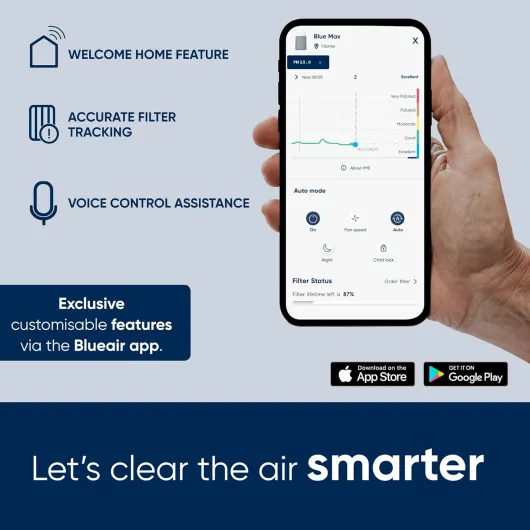
The WiFi and app setup is also relatively painless. You download the Blueair app, create an account, add the device, and follow the steps. It connected to my WiFi on the first try. From there, you can see air quality, switch modes, dim the lights, and set timers. The only slightly annoying part is that the air quality history graphs in the app are a bit clunky to navigate and feel more like a gimmick than something you’ll check regularly. But the basics—on/off, mode, light level—work fine.
Overall, the unboxing and first setup experience is smooth. No weird surprises, no hidden pieces, and no need to be a tech expert. If you’re buying this for someone who’s not very tech-savvy, they’ll manage. The only thing I’d change is maybe clearer info in the box about filter prices and where to get them, because that’s something you only really discover after the fact when you start looking for replacements.
Performance: how well it actually cleans the air
This is the part that matters: does it actually clean the air, or is it just a fancy fan? In daily use, it does a pretty good job. In my 20–25 m² bedroom, running it on auto most of the time, the air feels less stale in the morning, and I’m noticing less dust settling around the bed and on furniture. It’s not zero dust, obviously, but I’m not wiping visible layers every couple of days like before. For someone with mild dust and pollen allergies, it genuinely helped me wake up with less of a blocked nose.
Where it really shows its value is with odours and quick reactions. When I cooked something greasy or used the wax burner in the living room, the LED ring switched from blue to green or even red, and the fan ramped up on its own. You can hear it when it does that, but within 20–30 minutes the smell dropped noticeably and the light went back to blue. Same story when I shook out a dusty rug near it: the sensor picked it up and auto mode kicked in. So the sensor and auto mode don’t feel like gimmicks; they actually respond to what’s happening.
On paper it claims to remove 99.97% of particles down to 0.1 microns. I can’t lab-test that, but based on how it handles dust, pollen, and general stuffiness, I’d say it’s doing its job. It’s not magic: if you have windows open all day on a busy road, it won’t turn your room into a cleanroom. But in a closed room or with windows tilted, it keeps the background air quality clearly better than without it.
The only thing I’d question is the room size claim (48 m²). In a room that big, unless you run it on higher speeds quite often, I don’t think you’ll get the same “wow, the air feels cleaner” effect. For small rooms (bedroom, office), yes. For a big open-plan living/dining/kitchen, it’s more of a local helper than a full solution. So performance is solid, especially for allergies and odours, but be realistic about the room size and don’t expect miracles on the lowest speeds in a huge space.
What you actually get with the Blue Max 3250i
Out of the box, the Blue Max 3250i is pretty straightforward. You get the unit, the combo filter already inside, a power cable, and the usual paperwork. No remote, no fancy extras. It’s a corded electric purifier, about 48 cm tall and just under 27 cm wide and deep, and weighs around 3.4 kg. So it’s light enough to move around one-handed but not so light that it feels cheap or hollow. I’ve been carrying it between bedroom and kitchen without any hassle.
The brand claims it can handle up to 48 m² in 30 minutes on high, or about 20 m² in 12.5 minutes. In practice, I’d say it’s very comfortable for small to medium rooms (bedrooms, home offices, small living rooms). In an open-plan space, it helps, but you won’t get miracles unless you park it close to where you actually sit or sleep. It uses a combo filter with HEPA-style media plus activated carbon, so it deals with particles (pollen, dust, pet dander) and light odours (cooking, pets, basic VOCs).
The selling point is their HEPASilent tech: a mix of mechanical filtration and some electrostatic trickery to get more airflow with less noise. In plain terms, it moves a decent amount of air without sounding like a fan on full blast all the time. You’ve got the usual modes: manual fan speeds, auto mode that reacts to pollution, and a night mode that dials everything down. It’s also WiFi-enabled, so you can control it with the Blueair app and hook it into smart home stuff if you’re into that.
So on paper, it’s positioned as a smart, quiet purifier for small rooms, with a bit of a premium feel compared to no-name brands. It’s not the biggest unit, and it’s not meant for huge open spaces, but for a bedroom or office it’s sized pretty sensibly. Just keep in mind the ongoing cost of replacement filters and the fact that the “up to 48 m²” spec is under ideal conditions at higher fan speeds, not at whisper-quiet night mode.
Real-world effectiveness for allergies, dust and smells
In practice, effectiveness is where I was actually pleasantly surprised. I bought it mainly for dust and pollen, and a bit for cooking smells. After a few nights in the bedroom, I noticed I wasn’t waking up with that dry, slightly irritated throat I usually get when the room gets stuffy. My nose felt clearer in the morning, and I didn’t get that itchy-eye feeling during peak pollen days as much as I normally would. It’s not like my allergies vanished, but it took the edge off, which is what I was hoping for.
For dust, it doesn’t perform miracles across the whole room, but it helps a lot around where it’s placed. I put it near the bed and wardrobe, and I’ve seen fewer dust bunnies in that area. When I do a heavy clean or move stuff around, the purifier clearly detects it: the air quality light changes, the fan ramps up, and after a while the haze you sometimes see in sunlight dies down faster than without it. Still, corners far from the unit aren’t fully spared if there’s a lot of dust flying around, so placement matters.
For odours, it’s pretty effective as long as we’re talking normal household smells: frying, light smoke from cooking, pet smells, and scented wax burners. One time I fried fish without turning on the kitchen hood properly. The purifier, sitting a few meters away, went straight to red and the fan speed jumped. After 20–30 minutes, the fish smell was way less noticeable, and by an hour it was mostly gone. It’s not as strong as a big dedicated carbon filter unit, but for a small purifier, it does a decent job.
On the other hand, if you expect it to fully handle very strong or constant smoke (like heavy indoor smoking) or strong chemical smells, I’d say it’s not the ideal tool. The carbon filter is good for light to moderate odours, not industrial-level stuff. Overall, for regular home use—pollen, pet dander, dust, everyday cooking smells—it’s effective enough that you actually feel a difference. Just don’t expect it to fix a badly ventilated room all by itself if you never air out or you’re dealing with very strong pollution sources.
Noise and energy use: bedroom-friendly, but not silent on high
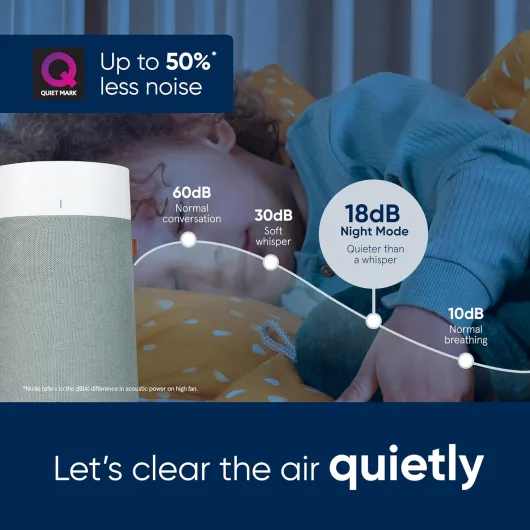
The noise levels are probably its biggest selling point. On the lowest speed and in night mode, it’s genuinely very quiet. The spec says 18 dB, and while I don’t have a meter, subjectively it’s about the level of a soft laptop fan or even less. In a bedroom at night, with some background street noise, I pretty much forget it’s running. If you’re sensitive to noise when sleeping, this is one of the better units I’ve tried. On auto mode, once the air is clean and it drops back down, it’s close to silent.
On the flip side, higher speeds are noticeable. When the air quality goes to red and it ramps up, you clearly hear the fan. It’s not jet-engine loud, but it’s far from silent. In a living room watching TV, it’s fine; you notice it, but it doesn’t drown things out. In a quiet bedroom, if it suddenly kicks to high, you’ll hear it and maybe wake up if you’re a light sleeper. The good news is that it usually doesn’t stay at full blast for very long unless you keep generating pollution (e.g., something burning in the kitchen).
In terms of energy use, it’s pretty modest. It’s designed to use less power than older HEPA-only purifiers for the same clean air delivery. I don’t have exact kWh numbers from my bill just for this, but leaving it on auto basically all day didn’t move the needle in any obvious way. On low, it’s in the “a few watts” territory, like a small LED lamp. On high, it obviously draws more, but you’re not going to go broke running it unless you blast it 24/7 at max speed, which doesn’t make sense anyway.
So for bedrooms and small offices, I’d rate it very good on noise and energy overall. Just set realistic expectations: whisper-quiet at low, perfectly livable at medium, and clearly audible at high. If you plan to put it in a nursery or you’re very sensitive to noise, stick to night mode and auto, and place it a couple of meters from the bed instead of right next to your head.
Pros
- Very quiet on low and night modes, genuinely bedroom-friendly
- Effective at reducing dust, pollen and everyday odours in small to medium rooms
- Easy setup, simple filter access, and useful auto mode with responsive sensor
Cons
- Replacement filters are relatively expensive and not always easy to find
- Higher fan speeds are noticeably loud and needed to realistically cover larger rooms
Conclusion
Editor's rating
The Blueair Blue Max 3250i is a solid choice if you want a quiet, mostly hands-off air purifier for a bedroom or small living room. It does a good job with everyday stuff: dust, pollen, pet dander, and normal cooking smells. The auto mode and sensor actually work—you see it react when you cook, burn a candle, or stir up dust, and the air does feel fresher after a while. Noise on low and night mode is very low, so it’s easy to live with, even if you’re picky about sound when sleeping.
It’s not perfect though. The official filters are pricey and sometimes hard to find, and the room size claims are a bit optimistic unless you’re ready to tolerate higher fan speeds now and then. The app is useful but not life-changing; once you’ve set your preferences, you mostly forget about it. So who is this for? People with mild to moderate allergies, those who hate noisy fans, and anyone who wants a purifier they can mostly ignore in the background. Who should skip it? If you’re on a tight budget, need to cover a very large open space, or don’t care about smart features and ultra-low noise, you can get cheaper, louder units that still clean the air decently.