
Summary
Editor's rating
Value for money: worth it or overkill?
Design: looks high-end, but not perfect for every room
Comfort and noise: good overall, but not the quietest
Build quality, maintenance and long-term concerns
Performance: heating, cooling and purification in real life
What the Dyson HP1 actually does (beyond the marketing)
Pros
- Heats a medium room evenly and reaches target temperature fairly quickly
- Strong, smooth airflow for cooling with good oscillation coverage
- Fully sealed HEPA H13 purification with useful Auto mode and app monitoring
Cons
- Price is high compared to buying separate basic devices
- Gets noticeably noisy at higher fan levels and during strong heating boosts
- Ongoing filter cost and reliance on Dyson ecosystem for replacements

Specifications
View full product page →| Brand | Dyson |
One device to replace your fan, heater and purifier?
I’ve been using the Dyson Purifier Hot+Cool HP1 in my living room for a few weeks now. My idea was simple: I wanted one device that could handle three things at once – heat in winter, cool in summer and clean the air all year. I was tired of having a separate cheap fan, a noisy space heater and a basic air purifier lying around. Too many cables, too much clutter, and honestly, none of them worked that well.
When you unbox this HP1, it’s clear you’re not dealing with a bargain gadget. It looks like the typical Dyson fan you see in ads, but this one also has the HEPA H13 filter and heating function. It’s not tiny, but it’s also not a monster tower. I set it up in about 10 minutes, including connecting it to the MyDyson app. No tools, just click the filter in, plug it, done.
From day one, I used it like a normal person would: auto mode most of the time, heating in the morning when the room was cold, fan mode in the afternoon, and night mode before going to bed. I didn’t sit there staring at the air quality graphs all day, but I did check the app enough to see if what it says matches what I feel in the room. Spoiler: most of the time, it does.
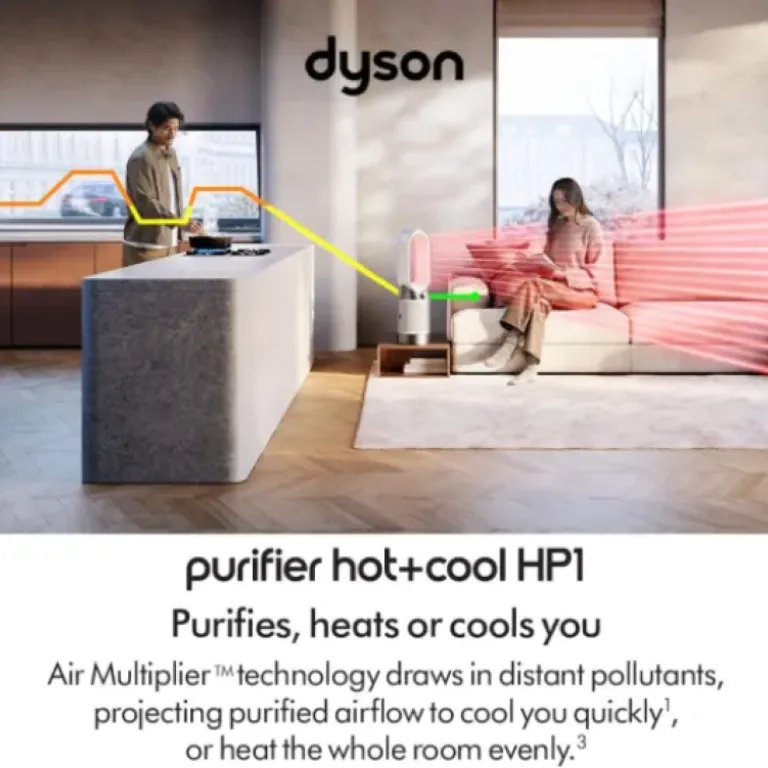
Overall, this thing is not perfect, but it clearly isn’t a gimmick either. It heats properly, it moves a lot of air, and the purifier side seems solid. The real question is whether all that justifies the price. That’s where it gets more nuanced: for some people it will make sense, for others a mix of cheaper devices will be enough.
Value for money: worth it or overkill?
This is where it gets tricky. The Dyson HP1 is not cheap, and you feel it when you hit the buy button. If you compare it to buying a basic fan, a budget heater and a small purifier separately, that combo will almost always be cheaper upfront. So if you just want something that moves air and gives a bit of heat, this is probably overkill. You’re paying for the design, the HEPA H13 sealed system, the smart features, and the fact that it replaces three devices in one footprint.
Where it starts to make sense is if you actually plan to use all three functions a lot: daily purification, regular heating in a main room, and cooling airflow in summer. In that case, the price becomes easier to swallow because you’re not just buying a fancy fan; you’re buying your main room heater and purifier too. A couple of Amazon reviewers said it felt like a good investment, especially when they caught it on a discount. I agree with that: at full price it hurts, on a solid promo it becomes much more reasonable.
You also have to factor in running costs: filters and electricity. The filter cost every year or so adds up, and if you use the heating function a lot, your power bill will notice. It’s 40 W in purifier/fan mode, but heating obviously pulls a lot more (Dyson doesn’t always shout about that). So it’s not a cheap device to own, but that’s the case with most quality purifiers and heaters anyway.
Personally, I see it as good value if: you live in a flat or small house where one main room is your living space, you care about air quality, and you want something that looks decent and is easy to control with an app. If you’re on a tight budget or you only need a fan two weeks a year, skip it and buy a simple fan and a basic heater. There’s better pure “bang for buck” elsewhere, but as an all-in-one, it’s pretty solid for the right user.
Design: looks high-end, but not perfect for every room
Design-wise, this is classic Dyson: tall oval loop on a cylindrical base, with a clean white/white finish. In a living room, it looks more like a piece of tech furniture than a clunky heater. If you care about how things look in your home, it’s definitely easier on the eyes than a cheap plastic heater or a fan with spinning blades. I had a couple of friends over and both noticed it right away and asked, “Is that the Dyson heater thing?” So yeah, it stands out.
The footprint is actually quite small: around 13.1 cm deep and 20.5 cm wide, so it doesn’t take much floor space, but it is 76.5 cm tall, which makes it quite visible. I had no trouble sliding it between the sofa and a shelf. Weighing about 5.26 kg, it’s light enough to move from living room to bedroom with one hand, but you still notice you’re carrying something. No handle though, which would have been nice – you just grab it by the loop.
One thing I liked is the magnetised remote. It just snaps on top of the loop and stays there. Simple, but it means you don’t spend 10 minutes hunting for the remote under cushions. The remote itself is small, curved, and controls all the basics: fan speed, oscillation, heating, Auto mode, night mode, etc. The main display on the base is small but readable from a couple of meters away. You see temperature, mode, and some air quality info.
On the downside, the white/white colour is clean but it will show dust and scuffs more than a darker model. After a few weeks, I already had some marks on the base from bumping it with a chair. Also, because it’s tall and fairly light, if you’ve got small kids or a big dog that charges around, I’d keep it out of the main traffic zone. It’s stable enough for normal use, but I wouldn’t want a kid hanging off the loop. So overall: nice design, looks modern, but not bulletproof for chaotic households.
Comfort and noise: good overall, but not the quietest
Let’s talk about noise, because that’s often what makes or breaks these devices. Officially it’s listed around 63 dB, and subjectively, on low fan levels (1–3) it’s fairly quiet, more like a soft whoosh in the background. In Auto mode during normal days, it mostly stayed around those levels, and I got used to it quickly. You can have a conversation or watch TV without really noticing it. Once it jumps above level 5–6 though, you clearly hear it across the room. Not a high-pitched whine, more like a strong air rush sound.
For sleep, I used night mode in the bedroom for a few nights. In that mode, it dims the display and limits the fan speed. On the lowest levels, I could sleep with it on, but if you’re very sensitive to noise, you might still find it a bit present. It’s not dead silent. Personally, I was fine with it since I’m used to some background noise, and I even liked the constant hum more than random street noise. But if you want total silence, this isn’t it.
In terms of thermal comfort, the heat it gives off feels pretty even. No burning smell, no hot plastic smell, nothing weird. The airflow is adjustable: you can have it oscillate to spread the air, or keep it directed at a specific area. There’s also a “diffused” setting where it sends air backwards so it purifies without blasting air at you, which is handy in winter when you don’t want a fan feeling all the time.
One thing I appreciated is how simple the controls are. The remote is straightforward, and the app mirrors the same functions. I didn’t have to dig through 20 menus to change the temperature or fan speed. Comfort-wise, the combo of decent noise levels on low, smooth airflow and precise temperature control makes it pleasant to live with. The only real downside is that when it decides to ramp up during a pollution spike or heating boost, the noise jump is noticeable. So it’s comfortable most of the time, but not a quiet ninja at full power.
Build quality, maintenance and long-term concerns
In terms of build quality, the HP1 feels solid but it’s still mostly plastic. The plastics don’t creak when you move it, and the base feels stable enough on a flat floor. I accidentally knocked it slightly with a chair leg once and it didn’t wobble too much, so it’s not flimsy. That said, it’s not a tank either. If you have kids who like to push things over, I wouldn’t rely on it surviving constant abuse. It looks like something you’d want to treat with a bit of care.
Maintenance is pretty simple. The filter is inside the base in a ring; you unclip the outer shell, pull the filter out and replace it. Dyson usually recommends changing filters about once a year depending on usage and air quality. That’s an extra running cost you have to factor in. Compared to no-name purifiers, Dyson filters are not cheap. On the plus side, the app warns you when it’s time to replace, so you don’t have to guess. Cleaning the exterior is just a matter of wiping dust off with a cloth every week or two.
As for reliability, a few weeks isn’t enough to judge properly, but I didn’t have any bugs or crashes. The app connection stayed stable, it reconnected after power cuts without drama, and the remote always worked. The auto shutoff and tip-over safety features are reassuring; if it falls or overheats, it stops. That’s standard, but good to have in a heater. The fully sealed HEPA H13 system is also good from a durability point of view: dust and particles are trapped inside the filter, not clogging the internals.
Long term, my only real worry would be spare parts and filter cost. Someone in the reviews even said they upgraded because they couldn’t get filters for their old model anymore. If Dyson stops supporting this HP11 model in a few years, you might be stuck. So if you buy it, go in with the idea that you’ll be paying for filters regularly and that it’s a bit of a long-term relationship with the brand. The hardware itself feels like it will last if you don’t abuse it, but the ecosystem cost is real.
Performance: heating, cooling and purification in real life
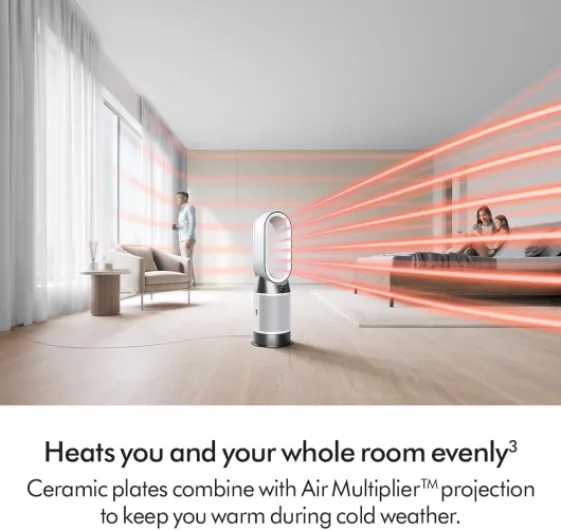
In day-to-day use, the heating performance is actually what impressed me the most. In a roughly 20–25 m² living room, starting from about 17–18°C, it got the room to a comfortable 21–22°C in around 15–20 minutes on a higher fan level. It doesn’t feel like a hair dryer pointed at your face; it’s more like the whole room slowly getting warmer, which is what you want. Once it hits the target temperature in Auto mode, it cuts the heater and just keeps a low fan going to maintain it. That works well and avoids the stuffy “oven” feeling some heaters give.
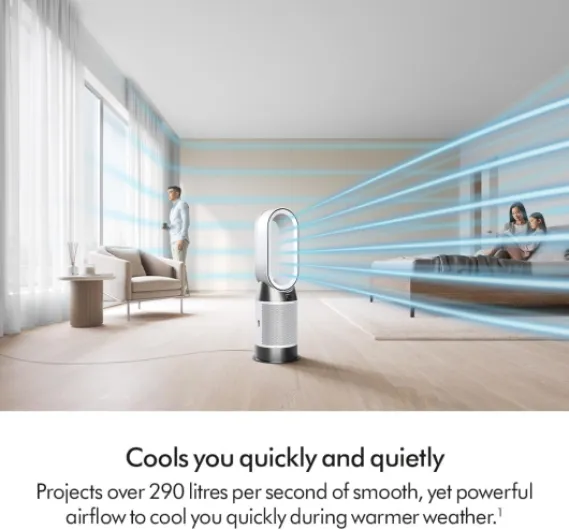
For cooling, keep your expectations realistic: it’s not an air conditioner. It doesn’t lower the room temperature magically, but the airflow is strong enough to make you feel cooler, especially on settings 6–10. On a warm day, having it oscillate across the room gave a decent breeze. Compared to my old cheap pedestal fan, the airflow feels smoother and more even, but if you stand right in front of it on max, the Dyson is actually stronger. It’s good for comfort, but if you live in a very hot flat, you’ll still need proper AC.
On the air purification side, it’s harder to “see” results, but I did notice two things. First, when cooking or using cleaning sprays, the air quality numbers in the app climbed quickly, and the fan automatically ramped up. After 10–20 minutes, values dropped and the smell in the room faded faster than without it. Second, dust on surfaces seemed to build up a bit slower over a couple of weeks. I can’t prove that scientifically, but compared to before, the TV stand and shelves needed wiping a bit less often. For allergies, I did feel slightly less stuffy in the morning, but that’s very personal and I wouldn’t buy it only for that without trying.
Overall, in terms of raw performance, it does what it claims: it heats a room properly, it pushes a lot of air to cool you down, and it reacts to pollution peaks. The downside is that it can get noisy on higher levels (we’ll get to that), and the heating side will obviously hit your electricity bill if you use it all day. But as a multi-function device, it’s pretty solid and actually useful, not just a fancy fan with a filter slapped on.
What the Dyson HP1 actually does (beyond the marketing)
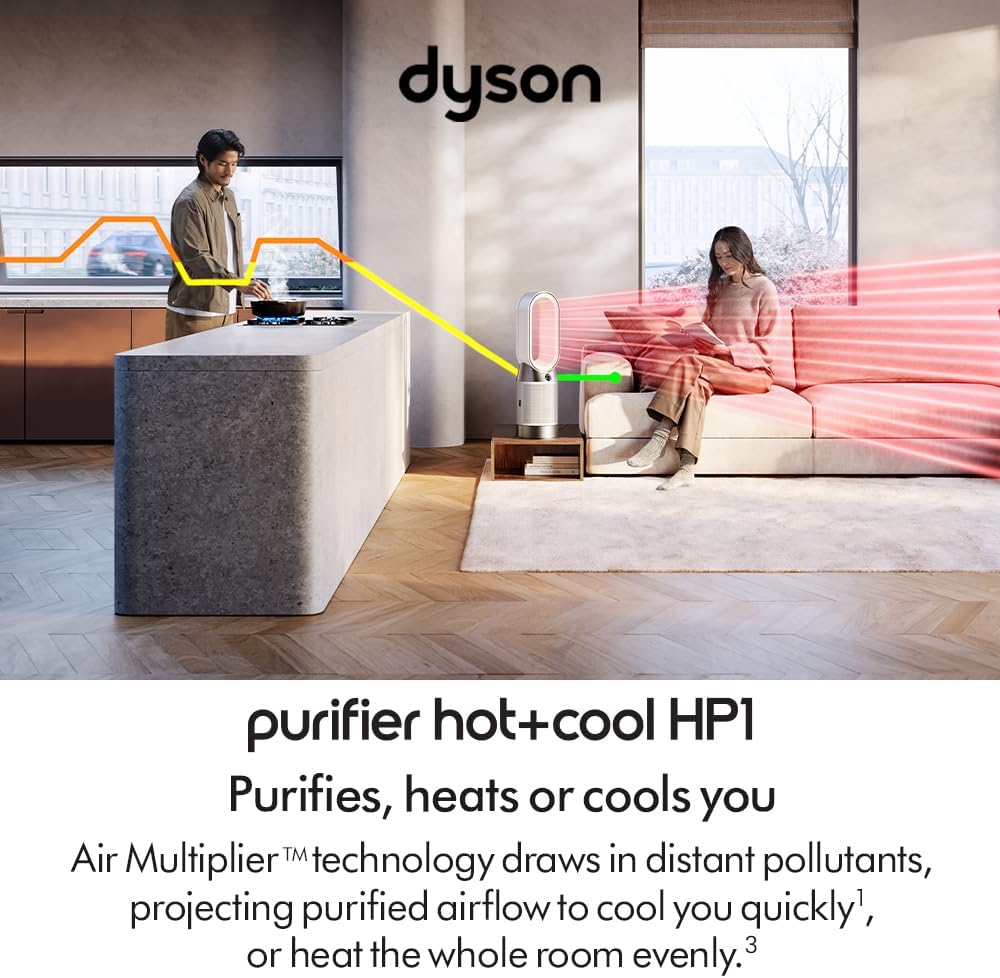
On paper, the Dyson Purifier Hot+Cool HP1 is a 3-in-1 device: air purifier, cooling fan, and heater. It uses a fully sealed HEPA H13-grade filter system that’s supposed to capture 99.95% of particles down to 0.1 microns. In normal words: dust, pollen, pet dander, and general city pollution. The whole unit is sealed, so the dirty air that gets sucked in is supposed to stay inside the filter instead of leaking back out around the edges.
The fan part uses Dyson’s Air Multiplier system, which basically means there are no visible blades. It pulls air in through the base and throws it out in a smooth stream through the oval loop. The brand claims it can project over 250 litres of air per second, which sounds like a random number until you actually feel it on a higher setting – it’s strong enough to move curtains and cool the room, not just your face if you stand right in front of it.
For the heater, it works more like a proper space heater than a weak warm breeze. You set a target temperature on the screen or in the app, and in Auto mode it heats until it reaches it, then the heating cuts off and the fan slows down. I tested it in a medium living room and it took the chill off in around 10–15 minutes from a cold morning, which is decent. It’s not going to replace central heating in a big house, but as a room heater it gets the job done.
The smart part: it connects to the MyDyson app. You can see indoor air quality, set schedules, change modes, and even control it remotely. I used this a lot to turn the heater on before I got home or to switch to night mode from the sofa. It also works with voice assistants if you’re into that. Overall, function-wise, it’s pretty loaded. The question is whether you’ll actually use all of that daily or if you’ll just leave it on Auto and forget about it.
Pros
- Heats a medium room evenly and reaches target temperature fairly quickly
- Strong, smooth airflow for cooling with good oscillation coverage
- Fully sealed HEPA H13 purification with useful Auto mode and app monitoring
Cons
- Price is high compared to buying separate basic devices
- Gets noticeably noisy at higher fan levels and during strong heating boosts
- Ongoing filter cost and reliance on Dyson ecosystem for replacements
Conclusion
Editor's rating
Overall, the Dyson Purifier Hot+Cool HP1 is a solid all‑in‑one unit that actually does what it says: it heats a room properly, gives a strong cooling airflow and purifies the air with a sealed HEPA H13 system. The design looks clean in a living room, the magnetised remote is handy, and the MyDyson app makes it easy to control and monitor things without getting too geeky. In daily use, I mostly left it on Auto and only tweaked temperature or fan speed when I felt like it, and that was enough to feel a real difference in comfort.
It’s not perfect though. Noise on higher fan levels is noticeable, the white finish marks fairly easily, and long‑term costs (filters and power if you use the heater a lot) are not negligible. Plus, the price puts it firmly in the “considered purchase” category, not an impulse buy. I’d recommend it to people who want one main device for their living room or bedroom that can genuinely replace a separate fan, heater and purifier, and who are okay paying extra for that convenience and design. If you just need a cheap fan or a backup heater, or if smart features don’t interest you, there are cheaper options that will do the basic job just fine. For the right user though, this HP1 is a pretty solid piece of kit.