
Summary
Editor's rating
Value for money: not cheap, but does it earn its price?
Design: big white box, but it blends in
Comfort and daily use: noise, modes, and living with it
Build quality and durability after a few weeks
Performance: how well it actually cleans the air
What you actually get with the Blue 3610
Effectiveness on dust, odours, and allergies
Pros
- Very quiet on low/auto, easy to ignore in daily use or at night
- Auto mode reacts quickly to cooking, smoke, and dust and clears the air fairly fast
- Simple one-button operation with washable pre-filter and strong overall filtration
Cons
- High purchase price plus ongoing cost of replacement filters
- Loud on maximum speed when auto mode kicks up during heavy pollution
- Some fine black dust likely from the carbon filter around the base over time

Specifications
View full product page →| Brand | BLUEAIR |
Big purifier for big rooms (and big allergies)
I’ve been using the Blueair Blue 3610 in my living room for a few weeks now. It’s a fairly big open-plan space with a sofa, TV, and an open kitchen at one end. I also have a cat, a partner who’s sensitive to dust and pollen, and we sometimes burn candles and cook stuff that smokes up the place. So the air is not exactly pristine. I bought this mainly to see if it would calm down the sneezing and the slightly stale smell we tend to get in the evenings.
First impression: this thing is not tiny, but it’s simple. You pull it out of the box, plug it in, hit the button on top, and that’s it. No app, no Wi‑Fi, no account to create. Honestly, I liked that. I already have too many devices asking for my email. The promise is pretty bold: big coverage, ultra quiet, and a filter that grabs everything from pollen and dust to smoke and odours. I went in a bit sceptical because most purifiers say the same things.
After a couple of days, though, I did notice a difference, mainly in how “stuffy” the room felt at night. The air feels less heavy, and there’s less dust floating in the sunlight beams by the window. My partner’s morning sneezing calmed down quite a bit too. It’s not magic, but there’s a clear before/after if you actually leave it running on auto most of the day. Compared to the cheap purifier we had before, this one seems to actually move air properly instead of just making noise.
It’s not perfect. It’s not cheap, and on full blast it’s definitely not “whisper quiet”. Also, the specs and marketing talk about HEPASilent and all that, but in daily life what matters is: does it clean the air, is it noisy, and is it a pain to use. So that’s how I’m judging it. Overall, it feels like a solid, practical machine for a medium to large room, as long as you accept the price and the size.
Value for money: not cheap, but does it earn its price?
Let’s talk money. The Blueair Blue 3610 is definitely on the pricier side compared to basic air purifiers you can grab from random brands. You’re paying for a known brand, the HEPASilent tech, quieter operation, and a bigger coverage area. If you just want something for a tiny bedroom and you’re on a tight budget, this is probably overkill. You can get a smaller, cheaper unit that will do a decent job in a small space, even if it’s noisier and less refined.
Where the Blue 3610 starts to feel like reasonable value is if you have a larger room, open-plan living space, pets, or allergy issues and you plan to run it a lot. The low energy use (4–38W) means you can leave it on auto pretty much all day without your electricity bill going crazy. On top of that, the washable pre-filter helps extend the life of the main filter, so you’re not replacing the whole thing every couple of months just because the outside is dirty. Filter replacements are not cheap, though, so you do need to factor that into the long-term cost.
Compared to cheaper units I’ve tried, the main differences are: it’s quieter on low, the auto mode actually reacts quickly to changes in air quality, and the airflow feels stronger and more even. Also, it doesn’t feel flimsy. The build is solid, and the controls are simple. You’re basically paying extra for comfort and reliability, not for flashy smart features. There’s no app, which some people will see as a minus, but personally I prefer not having yet another phone-connected thing to babysit.
So is it good value? I’d say it’s good value if: you have a medium to large room, you care about noise levels, and you’re serious about using it daily for allergies or smoke/odour control. It’s less convincing if you just want an occasional-use purifier for a small room. In that case, you’re paying for capacity you won’t really use. For my situation (big living room, cat, allergy-prone partner), the cost feels justified, but I wouldn’t call it a bargain.
Design: big white box, but it blends in
Design-wise, the Blue 3610 is pretty minimal. It’s basically a matte white column with a coloured fabric band around the bottom (the pre-filter). No shiny chrome, no fancy display, no fake “premium” touches. If you like clean, boring Scandinavian-style stuff, you’ll probably be fine with it. In my living room, it just sits in a corner and doesn’t scream for attention, which is exactly what I want from an air purifier.
The footprint is 33 x 33 cm, so you do need to plan a bit where to put it. You’re not sliding this under a desk. It needs some space around it to pull in air, especially at the bottom where the fabric is. I ended up placing it about 20–30 cm from the wall, and that seems to work well. It’s light enough to move if you want to pull it into the bedroom at night, but it’s not something you’ll be lugging up and down stairs every day just for fun.
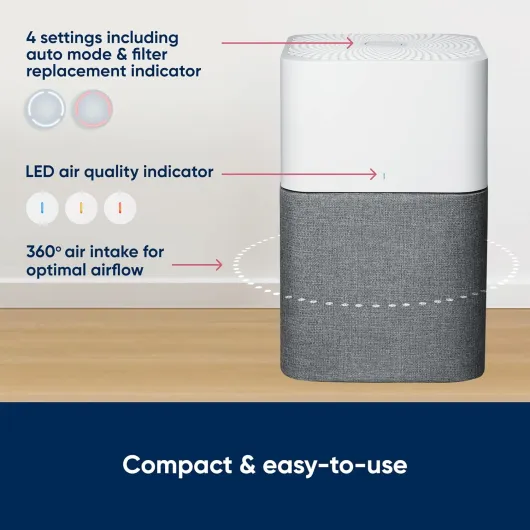
The top panel has a single touch button and a circular light that shows both the mode and the air quality. It’s very basic but in a good way: tap once to turn it on low, then again for medium, high, and auto, then off. No learning curve. The air quality indicator is a simple three-colour system: green is good, orange is moderate, red is bad. It’s not super scientific, but it’s enough to see at a glance if something set it off, like cooking or vacuuming.
One thing I liked is that the pre-filter fabric comes in different colours (mine is neutral grey). You can buy other colours if you care about matching your decor. The fabric feels decent and hasn’t pilled or stretched out yet after one wash. The only slight annoyance is dust sitting on the top grille over time, so you’ll want to wipe that every now and then. Overall, the design is functional and pretty solid: nothing flashy, but it blends into a normal home and doesn’t look cheap or fragile.
Comfort and daily use: noise, modes, and living with it
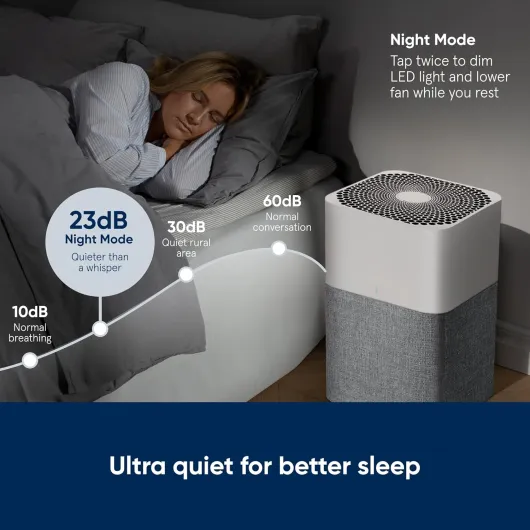
Day to day, the Blue 3610 is pretty easy to live with. You basically have four fan settings (three fixed speeds plus auto) controlled by a single touch button. I leave it on auto 90% of the time. On that setting, it usually runs on a very low speed where it’s honestly hard to hear unless the room is totally silent. The spec says around 23 dB on low, and that feels about right – it’s softer than most fridges. For sleeping, if you’re not super sensitive to any noise, it’s fine in a bedroom on low. If you are picky, you might still hear a faint whoosh, but it’s much quieter than many cheaper purifiers I’ve tried.
On medium and especially on high, it’s a different story. Medium is a noticeable background noise, like a fan on low. High is loud enough that you’ll be aware of it during a movie or a call. The good point is you don’t need high all the time. The auto mode only kicks it up when the air quality sensor detects a spike. When I’m cooking or vacuuming, it ramps up for maybe 5–15 minutes and then settles back down once the light goes green. So it’s a short burst of noise rather than a constant roar.
There’s also a night mode of sorts, where you set it on the lowest manual speed and the light dims. There’s no fancy sleep program, but in practice, it works: low noise, low airflow, but still filtering. I’ve slept with it in the room a few times and forgot it was on. If you really hate any light, you might need to cover the LED, but it’s not a huge glow – more of a soft ring.
Maintenance-wise, comfort is decent. The pre-filter is washable, so you just slide it off, throw it in the wash, and put it back when it’s dry. The main filter is a replace-every-few-months thing depending on your usage; it’s a simple lift-and-swap job, no tools. The only slightly annoying bit is remembering to clean the pre-filter regularly, because once it’s caked with dust, the airflow drops. But overall, in terms of living with it, it’s pretty low effort: one button, quiet most of the time, and no fiddly app settings to manage.
Build quality and durability after a few weeks
On durability, I obviously can’t judge it over years yet, but I can share how it feels and behaves after several weeks of daily use. The unit itself feels solid: no rattling panels, no cheap plastic smell, and no weird vibrations even when it ramps up to full speed. I’ve moved it around a few times between the living room and bedroom, and the casing hasn’t picked up scratches or dents. At 6.5 kg, it’s sturdy without being a brick.
The fabric pre-filter holds up fine to washing. I’ve run it through a gentle machine wash and it came out looking normal, no shrinking or loose threads. That’s important because if the pre-filter falls apart, you’ll end up clogging the main filter faster and paying more for replacements. The main filter itself is a standard cartridge-style piece; it slots in snugly and doesn’t wobble. After a few weeks, mine is already visibly grey, which is gross but also means it’s doing its job.
In terms of electronics and controls, the single-button interface has behaved well so far. The touch sensor responds consistently, and the air quality light changes in a way that makes sense with what’s happening in the room. I haven’t had any random shut-offs, error lights, or fan noises. The motor sound is smooth across all speeds, which usually points to decent build quality. Some cheaper purifiers develop a whining or buzzing sound after a while; so far, none of that here.
My only small concern is the mention (and my observation) of fine black dust likely coming from the carbon filter. It’s not a durability issue as such, but it does make me wonder how the carbon holds up over a long period. You’ll probably want to stick to the recommended filter replacement schedule to avoid it breaking down too much. Overall though, the Blue 3610 gives off the vibe of a solid, long-term appliance rather than a disposable gadget. Time will tell, but nothing so far suggests it’s fragile or poorly built.
Performance: how well it actually cleans the air
This is where the Blue 3610 earns its keep. In my place, the main test was: wood smoke from a neighbour’s stove, cooking smells from the open kitchen, and general dust and cat dander. On auto mode, the purifier usually sits on its lowest setting with a green light. When I start frying something or using the oven, the light almost always flips to orange or red within a minute or two, and the fan ramps up by itself. You can clearly hear it when it jumps to full power, but you also see the light go back to green in around 5–10 minutes after cooking, depending on how smoky I’ve been.
In terms of air quality, the most noticeable change has been the reduction in lingering smells and that slightly heavy feeling in the evening. Before, if we cooked something strong like curry or bacon, the smell would hang around for hours. Now it still smells while you’re cooking, but it fades much faster once you’re done. Same for candles: there’s still a bit of scent, but the smoky edge disappears quicker. It’s not like opening all the windows, but it clearly speeds things up, especially when it’s too cold outside to ventilate properly.
On the allergy side, my partner has seasonal allergies and is pretty sensitive to dust. With the purifier running most of the day on auto, they’ve had fewer random sneezing fits in the evening and less stuffy nose in the morning. It’s not a miracle cure, but the difference is real enough that we notice when we forget to turn it on for a day. The pre-filter and main filter collect a surprising amount of dust and fibres. When I checked after about two weeks, the fabric pre-filter was already coated with a grey layer, which is both gross and reassuring.
Noise-wise, performance is very mode-dependent. On low/auto at night, it’s genuinely quiet and easy to ignore. On full power, it’s loud – not unbearable, but you’re not going to forget it’s on. The good news is that in normal use it doesn’t stay on max for long. It kicks up, cleans, and drops back down. Overall, in practice, it gets the job done very well for a big living space: faster smell removal, less dust in the air, and calmer allergies. Not perfect, but for something you just plug in and leave alone, it’s pretty solid.
What you actually get with the Blue 3610
The Blueair Blue 3610 is basically a big square tower: 33 x 33 cm at the base and just over 52 cm tall. It weighs about 6.5 kg, so it’s not super light, but you can still move it around without breaking your back. It’s rated for large rooms (they say up to around 51 m² in the detailed text, and 122 m² floor area in the spec, which is a bit confusing). In practice, for a normal living room or open-plan area, it feels about right. I wouldn’t buy it for a tiny bedroom; it’s overkill.
Out of the box you get the main unit, a pre-filter fabric sleeve (mine was grey), and the main filter already installed. The pre-filter is like a stretchy fabric that wraps around the bottom half. It’s machine washable, which is handy because it catches a lot of visible dust and pet hair. There’s just one button on the top that controls everything: off, low, medium, high, and auto mode. No remote, no app, no screen full of numbers. You also get a simple colour LED ring that shows the air quality: green, orange, or red.
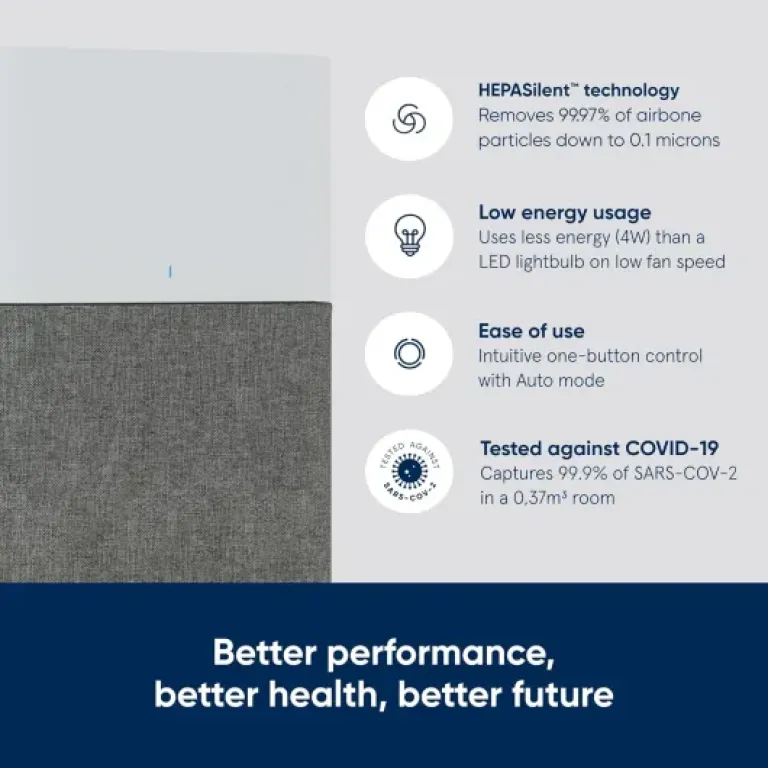
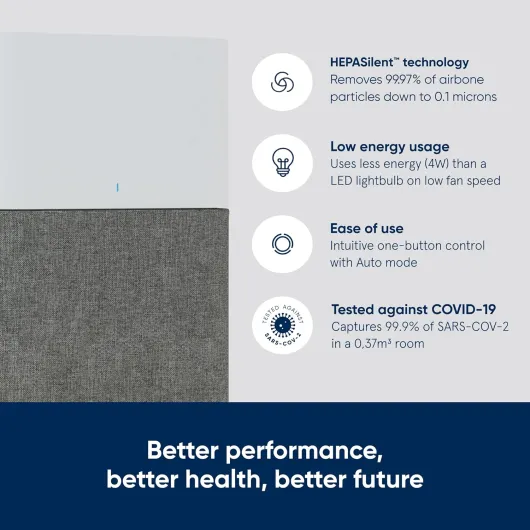
The filtration system is a combo: they use their so-called HEPASilent tech plus a carbon section. The technical bit says it removes 99.9% of particles down to 0.1 micron and 99.99% of pollen, and the carbon part helps with light odours and VOCs. I can’t verify the exact numbers, but I can say the filter gets dirty fast, which is a good sign it’s actually catching stuff. Compared to my old budget purifier, the airflow is stronger and you can feel the clean air coming out of the top.
One thing to flag: the specs list 4–38 W energy use, which is pretty low and fits with how it runs. There’s also a random “1500 watts” line in the data, which is clearly a mistake because it doesn’t pull anything close to that. On auto or low it sips power. Overall, the presentation is straightforward: big room purifier, simple controls, washable pre-filter, and a combination filter that covers particles plus odours. It feels like a no-nonsense appliance more than a gadget, which I personally prefer.
Effectiveness on dust, odours, and allergies
To be a bit more specific on effectiveness, I looked at three things: visible dust, smells, and allergy reactions. For dust, the easiest way to see it is on dark furniture and in the sunlight beams. After running the Blue 3610 daily, I noticed I’m dusting shelves and the TV stand slightly less often. Dust still settles, obviously, but it builds up slower. The pre-filter also tells the story: it goes from clean grey to dirty grey pretty fast, especially with a pet in the house. It definitely pulls a lot of fibres and fluff out of circulation.
For odours, I tested it with cooking (onions, bacon, stir-fries) and with a bit of smoke from a frying pan that got too hot. In all cases, the auto mode reacted, the fan ramped up, and the smell cleared quicker than if I just relied on the cooker hood and a cracked window. It doesn’t erase strong cooking smells instantly – you’ll still smell what you’ve cooked – but the heavy, stale layer that usually lingers into the night is much less present. Same story with general “closed house” odour after a weekend away: running it on medium for a couple of hours freshened the place up without having to open every window.
On allergies, this is obviously subjective, but the feedback from my partner is that their nose and eyes feel less irritated in the evenings. They used to get random sneezing fits when we sat down on the sofa after a day with the windows closed. That happens a lot less now. We also noticed fewer mornings with a dry, scratchy throat. I’m not saying it fixes asthma or replaces medication, but as a background helper, it seems to reduce the triggers a bit. That lines up with the claims about catching pollen and fine particles down to 0.1 micron.
There is one slightly odd side effect that another Amazon review also mentioned: very fine black dust around the unit. I’ve noticed a tiny bit of dark powder on the floor near the base after a while, likely from the carbon filter. It’s not dramatic, but it’s there if you look closely. Keeping the purifier a bit away from sensitive surfaces and doing a quick vacuum around it every now and then solves it, but it’s worth mentioning. Overall, though, as far as cleaning the air goes, it’s effective in a very practical, everyday way.
Pros
- Very quiet on low/auto, easy to ignore in daily use or at night
- Auto mode reacts quickly to cooking, smoke, and dust and clears the air fairly fast
- Simple one-button operation with washable pre-filter and strong overall filtration
Cons
- High purchase price plus ongoing cost of replacement filters
- Loud on maximum speed when auto mode kicks up during heavy pollution
- Some fine black dust likely from the carbon filter around the base over time
Conclusion
Editor's rating
The Blueair Blue 3610 is a solid choice if you’ve got a decent-sized room and you’re serious about cleaner air, especially for allergies, pets, or cooking odours. It’s not flashy: there’s no app, no fancy display, and the design is basically a big white box with a fabric band. But in daily use, it does exactly what you want an air purifier to do: it runs quietly in the background on low, ramps up automatically when the air gets dirty, and actually clears smells and dust faster than cheaper units. Allergies in my household eased up, and the room feels less stuffy, which is what I was hoping for.
On the downside, it’s not cheap, the replacement filters will add to the long-term cost, and when it jumps to full speed it’s definitely loud. There’s also that slight issue of fine black dust around the base, likely from the carbon filter, which is annoying but manageable if you keep it a bit away from surfaces and vacuum around it. If you only need something for a small bedroom and you’re on a tight budget, this is probably too much. But if you want a reliable, quiet workhorse for a big living room or open-plan space, and you’re willing to pay a bit more for comfort and performance, the Blue 3610 is a pretty solid bet.