
Summary
Editor's rating
Value for money: who should actually pay this much
Design: built more like a hospital machine than a living room gadget
Everyday comfort: noise, ease of use, and living with it
Build quality, filters and long-term use
Performance: how well it actually cleans the air
What you actually get when you buy the Rediair
Pros
- Dual HEPA 14 filters with high CADR, suitable for larger rooms and more serious filtration needs
- Quiet enough on lower settings to sleep or work next to, considering the airflow
- Solid, professional-feeling build quality that seems ready for regular use in offices or clinics
Cons
- Large and heavy unit that takes up floor space and is awkward to move between rooms
- High purchase price plus ongoing filter replacement costs
- No smart features or air quality display despite the premium positioning

Specifications
View full product page →| Brand | Clinell |
Serious air purifier for people who are actually worried about air quality
I’ve been using the Clinell Rediair in a medium-sized flat and occasionally dragging it into a small office, mainly for two reasons: allergies and the general fear of picking up every bug going around. I already had a cheaper consumer air purifier before this, so I wasn’t starting from zero. What pushed me to try the Rediair was the dual HEPA 14 claim and the fact Clinell kit is all over hospitals. That gave me a bit more confidence that this wasn’t just another white box with a fan inside.
First thing to know: this is not a cute little bedroom gadget. It’s big, heavy (around 15 kg), and looks like it belongs in a clinic rather than a living room. If you’re expecting something discreet you can tuck behind a plant, this isn’t it. You kind of have to accept that it will be a visible piece of kit in the room. On the flip side, it feels like it actually moves air, which was my main gripe with smaller units.
I’ve mainly run it in the living room (open-plan, roughly 35–40 m², decent ceiling height) and in a shared office with 4–5 people. Use cases for me: hay fever season, city pollution, and when someone is coughing their lungs out nearby. I don’t have lab equipment to measure particles, but I do have a nose, lungs, and a history of annoying allergies, so I notice when air is dusty or stuffy.
Overall, my feeling after a few weeks is that it’s a serious bit of hardware that actually clears the air, but it’s not perfect. It’s bulky, not cheap, and a bit overkill for tiny rooms. If you live in a small flat and just want a bit of help with cooking smells, there are cheaper and more compact options. If you’re trying to keep a shared space cleaner during flu season or dealing with pollution/allergies, then it starts to make more sense.
Value for money: who should actually pay this much
Let’s talk money. This thing sits in a much higher price bracket than your typical home air purifier. You’re paying for dual HEPA 14 filters, high CADR, and the fact it’s specced to a standard that makes sense in medical and office environments. If all you want is something to slightly reduce dust in a bedroom, this is probably overkill. You can get cheaper units that will do a decent job for half or a third of the price, even if they don’t catch quite as many tiny particles.
Where the value starts to make sense is if you actually care about serious filtration and larger rooms: offices, treatment rooms, shared living spaces, or households with someone who has asthma or a weak immune system. In that context, the price is still high, but you’re paying for proper airflow and higher-grade filters rather than pretty design or smart features. Compared to some "designer" purifiers that cost a lot but only offer HEPA 13 and lower CADR, the Rediair feels more honest: ugly but strong.
You do need to factor in filter replacement costs. With roughly 3,000 hours of filter life, it’s not like you’re changing them every few months, but it’s not free either. Over a few years, the total cost of ownership adds up. If you’re running it in a busy office or clinic, that’s probably acceptable as part of operating costs. For a private user, it might sting a bit, especially if you’re on a tight budget.
So, is it good value? I’d say it’s fair value if you actually need what it offers: high CADR, medical-grade HEPA 14, and solid build. If your needs are lighter – occasional use, small rooms, mostly smells rather than serious filtration – then it’s not great value at all and you’d be better off with a cheaper, smaller unit. This is more of a semi-professional tool than a casual home gadget, and the price reflects that.
Design: built more like a hospital machine than a living room gadget
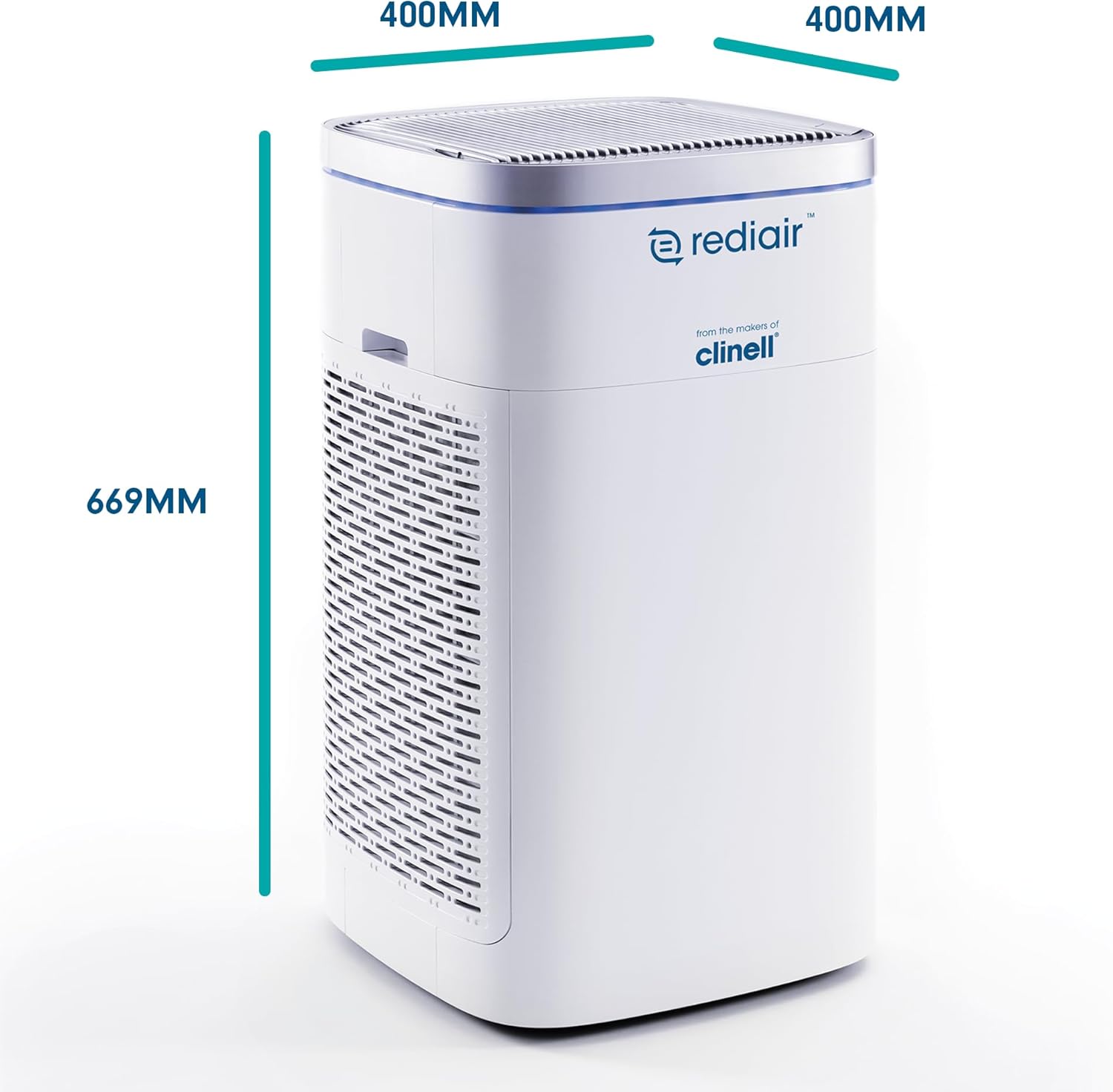
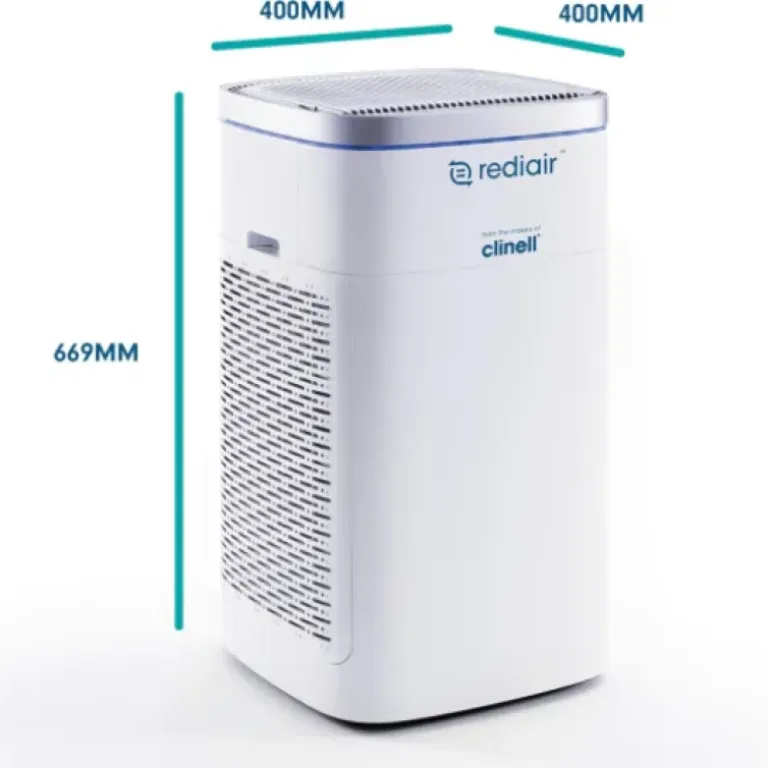
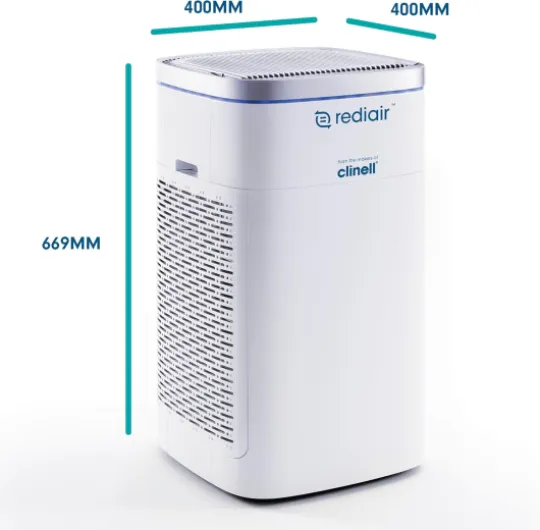
The design is very straightforward: a tall white rectangular unit (40 x 40 x 67 cm) with intakes on both sides and a control panel on top. No curves, no fancy trims, no wood-effect nonsense. It honestly looks like something you’d see in a clinic corridor, which makes sense given Clinell’s background. Personally, I don’t mind the clinical look, but it definitely doesn’t blend into a cosy living room the way smaller purifiers do. You have to accept that it will be visible and a bit industrial-looking.
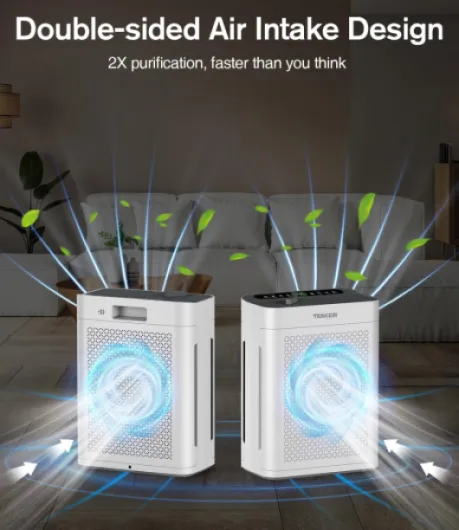
Because of the dual intake design, you need to give it space on both sides. You can’t shove it right up against a wall or a sofa and expect full performance. I ended up placing it slightly away from the wall, which means it eats into floor space more than I’d like. In a large room or open-plan office, that’s fine. In a cramped bedroom, it’s annoying. The footprint is roughly the size of a medium side table, but taller.
The build quality feels solid. The plastic doesn’t creak, the buttons respond well, and there’s no rattling or weird vibrations even on higher speeds. It doesn’t feel cheap or flimsy. That said, it’s not stylish – it’s functional. If you’re trying to keep your space looking minimal and carefully decorated, this will stand out. I wouldn’t call it ugly, but it’s not trying to be pretty either. It’s a white box whose job is to move air, and that’s exactly how it looks.
One thing I do like is the top-mounted control panel. You don’t have to bend down to the floor to change settings, which sounds small but actually matters when you’re using it daily. The touch buttons are clear and the icons are simple enough to understand without reading the manual. No colour screen or smart animations, but also no nonsense. Overall, the design is pragmatic and focused on performance, with very little attention paid to aesthetics beyond "clean white box".
Everyday comfort: noise, ease of use, and living with it
From a day-to-day comfort point of view, the Rediair is easy to live with as long as you accept the size. Using it is simple: touch buttons on top for power, fan speeds, timer, and child lock. No app to fiddle with, no registration, no cloud account. If you like simple hardware that just works when you press a button, that’s a plus. If you love automation and controlling everything from your phone, you’ll probably find it a bit basic.
Noise-wise, I was pleasantly surprised. On its lowest and night modes, it’s genuinely quiet enough to sleep with in the same room, assuming you’re not super sensitive. It’s a low, steady hum rather than an annoying high-pitched whine. On medium, it’s clearly audible but fine for working or watching TV if it’s not right next to you. On the highest setting, you notice it, but that’s usually when you want to clear the air quickly rather than keep it running all day. The brand claims 10 dB, which feels optimistic for all modes, but it’s definitely on the quieter side for the airflow you get.
The main comfort downside is the weight and bulk. At about 15 kg, moving it between rooms is possible but not fun, especially if you have stairs. I can carry it, but it’s not something I want to move every day. So in reality, you’ll probably park it in one main room and leave it there. If you were imagining easily rolling it from bedroom to living room to office, that’s not very realistic unless you’re strong and don’t mind lugging it around.
In terms of heat and drafts, it doesn’t blast cold air like an AC, but you do feel airflow around it, especially on higher settings. In winter, I didn’t find it uncomfortable, but you’ll want to avoid sitting directly in the strongest airstream. Overall, in daily use it’s user-friendly and not too noisy, but the size and weight mean you need to think a bit about where you place it and probably treat it as a semi-permanent fixture in one room.
Build quality, filters and long-term use
On the durability side, the Rediair feels like it’s built to be used in professional settings, not just turned on once a week at home. The casing is solid, the seams are clean, and the whole unit feels sturdy when you grab it. I didn’t notice any flexing or cheap feeling panels, even when I moved it around and bumped it lightly into a door frame (which happens when you’re dragging 15 kg around). It gives the impression that it can handle regular use in an office or clinic.
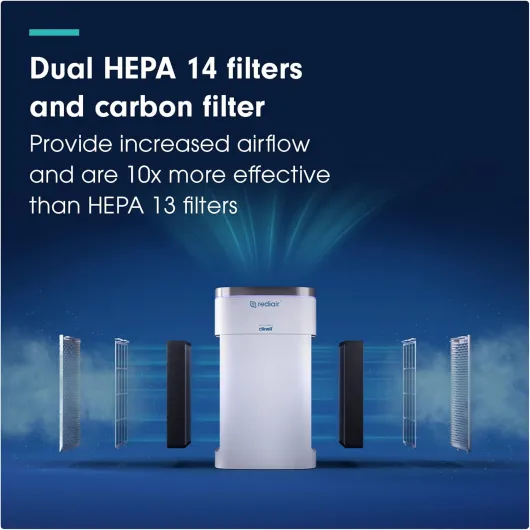
The filters are where the long-term cost comes in. You’ve got two HEPA 14 filters plus carbon and pre-filters, and the manufacturer mentions around 3,000 hours of life for the filters in typical usage. If you run it 8 hours a day, that’s roughly a year before needing to change them, but that obviously depends on your air quality. In a very dusty or polluted area, you might need to replace them sooner. Filter replacement isn’t as quick and cheap as the small consumer units either – you’re dealing with medical-grade parts, and the price reflects that.
Accessing the filters is straightforward enough; panels come off without tools, and you can see the layers clearly. That’s handy because you can visually check how dirty things are getting instead of guessing. I like that the pre-filter and carbon part take the first hit from dust and smells, which should help the HEPA filters last longer. There’s no complex mechanical parts to worry about beyond the fans, and those feel well balanced – no rattling or grinding noises after several weeks of use.
Overall, if you’re planning to use this regularly for the long haul, it looks and feels up to the job. Just keep in mind that the ongoing filter cost is part of the deal. This isn’t a one-off purchase where you forget about maintenance. It’s more like buying a serious appliance: solid, but you have to budget for keeping it in good shape.
Performance: how well it actually cleans the air
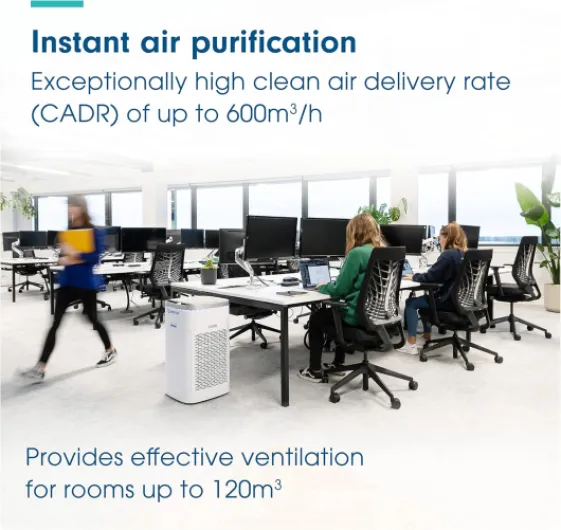
Performance-wise, this is where the Rediair justifies its size. With the CADR up to 600 m³/h and dual HEPA 14 filters, it moves a lot more air than the cheaper tower purifier I used before. In my open-plan living room (around 35–40 m²), running it on a medium setting for 30–60 minutes genuinely changes how the room feels. Dust in the air seems reduced, and that slightly stale smell you get after closing windows all day in winter goes away faster than with my old unit.
I don’t have pro measuring tools, but I do have some real-world tests. During a heavy cooking session (frying plus oven), I turned the Rediair on a higher speed in the adjacent room. Within about 20–30 minutes, the lingering smell dropped noticeably compared to what I’m used to. Same story with pollen season: my usual morning sneezing fits are cut down when I’ve had this running for a few hours the evening before. It doesn’t magically cure allergies, but it does make the air feel cleaner and less irritating.
In the office, with four people in a smallish room and windows mostly shut, the main difference I noticed was that the room felt less stuffy and “used” after a few hours. Hard to prove infection control with just day-to-day use, but it’s clearly moving a lot of air and the filters are proper medical-grade. If you’re aiming for multiple air changes per hour in a shared space, this makes more sense than a small bedside unit.
Noise performance is decent for the airflow you get. On the lower settings and night mode, you can sleep or work without being annoyed. It’s more of a soft whoosh than a harsh fan noise. On higher speeds, you do hear it, but it’s still quieter than I expected for something moving that much air. If you’re only used to tiny purifiers, you’ll notice the sound; if you’ve used big fans or air movers before, this will feel quite controlled. Overall, in terms of actual air cleaning and airflow, it gets the job done very well.
What you actually get when you buy the Rediair
Out of the box, the Clinell Rediair feels like a professional unit more than a home gadget. The box itself is big and awkward, and I’d honestly recommend having a second person around if you’re not comfortable lifting 15 kg. Inside you get the unit, the power cable, and documentation. No app, no remote, no fancy smart home stuff. It’s basically: plug in, press buttons, done. That can be good or bad depending on how much you like tech.
The main selling point on paper is the dual HEPA 14 filters plus carbon and pre-filter setup. HEPA 14 is a higher grade than the usual HEPA 13 you see in most consumer purifiers. In theory, that means it catches more of the tiny particles (they claim 99.995% down to 0.3 microns). You also get a claimed CADR of up to 600 m³/h, which is pretty solid for rooms up to around 120 m³ (so roughly a big living room, open-plan office, or a treatment room). In practice, that translates to feeling like it actually circulates and cleans the air instead of just gently stirring it.
The control panel on top is a simple touch interface with options for fan speed, timer, child lock, and a kind of quiet/night mode. No learning curve really – I didn’t even bother with the manual at first and still managed to get it going in about 30 seconds. There’s no built-in fancy screen that shows you particle counts in real time, which some people might miss if they like numbers and graphs. For me, that’s not a deal-breaker, but at this price, a basic air quality indicator would have been nice.
Overall, as a package, it feels like a piece of clinical equipment adapted for offices and homes, not the other way around. If you’re expecting a slick lifestyle product with an app and mood lights, this isn’t it. If you want something that looks and feels like it was designed to do one job – move and filter air hard – then the Rediair lines up pretty well with that expectation.
Pros
- Dual HEPA 14 filters with high CADR, suitable for larger rooms and more serious filtration needs
- Quiet enough on lower settings to sleep or work next to, considering the airflow
- Solid, professional-feeling build quality that seems ready for regular use in offices or clinics
Cons
- Large and heavy unit that takes up floor space and is awkward to move between rooms
- High purchase price plus ongoing filter replacement costs
- No smart features or air quality display despite the premium positioning
Conclusion
Editor's rating
The Clinell Rediair is a serious air purifier aimed at people who genuinely care about air quality, not just a cosmetic gadget to park next to a plant. The dual HEPA 14 filters, high CADR and overall build make it feel closer to hospital or office equipment than the usual slim home units. In real life, it moves a lot of air, cuts down on dust and pollen, and helps a room feel less stale, especially in city environments or during allergy season. Noise levels are reasonable for the amount of air it pushes, and daily use is simple thanks to the basic touch controls.
On the downside, it’s big, heavy, and not cheap. It’s not something you casually move from room to room, and it doesn’t try to look stylish or hide in the background. Ongoing filter costs also need to be considered, especially if you run it many hours a day. There’s no app, no fancy air quality readout, and no smart home gimmicks – which some people will see as a plus, others as a lack of features for the price.
Who is it for? Offices, clinics, shared workspaces, and homes where someone has asthma, strong allergies, or higher infection risk – basically places where you actually care about proper air changes and stronger filtration. Who should skip it? People in small flats wanting a compact, good-looking purifier for light use, or anyone on a tight budget who doesn’t need medical-grade specs. If you’re in the first group, it’s a pretty solid choice. If you’re in the second, it’s probably more machine than you need.