
Summary
Editor's rating
Value for money: worth it, but with a filter asterisk
Design: looks decent, but a few practical details are missing
Filters, maintenance and long-term worries
Noise, speed and app: how it behaves in real daily use
What this purifier actually is, on paper and in real life
Effectiveness: does it actually clean the air or just blow it around?
Pros
- Quiet in auto and sleep modes, suitable for bedroom use
- Good at reducing everyday dust, pet dander and cooking smells in small to medium rooms
- Low power consumption (~21–23W) so you can leave it running without worrying too much about electricity
Cons
- Official replacement filters are not cheap and availability is a concern
- No proper carrying handle, a bit awkward to move between rooms

Specifications
View full product page →| Brand | Philips |
A small purifier that actually feels like it’s doing something
I’ve been using the Philips Air Purifier 900 Series (AC0951/13, the 2025 black version) for a few weeks in a small flat: bedroom at night, living room during the day. I didn’t buy it for some hardcore pollution issue, more for allergies, dust and to cut down on cooking smells and that “stale flat” vibe. So this is coming from normal, daily use, not a lab test. I also already own a bigger purifier from another brand, so I had something to compare it with.
The first thing I noticed: on auto mode it stays quiet most of the time and only ramps up when something actually happens – cooking, candles, cleaning sprays, or when I open the window on a busy road. The colour ring and the PM2.5 number change fast, so you clearly see when the air goes from "clean" to "meh" and back again. It’s a bit reassuring because otherwise you’d just have to trust the device blindly.
Overall, the feeling in the room is simply that the air is less stuffy. No miracle, but less dust floating around in the sun rays, fewer lingering smells, and my nose is less blocked when I wake up. I’m pretty sensitive to dust and cat hair, and I can tell the difference if I forget to turn it on for a couple of days. It’s not night and day, but it’s noticeable.
It’s not perfect though. The app is useful but a bit overkill if you just want to press one button and forget about it. Replacement filters are not super cheap, and there’s already some worry about stock because Philips likes to rotate models. But in day-to-day use, the device itself is practical, simple, and it gets the job done without making a fuss or eating a lot of power.
Value for money: worth it, but with a filter asterisk
In terms of value, this Philips 900 Series sits in the mid-range of air purifiers. It’s not the cheapest, but it’s also not one of those super pricey “design” models. For what you pay, you get: solid cleaning performance for small to medium rooms, very low energy use, a proper HEPA + carbon filter, and decent noise levels. Considering the current Amazon rating (around 4.5/5 from a lot of reviews), I’m clearly not the only one who thinks it’s pretty solid overall.
Where the calculation gets trickier is the running cost. A new official filter every year at about £40 adds up if you plan to keep it for several years or if you run multiple units in your home. If Philips really does discontinue this model soon, as one reviewer suspects, then you might end up hunting for filters or settling for weaker third-party ones. That can kill the value pretty fast, because a purifier without a good filter is basically just a fan in a box.
Compared to cheaper no-name purifiers I’ve tried, the Philips does a better job on three points: faster reaction to pollution, more reliable automatic mode, and quieter sleep mode. For me, that justifies paying a bit more. Compared to bigger, more expensive units, it obviously moves less air and covers a smaller space, but for a typical bedroom or office, it’s enough. If you catch it on a discount like some Amazon buyers did, the price/performance ratio becomes quite attractive.
So in short: as long as filters stay available at a reasonable price, I’d say it’s good value for money for allergy sufferers, pet owners, and anyone annoyed by cooking smells or stuffy rooms. If filter supply becomes a mess, the value drops quickly. That’s the one big thing I’d check before buying: can you easily buy the FY0910 filter right now, and what does it cost?
Design: looks decent, but a few practical details are missing
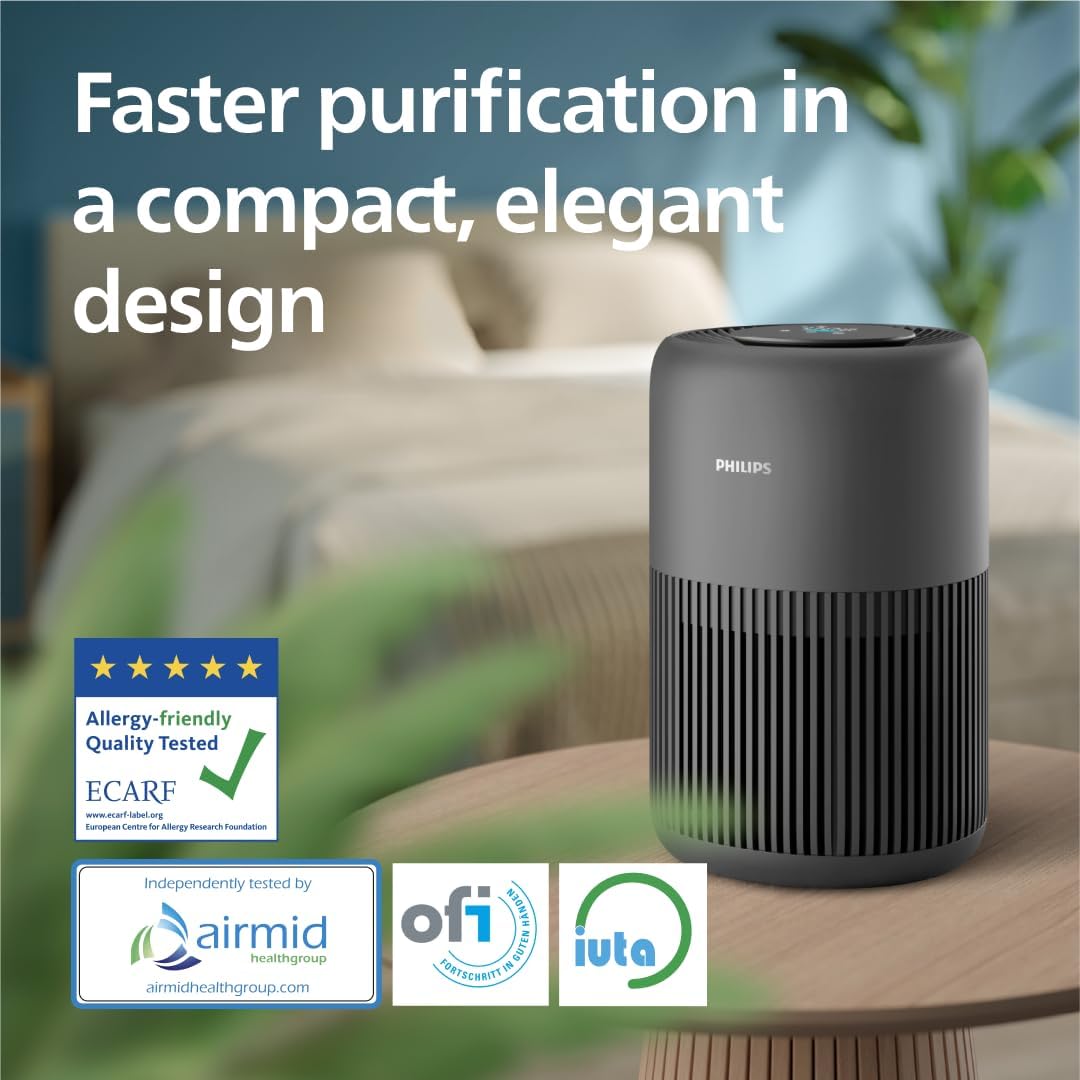
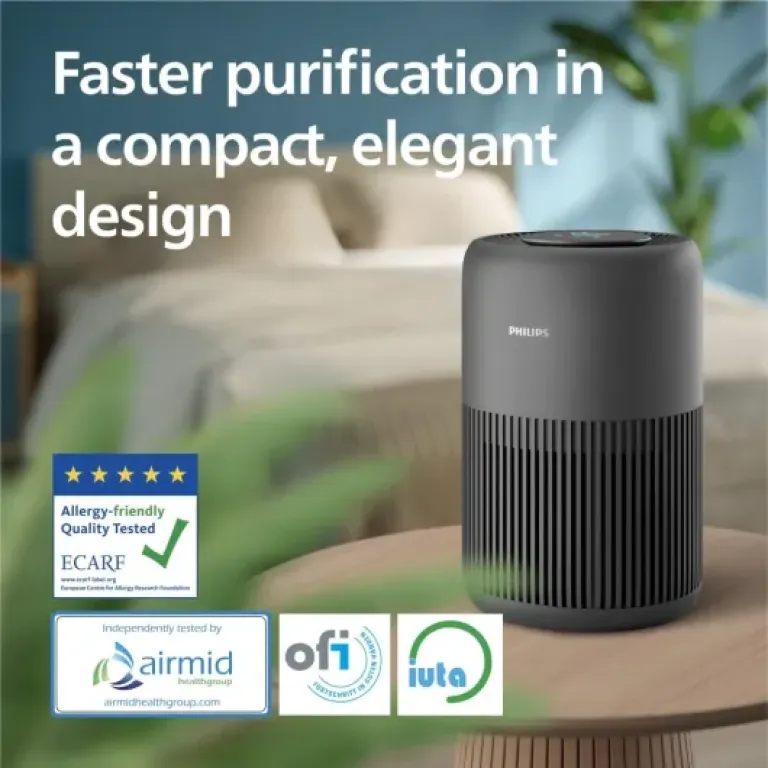
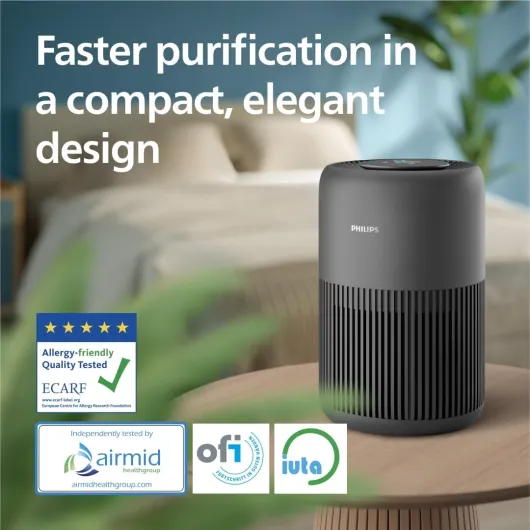
Design-wise, this thing is pretty simple: a black cylinder-ish box with rounded edges and a top grille where the clean air comes out. One Amazon reviewer said it looks like a Dalek, which isn’t totally wrong. Personally I don’t care much as long as it doesn’t scream “medical device”, and on that front it’s fine. In a corner of a living room or bedroom, it blends in enough – it just looks like another small appliance.
The control panel on top is clear: power button, mode selection, and a small screen that shows the PM2.5 number and colour ring (blue = clean, red = bad). The interface is basic but clear, which I prefer over those models where you need a manual to understand the icons. You can also turn the lights down in sleep mode, so it doesn’t light up the room like a Christmas tree at night. That’s something a lot of brands still get wrong.
On the downside, there’s no proper handle. At 3.5 kg it’s not heavy, but you do end up grabbing it awkwardly from the sides or from the bottom when you move it from bedroom to living room. A simple handle or recess would have made it much easier, especially if you move it every day. It’s a small detail but you feel it quickly in practice. Also, the power cable is just long enough for normal use, but don’t expect a lot of freedom if your sockets are badly placed.
Build quality feels decent for the price range: the plastic doesn’t look fancy, but it doesn’t feel super cheap either. The filter access is via the back/side panel which clips off easily, so maintenance is straightforward. No creaks, no weird vibrations so far. In short, the design is functional, not stylish. If you want something that looks like a design object, this isn’t it. If you want something that just sits in a corner and doesn’t attract too much attention, it does the job.
Filters, maintenance and long-term worries
For durability, the key part on this kind of product is clearly the filter situation. Philips says the FY0910 filter lasts up to about a year, depending on use and pollution. The purifier itself tracks filter life and tells you when to replace it, which is handy because you don’t have to guess. In practice, after a few weeks, the filter already had a visible layer of dust on the pre-filter when I opened it to vacuum it. That’s both slightly gross and reassuring, because it shows the thing is actually catching stuff.
The annoying bit is what some Amazon reviews mentioned: availability of replacement filters. Philips has a habit of changing models and sometimes the filters go out of stock for a while. Official filters are not cheap (around £40 at the time of writing), and third-party filters are hit or miss. A few people say the generic ones don’t filter as well. So if you plan to keep this purifier for several years, this is something to keep in mind. The device itself might last, but if you can’t find decent filters easily, it’s a problem.
On build quality, after a few weeks of moving it between rooms, no rattling, no weird noises, and the plastic casing still feels solid enough. The panel for accessing the filter clips on and off without feeling like it’s going to snap. There are no fancy moving parts aside from the fan, so in theory there’s not much to break. I’d expect it to last a few years if you don’t abuse it, especially since the motor isn’t running at insane power levels.
Maintenance is simple: vacuum the pre-filter roughly once a month (depending on how dusty your place is) and replace the full filter around once a year. If you’re lazy with cleaning, performance will drop and the fan might get noisier. So it’s not totally maintenance-free, but it’s manageable. Overall, durability seems fine for the price, but the uncertainty around long-term filter supply is the main red flag for me.
Noise, speed and app: how it behaves in real daily use
On the performance side, there are three big points: noise, cleaning speed, and the app. Noise first. In sleep mode, Philips says 20.5 dB, and subjectively it’s really quiet. In a silent bedroom at night, you hear a soft airflow if you listen for it, but it’s not disturbing. If you like white noise, it’s even a bit pleasant. Auto mode at night will usually stay at this low level unless you open a window or stir up a lot of dust.
On medium and turbo, you’ll definitely hear it. It’s not like a vacuum, but it’s clearly noticeable if you’re watching TV quietly. The good thing is that auto mode doesn’t stay loud for long. When it detects pollution (cooking, smoke, aerosols), it ramps up, cleans for a while, and then drops back down when the PM2.5 level falls. In my 20 m² living room, after frying food or using the oven, it takes roughly 10–20 minutes to go from orange/red back to blue, depending on how intense the smell is.
In terms of power, it’s pretty modest at around 21–23W max. So you can leave it running a lot without stressing over the electricity bill. I’ve basically left it on auto from morning to night most days, and I haven’t seen any scary jump on my smart meter. This is a clear advantage over older, more power-hungry units.
About the Air+ app: connection was okay, but not instant. Like some reviewers, I had a short delay before the purifier appeared correctly in the app. Once it’s set up, you can control everything remotely, see indoor air quality history, and even check outdoor pollution and pollen for your area. It’s cool at first, but honestly, after a week I mostly stopped opening the app. For me, the app is a bonus, not a reason to buy. If you like tinkering with schedules and graphs, you’ll enjoy it. If not, you can ignore it and just use the buttons on top, and you’re not losing much.
What this purifier actually is, on paper and in real life
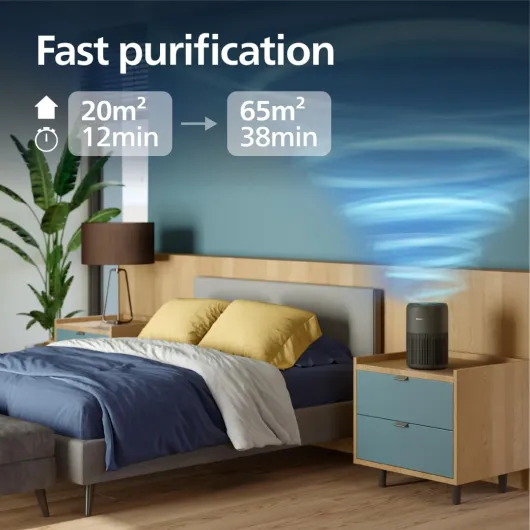
On paper, this Philips 900 Series purifier is supposed to handle up to 65 m² with a CADR of 250 m³/h. In reality, I’d say it’s best for bedrooms, offices, and medium living rooms. In my 20 m² living room it can clear cooking smells and general haze reasonably fast, but I wouldn’t rely on a single unit like this for a big open-plan flat. It weighs about 3.5 kg and measures roughly 24 x 24 x 36 cm, so it’s compact enough to move around, but not tiny either – think small pedal bin size.
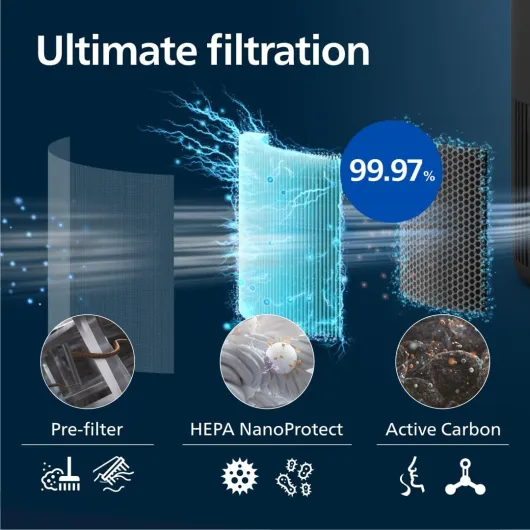
Inside, you’ve got a 3-layer filter: pre-filter, HEPA NanoProtect, and activated carbon. That combo is meant to catch fine particles, allergens, and some gases/odours. The HEPA part is rated to trap 99.97% of tiny stuff, down to 0.003 microns according to Philips. I obviously can’t verify the exact numbers at home, but based on how it reacts to smoke from a pan or a blown-out candle, the sensor is not just for show. It ramps up within seconds and you can literally watch the PM2.5 value climb and then drop again.
There are several modes: Auto, Sleep, and manual fan speeds (including a higher one that’s quite audible). Auto mode is the only one I really use; it manages noise vs cleaning fairly well. Sleep mode is impressively quiet – if you’re used to some background noise, you’ll barely notice it. The screen dims, which is good if you’re picky about light at night.
Philips also pushes the Air+ app angle. Once connected to Wi‑Fi, you can turn it on/off, change modes, see indoor and outdoor air data, and set schedules. It’s handy if the purifier is in the bedroom and you want to start it from the sofa, but honestly, after the first week I mostly left it on auto and didn’t touch the app much. The big point is: the basics work fine without the app, you’re not forced to fiddle with your phone all the time.
Effectiveness: does it actually clean the air or just blow it around?
This is the part that matters: does it actually change anything in day-to-day life? In my case, yes, but it’s more of a steady improvement than a big wow moment. I have mild dust and pollen allergies and a cat. With the purifier running on auto all day in the living room, I’ve noticed fewer sneezing fits when I sit on the sofa and less of that scratchy feeling in the throat in the evening. When I forget to turn it on for a couple of days, I do feel a slight difference, especially with the cat.
For odours, it’s pretty solid. Cooking smells don’t spread as much beyond the kitchen if I switch the purifier to a higher speed or just let auto mode react. One Amazon review mentioned it picks up cigarette smoke and burnt food quickly; I had a similar experience with a badly burnt toast situation – the ring went orange/red, fan ramped up, and after 15–20 minutes the room smelled normal again instead of like a toaster graveyard. It also reacts to things like candles, cleaning sprays, and even that “new appliance” smell from a washing machine, which lines up with other user reviews.
About the allergy claims (ECARF certified, 99.99% of allergens, etc.): I can’t measure that precisely at home, but my nose is a decent sensor. During a high-pollen week, sleeping with this in the bedroom on sleep mode, I woke up with a less blocked nose than usual. Not completely clear, but better. Compared to having no purifier or a cheap basic one I used before, the Philips feels more consistent. It reacts faster and seems to keep the air a bit more stable once it gets to the “blue” zone.
So no, it doesn’t turn a polluted room into a mountain cabin, but for everyday stuff – dust, pet dander, cooking smells, light smoke, general stuffiness – it does a good job. If your expectations are realistic and you use it in a room size that makes sense (up to 20–30 m² ideally), you’ll probably be satisfied with the actual cleaning performance.
Pros
- Quiet in auto and sleep modes, suitable for bedroom use
- Good at reducing everyday dust, pet dander and cooking smells in small to medium rooms
- Low power consumption (~21–23W) so you can leave it running without worrying too much about electricity
Cons
- Official replacement filters are not cheap and availability is a concern
- No proper carrying handle, a bit awkward to move between rooms
Conclusion
Editor's rating
Overall, the Philips Air Purifier 900 Series (AC0951/13) is a practical, no-nonsense purifier that does what most people actually need: it reduces dust, pet dander, and everyday smells, and it does it quietly enough to live with all day. In a normal-sized bedroom or living room, the automatic mode keeps the air reasonably clean without you having to babysit it, and sleep mode is quiet enough even if you’re sensitive to noise. The app is a nice extra if you like data and remote control, but it’s not mandatory to get value from the device.
It’s not perfect. The lack of a proper handle is a bit dumb for something you might move between rooms. The main concern though is filter availability and cost. The purifier itself is decent value, but you’re committing to buying a new filter about once a year, and if Philips stops stocking them or keeps them pricey, the long-term cost climbs. If you’re okay with that and you’re mainly targeting allergies, pet hair, and cooking smells in small to medium rooms, it’s a solid option. If you want to cover a huge open space or you hate the idea of paying for filters regularly, you should probably look at either a bigger unit or a different brand.