
Summary
Editor's rating
Value for money: where it makes sense and where it doesn’t
Design: compact, a bit plasticky, but practical
Noise, daily use, and living with it 24/7
Aromatherapy feature: nice extra, not a diffuser replacement
Performance: solid CADR, realistic coverage is smaller than the ad
What you actually get with the TENKER AP300
Effectiveness in real life: pets, dust, and smells
Pros
- Quiet operation with a very usable sleep mode (no lights, very low noise)
- Decent CADR (300 m³/h) and dual-sided H13 HEPA + carbon filters for solid cleaning in medium rooms
- Simple controls with auto mode, PM2.5 display, and washable pre-filters that keep running costs reasonable
Cons
- Coverage claim (3000 ft²) is unrealistic for fast cleaning; better suited to single rooms or small flats
- Build feels a bit plasticky and sensor readings tend to be slightly optimistic compared to external meters

Specifications
View full product page →| Brand | TENKER |
An unknown-brand purifier I actually left running all day
I’ve been running the TENKER AP300 air purifier at home for a bit now, in a two-bedroom flat with a cat, cooking smells, and a main road right outside. I didn’t know the brand at all before this. I usually stick to better-known names like Philips or Levoit, so I went in expecting something a bit cheap-feeling or noisy. Instead, I got something that’s clearly built to hit a low price while still ticking most of the important boxes: HEPA, carbon, auto mode, and a real PM2.5 sensor.
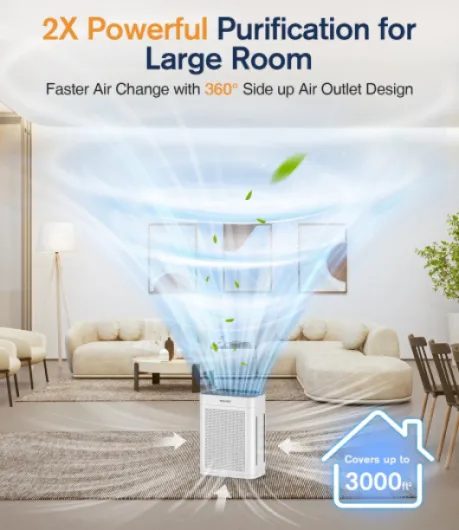
The headline numbers look good on paper: CADR 300 m³/h, dual-sided intake, H13 HEPA, and they claim coverage up to 3000 ft², which is clearly marketing more than reality. In practice I used it in a 25–30 m² living room and sometimes left doors open to the hallway and bedroom. The air did feel less dusty and less “stale” after a day or two, especially with the cat litter box in the corner.
What pushed me to keep using it was mainly the noise level and auto mode. I’m picky with fan noise, and I hate fiddling with settings all day. This one can stay in auto most of the time without driving me crazy. But it’s not perfect: the PM2.5 sensor seems a bit optimistic, and the coverage claims are clearly exaggerated if you want fast cleaning.
If you’re expecting a premium, super polished product, this isn’t that. It’s more like: “decent workhorse from a no-name brand that gets the job done for a medium-sized flat.” That’s basically how I’d sum up my time with it so far: pretty solid for the money, with realistic limits you need to know before buying.
Value for money: where it makes sense and where it doesn’t
On the value side, the AP300 sits in an interesting spot. It offers CADR 300 m³/h, dual H13 HEPA filters, a real PM2.5 sensor, auto mode, and very low noise for a price that’s usually below many big-name brands with similar specs. The washable pre-filters also help keep running costs down a bit, since you’re mainly replacing the HEPA/carbon section every 3–6 months. Replacement filters (ASIN B0H5JXCN41) are available on Amazon, which is important; I checked that before judging the value.
Compared to something like a Levoit Core 300/400 or a basic Philips unit, you’re basically trading brand reputation and smart features (apps, more refined sensors) for a slightly lower price and dual-sided intake. If you don’t care about apps and just want a simple machine with decent CADR, the TENKER is good value for money. If you like having everything in your phone and want a brand with a long track record, you might prefer paying more for a known name.
Running costs are reasonable. At 38W max, even 24/7 operation is not expensive. Filters every 3–6 months is standard in this category. The only real value concern is the exaggerated coverage claim. If you buy it expecting it to handle a massive 3000 ft² house, you’ll be disappointed. Used in a realistic space (bedroom, living room, small flat), it’s a fair deal.
So in my opinion, the AP300 makes the most sense if you’re: on a budget, okay with an unknown brand, and want something quiet with proper HEPA and carbon. If you’re very picky about sensor accuracy, brand support, or long-term ecosystem, then you might see better long-term value in a bigger name, even if the upfront cost is higher.
Design: compact, a bit plasticky, but practical
Design-wise, the AP300 is basically a white rectangular box: 40 cm wide, 30 cm high, 17 cm deep, and about 3.3 kg. It’s pretty compact for a unit rated at CADR 300 m³/h. It fits easily against a wall or next to a TV stand without looking too bulky. The housing is all plastic, and you can feel it’s not premium, but it doesn’t feel like it will crack in your hands either. For the price and the brand level, I’d call the build quality decent but nothing more.
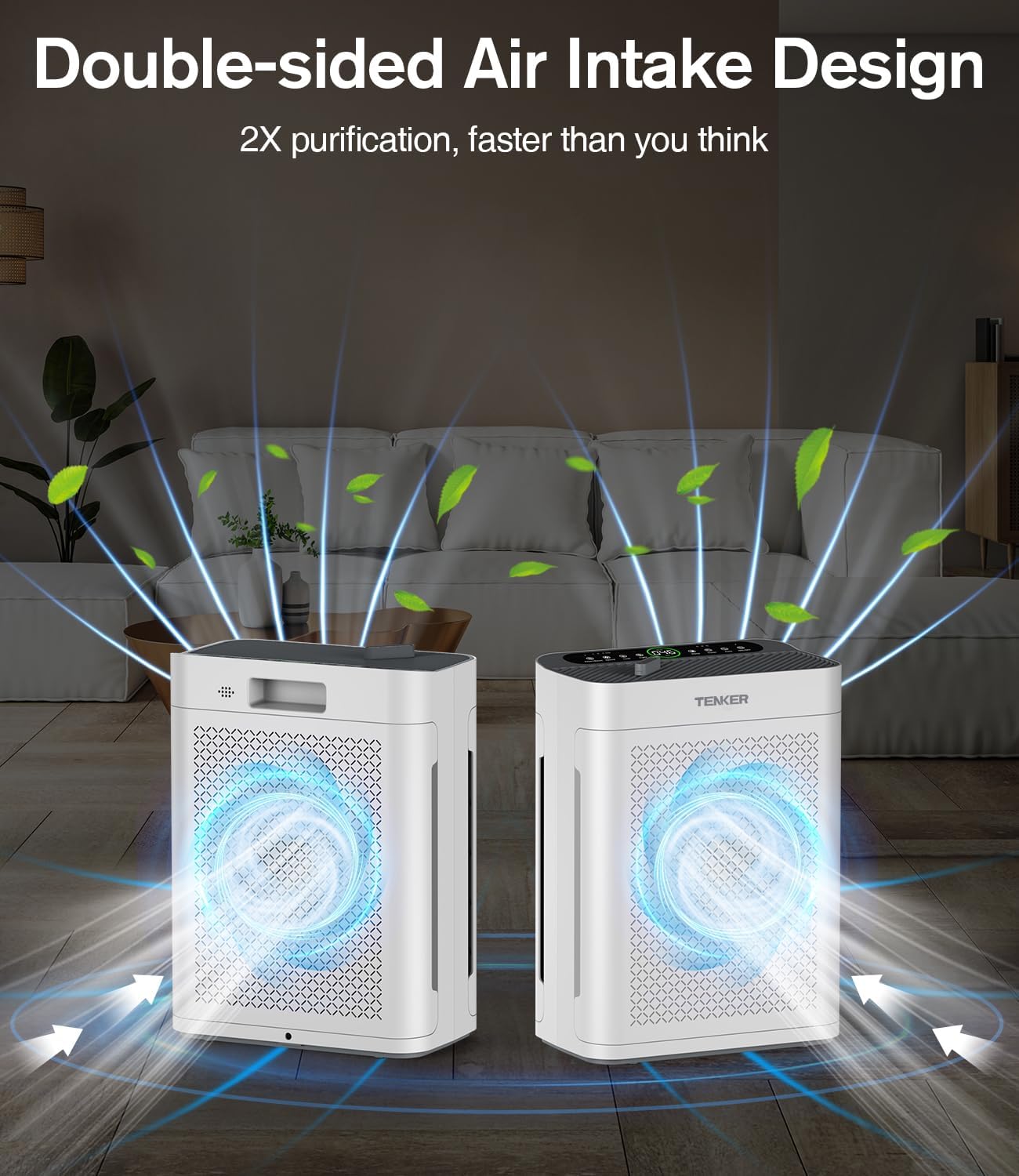
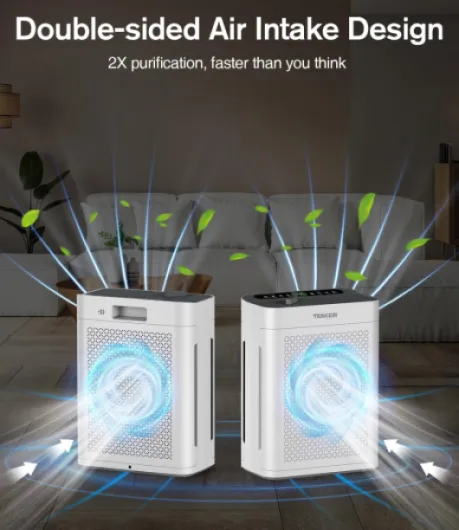
The dual-sided air intake is the main design feature. You have grill panels on both sides, with filters behind them, and the clean air blows out through the top. In practice, this means you should avoid blocking either side. I first stuck it near a corner with one side too close to the wall, and it clearly reduced performance and airflow noise changed. Once I pulled it at least 20–30 cm away from obstacles on both sides, it worked better and sounded smoother.
The touch panel on top is easy enough to use. The icons are clear: speed, mode, timer, lock. The PM2.5 display is on the front, so you can see the air quality from across the room. One small annoyance: the glossy plastic on top picks up fingerprints and dust pretty fast. If you’re picky about looks, you’ll be wiping it down regularly. On the plus side, the overall footprint is small enough that you can move it from bedroom to living room without much effort.
From a practical point of view, the design choices make sense: lightweight, easy access to filters, simple controls. It doesn’t look fancy, but it blends in. I’d have liked a built-in handle and maybe a matte top surface, but those are minor complaints. For an unknown brand at this price, the design is honestly fine and focused on function.
Noise, daily use, and living with it 24/7
Comfort-wise, the big points are noise levels, sleep mode, and how much you have to babysit it. On Sleep mode, they claim 15 dB. I don’t have a sound meter, but subjectively it’s very quiet. In a closed bedroom at night, I could barely hear a soft airflow if I really listened for it. All the lights turn off in sleep mode, which I appreciate a lot. No bright blue LEDs ruining a dark room. For sleeping, it’s honestly one of the quieter purifiers I’ve used at this price.
On Low and Medium, the noise is still quite reasonable. You can watch TV, work, or chat without feeling like there’s a fan blasting in your ear. On High and Turbo, it’s obviously louder, to the point where you might not want Turbo while watching a quiet movie. But that’s normal for this class of device. At least the noise quality is more like airflow than a harsh motor whine, thanks to the brushless motor.
Daily use is pretty simple: I mostly left it on Auto during the day and Sleep at night. The child lock is handy if you have kids or pets that like to poke at buttons; one long press and the panel is locked. The timer is useful if you want it to shut off after you fall asleep or if you’re airing out a room and don’t want it running all day. Power consumption is low: 38W at full speed, so even running it 24/7 isn’t going to wreck your electricity bill.
In terms of living with it, it’s easy: no app, no pairing, no weird beeps beyond basic feedback. The only slightly annoying part is remembering to vacuum the pre-filters every couple of weeks so you don’t choke the airflow. But that’s the same with any purifier. Overall, it’s a comfortable device to keep on all the time, especially if you’re noise-sensitive or sleep with it in the bedroom.
Aromatherapy feature: nice extra, not a diffuser replacement
The AP300 has a small essential oil box on top. You pull out a tray, drop a few drops of oil on the pad, slide it back in, and the airflow spreads the smell. It’s basically a passive diffuser piggybacking on the purifier’s fan. I tried it with a simple lavender oil and later a citrus one. With 2–3 drops, you get a light, pleasant scent in a medium room after 10–15 minutes. It’s not super strong, which I actually prefer. If you want a very strong smell, you’ll need more drops, but then you risk it being too much.
This feature is nice but clearly secondary. If you buy this thinking it will replace a dedicated diffuser, you’ll be disappointed. It’s more of a “bonus” to slightly freshen the room or mask mild odors. For example, after cooking fish, I ran the purifier on High with a couple of drops of citrus oil. It helped reduce both the fish smell and added a mild fresh scent. Not perfect, but better than just opening windows in winter.
One thing to note: the aromatherapy box is external and easy to clean, which I like. You’re not pouring oil directly into the air path or onto the main filters, so less risk of gunking them up. Still, I’d avoid going crazy with very thick or sugary oils. Also, if you’re sensitive to fragrances or have asthma triggered by scents, just skip this feature and leave the tray empty; the purifier works fine without it.
In short, the fragrance function is a small quality-of-life extra, not a key selling point. I used it occasionally in the evening to make the living room smell nicer. It’s handy, but if they removed it tomorrow, I’d still consider the purifier for what it does with particles and smells on its own.
Performance: solid CADR, realistic coverage is smaller than the ad
This is where the AP300 does pretty well. With a claimed CADR of 300 m³/h, it’s in the mid-range segment. In my 25–30 m² living room (about 270–320 ft²) with a cat and a fairly busy street outside, running it on medium or auto noticeably reduced dust on surfaces over a few days and cut down on that “stuffy” smell by the evening. When I cooked something strong (stir-fry, bacon), switching to High or Turbo cleared the smell much faster than my older smaller purifier.
About the coverage claims: they say up to 3000 ft² and refreshing 533 ft² in 10–12 minutes. That 3000 ft² number is just not realistic if you expect fast cleaning. In real life, I’d say it’s comfortable in:
- Up to ~30 m² (320 ft²) for quick, noticeable cleaning
- Up to ~50 m² (around 500 ft²) for slower, background cleaning
Beyond that, it’s more “helpful” than properly sized. So if you have a big open-plan house, you’ll either need multiple units or a bigger machine.
The PM2.5 sensor and auto mode are handy but not laboratory-grade. It definitely reacts to smoke and cooking: you see the PM2.5 number climb and the fan ramp up. But compared to a separate handheld meter I have, the built-in sensor usually reads a bit lower, especially when pollution is mild. So it tends to say the air is “good” a bit too early. For everyday home use, it’s OK, but if you’re very sensitive to pollen or pollution, you might want to keep it on Medium or High instead of trusting auto all the time.
Overall, I’d say performance is pretty solid for the price. It cleans a medium room well, handles pet dander and everyday dust, and helps with cooking smells and light smoke. Just ignore the 3000 ft² marketing line and think of it as a good unit for flats and single rooms, not an entire big house.
What you actually get with the TENKER AP300
Out of the box, the TENKER AP300 is pretty straightforward: the unit, the dual-sided filter already installed, a small aromatherapy box with a pad, and a short manual that’s clear enough. No remote, no app, no Wi‑Fi. If you’re used to connected purifiers, this one feels basic, but that also means fewer things to set up and fewer annoying notifications. Plug it in, peel the plastic off the filter if there is any, and you’re running in under five minutes.
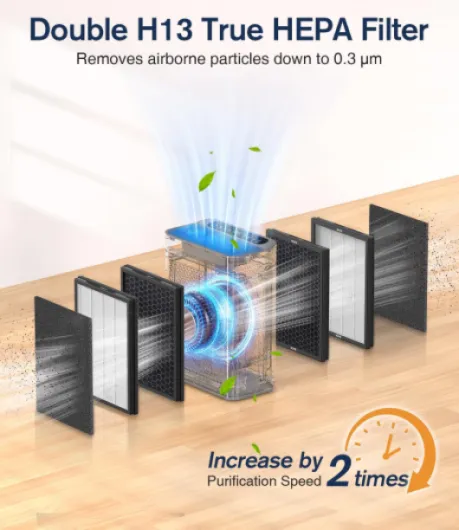
The core of the product is the dual-sided H13 HEPA + activated carbon filter. You get two filter panels (one each side), with a washable pre-filter and what they call 112.5% more carbon. Marketing numbers aside, the filters look decent and not flimsy. You can vacuum or rinse the pre-filter, but the HEPA/carbon part itself is replace-only. TENKER says 3–6 months for replacements depending on use, which sounds about right if you run it daily in a city or with pets.
The top has a touch control panel with fan speed, timer (2/4/8 hours), sleep mode, auto mode, child lock, and filter reset. On the front, you get a PM2.5 display and color ring for air quality. It’s not as detailed as some big-brand models, but you can at least see a number and a color (good/medium/bad) which is more helpful than a simple light. Everything is powered by a 38W motor, so it’s not a power hog even at full blast.
Overall, the presentation is functional, not fancy. You’re clearly paying for the core features (CADR, HEPA, carbon, sensor) and not for smart-home extras or high-end design. For a mid-budget air purifier, I think that’s fair. If you want app control, voice commands, or ultra-polished UI, this isn’t it. If you just want to plug in something and let it clean the air, this is more than enough.
Effectiveness in real life: pets, dust, and smells
In terms of real-world effectiveness, I focused on three things: pet hair/dander, dust, and smells. I’ve got a cat that sheds a fair bit and a litter box in the living room. After running the AP300 almost continuously for about two weeks, I noticed fewer floating hairs in the air when the sun hits the room, and the litter smell was less noticeable unless the box had just been used. It doesn’t fully remove that first strong whiff, but the lingering odor disappears faster than before.
For dust, I did a simple test: wiped a black TV stand clean, ran the purifier on Auto for three days, and compared it to a similar three-day period with the unit off. With the purifier on, there was still dust (nothing magic here), but clearly less of that thick layer that usually builds up. It’s not night and day, but enough that I could stretch my dusting by a day or two without the place looking neglected.
On smells and VOCs, the upgraded carbon filter does a decent job. Cooking smells clear out faster, especially fatty or smoky cooking. I also tried burning a scented candle and blowing it out near the purifier: the burnt wick smell triggered the sensor, fan ramped up, and the smell faded in a few minutes. If you’re a heavy smoker indoors, I think it will help, but it won’t make the room smell like nothing ever happened. For regular kitchen use and everyday odors, it’s good enough.
As for allergies, I’m mildly sensitive to dust and pollen. With the AP300 running at night in the bedroom for a few days, I woke up with less of that scratchy throat and blocked nose feeling. It’s not a miracle cure, but it clearly helps. For anyone with moderate allergies, I’d say this purifier is a useful tool, not a magic fix. It reduces triggers, but you’ll still want to clean regularly and maybe combine it with other measures like washing bedding more often.
Pros
- Quiet operation with a very usable sleep mode (no lights, very low noise)
- Decent CADR (300 m³/h) and dual-sided H13 HEPA + carbon filters for solid cleaning in medium rooms
- Simple controls with auto mode, PM2.5 display, and washable pre-filters that keep running costs reasonable
Cons
- Coverage claim (3000 ft²) is unrealistic for fast cleaning; better suited to single rooms or small flats
- Build feels a bit plasticky and sensor readings tend to be slightly optimistic compared to external meters
Conclusion
Editor's rating
After using the TENKER AP300 daily, I’d sum it up as: a practical, quiet purifier that does the basics well, from a brand you probably haven’t heard of. It handles dust, pet dander, and everyday smells in a medium-sized room without much fuss. Noise levels are low, sleep mode is genuinely quiet and dark, and auto mode is good enough for most people, even if the PM2.5 sensor feels a bit optimistic at times. The dual-sided intake and H13 HEPA + carbon filters give it decent cleaning power for flats, bedrooms, and living rooms.
It’s not perfect. The coverage claim of 3000 ft² is clearly marketing, the build is a bit plasticky, and you don’t get any app or smart-home integration. The aroma feature is a nice extra, but nothing more. Still, for the price, it’s pretty solid value if you use it in realistic room sizes (up to around 30–40 m²) and just want clean air without paying for a big brand logo.
I’d recommend it to: people in small to medium flats, pet owners on a budget, and anyone who wants a quiet bedroom purifier with real HEPA and carbon. I’d skip it if: you want full-house coverage from one device, you’re obsessed with perfect sensor accuracy and app control, or you only trust big-name brands. For most everyday users who just want less dust, fewer smells, and calmer allergies, this unit gets the job done without drama.