
Why mothball smell lingers and when an air purifier really helps
Mothball smell clings to fabrics, wood, and dust because the chemicals slowly evaporate into indoor air. Those vapors create a stubborn mothball odor that seeps from closets into bedrooms, hallways, and living spaces, turning a small storage choice into a whole home odor problem. When the fumes from each moth ball accumulate, they form a persistent cloud of mothball fumes that standard cleaning cannot simply remove.
The classic white moth balls usually contain naphthalene or paradichlorobenzene, and each mothball releases gas that repels the moth but also irritates human airways. Both substances are regulated in many countries because long-term exposure can affect the liver, blood, and nervous system, so always follow label directions and local disposal rules when you remove old mothballs. As these mothballs off gas, the ball smell binds to porous materials, so even after you throw away the last mothball, the lingering mothball smells and secondary odors remain trapped in carpets, curtains, and clothing. This is why many people start searching for an air purifier for mothball smell only after realizing that opening windows for fresh air and using basic baking soda bowls barely touch the deeper mothball odors.
Air purifiers designed for gases and odors can capture and adsorb the volatile compounds that create the characteristic mothball smell. A standard particle only air purifier will not work well on mothball odors, because it mainly targets dust and pollen rather than gaseous odor molecules. To truly reduce mothball odor from indoor air, you need a product that combines a strong activated carbon stage with enough airflow to cycle the air in the affected place several times per hour; in practice, aim for at least 4 to 5 air changes per hour (ACH) in a bedroom and a clean air delivery rate (CADR) close to the room’s volume in cubic metres, as recommended in guidance from organizations such as AHAM and several national health agencies.
How activated carbon and deodorizer granules tackle mothball fumes
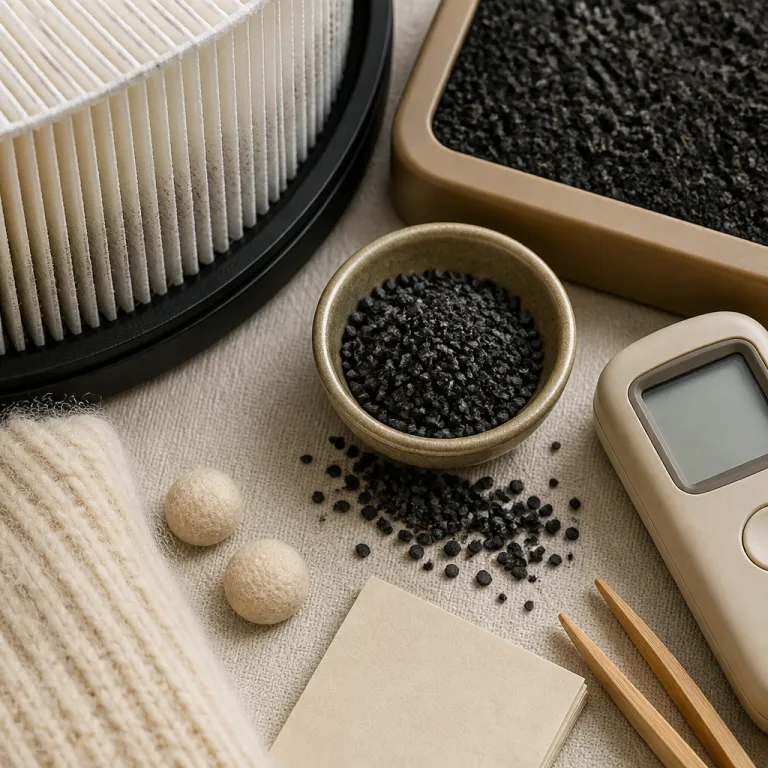
Activated carbon is the core technology that makes an air purifier for mothball smell effective rather than decorative. Each gram of carbon contains a maze of microscopic pores that trap odor molecules from the air, including the chemicals responsible for every lingering mothball smell in your wardrobe or storage room. Laboratory measurements show that high quality activated carbon can provide well over 1,000 square metres of internal surface area per gram, which explains why relatively compact filters can hold a surprising amount of mothball fumes. When manufacturers blend carbon with specialized deodorizer granules, they increase the surface area available for odor removal and extend the working life of the filter.
In practice, a high quality air purifier uses a pre filter for dust, a HEPA filter for particles, and then a thick bed of carbon or deodorizer granules powder to capture gases. That final stage is where mothball fumes, cigarette smoke, cooking odors, and other smells are adsorbed, turning a stuffy room into a space with noticeably fresher air. For people comparing air purifiers, it is worth reading technical sheets rather than only customer reviews, because the weight of carbon and the volume of deodorizer granules directly influence how well the product will work on mothball odors; for a typical 12 to 20 square metre room, many experts recommend looking for roughly 0.5 to 1 kilogram of gas phase media in serious odor units rather than a thin perfumed pad, which aligns with specifications published by several well known manufacturers.
Some brands also offer loose granules or deodorizer granules that you can place in bowls or sachets near the source of the mothball odors. These are not full air purifiers, but they can complement an air purifier by absorbing ball smell from drawers, boxes, or closed trunks where airflow is limited. To understand how gas filters behave in real homes, you can look at this detailed guide on a VOC air filter transforming indoor air quality, because the same principles apply when you want to remove mothball odor and other chemical smells.
Natural mothball alternatives and how to manage existing odors safely
Once you have invested in an air purifier for mothball smell, the next step is to stop adding new sources of contamination. Replacing traditional moth balls with a more natural mothball strategy reduces both mothball fumes and long term health concerns for children and pets. Many households now use cedar blocks, lavender sachets, or sealed garment bags instead of a chemical mothball product, which protects clothes from the moth without creating harsh odors.
If you still rely on mothballs for severe infestations, keep each moth ball in an airtight container or garment bag and label the place clearly. This limits how much mothball odor escapes into the room air and makes it easier for your air purifier and any supplementary deodorizer granules to keep up with the odor problem. When you eventually remove the mothballs, wash fabrics with hot water where possible, vacuum slowly with a HEPA vacuum, and then let the air purifier run continuously to strip remaining mothball smells from the air.
Some readers ask whether baking soda alone can remove mothball smells from a room, because it is cheap and natural. Baking soda can help with localized odor removal in shoes or small boxes, but it cannot process the volume of air that a dedicated air purifier can handle in a bedroom or basement. For smoke, chemical fumes, and complex odors, a specialized unit such as the type described in this article on a smoke away purifier transforming indoor air gives a more reliable framework for dealing with mothball odors as well.
Comparing air purifiers and odor products for real homes
When you compare one air purifier for mothball smell with another, focus on filter composition, room coverage, and independent reviews rather than marketing slogans. A serious model aimed at mothball odors will specify the mass of activated carbon or deodorizer granules powder in kilograms, not just mention a thin carbon sheet as a bonus feature. Units with thicker carbon beds usually cost more as a product, but they work longer and handle stronger mothball smells without saturating quickly.
Some households combine an air purifier with targeted odor removal products such as sachets, gels, or loose granules placed inside drawers and wardrobes. These smaller deodorizer solutions can remove ball smell directly at the source, while the main air purifier cleans the general air and keeps fresh air circulating through the room. When reading customer reviews, pay attention to comments about how the device handles specific odors like mothball smell, pet accidents, or cooking fumes, because these details reveal whether the filtration system is robust or mostly cosmetic.
It is also worth checking noise levels and energy consumption, because an air purifier for mothball smell must often run for many hours per day. A quiet unit encourages continuous use, which is essential when mothball odors have penetrated walls, carpets, and stored textiles over many seasons. If you live in a region where retailers offer free shipping and extended returns, you can test how well a chosen model handles your particular odor problem without committing permanently on day one; for example, you can compare a compact unit rated around 150 to 200 m³/h CADR for a 15 m² bedroom with a larger model rated near 300 m³/h for open plan spaces and see which one maintains fresher air at lower fan speeds.
Smelleze natural deodorizer and other targeted odor removal tools
Among specialized odor products, some readers encounter the Smelleze Natural line when searching for help with a difficult mothball smell. A typical Smelleze natural deodorizer uses mineral based granules to adsorb odors from the air, working in a similar way to activated carbon but with a different pore structure. These deodorizer granules can be placed in bowls, pouches, or trays near the strongest mothball odors, where they gradually remove smell molecules without adding fragrance.
In practice, Smelleze natural products are often used alongside air purifiers rather than instead of them, especially in homes where mothball fumes have built up over many years. The air purifier for mothball smell handles the continuous flow of contaminated air, while the granules focus on concentrated pockets of mothball odor inside boxes, trunks, or closets. When you read customer reviews about Smelleze or similar brands, look for long term feedback on how well the granules work after several weeks, because some materials saturate quickly and then stop absorbing odors.
Loose granules powder can be messy if spilled, so many people prefer sealed pouches that you can simply place and later remove. Whatever format you choose, treat these products as part of a layered odor removal plan that also includes ventilation, cleaning, and careful control of any remaining moth balls. Used thoughtfully, a combination of natural mothball alternatives, targeted deodorizer granules, and a capable air purifier can gradually restore genuinely fresh air to spaces that once reeked of mothball smells.
Practical setup tips to clear mothball smells room by room
Positioning your air purifier for mothball smell correctly can make the difference between modest improvement and a real transformation. Place the unit in the room where the mothball odors are strongest, usually a bedroom with a large wardrobe, a basement storage area, or an attic filled with boxes. Keep the air purifier at least several centimetres from walls and furniture so that air can flow freely into the intake and out through the clean air outlet.
Run the air purifier on a higher setting for the first few days, especially if the mothball smell is intense and the ball smell hits you as soon as you open the door. After that initial period, you can usually reduce the fan speed while still maintaining fresh air, but do not switch the unit off completely until the mothball odors have clearly faded from fabrics and surfaces. For rooms with heavy contamination, you may need to combine continuous filtration with repeated washing of textiles, careful vacuuming, and the strategic place of deodorizer granules or bowls of baking soda to catch residual smells.
Remember that even the best air purifiers cannot compensate for new moth balls being added constantly to the same space. If you must use a mothball product, seal it in containers and keep it away from main living areas, then let the air purifier and any supplementary odor removal tools handle the remaining trace odors. For deeper background on how filtration stages interact with particles and gases, this guide on how a true HEPA air purifier tackles mold in real homes offers a useful framework that also applies when you are fighting persistent mothball smells.
Key figures on indoor air, odors, and filtration performance
- According to indoor air quality reviews from the World Health Organization and other public health agencies, people typically spend around 80 to 90 % of their time indoors, which means that any persistent mothball odor in indoor air can significantly influence perceived comfort and well being over many hours each day.
- Studies on activated carbon show that a single gram can offer more than 1 000 square metres of internal surface area, explaining why relatively small filters can adsorb large quantities of mothball fumes and other odors when used in a well designed air purifier.
- Field measurements in residential buildings indicate that air purifiers with adequate airflow can reduce certain indoor volatile organic compounds by 50 to 80 % within a few hours when sized for at least 4 to 5 ACH, which aligns with user reports of rapid odor removal when treating mothball smells in closed rooms and with performance summaries from independent testing laboratories.
- Consumer surveys from major appliance retailers consistently show that odor control ranks among the top three reasons people purchase air purifiers, alongside allergy relief and smoke removal, highlighting how central smell management has become in modern indoor air strategies.
- Independent laboratory tests on HEPA filters, based on standards such as EN 1822 and similar protocols, confirm capture efficiencies of 99.97 % for particles around 0.3 micrometres, which does not directly remove mothball odors but prevents dust and fibers from carrying and redistributing absorbed smell compounds throughout the home.
FAQ: air purifiers and mothball smells
Can an air purifier completely remove mothball smell from a room ?
An air purifier with a substantial activated carbon stage can significantly reduce mothball smell, but complete removal also requires eliminating the moth balls and cleaning affected fabrics and surfaces. If the mothball odors have penetrated deeply into wood or insulation, several weeks of continuous filtration may be necessary. Combining filtration with ventilation and targeted deodorizer granules usually gives the best long term result.
What type of filter is best for mothball fumes and odors ?
For mothball fumes, a thick activated carbon or similar adsorbent filter is essential, because HEPA alone only captures particles. Look for an air purifier that specifies the weight or depth of its carbon or deodorizer granules rather than a thin perfumed pad. Models marketed for chemical sensitivity, smoke, or volatile organic compounds often perform well on mothball odors too.
Are natural mothball alternatives safer for indoor air quality ?
Natural mothball alternatives such as cedar, lavender, or sealed garment bags avoid the naphthalene and paradichlorobenzene that create strong mothball smells and potential health concerns. They still need to be used correctly, because any product that repels the moth must be strong enough to affect insects. However, these options generally have milder odors and place less load on your air purifier for mothball smell.
How long should I run an air purifier to tackle mothball odors ?
In a heavily contaminated room, plan to run the air purifier continuously for at least several days, then reassess the intensity of the mothball smell. Many users keep the unit on a lower setting around the clock for weeks, because odor molecules continue to off gas from fabrics and stored items. Turning the purifier off too early often allows mothball odors to build up again.
Do small deodorizer products replace the need for an air purifier ?
Small deodorizer products such as sachets, gels, or granules can help with localized odor removal in drawers and boxes, but they cannot process the full volume of air in a bedroom or basement. An air purifier for mothball smell provides continuous whole room treatment, while localized products handle specific hotspots. Using both together usually offers the most reliable path to genuinely fresh air in a home affected by mothball smells.