
Summary
Editor's rating
Value for money: good purifier, pricey filters
Design: big footprint but not ugly
Comfort, noise, and everyday usability
Durability and maintenance after some use
Performance: does it actually clean the air?
What this purifier actually offers
Effectiveness in real life: dust, smells, and day-to-day use
Pros
- Cleans air effectively in medium to large rooms (dust, odors, general stuffiness)
- Quiet on low/sleep with a useful auto mode and air quality display
- Solid build quality and easy access to filters for cleaning and replacement
Cons
- Bulky unit with no wheels and takes noticeable floor space
- Replacement filters are expensive and add significant running cost
- Ionizer cannot be disabled, which is a problem for some users (e.g. bird owners)

Specifications
View full product page →| Brand | Olimpia Splendid |
Big purifier, big promises
I’ve been using the Olimpia Splendid 99350 Aura Di air purifier for a few weeks in a small flat with a separate bedroom and a combined kitchen/living room. I mainly got it for cooking smells, dust, and pollen, plus I was curious about the UV and ionizer features. I already had a smaller, cheaper purifier from another brand, so I wasn’t going in blind. I wanted to see if paying more actually made a difference in how the air feels day to day.
First thing: this thing is not small. When you unbox it, it feels more like a compact heater than a discreet gadget. It weighs around 8.8 kg, so you can move it, but it’s not the kind of device you casually shift every hour. I ended up parking it in the living room near the kitchen door because that’s where smells and particles build up the most. I also dragged it to the bedroom a few nights to see if it helped with sleep and morning congestion.
In daily use, I mostly relied on the auto mode and watched the air quality indicator to see if it was actually doing something or just making noise. Between cooking, vacuuming, and opening the window to a fairly busy street, the readings did move a lot, and the fan reacted accordingly. That already gave me a better feeling than my older purifier, which just had three manual speeds and no idea what the air was like.
Overall, my first impression is: it’s pretty solid at cleaning the air, but there are some annoying details, especially the size, the price of the filters, and the ionizer you can’t turn off. If you’re expecting a cheap, ultra-compact gadget, this isn’t it. If you want a workhorse for a medium to large room and you’re okay with spending a bit more over time, it starts to make sense.
Value for money: good purifier, pricey filters
On the value side, this purifier sits in a slightly awkward spot. Performance-wise, it’s solid: it cleans the air well, handles biggish rooms, and runs fairly quietly most of the time. But when you look at the total cost – the unit plus replacement filters – it’s not exactly cheap. Filters are around £60 and rated for up to 2000 hours. If you use it heavily, you’re looking at at least one set a year, possibly more. That adds up over a few years, especially compared to some other brands with cheaper consumables.
What you get for that money is a well-built machine with HEPA, carbon, UV, an ionizer, and a decent air quality sensor. It feels more robust than budget models and clearly has more power and coverage. For someone who really cares about indoor air quality – allergies, asthma, traffic pollution, cooking smells – and wants a single unit that can handle a living room or open-plan area, it’s easier to justify the price. If you just want something for a small bedroom or occasional use, you can probably save money and go for a simpler, cheaper purifier.
Where the value drops a bit is on missing features for the price: no remote, no app, no way to turn off the ionizer. Competitors in the same ballpark often give you at least a remote and sometimes Wi‑Fi control. Also, the inability to disable the ionizer might be a deal-breaker if you have birds or you’re very cautious about ozone. That’s not a small detail; it directly affects whether some people can safely use it.
So in my view, value for money is good but not outstanding. You pay for solid filtration and build quality, and you do get that. You don’t get much in terms of smart features or flexibility, and ongoing filter costs are noticeable. If you catch it on discount and you need its power for a big room, it’s a decent buy. At full price, with all the cheaper alternatives around, you really have to care about the stronger performance and be ready to pay for filters over time.
Design: big footprint but not ugly
Design-wise, this purifier is large and fairly heavy, but not hideous. It’s a white unit with a modern, slightly rounded shape that doesn’t scream “medical device” the way some purifiers do. Still, if you have a tiny room or a cluttered flat, you will notice it. It’s not something you tuck behind a plant or under a side table. I’d say it’s more suited to a living room, open-plan space, or a bigger bedroom where you don’t mind dedicating a corner to it.
The build quality feels decent. The plastics don’t feel cheap or flimsy, and the front panel and filter housing open and close without weird creaks or gaps. The weight (8.8 kg) actually gives it a bit of a solid feel, even though it makes it slightly annoying to move from room to room. I can lift it easily enough, but if you plan to move it daily between upstairs and downstairs, it will get old pretty fast. There are no wheels, which would have helped a lot for this kind of size.
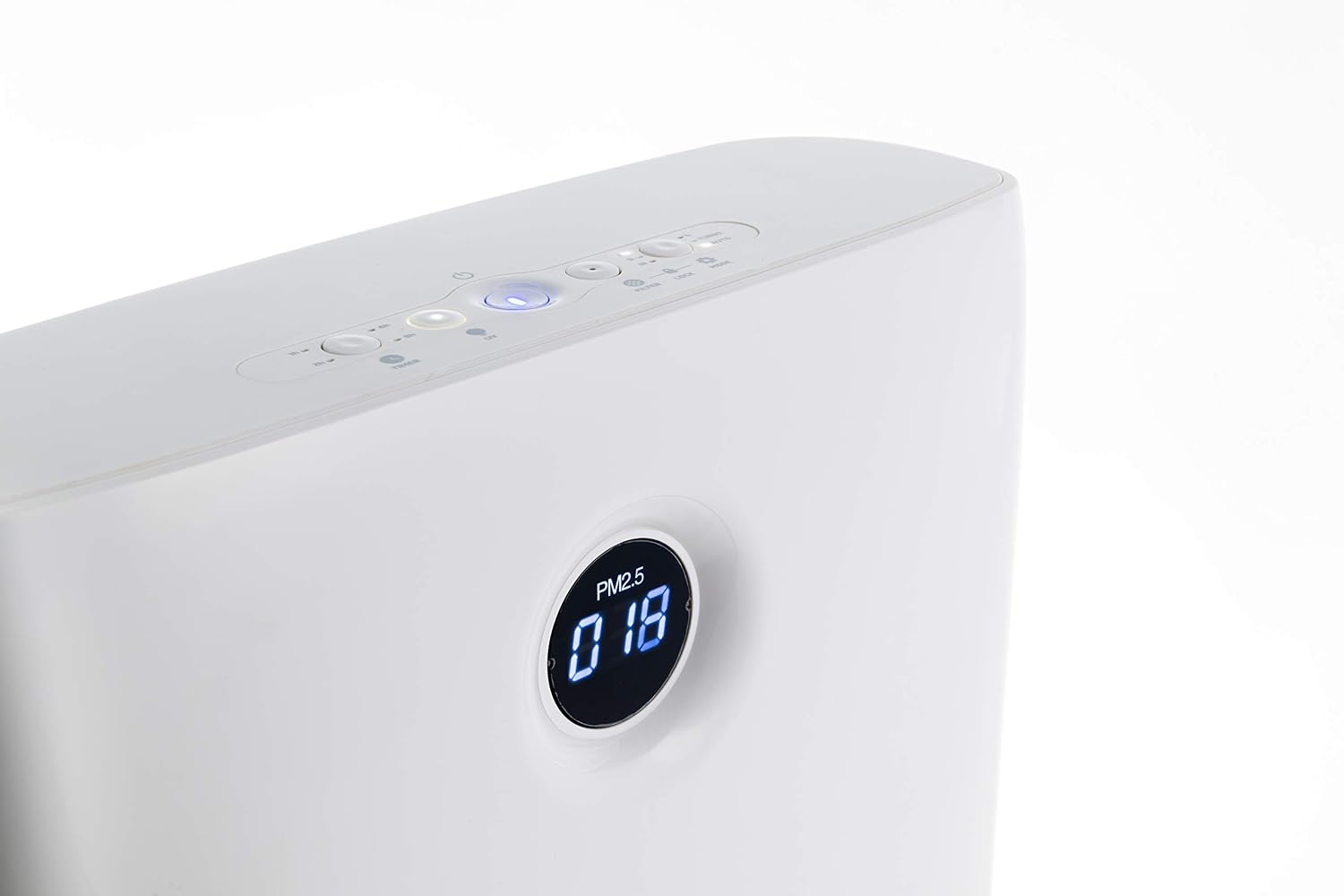
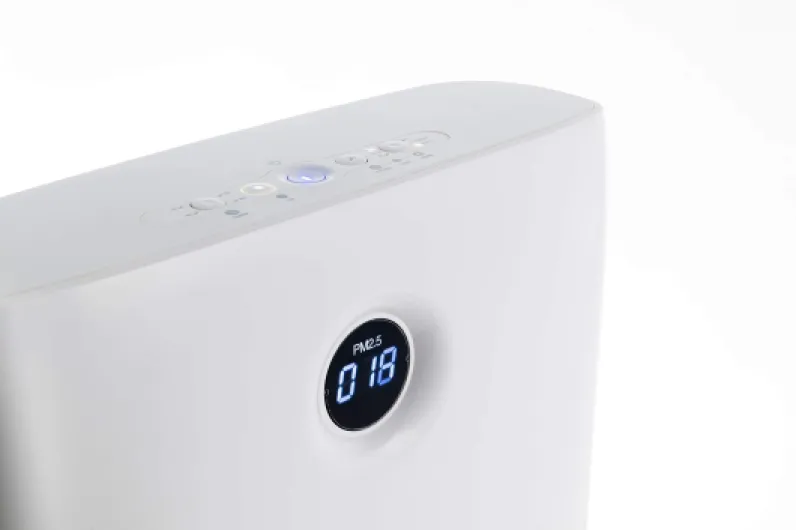
The control panel is on the top, with touch buttons and a digital display that shows the air quality reading and mode. The icons are clear enough; you can figure things out without living in the manual. The air quality number is useful and gives you something concrete to look at, instead of just a vague color ring. It also helps you see how quickly the purifier responds when you start cooking or open a window. At night, the lights are a bit bright for my taste, especially if you’re sensitive to LEDs in a dark bedroom, but it’s manageable if you don’t sleep with it right next to your head.
Visually, it’s fine but not special. It blends in well enough in a modern room, but it’s still a big white box. If design is your top priority, there are slimmer and more discreet models out there. If you care more about function and don’t mind a noticeable appliance in the room, this gets the job done without looking cheap. For me, once I found a spot for it, I basically stopped thinking about the looks after a couple of days.
Comfort, noise, and everyday usability
Comfort with this purifier is mostly about noise, airflow, and how annoying it is to live with. On low and sleep mode, I barely notice it after a while. It’s a soft, constant fan sound that actually works as a bit of white noise. I slept with it on in the bedroom a couple of nights, and it didn’t keep me awake. If you’re very sensitive to any noise at all, you might still prefer to turn it off at night, but for average people it’s fine. On turbo, it’s loud enough that you notice it, but you usually only run that for short bursts when the air is really bad.
The airflow is strong enough that you feel a slight breeze if you stand close to it, but it’s not like sitting in front of a fan. The air comes out clean and neutral, without any weird smell. I didn’t notice any dryness or irritation from having it run for several hours, which sometimes happens with cheap purifiers or heaters. The auto mode helps a lot with comfort because it doesn’t blast at full speed all the time; it ramps up when needed and then calms down again once the air quality improves.
Using the controls is straightforward. The touch buttons respond well, and the icons are clear. You get buttons for power, mode, fan speed, timer, etc. No remote control though, which is annoying when you’re on the sofa and want to tweak the settings. There’s also no app, no smart home integration, nothing fancy. You have to physically get up and touch it. For the price, I expected at least a basic remote. It’s not a deal-breaker, but it does feel a bit outdated compared to some other purifiers in the same price bracket.
Overall comfort is pretty good once you accept its size. It doesn’t dominate the room visually, but it does take up floor space. The noise is manageable, the airflow feels clean, and day-to-day use is simple. The main comfort drawbacks are the lack of remote/app and the bright-ish display lights at night. If you’re okay with a bit of light and don’t mind walking over to it to change settings, it’s easy to live with. If you want fully connected, couch-control convenience, this isn’t that kind of product.
Durability and maintenance after some use
In terms of durability, I obviously can’t speak for years of use yet, but after some weeks of regular daily use, the unit feels stable and well put together. No rattling, no sudden weird noises, and no loose panels. The fan sound has stayed consistent, and the buttons still respond properly. Given the 2-year manufacturer warranty and the overall feel of the plastics and assembly, I’d expect it to hold up fine if you don’t abuse it or move it around constantly.
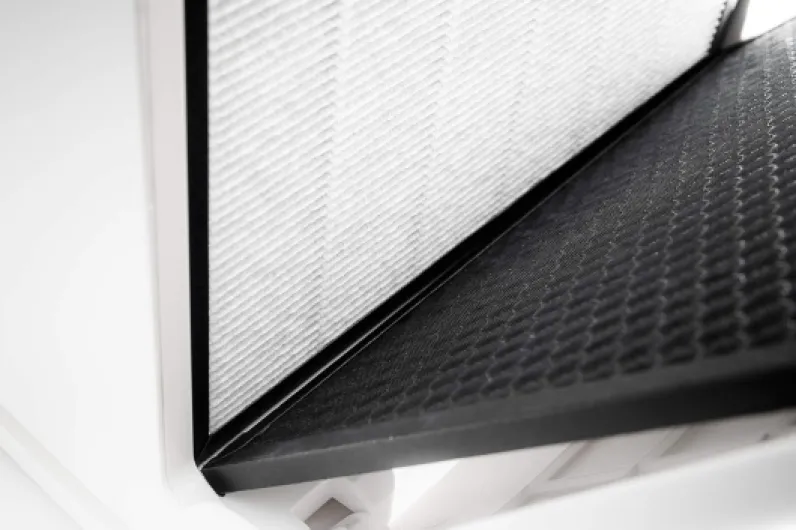
Maintenance is straightforward. The front panel comes off easily, and you can access the pre-filter, HEPA, and carbon filter without tools. I vacuumed the pre-filter after about two weeks and it already had a decent amount of dust. That’s a good sign for how much it’s catching, but it also means you should remember to clean it regularly if you want to reach anything like the 2000-hour life. The filters feel solid, not flimsy paper, and they slide in and out without hassle. Just be aware that when they finally need replacing, the cost is on the high side.
The air quality sensor seems stable too. The numbers it shows react in a predictable way: higher when cooking, lower after some time running, and they don’t jump around randomly. That suggests the sensor is at least reasonably calibrated. Long term, sensors can drift, but so far there’s no sign of that. The touch panel also hasn’t shown any ghost touches or lag, which I’ve had with cheaper devices.
Overall, durability and maintenance are reassuring. It feels like a device built to run many hours without falling apart, as long as you accept the ongoing filter cost and do basic cleaning. There are no delicate moving parts exposed, no weird hinges, and the general design is simple enough that there’s not much to break. If you want something that you can plug in, leave on auto most of the time, and just clean and swap filters when needed, this fits that profile pretty well.
Performance: does it actually clean the air?
This is where the Olimpia Splendid 99350 does pretty well. In daily use, odors and general stuffiness in the room drop noticeably after 15–30 minutes on auto or a higher fan setting. After cooking something strong (onions, frying meat, etc.), I’d see the air quality number shoot up and the fan kick into a higher speed. Within half an hour, the smell was mostly gone without opening all the windows, and the number on the display came back down to a cleaner range. Compared to my older, smaller purifier, this one clears out cooking smells faster and seems to handle larger spaces better.
In terms of allergies and breathing, I noticed fewer sneezing fits in the morning and less of that dry, dusty feeling in the throat after a few days of running it a few hours a day. I have mild dust and pollen allergies, nothing extreme, but enough to feel a difference when the air is cleaner. A few Amazon reviewers with asthma and hay fever say roughly the same: it doesn’t cure anything, but it helps reduce triggers. I’d say that matches what I felt – not a miracle, but a clear improvement over not using anything.
Noise levels are reasonable. On the lowest speed and in sleep mode, it’s quiet enough that you can sleep with it in the room if you’re not super sensitive to background noise. It’s more like a soft fan hum. On medium, you hear it but it’s still fine for watching TV or working. On high or turbo, it’s noticeably loud, more like a strong fan, but you only need that when the air quality is really bad or you want a quick cleanup after heavy cooking. Most of the time, in auto, it will sit at low or medium and barely draw attention.
One thing to mention: the ionizer and UV light are always part of the system, and you can’t disable the ionizer separately. That might bother some people, especially if you have birds or you’re worried about ozone. I personally didn’t notice any smell or irritation from it, but I’m also not ultra-sensitive. Still, the lack of control over that feature is a real downside. Overall, performance on dust and smells is pretty solid, but it’s not a feature-packed smart device, and the ionizer limitation is something you should think about before buying.
What this purifier actually offers
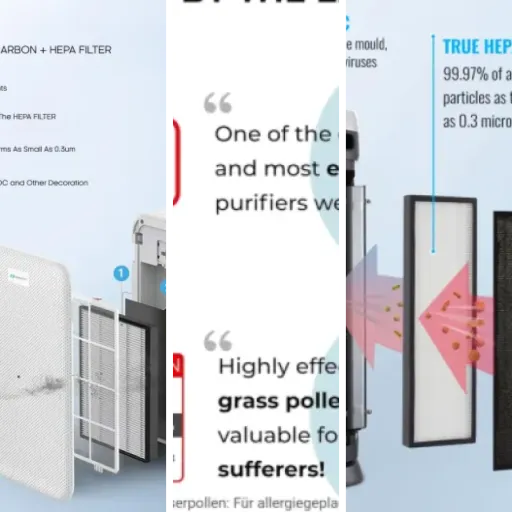
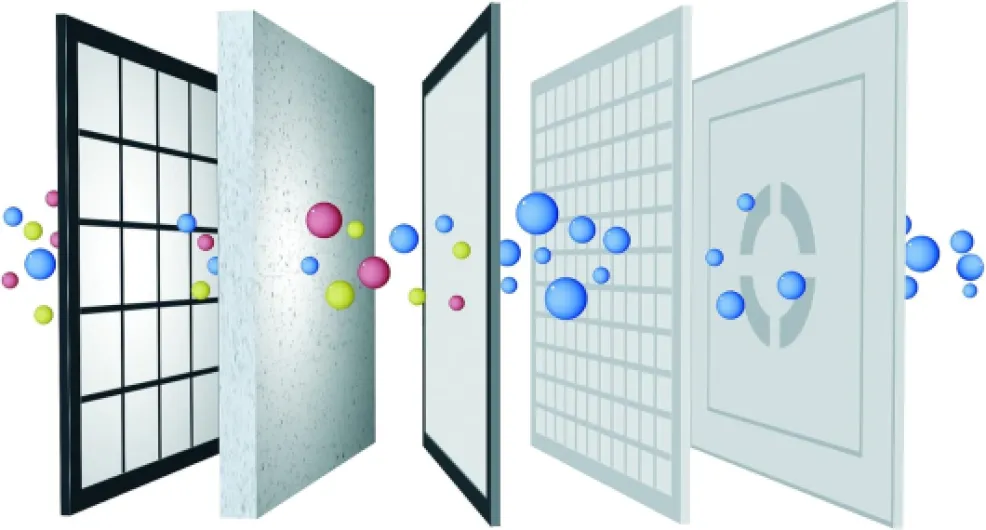
The Olimpia Splendid 99350 is basically a multi-stage air cleaner with a few extra tricks. On paper, it has three main physical filters: a dust/antidust pre-filter, a HEPA filter, and an active carbon filter. On top of that, you get UV light and an ionizer built in. The manufacturer says it can catch particles down to 2.5 microns, which lines up with PM2.5 (fine particles from traffic, smoke, cooking, etc.). There’s an air quality sensor and a digital display that shows a number representing the pollution level in the room.
Modes are straightforward: Auto, three manual fan speeds, Turbo, Sleep, and a timer. Auto is clearly the main one – it adjusts the fan speed depending on the detected air quality. In practice, I’d cook something greasy or fry food, and within a minute or two, the number would climb, the fan would ramp up, and after around 15–20 minutes the value dropped back down to cleaner levels. It’s not magic, but you can see it reacting to what you’re doing in the room, which is reassuring.
Filters are rated for up to 2000 hours. If you ran it 8 hours a day, that’s roughly 8–9 months. Replacement filters are not cheap – around £60 from what other users mention – and you need to budget that in. You can vacuum the pre-filter and some parts to extend life a bit, but at some point you’ll have to replace them if you want the purifier to stay efficient. This is not one of those low-maintenance, low-cost machines; it’s more like a mid-to-high tier unit with running costs to match.
Overall, spec-wise it’s pretty complete: HEPA, carbon, UV, ionizer, digital air quality display, auto mode, timer, sleep mode. The one obvious missing thing is a remote control or app control – you have to walk up to it and use the touch panel. For the price range it sits in, that’s a bit of a letdown, especially when some cheaper brands already throw in a basic remote or Wi‑Fi app.
Effectiveness in real life: dust, smells, and day-to-day use
In real-world use, the effectiveness of this purifier is mostly noticeable on three fronts: dust, smells, and general air freshness. After about a week of running it regularly in the living room, I noticed less dust buildup on the TV stand and shelves near the purifier. It doesn’t magically remove all dust from the entire flat, but the surfaces in the same room definitely stayed cleaner for longer. When I opened the front to check the pre-filter, I could see a visible layer of dust and fluff, which is exactly what I want: dust in the filter, not in my lungs or on my furniture.
On the smell side, it does a good job. Cooking odors, especially from frying or strong spices, clear out faster. Before using it, if I cooked something heavy in the evening, the smell would still hang around the next morning. With the purifier running on auto or medium-high after cooking, the next day the room just smelled neutral. Same thing with general stale air after having a few people over – the room just feels fresher after an hour or two with the purifier working. The active carbon filter seems to be doing its job here.
For allergy-type issues, my experience mirrors what a few reviewers said: sneezing less, less irritation. I don’t have severe asthma, but I do get irritated eyes and nose from dust and pollen. With this unit running for several hours a day, those symptoms eased up. Not gone, but noticeably reduced. I still needed my usual allergy meds during peak pollen days, so I wouldn’t rely on this alone if you’re really sensitive, but as an extra layer of help, it’s decent.
The only thing I can’t really measure is the UV and ionizer effectiveness. There’s no clear way to see if the UV is doing anything to bacteria, and the ionizer just silently does its thing in the background. I mainly judge the purifier on what I can see and feel: less dust, fewer smells, and calmer sinuses. On that basis, it gets the job done well, but I wouldn’t buy it solely for the UV/ionizer buzzwords. The HEPA and carbon filters are the real workers here.
Pros
- Cleans air effectively in medium to large rooms (dust, odors, general stuffiness)
- Quiet on low/sleep with a useful auto mode and air quality display
- Solid build quality and easy access to filters for cleaning and replacement
Cons
- Bulky unit with no wheels and takes noticeable floor space
- Replacement filters are expensive and add significant running cost
- Ionizer cannot be disabled, which is a problem for some users (e.g. bird owners)
Conclusion
Editor's rating
Overall, the Olimpia Splendid 99350 Aura Di is a solid, no-nonsense air purifier that actually improves air quality in everyday use. It handles dust, cooking smells, and general stuffiness in medium to large rooms without struggling, and the auto mode plus air quality display make it easy to just switch on and forget. Noise levels are reasonable, build quality feels good, and the combination of HEPA and carbon filters clearly does the heavy lifting. If you suffer from mild allergies or just hate lingering cooking odors, you’re likely to notice a real difference after a few days.
On the flip side, it’s bulky, not cheap, and the replacement filters are expensive. You also don’t get a remote or app, which is a bit disappointing at this price. The biggest red flag for some people will be the ionizer that you can’t turn off. If you have pet birds or you’re very cautious about ozone, that’s a serious limitation. So who is this for? It suits someone who wants a strong, simple purifier for a bigger room, is okay with a larger unit taking floor space, and is prepared to pay for quality filters over time. Who should skip it? People in small flats who want something compact and cheap, anyone obsessed with smart features, and anyone who needs full control over the ionizer. In short: good performer, some compromises, decent buy if you match the target user.