
Why mold in indoor air is a serious health problem
Mold in indoor air is more than an aesthetic issue on walls. When mold grows on damp surfaces it releases mold spores into the air, and these airborne particles can trigger allergies, asthma and chronic respiratory irritation. In homes with poor ventilation and high humidity, mold contamination often becomes a persistent problem that standard cleaning cannot fully solve.
Each mold spore is a biological particle small enough to stay suspended in air for hours. These particles can bypass the nose’s natural defenses and reach the lungs, so air purifiers aimed at mold control must focus on very fine particle removal rather than just visible dust. A high quality air cleaner with a sealed HEPA filter and an effective carbon filter can significantly reduce mold spores and their musty odors, especially when combined with moisture control in the room.
People with asthma, COPD or weakened immune systems are particularly sensitive to prolonged exposure. For them, choosing a capable mold air purifier is not a lifestyle upgrade but a health protection measure that reduces flare ups and medical visits. Even in healthy adults, long term exposure to mold spores in large rooms or small bedrooms can cause fatigue, headaches and sleep disruption that only improve once clean air is restored. The World Health Organization notes that dampness and mold in buildings are consistently associated with increased respiratory symptoms and asthma exacerbations (WHO, Guidelines for Indoor Air Quality: Dampness and Mould, 2009).
Key technologies that make an air purifier effective against mold
Not every air purifier is engineered to handle mold spores efficiently. To qualify among the best air purifiers for mold, a device needs a true HEPA filter that captures at least 99.97 percent of particles down to 0.3 micrometers, which covers most mold spore sizes. The HEPA filter must sit in a well sealed core so that no unfiltered air bypasses the media, otherwise the real particle removal rate and effective Clean Air Delivery Rate (CADR) will be much lower than advertised.
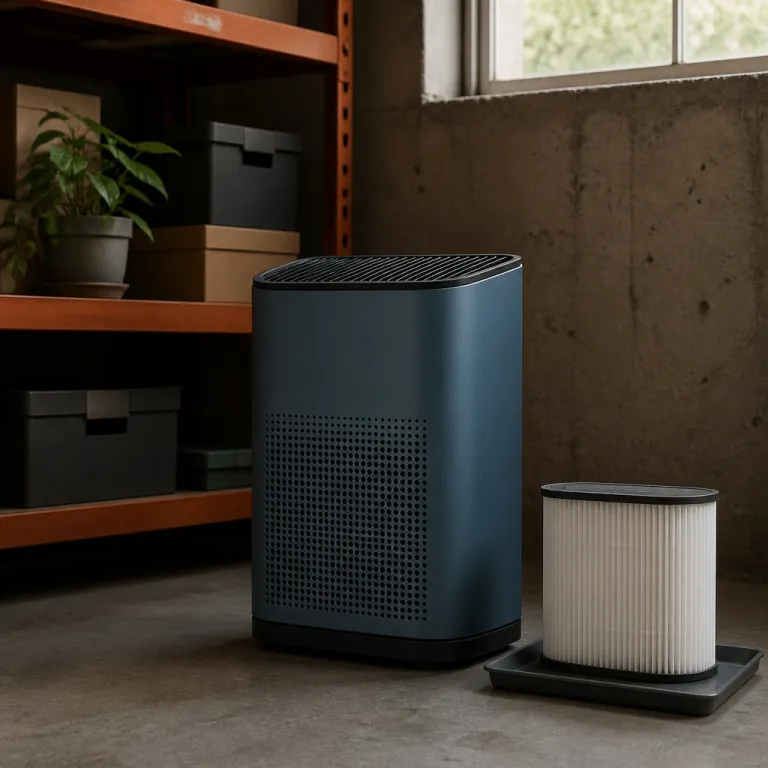
Most serious mold air purifiers combine several layers of filtration in one compact housing. A pre filter traps hair, lint and larger particle debris, protecting the main HEPA filter and extending its life, while a cartridge filled with granular activated carbon adsorbs musty odors and volatile organic compounds released by damp materials. When you compare products, look for a Clean Air Delivery Rate (CADR) expressed in cubic feet per minute (CFM) or cubic meters per hour that matches your room size, because even the best air purifier design fails if the airflow is too weak for a large living area.
Noise level matters as well, especially in bedrooms where purifiers run all night. Manufacturers usually express sound output in dBA, and for continuous sleep use a noise level below roughly 30 dBA on low fan speed is comfortable for most people. If you are evaluating an air purifier for home large rooms up to around 170 m², check independent tests or a detailed large room air purifier review such as this test of a HEPA purifier for big spaces to see how real world performance compares with marketing claims.
How to size the best air purifiers for mold to your room
Choosing the best air purifiers for mold starts with matching capacity to space. Every serious air purifier lists a Clean Air Delivery Rate (CADR) in cubic meters per hour or cubic feet per minute, and this figure tells you how quickly it can reduce mold spores and other pollutants in a defined room. For mold control, aim for at least four to five air changes per hour, meaning the purifier can process the full room volume that many times each hour.
To calculate this, measure your room length, width and height in meters, then multiply to get volume. Compare that volume with the CADR (in CFM or cubic meters per hour) on different air purifiers, and select a model whose rating is high enough to cycle the air frequently even on medium fan speed, which keeps noise level and energy use reasonable. In very large open plan rooms, two smaller purifiers placed at opposite ends often outperform one oversized unit because they reduce dead zones where mold laden air can accumulate.
Some people also need humidity control alongside filtration, especially in basements where mold thrives. In those cases, a separate dehumidifier plus a high performance air purifier usually works better than a single hybrid device, but there are situations where a combined purifier humidifier can help stabilize comfort in dry climates, and you can review options in this guide to top air purifiers with humidifier functions. Whatever configuration you choose, remember that even the best air purifier cannot compensate for active leaks or standing water, so fixing moisture sources remains the first line of defense.
Comparing leading brands for mold: Levoit, Blueair and others
Among mainstream brands, Levoit and Blueair often appear on shortlists of the best air purifiers for mold. Levoit focuses on compact designs like the Levoit Core series, which combine a cylindrical HEPA filter, a pre filter mesh and a ring of activated carbon pellets in a single cartridge that is easy to replace. Many Levoit Core air purifier models include an air quality sensor that adjusts fan speed automatically, which helps maintain clean air without constant manual control.
Blueair, by contrast, emphasizes high airflow and quiet operation in its Blue Pure and Classic lines. The Blue Pure purifiers use a combination of mechanical filtration and electrostatic charge to improve particle removal efficiency while keeping resistance low, which allows a high CADR at relatively modest noise level settings. For mold spores in large living rooms, a Blueair unit with a strong Clean Air Delivery Rate can clear the air faster than many compact competitors, provided you maintain the pre filter and carbon filter regularly.
When comparing these products, look beyond the headline best air marketing claims. Check independent lab tests where available, and pay attention to the score for mold spores, fine particle capture and gas removal, because some air purifiers excel at dust but lag on odors. Also factor in long term costs at the time purchase, including HEPA filter and activated carbon replacements, since a low initial price on an air purifier can be offset by expensive consumables over several years.
Quick comparison snapshot (typical mid range models)
- CADR: roughly 200–300 CFM for a standard Levoit Core or Blue Pure unit, suitable for medium to large rooms.
- Recommended room size: about 35–50 m² for four to five air changes per hour on medium speed.
- Noise level: around 24–30 dBA on low and 45–55 dBA on high, depending on the specific purifier.
- Annual filter cost: often in the range of one to three replacement sets per year, with total expenses varying by model and usage intensity.
Noise, maintenance and real world performance in mold control
Once an air purifier is running in your bedroom or office, daily experience matters as much as lab data. A device that technically ranks among the best air purifiers for mold but drones loudly at 55 dBA on its effective setting will likely be switched off at night, which defeats its purpose. Look for models where the high fan speed used for rapid particle removal is still tolerable, and where a medium setting around 30 to 40 dBA can maintain clean air quietly.
Maintenance also shapes real world performance against mold spores. A clogged pre filter or saturated HEPA filter increases resistance, lowers airflow and reduces the effective CADR, so even a high quality air purifier can underperform if filters are neglected for months. Many modern air purifiers include filter change indicators, but you should still inspect the pre filter every few weeks, especially in homes with pets or heavy dust, and vacuum or wash it according to the manufacturer’s instructions.
Odor control is another practical test of performance in damp rooms. When a carbon filter or cartridge filled with advanced sorbents is fresh, musty smells usually fade within hours of continuous operation, while a worn out cartridge allows mold related odors to linger even if particle counts are low. If you notice that smells return quickly after the purifier is turned off, it may be time to purchase replacement filters or reassess whether the current air purifier has enough clean air capacity for the size of the room.
Buying guide: how to choose the best air purifiers for mold for your situation
Choosing the best air purifiers for mold starts with clarifying your priorities. If you or a family member has asthma or severe allergies, prioritize an air purifier with a certified HEPA filter, a strong score for mold spores and a sealed core design that prevents leaks around the filter edges. For people mainly bothered by musty odors and general air quality, a thick activated carbon filter and a moderate Clean Air Delivery Rate may be sufficient, especially in smaller bedrooms.
Room size and layout come next in the decision process. Measure each room where you plan to use an air purifier, then shortlist products whose CADR ratings can deliver at least four air changes per hour on medium speed, which balances performance and noise level. In very large or irregular spaces, consider two coordinated air purifiers placed to promote circular airflow, and review guidance on sizing from independent testing organizations or detailed analyses such as this article on how many purifiers are needed for indoor pollution spikes.
Finally, think about long term ownership rather than just the first time purchase. Check how often the HEPA filter, pre filter and carbon filter need replacement, and calculate annual costs so you can compare products fairly on total cost of clean air rather than sticker price alone. A slightly more expensive air purifier with durable filters, a lower noise level and consistently high performance against mold spores and other pollutants often proves to be the best air choice over several years of daily use.
Key statistics on mold, air quality and air purifiers
- In a nationwide review by the World Health Organization, approximately 10 to 50 percent of indoor environments in Europe and North America showed signs of dampness or mold, highlighting how common mold related air problems are in ordinary homes (WHO, Guidelines for Indoor Air Quality: Dampness and Mould, 2009).
- Controlled chamber tests of true HEPA filters typically show at least 99.97 percent removal of particles around 0.3 micrometers, which includes many mold spores, while lower grade filters may capture less than 80 percent of the same particle size range.
- Studies on Clean Air Delivery Rate indicate that achieving four to five air changes per hour in a bedroom can reduce airborne particle concentrations by more than 80 percent compared with no filtration, significantly improving perceived air quality for occupants (U.S. EPA, Residential Air Cleaners: A Technical Summary, 3rd Edition, 2018).
- Noise measurements of consumer air purifiers reveal that quiet models on low speed often operate around 20 to 30 dBA, while powerful units on maximum speed can exceed 55 dBA, which many users find too loud for sleep or focused work.
- Field research in damp housing has shown that combining moisture control with high efficiency air purifiers can reduce reported respiratory symptoms in sensitive individuals by around 20 to 40 percent, compared with moisture control alone, although results vary by study design and population.
FAQ: best air purifiers for mold
Do air purifiers really help with mold problems
Air purifiers with true HEPA filters are effective at reducing airborne mold spores, which helps lower allergy and asthma symptoms. They cannot remove visible mold growth on walls or furniture, so you still need to fix moisture sources and clean contaminated materials. Used continuously in the right size room, a good air purifier significantly improves air quality but works best as part of a broader mold control strategy.
What type of filter is best for mold spores
A true HEPA filter is the standard for capturing mold spores because it removes at least 99.97 percent of very small particles. A pre filter in front of the HEPA layer catches larger debris and extends the life of the main filter, which keeps airflow strong. For musty odors, a separate activated carbon filter is useful, but it complements rather than replaces HEPA filtration.
How do I know what size air purifier I need
Start by measuring the length, width and height of your room to calculate its volume. Then choose an air purifier with a Clean Air Delivery Rate that can process that volume at least four times per hour on a medium fan setting, which balances performance and noise. Manufacturers often list recommended room sizes, but checking the CADR figure yourself gives a more reliable match.
Where should I place an air purifier for mold control
Place the air purifier in the room where you spend the most time, usually the bedroom or main living area. Position it a little away from walls and furniture so air can circulate freely around the intake and outlet, and avoid blocking it behind curtains or under tables. In homes with multiple mold hotspots, using more than one purifier in different rooms often gives better overall coverage.
How often should I change filters in an air purifier
Most HEPA filters last between six and twelve months in typical homes, while pre filters may need cleaning every one to three months depending on dust levels. Activated carbon filters that handle odors from mold and other sources often require replacement every three to six months to stay effective. Always follow the manufacturer’s schedule and adjust based on visible dirt, odor breakthrough and any filter change indicators on the device.