
Summary
Editor's rating
Is the Eleva 300X worth the money?
Compact, neutral design that doesn’t scream ‘medical device’
Day-to-day comfort: noise, lights, and ease of living with it
Noise, dust, and real-life performance in a bedroom
What you actually get with the Eleva 300X
Does it really help with allergies and daily comfort?
Smart features, app, and AI stuff: useful or just a gimmick?
Pros
- Very quiet on Sleep and low speeds, suitable for bedside use
- Good dust and allergen capture with visible results on the filter
- Useful sensor and app with real-time PM1.0/2.5/10 readings and scheduling
Cons
- Replacement filters are not cheap, even if they last fairly long
- Standard carbon filter is only moderate for strong odours and smoke

Specifications
View full product page →| Brand | Levoit |
A bedroom air purifier that finally doesn’t sound like a hairdryer
I’ve been using the Levoit Eleva 300X in Pearl White mainly in my bedroom for a few weeks, and I’ll be straight: it’s not magic, but it does make the room feel cleaner and less dusty. I bought it because I was waking up with a stuffy nose and the amount of dust on my shelves and PC setup was getting on my nerves. I already knew Levoit from their older Core models, so I was curious if this newer Eleva with all the PM1.0/2.5/10 stuff and AI app talk was actually useful or just marketing.
In daily use, the first thing that stood out is how quiet it is on the lower levels. On sleep mode, you basically forget it’s there, and that’s important if it’s sitting one meter from your head. I’ve had other purifiers before that sounded like a small fan even on low, and I usually ended up turning them off at night. With this one, I leave it running nonstop in Auto/Sleep and don’t touch it.
Another thing I noticed after a few days: less dust on furniture and less morning nose irritation. I’m not severely allergic, but I do react to dust and pollen. It’s not like my life changed overnight, but I do wake up less blocked, and when I checked the filter after about two weeks, there was already a decent layer of dust and fluff stuck in it. At least you can see it’s actually catching stuff instead of just moving air around.
Is it perfect? No. The app is useful but a bit overkill if you just want to press a button and forget it. And filter replacements aren’t cheap, even if they last quite a while. But overall, for a bedroom or small living room, it’s a pretty solid, quiet option that doesn’t feel like a gimmick. I’ll break down what works and what’s a bit meh in the rest of the review.
Is the Eleva 300X worth the money?
In terms of value for money, the Eleva 300X sits in that mid-range zone: not the cheapest purifier you can buy, but also not in the super premium bracket. It’s currently one of the top sellers on Amazon and sits at 4.5/5 with over 11,000 reviews, which usually means it hits a decent balance for most people. What you’re paying for here is a mix of solid filtration, quiet operation, and the extra smart features, not luxury materials or fancy design.
Running costs are actually not too bad. It only uses about 7.5 W on average in normal use, and up to 25 W at full speed, so it’s basically like running a small fan – nothing crazy on the electric bill. The filter life is advertised up to 2 years, but realistically I’d budget for roughly 12–18 months per filter depending on how dirty your air is and how often you run it. Replacement filters aren’t super cheap, but the fact you can replace HEPA and carbon separately should save some money over time if you don’t need heavy odour control all the time.
Compared to cheaper no-name purifiers I’ve tried, the Eleva 300X feels more reliable: better sensor, quieter on low, and better documented performance (CADR 273 m³/h, ECARF certification, etc.). On the other hand, if you live in a tiny room and don’t care about app control or PM readings, you could probably get away with a simpler, cheaper model and still have some benefit. This one makes more sense if you want a quiet, semi-smart purifier you can leave running 24/7 in a bedroom or small living room.
Overall, I’d say the value is good but not mind-blowing. You’re paying a bit extra for the brand, the sensor, and the app, but you also get a product that feels thought through and is easy to live with. If budget is tight, look at smaller Levoit models or non-smart options. If you’re okay paying a bit more for quieter nights and more control, the Eleva 300X is a solid choice that doesn’t feel like a waste of money.
Compact, neutral design that doesn’t scream ‘medical device’
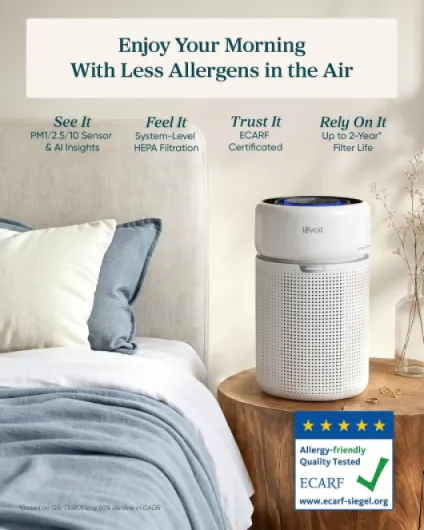
Design-wise, the Eleva 300X is pretty compact: about 24 x 24 cm footprint and 38 cm tall. So it’s basically the size of a small waste bin or a fat tower speaker. The Pearl White colour is neutral and blends in fine next to a bedside table, desk, or TV unit. It doesn’t look high-end or cheap – just like a normal, modern appliance. I had no problem leaving it visible in the bedroom; it doesn’t ruin the room, which is already a win compared to some bulky purifiers.
The air intake is all around the sides and it blows cleaned air out the top. That top grill is slightly recessed, so you’re not staring directly into a fan. The touch controls sit in the middle: power, fan speed, sleep mode, auto mode, timer, display light, and Wi‑Fi. Everything is clearly labelled with icons, and after one or two days, you know where everything is by muscle memory. One thing I liked is the option to turn all the lights off at night – both the screen and LED ring – while keeping the purifier running. For light-sensitive sleepers, that’s actually quite important.
In terms of layout, it’s pretty practical. The filter is accessed from the bottom: you flip the purifier, twist the cover, and pull the filter out. It’s simple enough that you can do it without reading the manual once you’ve seen it once. The only small annoyance is that if you place it under a low bedside table, you’ll have to pull it out to access the bottom. Not a huge deal, but something to keep in mind when you pick a spot.
Overall, the design is clean and functional. It won’t impress anyone, but it also doesn’t look like industrial gear. If you want something that just quietly sits in a corner without attracting attention, this one fits that brief. The only thing I’d have liked is maybe a handle or more obvious grip area for moving it, but at 3.5 kg it’s manageable as is.
Day-to-day comfort: noise, lights, and ease of living with it
For a bedroom purifier, comfort is almost more important than raw power. If it’s noisy or bright, you’ll just end up turning it off at night, which defeats the purpose. On that front, the Eleva 300X is well thought out. In Sleep Mode, the fan is very quiet and the display lights can be completely turned off. That means no glowing ring, no bright digits, just a faint airflow sound. I’m fairly sensitive to fan noise, and I had no trouble sleeping with it less than a meter from my head.
During the day, I usually leave it on Auto. It hums along on a low speed most of the time and only ramps up when it detects more particles. When it does, the sound is noticeable but still not annoying. It’s more like a medium fan than a loud extractor. If you’re working from home, it’s fine in the same room for calls or focus work. Watching TV in the bedroom was also fine – on Speed 1 or Auto, it doesn’t drown anything out.
Using and maintaining it is also pretty painless. The touch controls are simple: you’ve got clear icons for fan speed, sleep, auto, timer, and display. The filter check is just opening the bottom and visually checking every month or so; no tools needed. Cleaning the outside is basically a quick wipe with a cloth to get rid of dust on the plastic. There’s no complicated pre-filter panel to unclip every week, which I appreciate.
The only comfort downside is that if you’re constantly changing modes or settings, you’ll rely on the top panel, and if it’s under a low bedside table, you have to lean a bit awkwardly. The app solves that, but not everyone wants to use a phone for everything. Still, once you’ve set it to Auto or Sleep, you don’t really need to touch it much. In short, it’s easy to live with, quiet enough for light sleepers, and doesn’t add extra chores to your week.
Noise, dust, and real-life performance in a bedroom
In daily use, the big strength of this purifier is how it handles noise versus airflow. On Sleep Mode, it’s rated at 19 dB, and honestly, it’s extremely quiet. In a silent bedroom at night, you hear a very soft airflow if you really listen for it, but it’s more like background white noise. I had it on the bedside table for several nights and never felt the need to turn it off. On Speed 1, it’s still very discreet. Speed 2 adds a bit more whoosh, but nothing that drowns out conversation or TV. Max speed is of course audible, but it’s still less aggressive than many cheaper purifiers I’ve tried.
On the dust and allergy side, I noticed a difference after about 3–4 days of running it 24/7 in Auto/Sleep. Less dust settled on my desk and shelves, especially around my PC and Lego models, which normally collect dust fast. I also had fewer mornings with a blocked nose and dry throat. It’s not life-changing, but the improvement is clear enough that I’d rather keep it running than go back. When I checked the filter after roughly two weeks, it already had a visible grey layer of dust and fluff, which matches what some Amazon reviewers mentioned – it’s definitely catching stuff.
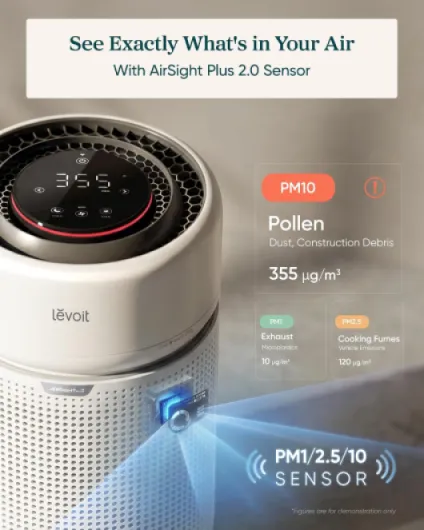
The air quality sensor is not just for show. When I opened the window on a busy street or started cooking, the PM values went up and the colour ring changed, then the fan ramped up in Auto mode. Same when I sprayed deodorant or used a strong cleaning product – the PM reading jumped, then slowly went back down. It’s a good way to see that it’s not just spinning at a fixed speed. Is the sensor perfectly scientific? Probably not, but it’s responsive enough to everyday changes.
For odours, the standard carbon filter is decent but not miraculous. It helps reduce light cooking smells and mild smoke, but if you smoke heavily indoors or fry food all the time, you’ll want the specialised carbon filter. In my case, for a bedroom and occasional food smell from the hallway, the default setup is fine. Overall, the performance is pretty solid for a small/medium room: good dust capture, better mornings, and quiet operation. Just don’t expect it to fully clean a huge open-plan space all by itself.
What you actually get with the Eleva 300X
Out of the box, the Levoit Eleva 300X is pretty straightforward: the purifier, the combined HEPA + carbon filter already installed, the power cable, and the usual quick-start guide. No weird accessories, no remote, everything is handled on the top touch panel or via the VeSync app. It weighs about 3.5 kg, so you can move it around with one hand, but it’s not something you’ll be carrying room to room every hour either. It’s clearly meant to live in one main spot, like a bedroom or home office.
On paper, the specs are fairly solid for the size: CADR of 273 m³/h, coverage up to 113 m² in one hour (realistically it’s more suited to smaller rooms, in my opinion), and a fully sealed HEPA system that claims to capture 99.97% of particles down to 0.3 microns. It also has this “3-channel sensor” thing that reads PM1.0, PM2.5 and PM10, which basically means it can detect very fine particles (like smoke and some allergens) as well as larger dust. You see all this as a colour ring and numbers on the display or in the app.
The other part that stands out is the dual-filter concept: HEPA and activated carbon are separate, so you can replace them independently. On paper that’s good for cost over time, especially if you mainly care about dust/allergens and don’t need heavy odour control all the time. They also sell specialised carbon filters for cooking or pet odours, which is nice if you’ve got a specific problem (like smoking, litter trays, or a kitchen open to the living room).
Overall, the presentation is practical: it’s not packed like a luxury gadget, but it feels like a decent home appliance. The product information is clear, and setup is basically: remove plastic from the filter, plug in, pick a mode. If you want the smart side, you add the app and link it to Wi‑Fi, which took me about five minutes. Nothing fancy, but it gets the job done without drama.
Does it really help with allergies and daily comfort?
Effectiveness is always the tricky part with air purifiers, because you can’t see most of what they claim to remove. In my case, I mainly wanted less dust and fewer minor allergy symptoms in the morning. After a couple of weeks, I can say it does help, but it doesn’t magically erase every problem. I still sneeze sometimes if I clean or move old boxes, but the constant low-level irritation in the bedroom is clearly reduced. I also noticed I don’t wake up with that slightly heavy, stuffy feeling in my nose as often.
The ECARF certification and all the lab numbers are nice, but what convinced me more is the combination of three things: visible dust on the filter, less dust on surfaces, and the real-time PM readings. For example, after dusting or changing bed sheets, the PM2.5 and PM10 numbers spike, then slowly come back down as the purifier runs faster. Same after opening the window during pollen season. You can see the values drop within 15–30 minutes, which gives some confidence that it’s not just blowing air for nothing.
For people with strong asthma or severe allergies, I’d be careful with expectations. This purifier can help reduce triggers, but it won’t replace medication or good cleaning habits. It’s more like an extra layer of defence: it catches a lot of the fine stuff floating around and keeps the background level lower. If you already vacuum regularly, wash bedding hot, and keep windows reasonably managed, this fits nicely on top of that routine.
One plus is the claimed filter life up to 2 years (based on heavy use tests). In real life, I’d expect more like 1 year in a dusty or urban environment if you want good performance, but even that is better than some models that need a new filter every 6 months. You can also track filter life in the app, which is more useful than a basic fixed timer. Overall, in terms of real-world effectiveness, I’d say it’s good: not mind-blowing, but clearly helpful if dust and mild allergies are your main issues.
Smart features, app, and AI stuff: useful or just a gimmick?
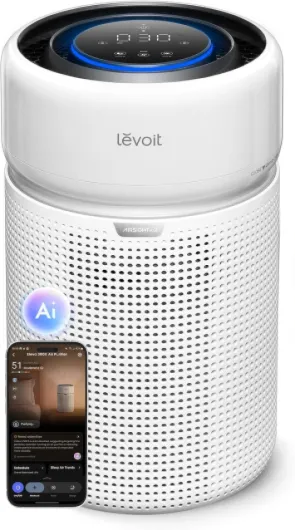
The Eleva 300X pushes the smart angle quite a bit with the VeSync app, AI insights, and compatibility with Alexa and Google Assistant. I actually connected it to the app to see if any of this is more than just a buzzword. Setup was straightforward: install VeSync, add device, connect to Wi‑Fi, done in a few minutes. Once connected, you can see real-time PM1.0, PM2.5, and PM10 levels as numbers, not just colours, plus the current mode, fan speed, and remaining filter life.
The useful part for me is: remote control, schedules, and air quality history. For example, you can set it to go into Sleep Mode at 11 pm and back to Auto at 7 am automatically. You can also turn it on/off from another room or even outside the house if you forgot. The history graph is nice if you’re curious about how your air changes during the day – you can clearly see spikes when you cook, clean, or open windows on a busy street.
The whole AI insights idea is more mixed. It analyses your usage and gives suggestions like “run the purifier longer in the evening” or “Auto mode is enough in your environment.” It’s not bad, but it also feels like something you could figure out on your own after a week of using it. It’s more of a bonus than a real selling point. Voice control with Alexa/Google works fine (on/off, change mode, change fan speed), but honestly, I rarely use it. Pressing the button or using the app is just as quick.
If you hate apps and smart home stuff, you can ignore all of this and still get full basic functionality from the touch panel. The core features – sleep mode, auto mode, fan speeds – are all accessible without a phone. I’d say the smart features are nice to have rather than essential: handy for scheduling and data nerds, but not a reason alone to buy it. At least they’re stable and not buggy in my experience, which is already something these days.
Pros
- Very quiet on Sleep and low speeds, suitable for bedside use
- Good dust and allergen capture with visible results on the filter
- Useful sensor and app with real-time PM1.0/2.5/10 readings and scheduling
Cons
- Replacement filters are not cheap, even if they last fairly long
- Standard carbon filter is only moderate for strong odours and smoke
Conclusion
Editor's rating
After using the Levoit Eleva 300X daily, my take is pretty simple: it’s a solid bedroom air purifier that focuses on being quiet and practical rather than flashy. The noise levels on Sleep and low speeds are low enough that you can genuinely forget it’s running, which is crucial if it sits near your bed. The filter catches a visible amount of dust, the room feels less stuffy, and morning nose irritation is clearly reduced in my case. The built-in sensor and PM readings aren’t just decoration – they actually react to things like cooking, cleaning, or opening windows.
The smart side (VeSync app, AI insights, Alexa/Google) is a nice extra but not essential. It’s handy for scheduling and checking air quality history, but if you’re not into apps, you can ignore it and just use the touch controls. Where it’s a bit weaker is on odours with the standard filter and the fact that replacement filters aren’t super cheap, even if they last quite a while. It’s also not the best pick if you want to treat a massive open-plan space; it’s really more at home in bedrooms and smaller living areas.
If you want a quiet, reasonably powerful purifier for dust and everyday allergens, and you like the idea of seeing actual air quality numbers, this is a good fit. If you’re on a tight budget, hate apps, or need heavy-duty odour removal for smoking or strong cooking smells, you might want to look at simpler or more specialised models instead. For most bedroom users, though, it gets the job done without being annoying, which is kind of the whole point.