Summary
Editor's rating
Value for money: where the Alto four sits in the market
Design and usability: simple, functional, not a decor object
Build, filters and long-term use potential
Noise, coverage and day-to-day behaviour
What the EVA Alto four promises on paper
Filtration effectiveness: what buyers actually notice
Pros
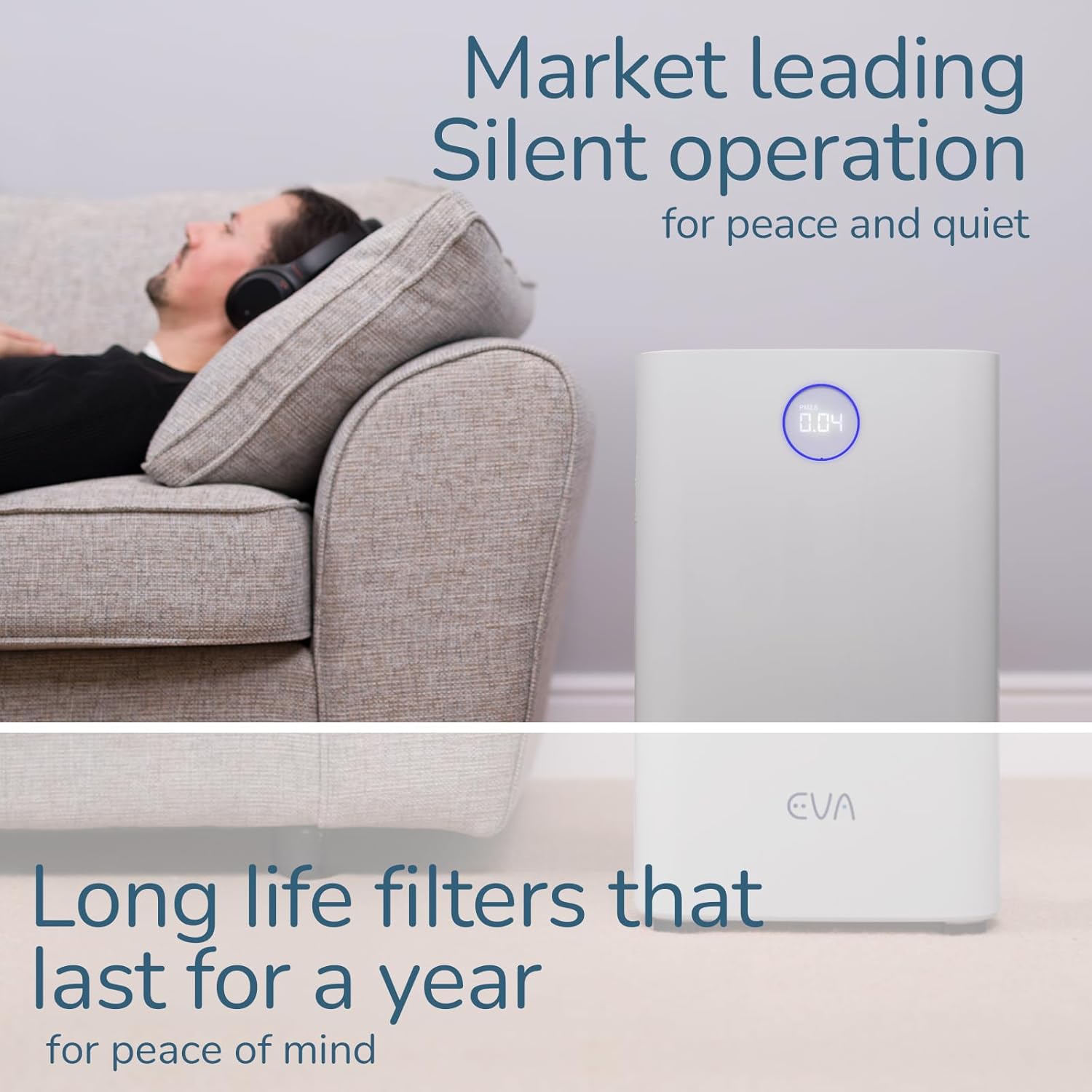
- Very quiet operation (advertised 17 dB) with many buyers confirming it is easy to sleep or watch TV with it running
- True HEPA + high-density activated carbon filtration with responsive PM2.5 sensor and auto mode that reacts to cooking, sprays and dust
- Good value extras: two-year filter supply included, low 34 W power draw, and a two-year unlimited warranty with lifetime support
Cons
- No Wi‑Fi, app control or voice assistant integration for those who want smart-home features
- Coverage and airflow details (like CADR) are not clearly published, making it harder to compare precisely with some competitors

Specifications
View full product page →| Brand | EVA Air Purifier |
A quiet purifier that seems to punch above its size
The EVA Alto four sits in a crowded air purifier market, but its spec sheet and the public comments around it draw attention for a few clear reasons. It promises ultra-silent operation at 17 dB, a True HEPA filter rated at 99.97% for particles down to 0.3 microns, and coverage up to 55 m² with multi-room capability if doors are left open. On top of that, it adds a high-density activated carbon stage meant to tackle odours from cooking, pets, damp and smoke.
On paper, this is a fairly compact unit (about 53.5 cm tall, 34.7 cm wide, 17.5 cm deep) weighing 5.6 kg and drawing only 34 W, which is low for something claiming multi-room throughput. The manufacturer pushes a more responsible angle: long-life filters, a filter replacement indicator and moderate power draw, which should mean less waste and lower running costs if the claims hold up.
Among published Amazon reviews, the overall tone is clearly positive: 4.6/5 over 100+ ratings is not a fluke. Buyers often highlight two things: perceived improvement in allergies / breathing and how little noise they notice at lower speeds. Several comments also mention the PM2.5 sensor reacting visibly to pollution spikes from cooking, sprays or vacuuming, which suggests the automatic mode is actually doing something rather than being a decorative feature.
It’s not perfect: coverage claims always need to be taken with caution, the replacement filters are an extra cost, and some users were initially confused about the filter being pre-installed. But if you look at the spec sheet and the pattern in the reviews, the Alto four comes across as a quiet, feature-complete purifier that focuses on real filtration rather than gimmicks. The rest of the analysis digs into whether that impression holds up when you scrutinise effectiveness, noise, usability and value.
Value for money: where the Alto four sits in the market
The exact price is not displayed here, but the EVA Alto four is clearly positioned as a mid-range home air purifier rather than a budget or ultra-premium model. To judge value, it helps to look at what you get relative to typical competitors around this level. On the feature side, it offers: True HEPA filtration, a high-density carbon stage, an integrated PM2.5 sensor with auto mode, a child lock, timer, light sensor for night dimming, and touch controls. There is no Wi‑Fi or smartphone app, but many buyers don’t mention missing that at all.
Where it scores well for value is the included two-year filter supply plus the low 34 W power draw. On many purifiers, ongoing filter costs quietly double the real price over a couple of years. Here, you are covered for a while from day one, and the filter replacement indicator helps avoid both premature and overdue changes. Combined with modest power consumption, the running costs should stay under control if you use it sensibly (for example, auto mode most of the time rather than max speed 24/7).
The performance reported by buyers – reduced allergy symptoms, lower odours, dust reduction, responsive sensor – lines up with what more expensive brands claim. The 4.6/5 rating from over a hundred reviews also suggests that most owners feel they got their money’s worth. In my opinion, the main things you give up compared with pricier models are: app integration, voice assistant support, sometimes higher published CADR values, and perhaps a more premium exterior design. If you don’t care about controlling the purifier from your phone and you mostly want clean air, quiet operation and straightforward controls, this trade-off looks reasonable.
Overall, I’d place the EVA Alto four as good value for households focused on practical performance: allergy sufferers, pet owners, people living near busy roads, or anyone with a log burner or frequent cooking smells. It is not the cheapest purifier you can buy, but between the extra filters, the warranty, the real-world feedback and the spec sheet, it offers a solid cost/benefit balance. The only caution would be for those who absolutely need whole-house coverage or advanced smart features; in those cases, a larger or more connected system might justify a higher budget.
Design and usability: simple, functional, not a decor object
Visually, the EVA Alto four sticks to a plain white, rectangular design with rounded edges. At roughly 53.5 cm high and 34.7 cm wide, it is about the size of a slim tower fan or a small office shredder. The depth of 17.5 cm means it can sit relatively close to a wall without jutting far into the room, which is practical in smaller spaces. This is not a statement piece; it looks like a typical appliance you park against a wall and forget about, which many buyers actually seem to appreciate.
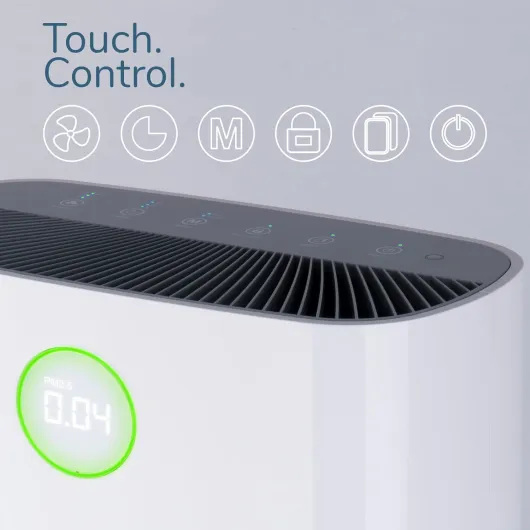
Controls are touch-based on the top panel. From there, users can select fan speed, engage auto mode, set the timer, enable child lock or adjust display behaviour. The front area shows the air quality indicator ring backed by a numerical PM2.5 reading. The colour codes are straightforward: blue for very good air, green for normal, purple for poor and red for high risk. Several reviews describe watching it flip quickly from blue to red when cooking or spraying products, then gradually back to blue as the purifier runs, which confirms that the sensor and indicator are not just cosmetic.
A recurring point in the comments is the discreet behaviour at night. The unit includes a light sensor and a dedicated silent mode that dims or turns off lights, which is important if it’s placed in a bedroom. A few buyers highlight that they can sleep with it running, without being disturbed by either light or noise. The child lock is another practical design choice if the purifier sits in a living room where kids might be tempted to poke at the controls.
At 5.6 kg, the Alto four is light enough that some buyers say they move it between rooms during the day. It does not seem to rely on elaborate handles or wheels; it’s simply not that heavy. In my opinion, the design is functional rather than stylish: if you want an object that blends quietly into a modern interior and is easy to operate, it ticks the box. If you are looking for premium materials, unusual shapes or app-based control with smart-home integration, this model is more basic. The focus is clearly on straightforward operation and readable feedback about air quality.
Build, filters and long-term use potential
Durability for an air purifier is mainly about three things: reliable electronics, motor/fan lifespan, and filter support over time. The EVA Alto four doesn’t have years of long-term tracking in the public comments, but there are some reassuring signs. First, the manufacturer offers a two-year unlimited product warranty and promises lifetime product support. That kind of warranty is fairly generous for this category and suggests the brand has some confidence in the basic reliability of the motor, sensor and control electronics.
The unit is made in China, like most purifiers in this price range, and uses mostly plastic construction. There are no luxury materials here, but no recurring complaints about cheap feeling parts or panels either. At 5.6 kg, it’s not feather-light, which usually indicates a reasonably solid internal frame and motor. Some buyers mention moving it from room to room without issue, which implies the casing and internal mountings hold up to regular handling.
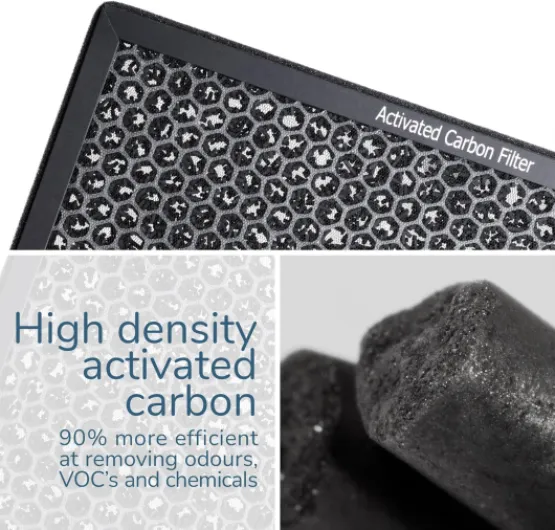
The filter system is where EVA tries to differentiate itself. The brand claims its activated carbon filters are “high density” and up to 90% more efficient than other brands for odours. That’s marketing language, but the practical upside is that the Alto four ships with a two-year filter supply included. Assuming typical home use and that the filters last as long as advertised, that reduces both waste and cost in the first years. There’s also a filter replacement indicator, which is key for avoiding overused filters that reduce performance and strain the motor.
From the reviews, there aren’t widespread reports of early failures, odd noises, or sensor problems. People talk about consistent behaviour of the PM2.5 readings and auto mode over weeks to months. One user with a dusty environment (log fire, lots of airborne particles) highlights that the unit coped well and that dust accumulation on furniture dropped, which indirectly suggests the filter and fan system can handle a reasonably heavy load. In my opinion, given the warranty, the extra filters in the box, and the absence of red flags in comments, the Alto four looks decently robust for home use. It is still a mid-range plastic appliance, not a tank, but nothing stands out as a weak point from the information available.
Noise, coverage and day-to-day behaviour
On the performance side, three aspects stand out: noise levels, coverage claims and smart behaviour. EVA advertises 17 dB in silent mode, which is extremely low on paper – roughly comparable to a very quiet bedroom at night. While we don’t have lab measurements here, multiple reviews back up the idea that the unit is genuinely quiet. People say they can sleep with it on, watch films without being annoyed, and generally forget it’s running on the lowest or auto settings. No one describes intrusive fan noise at night, which is often a common complaint with cheaper purifiers.
Coverage is rated at 55 m², with the brand suggesting that multiple rooms can be purified if doors are left open. In practice, buyers mostly talk about using it in single rooms or open-plan spaces: living rooms, bedrooms, lounges with a log fire, or large downstairs areas. One reviewer with a large open-plan downstairs was sceptical it could handle the volume, then reports that the unit still picked up cooking emissions from a distant kitchen and cleared them, based on the sensor readings and colour changes. That lines up with a decent air throughput, even if the exact CADR figure isn’t published.
The auto mode and sensor behaviour get a lot of praise. Users describe it idling quietly with a blue ring during normal conditions, then ramping up when pollutants rise. Examples include cooking bacon, using sprays, or stirring up dust with a vacuum. The fact that the PM2.5 reading drops in a plausible way, and that the fan calms down once levels are low again, suggests the feedback loop is working. One London user mentions the unit maintaining indoor PM2.5 around 8 µg/m³, which is relatively low for a city environment, and says their lungs feel less rough during indoor exercise sessions with the purifier running.
From a power perspective, 34 W maximum is modest, which should allow long daily runtimes without a major electricity penalty. That said, lower power usually means you need longer runtimes to fully clean larger spaces. In my opinion, the Alto four seems ideally suited for small to medium rooms or single open-plan areas, where it can cycle the air several times per hour. For a whole house with doors closed and multiple floors, one unit would be optimistic. But for the typical use cases described in the reviews – bedroom at night, lounge with pets or a log burner, city flat near traffic – the performance looks solid and well matched to its specs.
What the EVA Alto four promises on paper
The EVA Alto four is positioned as a multi-stage filtration air purifier for homes, offices and multi-room spaces up to 55 m². The filtration stack is classic but solid: a 3-stage system with pre-filter, antibacterial True HEPA and high-density activated carbon. The HEPA stage is advertised to trap 99.97% of particles down to 0.3 microns, which covers common allergens such as pollen, dust mite debris, pet dander and fine particulate matter (PM2.5). The manufacturer also claims 99.95% removal of bacteria and viruses, which is a bold statement but in line with what a decent HEPA system can theoretically achieve for airborne particles passing through the filter.
The unit is rated for 55 m² floor area, with marketing language suggesting it can handle multiple rooms as long as doors stay open. There’s no CADR figure listed here, which would have been more precise, but buyers mention it cycling air several times per hour in typical living rooms. Power draw is listed at 34 W, which is modest; in theory this allows continuous operation without a major impact on the electricity bill, especially at lower fan speeds or in auto mode.
Feature-wise, it is not stripped down. It includes auto mode linked to a professional-grade PM2.5 particulate sensor, touch controls, a timer function, child lock, a light sensor to dim the display at night, and a replace filter indicator. A nice practical point: the box is advertised as including a two-year filter supply, which is unusual in this price bracket and reduces the running cost for the first couple of years if filters last as long as suggested.
In the public comments, several buyers say the unit arrived with the main filter already installed inside the housing, which led a few people to think it was missing until they opened it. Once running, reviewers often refer to the colour-coded air quality ring (blue, green, purple, red) and the numerical PM2.5 reading as useful feedback. On the whole, the Alto four presents itself as a mid-sized, fully featured purifier with a focus on low noise, serious filtration and relatively hassle-free ownership rather than flashy smart-home extras.
Filtration effectiveness: what buyers actually notice
The core question with any purifier is simple: does it make the air feel cleaner for real people in real homes? With the EVA Alto four, a lot of the public feedback goes in that direction. Several verified buyers with hay fever, asthma or chronic sinus issues mention a noticeable improvement. One person reports a significant drop in hay fever symptoms in about 20 minutes in a small to medium room. Another, with asthma and permanent sinus problems, says they are breathing a bit better after running it in auto mode in a large downstairs area for a few days.
Odour removal comes up repeatedly. One user describes a redecorated home with strong paint fumes that were “really bad on the lungs”; they say the EVA unit cleared the smell within a few days to the point that the space felt livable again. The same review notes that running it on low in the bedroom coincided with reduced snoring and generally easier breathing, and they also highlight that cat litter odours are reduced quickly when the purifier is running. Another buyer with a log fire talks about heavy dust buildup and a high initial PM reading (reported as 245 on the display) that dropped to near zero after several hours, with dust on furniture apparently much reduced afterwards.
Several comments point out how the PM2.5 sensor reacts to specific triggers: cooking bacon in a distant kitchen, using air freshener, or vacuuming. In these cases, the ring indicator flips to red or purple, fan speed ramps up, and the numeric PM reading then slowly falls back to a low level (often around 8 µg/m³, according to one London-based buyer). That doesn’t prove lab-grade accuracy, but it does indicate that the sensor is sensitive enough to respond to real pollution events and that the filtration plus airflow can reduce particle load in a noticeable way.
On paper, the combination of a pre-filter, antibacterial True HEPA and high-density activated carbon should cover both particles and many odours. The manufacturer even claims removal of various traffic-related pollutants such as PM10, PM2.5, polycyclic aromatic hydrocarbons and heavy metals, which are all typically bound to fine particles. In my opinion, the lack of independent lab results or CADR figures is a downside for anyone who wants hard numbers. But the consistency in buyer comments about fewer allergy symptoms, reduced smells and visibly lower dust suggests that, in typical home conditions, the Alto four is genuinely effective for allergens and odours rather than just moving air around.
Pros
- Very quiet operation (advertised 17 dB) with many buyers confirming it is easy to sleep or watch TV with it running
- True HEPA + high-density activated carbon filtration with responsive PM2.5 sensor and auto mode that reacts to cooking, sprays and dust
- Good value extras: two-year filter supply included, low 34 W power draw, and a two-year unlimited warranty with lifetime support
Cons
- No Wi‑Fi, app control or voice assistant integration for those who want smart-home features
- Coverage and airflow details (like CADR) are not clearly published, making it harder to compare precisely with some competitors
Conclusion
Editor's rating
The EVA Alto four comes across as a quiet, competent workhorse rather than a flashy gadget. On paper, it combines a proper 3‑stage system (pre‑filter, antibacterial True HEPA, high‑density carbon) with a PM2.5 sensor and auto mode, wrapped in a 34 W package rated for up to 55 m². In the published reviews, the same themes repeat: better breathing for allergy and asthma sufferers, clear drops in smells from paint, pets and cooking, visible dust reduction in rooms with a log fire, and very low perceived noise at night.
It’s not trying to be a designer object or a smart-home hub. There’s no app, no voice control, no metal casing. Instead, you get practical touches: child lock, timer, light sensor, dimmable display, and a lifetime of product support with a two-year unlimited warranty. The included two-year filter supply and low power draw help the long-term cost side, which many people underestimate when choosing a purifier.
In my opinion, the Alto four suits users who want clean air with minimal fuss: families with pets, people near busy roads, those with hay fever or mild asthma, and anyone who wants something they can leave in auto mode without thinking about it. If you live in a very large home and expect one unit to handle everything behind closed doors, or if you care a lot about app integration and designer looks, this model will feel limited. But for typical bedrooms, lounges and open-plan living areas, the mix of quiet operation, credible filtration and reasonable running costs makes it a solid choice in the mid-range segment.