Federal agencies put DIY clean air rooms on the official map
The new federal wildfire smoke guidance and 2026 clean air room framework marks a turning point for people living with recurring wildfire smoke. For the first time, the Environmental Protection Agency explicitly endorses a do it yourself box fan and high efficiency filter setup as a legitimate way to protect indoor air during a smoke event, placing it alongside commercial air cleaners in national recommendations for public health officials. This shift matters for every resident who has watched heavy smoke roll into their neighborhood and wondered whether a single portable air cleaner or an improvised system would be enough to protect family members with fragile health.
Released in May 2024 by EPA with the Centers for Disease Control and Prevention, the U.S. Forest Service, the California Air Resources Board and Western States Pediatric Environmental Health Specialty Units, the updated guide arrives as wildfires already send smoke across Colorado and the West. The Aspen Acres fire has triggered air quality advisories for multiple counties, underscoring how quickly wildfire smoke can turn otherwise safe indoor air into a hazard when windows and doors leak or when an older HVAC system pulls polluted air inside. In that context, the revised wildfire smoke guidance and 2026 clean air room strategy focuses on four priorities, from pre event planning to stronger protections for children, older adults and people with chronic heart or lung disease who feel smoky conditions first.
For purifier owners, the most practical change is the clear federal recognition that a well built DIY air cleaner can complement a certified device during intense smoke events. The guide’s fact sheet series, available as a downloadable PDF set from EPA’s wildfire smoke and indoor air quality resources, walks public health agencies through messaging on indoor air, wildfire smoke and the role of both commercial air cleaners and box fan based systems in a layered defense. While the document targets public officials, its detailed language on air monitoring, filter selection and room level strategies effectively serves as a playbook for any household trying to maintain air quality when wildfires turn the sky orange and the smell of fire seeps through every window air unit or aging air conditioner.
How DIY box fan filters stack up against commercial purifiers
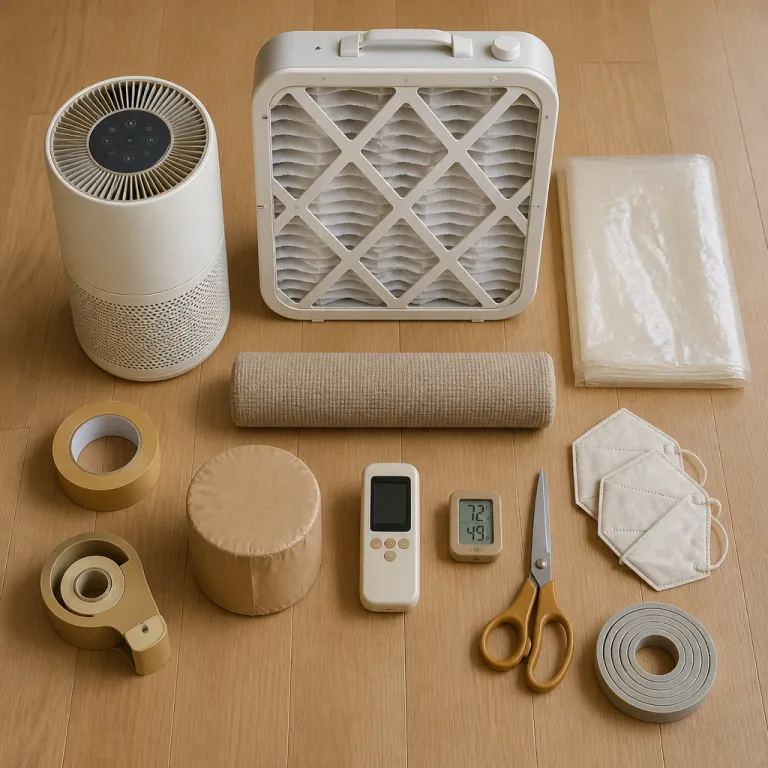
The federal wildfire smoke guide and 2026 clean air room recommendations do not treat a box fan with a taped on filter as a magic solution, but they do frame it as a realistic stopgap when budgets are tight or stores sell out of portable air cleaners. A properly assembled DIY air cleaner uses a standard box fan and a high efficiency filter, ideally rated MERV 13 or higher, to pull smoke filled air through dense fibers that trap fine particles which otherwise penetrate deep into the lungs. In calm smoky conditions, such a system can significantly improve indoor air quality in a single bedroom or living room, especially when doors and windows stay closed and the central HVAC system is set to recirculate rather than draw in outdoor air.
Commercial air cleaners, by contrast, are engineered as sealed systems with optimized airflow paths, quieter fans and filters designed specifically for repeated wildfire smoke events. Many portable air cleaner models use true HEPA filters that capture at least 99.97 percent of particles down to 0.3 micrometers, outperforming most generic furnace filters taped to a fan, particularly when heavy smoke lingers for days. For families managing asthma or heart disease, experts generally recommend using a certified air cleaner as the primary defense and treating any DIY air system as a backup, especially in small homes where a single device can maintain cleaner indoor air in the main clean air room while a second unit or box fan filter supports adjacent spaces.
Noise, durability and safety also separate the two approaches, and the federal wildfire smoke guidance and 2026 clean air room language reflects those tradeoffs. A box fan running on high can be loud, may not be designed for continuous operation under smoke event loads and requires careful placement away from children, pets and loose fabrics near the fan blades. By comparison, a quality portable air cleaner is built for long runtimes, often includes a child lock, and uses enclosed fans and filters that reduce the risk of accidents while still moving enough air to protect family members during repeated wildfires, especially when combined with targeted bedroom strategies highlighted in independent guidance on asthma friendly room setups.
Turning guidance into a practical clean air room plan at home
For households already using a purifier, the new wildfire smoke guide and 2026 clean air room playbook effectively confirms that combining a commercial air cleaner with a carefully built DIY air filter box can create a stronger buffer against wildfire smoke. The core idea is simple, yet powerful during a smoke event, choose one room with minimal window leaks, close interior doors, seal obvious gaps and run both the portable air cleaner and any box fan filter continuously on higher settings. When wildfires intensify and outdoor air monitoring shows rising fine particle levels, this layered system helps maintain a pocket of safer indoor air where vulnerable people can rest, take medications and ride out the worst smoky conditions.
Maintenance and timing are critical, and this is where many residents quietly lose protection without realizing it. Filters in both air cleaners and HVAC system units clog faster under heavy smoke, so the federal wildfire smoke guidance and 2026 clean air room approach implicitly assumes that households will check and replace filters more often during fire season, not just on a fixed calendar. A structured maintenance routine for purifiers, fans and filters, applied before the first smoke events of the season, can restore lost performance and ensure that every cleaner, fan and window air conditioner in the home is ready when the next smoke event arrives.
The updated guide also leans on communication tools such as each fact sheet and the longer PDF manual to help public health agencies explain why some rooms feel safer than others during wildfires. For residents, that translates into practical steps, like using a box fan filter in a small office with no central HVAC system, running a portable air cleaner in the main bedroom, and keeping windows closed even when the smell of fire seems faint. As communities from the Bay Area to inland Colorado brace for more frequent smoke events, the federal wildfire smoke guide and 2026 clean air room strategy signals a new federal consensus, one that treats every cleaner, from commercial units to humble DIY air boxes, as part of a flexible toolkit to protect family health when wildfire smoke turns the simple act of breathing into a daily calculation.