
Summary
Editor's rating
Value for money: good everyday option, not a miracle odor buster
Design: compact, decent-looking, and easy to place
Comfort and noise: decent white noise, but high speed is noticeable
Build quality, filters, and long-term use
Performance: good for dust, allergies, and light smells, less magic for heavy odors
What you actually get with the PuroAir 240 (2-pack)
Pros
- Noticeable reduction in dust and allergy symptoms after a week of continuous use
- Quiet enough on low/sleep mode for bedroom use, with useful auto mode and sensor
- Compact footprint and simple, no-app setup make it easy to place and run 24/7
Cons
- Struggles to fully remove strong, persistent odors like multiple litter boxes in a small room
- Ongoing filter replacement costs add up over time, as with most HEPA purifiers

Specifications
View full product page →| Brand | PuroAir |
Two purifiers, one house full of dust and allergies
I’ve been running this PuroAir 240 two-pack for a few weeks: one unit in the bedroom and one in the main living area. My house is pretty standard: older HVAC, a lot of dust, one pet, and a partner with annoying seasonal allergies. I’m not a tech nerd about air quality; I just wanted less dust on surfaces and fewer mornings waking up congested. So I plugged these in and basically left them on 24/7 like the brand suggests.
The first thing I noticed wasn’t some dramatic feeling of “crisp mountain air” or anything like that. It was more basic: less dust building up on the nightstand, and fewer sneezing fits in the morning. After about 5–7 days of constant use, that’s when it became pretty clear these weren’t just blowing air around. The air felt a bit “lighter”, especially in the bedroom, and I wasn’t waking up with the usual dry throat and stuffy nose.
Noise-wise, I was a bit worried. I hate loud fans when I’m trying to sleep. On low and sleep mode, they’re very manageable – more like a low hum than a loud fan. You do hear them kick up when they detect something in the air (like cooking smoke), but it’s not crazy loud. I’d compare it to a box fan on low/medium. If you’re super sensitive to noise, you’ll want sleep mode at night, but for me it was fine even on low regular mode.
Overall, my first impression is: this isn’t some miracle device, but it feels like a pretty solid upgrade if your home is dusty or you have mild to moderate allergies. It’s not perfect, and it’s not going to fix a seriously smelly litter box situation on its own, but for everyday dust, pollen, and general “stale house” air, it actually gets the job done better than I expected.
Value for money: good everyday option, not a miracle odor buster
In terms of value, this PuroAir 240 two-pack sits in a pretty reasonable spot. You’re getting two decent-sized HEPA purifiers with auto mode, a sensor, and carbon filters for less than some brands charge for a single big unit. For a normal household with dust, pollen, and maybe one or two pets, I think the price makes sense. You’re not paying for smart home apps or fancy displays; you’re basically paying for filtration and quiet operation, which is what most people actually need.
Compared to higher-end units (like that GT-3000 someone mentioned at around $1,000), you obviously don’t get the same level of odor removal power. If you’re expecting this to nuke heavy cat litter smells in a basement in two hours, you’ll probably be disappointed. But that’s also a totally different price bracket. For the cost here, it does a pretty solid job on the basics: dust, pollen, general indoor stuffiness, and lighter odors from cooking or a single litter box.
You do have to factor in filter replacements. Over a couple of years, the filters will probably add up to a decent chunk of the original price. That’s standard for all purifiers, though. If you’re not willing to keep up with filter changes, honestly, don’t buy any HEPA purifier – they all need it. At least PuroAir has clear indicators and easy access, so you’re not fighting the unit to keep it maintained.
So, value-wise, I’d sum it up like this: for someone who wants reliable, simple purifiers that help with allergies and dust and can run quietly all day, this 2-pack is a good deal. If your main mission is hardcore odor control or you want app integration and more advanced features, you’re probably better off either spending more on a high-end unit or looking at a different category entirely. For regular home use, it hits a nice middle ground between cost and performance.
Design: compact, decent-looking, and easy to place
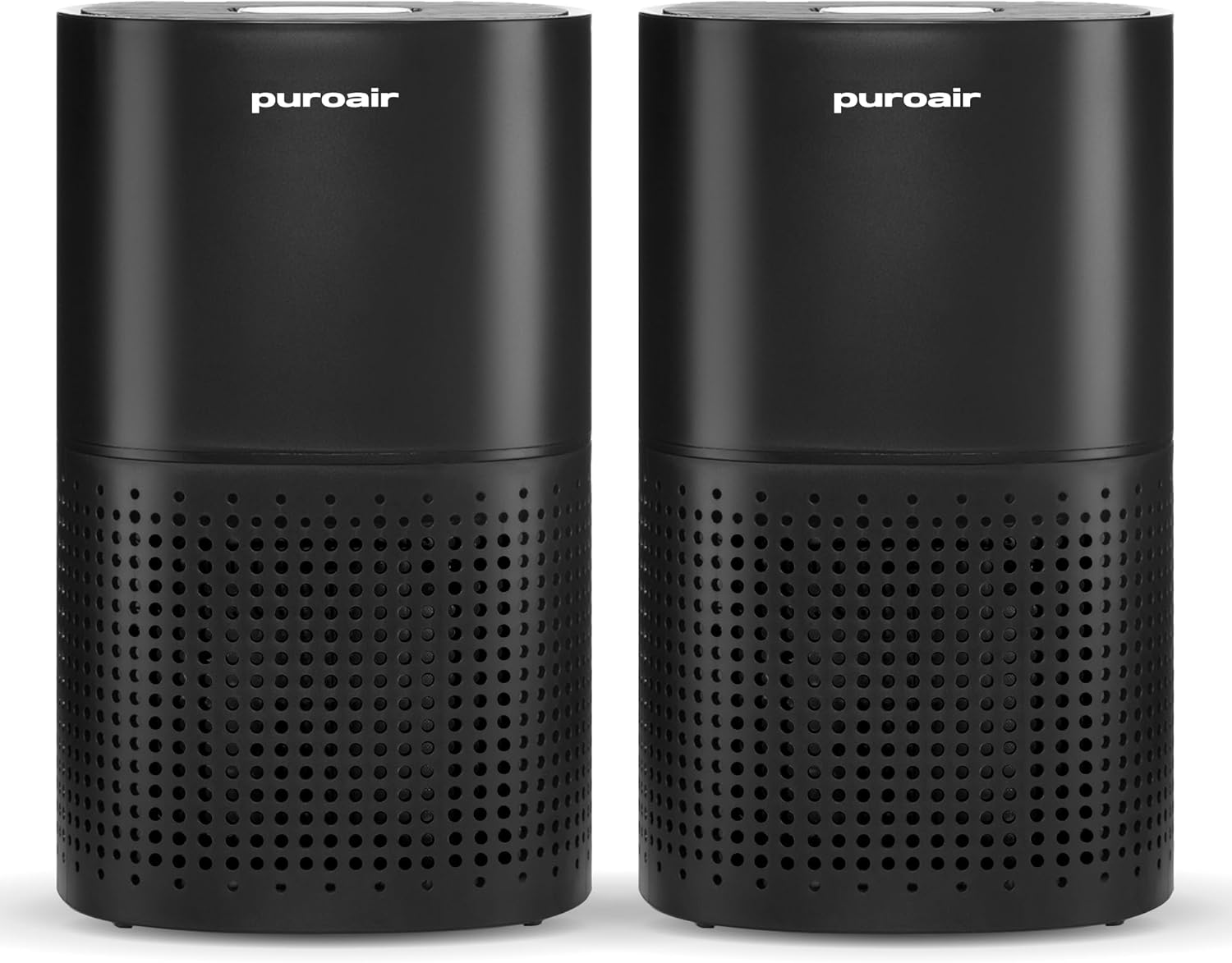
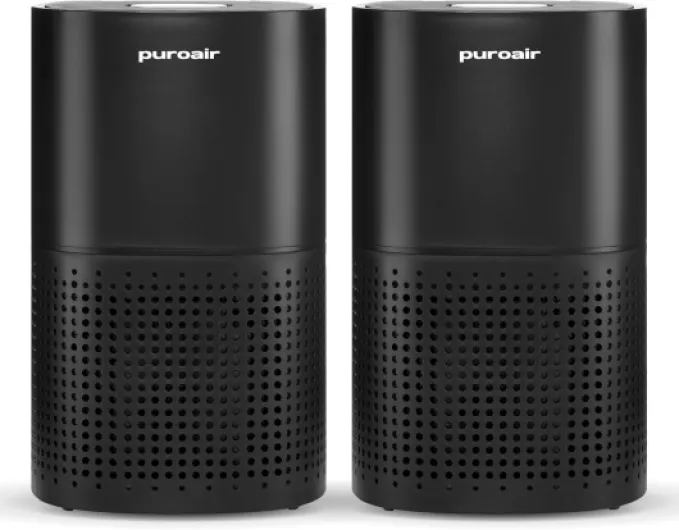
Design-wise, the PuroAir 240 is pretty low-key, which I like. It’s a black rectangular tower with rounded edges and air intake around the sides, and clean air blowing out the top. No weird futuristic curves or shiny chrome. It just looks like a small appliance. If you’re picky about aesthetics, it’s neutral enough that it won’t clash with anything. I dropped one in a bedroom and one in the living room, and neither looks out of place or cheap.
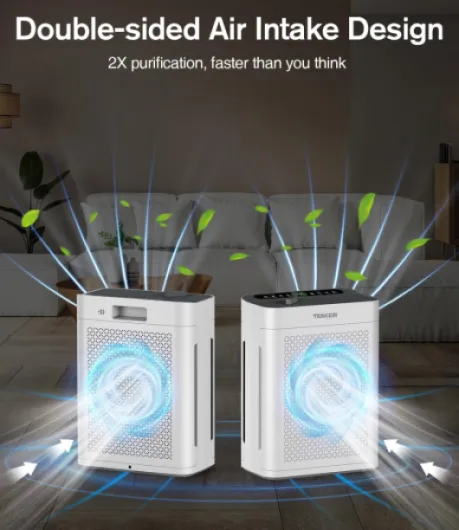
The footprint is small, which is a big plus. At a little over 8" square, you can tuck it next to a nightstand, beside the TV stand, or in a corner and still give it some breathing room. Because it pulls air from around the unit instead of just the back, it’s easier to place than some bigger purifiers that need to stand a foot away from the wall. One user mentioned the PuroAir 400 being a bit awkward since it pulls air from the back; with this 240 model, that’s less of an issue. You still shouldn’t shove it tightly against a wall, but it’s not nearly as fussy.
The top panel has touch buttons and a simple display. No clutter, no tiny text. You can see the mode, fan speed, and when the filter needs changing. It’s straightforward enough that someone who’s not into gadgets can figure it out in a minute. I also like that it’s light enough (about 7 lbs) to move around with one hand. I’ve dragged it from bedroom to office a few times without thinking about it. That’s a big difference compared to the huge, heavy purifiers that feel like small furniture.
If I had to nitpick, I’d say the design is a bit plain. It doesn’t feel premium, but it doesn’t feel cheap either. Just functional. There’s no handle built in, which would have been nice, but because it’s light and not that tall, it’s not a big deal. So on design: nothing fancy, nothing annoying, and that’s honestly what I want from a purifier I’m going to ignore 99% of the time.
Comfort and noise: decent white noise, but high speed is noticeable
Comfort here is mainly about noise and airflow, since you’re not physically touching the thing. On the lowest speed and sleep mode, the PuroAir 240 is easy to live with. It’s a soft fan hum, a bit like a laptop fan on low or a quiet desk fan. In my bedroom, I actually found it kind of nice as white noise. It didn’t mess with my sleep at all. If you’re the type who needs absolute silence, you might notice it, but compared to other purifiers I’ve tried, this one is on the quieter side at low settings.
On medium, you know it’s on, but you can still watch TV or have a conversation without shouting. I’d call it comfortable for living rooms or offices. High speed is where it gets more obvious. It’s not jet-engine loud, but you probably won’t want it on max speed all night in a bedroom. The good news is you rarely need high constantly. Auto mode only pushes it up when the air is actually dirty – like when cooking or when there’s smoke or strong smells. Once things clear up, it drops back down.
The airflow direction is straight up, which I like. You don’t get a cold draft blowing straight at you. It mixes the air in the room without feeling like a fan pointed at your face. I could sit a few feet away and not feel any uncomfortable breeze, even though the air was clearly circulating. If you’re sensitive to moving air, this top-vent style is better than side-blowing designs.
Day to day, I’d say these are comfortable to live with. I don’t find myself turning them off because of noise or draft. The only time the sound really stands out is when the sensor kicks it up to high speed, but that usually doesn’t last very long. So if you want something that can run 24/7 in a bedroom or office without driving you nuts, this fits that use pretty well, as long as you stick to low or sleep mode at night.
Build quality, filters, and long-term use
Build-wise, the PuroAir 240 feels like a mid-range plastic appliance. The housing is solid enough, no rattles or weird vibrations, but it’s not heavy-duty metal or anything like that. For a 7 lb purifier, that’s normal. I’ve moved mine around quite a bit and it hasn’t picked up any scuffs or creaks yet. The top touch panel hasn’t scratched or faded, and the buttons still respond well. It doesn’t feel fragile, but I also wouldn’t expect it to survive being dropped down stairs.
The key durability question on these things is really the filters. They’re easy to access: pop open the panel, pull out the filter, vacuum the pre-filter if needed, and swap the main filter when the light tells you to. You don’t have to guess when to change it, which helps if you’re lazy about maintenance like I am. Replacement filters aren’t the cheapest in the world, but they’re also not in the crazy “why is this almost the price of the machine” territory. If you run it 24/7, expect to budget for a couple filter changes per year, depending on how dusty your place is.
They advertise a 2-year risk-free warranty, which is actually pretty reassuring for something with a fan and sensor that’s supposed to run non-stop. I obviously haven’t had these for two years yet, but knowing there’s a decent warranty behind it makes it easier to leave them on all the time without worrying they’ll die in six months. Also, there are enough user reviews going back a while that I’d be more worried about filters and cleaning than the motor itself.
Overall, I’d call durability solid but not bulletproof. Treat it like any other small appliance: don’t block the vents, vacuum the pre-filter now and then, and don’t slam it around. If you do that, it feels like it should hold up fine for several years of normal home use. The fact that people are using multiple units around the house and still happy after months lines up with that impression.
Performance: good for dust, allergies, and light smells, less magic for heavy odors
In daily use, the biggest difference I noticed was with dust and morning allergy symptoms. After about a week of running these almost nonstop, I wasn’t wiping down dust nearly as often, especially on dark furniture that usually shows everything. My usual pattern was waking up with a stuffy nose and some sneezing for the first 30 minutes. With the PuroAir 240 running in the bedroom, that dropped a lot. Not zero, but noticeably less. That lines up pretty well with what other buyers are saying about allergies easing up after a few days of use.
The auto mode and sensor are actually useful. Whenever I’m cooking and some smoke or strong smell escapes into the living area, the unit in that room ramps up on its own. The fan noise increases, you can hear it clearly, but not to the point where it’s unbearable. After maybe 20–30 minutes, the smell is mostly gone and the fan drops back down. Same thing with things like cleaning sprays: it reacts, works harder for a bit, then calms down. It’s one of those features you don’t think you need until you see it doing its job without you touching anything.
Now, for heavy odors, like multiple cats and litter boxes in a small room, it’s more of a helper than a solution. One review mentioned using it in a 100 sq ft cat room and said it helped but didn’t fully remove the smell. That seems fair. It’s not some industrial odor killer. If your main goal is to erase strong pet or basement smells in a couple hours, you’d probably need something much more expensive or combine this with better ventilation and more frequent cleaning. For normal house smells, cooking, light pet odor, and general stale air, it does fine. For extreme situations, don’t expect miracles.
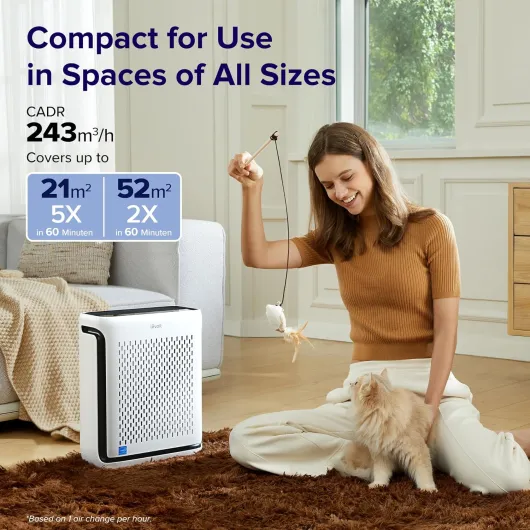
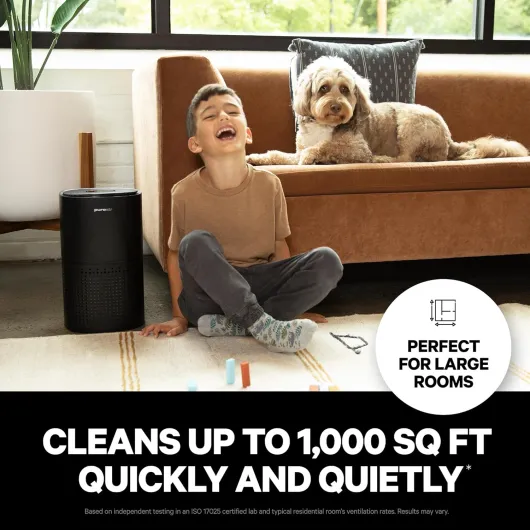
As for coverage, PuroAir says up to 1,000 sq ft in an hour. In reality, I’d say it’s best in the 200–400 sq ft range per unit if you want a clearly noticeable effect. In my open living/dining area (roughly 500–600 sq ft), one unit still helped, but the difference was more subtle than in the smaller bedroom. If you’re buying this 2-pack for a typical house or apartment, my view is: one per floor or one per main room is a reasonable plan, just don’t expect one unit to handle a whole big open floor perfectly.
What you actually get with the PuroAir 240 (2-pack)
The 2-pack basically gives you two identical PuroAir 240 units, each rated for up to about 1,000 sq ft per hour. In real life, I’d say they’re ideal for a typical bedroom, office, or a medium living room. I wouldn’t rely on one single unit for an entire big open floor, but two spread out in key spots feels about right. Each purifier comes with its HEPA filter already installed; you just have to unwrap the plastic before using it.
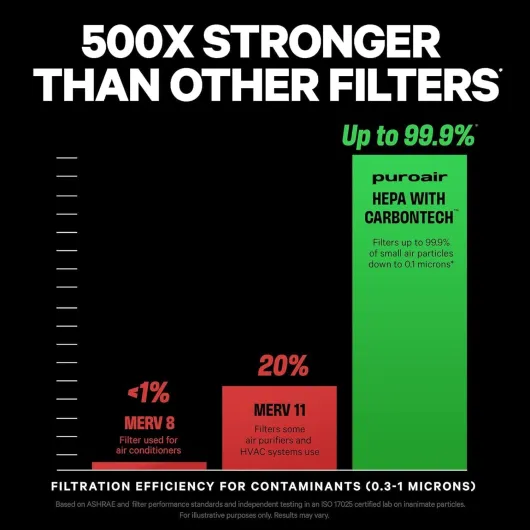
Specs-wise, they’re pretty compact: roughly 8.5" x 8.5" footprint and about 14" tall, around 7 lbs. Power is corded, no battery, so you’re obviously tied to an outlet. They use a 3-layer system: pre-filter, HEPA, and activated carbon. That’s standard for this type of purifier and means it targets dust/pollen (HEPA) and smells/VOCs (carbon). There’s a built-in air quality sensor and an auto mode, which is what I used 90% of the time. You also get a sleep mode, timer, and a filter replacement indicator, which is handy because I’m not going to track that manually.
In terms of setup, it’s as simple as it gets: unbox, remove the plastic from the filter, plug in, pick a mode. No app, no Wi-Fi, no account to create. Some people like connected apps; personally, I’m fine with just hitting a button on top. The control panel is touch-based, and the icons are pretty straightforward once you’ve used it once or twice. There’s also an air quality indicator that changes based on how dirty the air is, which is more of a sanity check than a precise scientific tool, but it’s nice to see it go up when you burn something in the kitchen.
So in plain terms: you’re paying for simple, plug-and-play purifiers with decent coverage, proper HEPA filtration, and some basic smart behavior (auto mode, sensor) without any complicated ecosystem. If you want deep app control and fancy graphs, this isn’t that. If you want something you can forget about in the corner that just runs, this lines up with that kind of use.
Pros
- Noticeable reduction in dust and allergy symptoms after a week of continuous use
- Quiet enough on low/sleep mode for bedroom use, with useful auto mode and sensor
- Compact footprint and simple, no-app setup make it easy to place and run 24/7
Cons
- Struggles to fully remove strong, persistent odors like multiple litter boxes in a small room
- Ongoing filter replacement costs add up over time, as with most HEPA purifiers
Conclusion
Editor's rating
The PuroAir 240 (2-pack) is a practical choice if your main problems are dust, pollen, and general indoor air feeling stale. In my own use, the biggest wins were less visible dust on surfaces and fewer allergy symptoms in the morning, especially in the bedroom. Noise is reasonable on low and sleep modes, and auto mode actually behaves the way it should: quiet most of the time, louder only when the air gets worse (cooking, smoke, sprays, etc.). You get proper HEPA + carbon filtration without a complicated app or setup.
It’s not perfect. If you’re dealing with strong, constant odors – like multiple cats in a small room or a very musty basement – this will help, but it won’t completely fix it on its own. And while the build is decent, it’s still mostly plastic, so treat it like any other mid-range appliance. You also need to be okay with the ongoing cost of replacement filters, because that’s part of the deal with any purifier in this category.
I’d recommend this 2-pack for: people with mild to moderate allergies, dusty homes, pets that cause some dander but not extreme odor, and anyone who wants a simple, always-on purifier they can mostly forget about. I’d say skip it or look higher-end if your main goal is heavy odor removal, or if you want deep smart-home integration and app control. For straightforward, everyday air cleaning across a couple of rooms, it’s a good value and gets the job done without trying to be fancy.