Summary
Editor's rating
Is the Dreo HM735S worth the price?
Tall tower design: practical, but the base could be stronger
Day-to-day comfort: sleep, plants, and general feel
Build quality, plastic feel, and cleaning reality
Humidity control, noise, and real-world coverage
What you actually get with the HM735S
Does it actually fix dry air problems?
Pros
- Very large 11L tank with genuinely long runtime (up to several days on low)
- Quiet operation, especially in sleep mode, suitable for bedrooms and nurseries
- Top-fill design and smart app/voice control make daily use and scheduling easier
Cons
- Built-in hygrometer can read 10–15% higher than actual, making Auto mode less accurate
- Base feels a bit weak for such a tall unit and there are no handles for moving it when full
- Ongoing costs and care: demineralization cartridges, need for filtered/distilled water, and regular cleaning

Specifications
View full product page →| Brand | Dreo |
A big smart humidifier that actually runs for days
I’ve been running the Dreo HM735S 11L in my place for a bit now, mainly in a large living room and sometimes moved into the bedroom at night. I bought it because I was tired of refilling tiny 1–2 gallon units every single night in winter and dealing with crusty filters. On paper this one checks a lot of boxes: 11L tank, smart control, quiet, and rated for up to 700 ft². I wanted something I could fill, forget for a few days, and still keep humidity in the 40–50% range.
Out of the box, it doesn’t feel like a cheap toy, but it also isn’t some heavy-duty industrial thing. It’s tall and slim, and honestly the size is what you notice first. If you’re used to those tabletop humidifiers, this is more like a mini tower on the floor. I set it near the middle of the room at first, then tried it closer to a wall. It pushes the mist high enough that it doesn’t immediately drench the floor, which is good.
I mainly used it on Auto or level 1, with the app to tweak things. My goals were simple: stop waking up with a dry throat, keep the guitars from drying out too much, and give the plants a bit more humidity without turning the whole house into a sauna. I also kept an eye on white dust and noise, because those are the two things that usually make me ditch a humidifier.
Overall, it does what it says, but it’s not perfect. The built‑in humidity reading can be off compared to a separate hygrometer, the base feels a bit flimsy for how tall it is, and you still have to think about water quality and the demineralization cartridge. But if you want capacity and quiet operation more than laboratory‑level accuracy, it’s a pretty solid option.
Is the Dreo HM735S worth the price?
Looking at value for money, I’d say this humidifier is good but not unbeatable. For the price range it usually sits in, you’re paying for three main things: the big 11L tank, the smart features, and the quiet operation. If you actually use all of that—especially the capacity and app control—then it feels like decent value. It ranks around #43 in humidifiers on Amazon with a 4.4/5 rating, which roughly matches my own feeling: not perfect, but generally solid.
Where the value gets a bit more debatable is the ongoing costs and small flaws. You’ve got the recommended monthly demineralization cartridge (if you follow their guidelines strictly), possible use of distilled or filtered water, and your time spent cleaning. On top of that, the built‑in hygrometer being off by 10–15% in some cases means you don’t fully benefit from the Auto mode unless you pair it with another hygrometer. So you’re paying for a smart, automatic humidifier, but then you end up babysitting it more than you’d like if you care about precision.
On the other hand, compared to smaller 1–2 gallon units, this thing just runs longer. I got 2–4 days of runtime depending on the setting, where my old tabletop unit needed daily refills and still struggled to keep up. If you factor in the time and hassle saved by not refilling constantly, that has real value, especially in winter when you’re already dealing with enough house chores.
If your budget is tight and you only need to humidify a small bedroom, there are cheaper, simpler models that will do the job. But if you want one unit to cover a bigger room, like a living room or open office, and you care about quiet operation and app control, the HM735S is a pretty solid compromise. Just go in knowing it’s not perfect, the base isn’t bombproof, and you’ll still need a bit of maintenance and a separate hygrometer if you’re picky.
Tall tower design: practical, but the base could be stronger
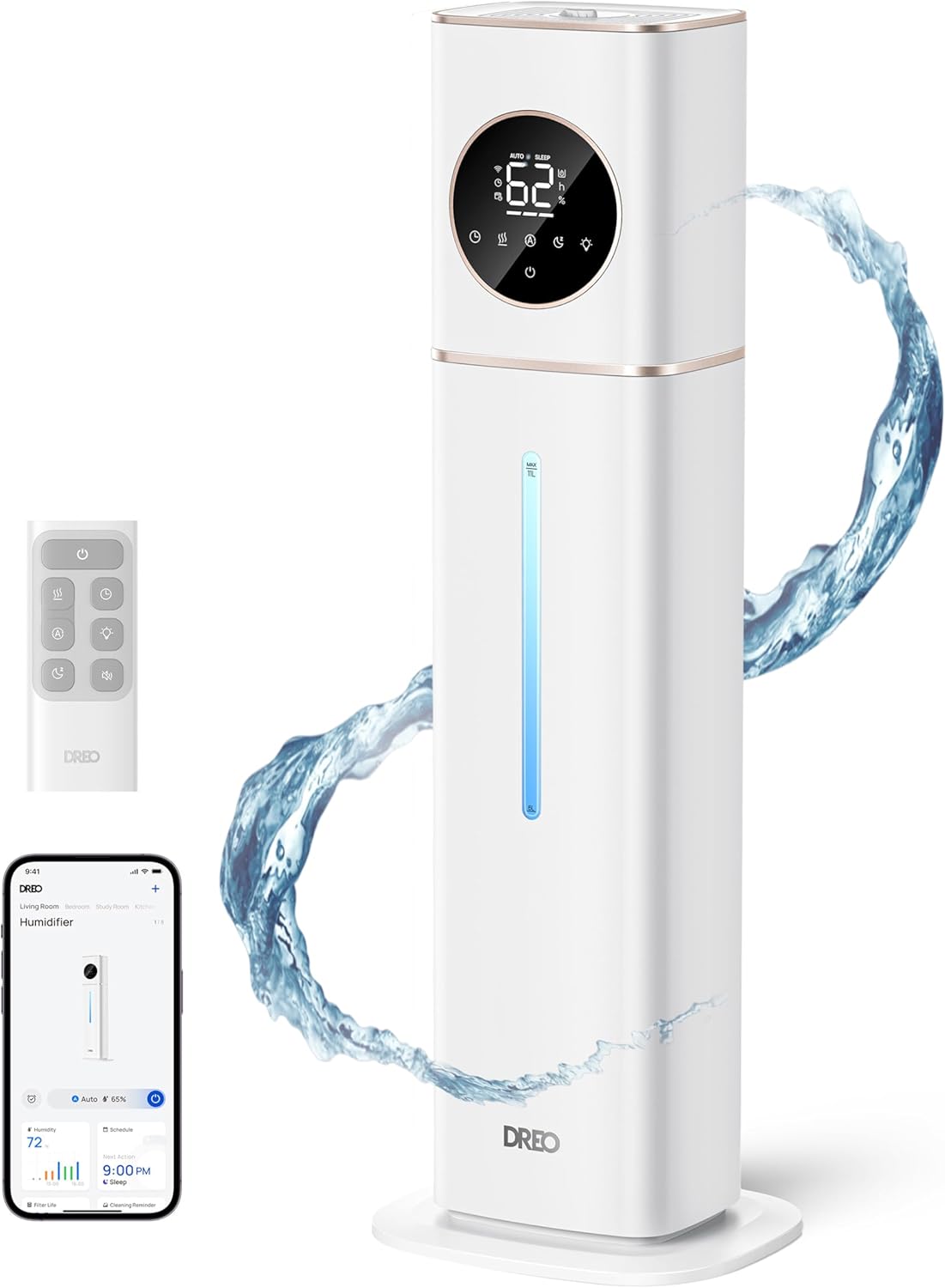
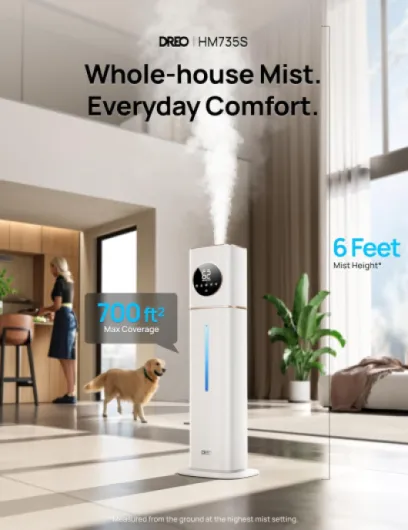
Physically, the HM735S is a tall, narrow tower: about 31 inches high, 10.24" deep, and 8.86" wide. The shape is basically a square column with a slightly more solid base. The top has a flat lid with a 360° rotatable nozzle that’s fixed at about a 30° angle. You can spin it to aim the mist anywhere around, but you can’t adjust the up‑down angle. That’s fine for most setups, but if you like to point the mist more upwards or away from a wall, you don’t get that fine control.
The unit is split into two main sections with a silver band in the middle. The bottom is the big reservoir with the water draw tube and filter; the top holds the motor, electronics, and the mist outlet. The top section lifts off easily for cleaning. There’s a twist‑lock style connection and a screw that ties it down to the base. This is where one of my concerns comes in: the base feels a bit weak for how tall the whole thing is. It’s not about to fall over by itself, but if you have kids or pets barreling around, I can see that base getting chipped or cracked over time, like one Amazon reviewer mentioned.
There are no real handles, which is a weird choice for something that can weigh around 24 pounds when full. When it’s empty, it’s easy to move, but once the tank is loaded, you don’t really want to drag it around. For refilling, the top‑fill design lets you leave it in place and pour water in from a jug or pitcher, which helps. If you’re the type that likes to carry the tank to a sink, this isn’t really designed for that; it’s more of a "fill it where it stands" situation.
Visually, it’s just a white tower with a simple display and RGB light. Nothing fancy, but it blends into a corner without screaming for attention. The display is clear enough from a distance, but you’ll rely on the app more once you set it up. Overall, the design is functional, but I’d have liked a sturdier base and at least one integrated handle or grip point to move it when there’s still some water inside.
Day-to-day comfort: sleep, plants, and general feel
From a comfort standpoint, this thing gets the job done. After a couple of nights running it in the bedroom on sleep mode with a target around 45%, I woke up with less dry throat and no nosebleeds, which was the main goal. It doesn’t turn the room into a fog bank or leave everything damp, as long as you don’t crank it to max in a tiny space. The cool mist feels neutral; you don’t really notice it, which is what you want.
For plants, it’s actually pretty helpful. I’ve got a few humidity‑loving ones (ferns, some tropicals), and they perked up after a week of more stable humidity. One Amazon reviewer bought a second unit just for their plants, which I understand if you’ve got a lot of greenery in a dry house. Because the tank is big, you don’t have to babysit it every day, which makes it easier to keep a steady environment for both plants and people.
The RGB night light is a nice extra if you like some ambient light in the room. You can change colors or turn it off completely. I mostly kept it off at night because I prefer the room dark, but in a kid’s room or nursery, it could double as a night light. The noise level on sleep mode is low enough that I’d be comfortable putting it in a baby’s room, as long as it’s a safe distance from the crib and not blasting directly at them.
One thing to keep in mind: because the humidity reading can be off, it’s easy to either under‑humidify or over‑humidify if you trust the number on the screen too much. I ended up just using my separate hygrometer as the reference and adjusting mist level or target based on that. With that little workaround, overall comfort in the house improved a lot: less static shocks, less dry skin, and the guitars didn’t feel quite as dried out. It’s not perfect, but it definitely makes winter air more tolerable.
Build quality, plastic feel, and cleaning reality
The whole unit is mostly plastic, which is normal for humidifiers in this price range. The plastic doesn’t feel super cheap, but it’s not premium either. The main reservoir has a solid, one‑piece plastic floor, which is a good point: there aren’t seams that can randomly start leaking. One reviewer noted that leaks only happen if you overfill past the max line, and that matches what I’ve seen. As long as you respect the fill line on the front, the tank behaves.
The weak spot for me is still the base and overall stiffness. Because the humidifier is tall and fairly slim, any knock at the top puts stress on the bottom. After a few months of use, one reviewer already worried about chipping or cracking, and I kind of get that. It’s not fragile if you handle it normally, but I wouldn’t put it in a high‑traffic hallway or anywhere kids or dogs are likely to hit it. There are no metal reinforcements or thick rubberized parts down there; it’s just molded plastic.
As for internal components, the water draw tube and the round filter are straightforward and easy to reach. The included small cleaning brush helps with the usual corners and edges where gunk likes to build up. The manufacturer pushes a demineralization cartridge (sold separately) and suggests swapping it monthly. That’s another piece of plastic and filter media you’re tossing regularly, so factor that into cost and waste. If you use distilled or filtered water, you can probably stretch that a bit, but officially they say monthly.
Cleaning isn’t horrible, but you still have to commit to it. The app actually gives you cleaning reminders and step‑by‑step instructions, which is handy if you tend to forget. You’ll want to drain the tank, wipe down the surfaces, hit the corners with the brush, and check for any slime or mineral buildup. If you skip this for weeks, like with any humidifier, you risk smells or bacteria. Overall, the materials are fine for home use, but don’t expect something you’ll casually kick around the room without consequences.
Humidity control, noise, and real-world coverage
In practice, the performance is pretty solid for an ultrasonic unit of this size. With the humidifier in the middle of my living room (around 400–450 ft² open space), starting from about 22–25% humidity in winter, I could push the room into the low‑ to mid‑40s over a few hours on level 2. Level 3 obviously works faster but is more audible. One Amazon reviewer mentioned going from 22% to 52% overnight with a 65% target, which lines up with what I saw: it improves comfort clearly, but it won’t magically fix a super leaky house.
Noise-wise, sleep mode and level 1 are genuinely quiet. You can hear a faint hum and some very soft water sounds if the room is totally silent, but it’s not the kind of noise that keeps you awake. I’d compare it to a low fan setting on a small air purifier. Level 3 is audible, especially if you’re sitting right next to it, but still not obnoxious. If you’re sensitive to noise at night, just use sleep mode; the trade-off is slower humidity increase, but it’s fine for maintaining a level.
Where things get a bit annoying is the built-in hygrometer accuracy. Several people, and I noticed the same, see readings that can be about 10–15% higher than a separate room hygrometer, especially right after filling the tank or when the sensor is getting more of the immediate mist. That means Auto mode sometimes thinks the room is at your target humidity when it’s actually lower. A couple of users said the reading got better after a few days of use, and I saw something similar, but I still wouldn’t trust it as my only reference.
The mist itself is fine and fairly even, with a decent height, so you don’t get a wet ring around the base like with some cheap tabletop models. But like any ultrasonic unit, if you blast it on max in a small room, you can over-humidify and get condensation on windows or nearby surfaces. Overall, the performance is good enough for most people: it definitely eases dry air, helps plants, and protects guitars or wooden furniture a bit. Just use a separate hygrometer if you care about precise numbers, and don’t rely blindly on Auto mode.
What you actually get with the HM735S
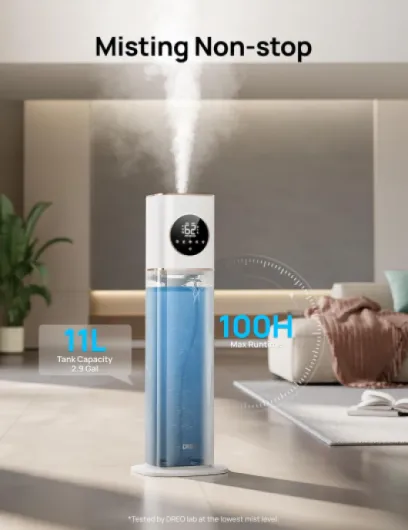
The Dreo HM735S is basically a tall ultrasonic humidifier with smart features and a big 11L (about 2.9 gallon) tank. It’s rated for rooms up to around 700 ft², which roughly lines up with my use in an open living room plus a bit of hallway. The box includes the main unit, an aroma pad, a little cleaning brush, a screw for securing the base, and the manual. No extra filters or cartridges in my box beyond the standard one on the intake tube.
In terms of features, you get three mist levels, an Auto mode, sleep mode, a 12‑hour timer, RGB night light, an aroma tray in the back, and smart control through the Dreo app. You can hook it to Wi‑Fi and control it with Alexa or Google Assistant. From the app you can set target humidity, schedules, and get cleaning reminders. The tank is top‑fill, which is actually useful: you don’t have to flip a huge tank upside down over the sink and hope you don’t flood the counter.
The unit uses an ultrasonic mechanism, not a warm mist or evaporative wick system. That means it’s quiet and pushes a very fine cool mist, but it also means you have to care about minerals in the water (white dust) and keep up with cleaning. Dreo mentions a demineralization cartridge you’re supposed to replace monthly. That’s an extra running cost and something to remember. If you use hard tap water and ignore this, you’ll probably see the same white dust you get with any other ultrasonic unit.
On paper, the specs are decent for the price range: 26 dB in sleep mode, up to 100 hours runtime at low output, and about 32W max power draw. In reality, you won’t get 100 hours if you run it hard, but the capacity is clearly higher than typical bedroom models. So if you’re looking for a set‑and‑forget humidifier for a larger room, the general package makes sense. Just don’t expect medical‑grade humidity control or zero maintenance. It’s still an appliance that needs regular cleaning and sensible water use.
Does it actually fix dry air problems?
From a straight “does it work” angle, yes, it helps a lot with dry air, but it’s not magic. In my case, I was sitting around 20–25% humidity in winter with the heat running. After running the Dreo for a few evenings and overnight, I was consistently in the low‑ to mid‑40s in the room where it was placed. That’s enough to notice a clear difference in comfort: less dry skin, fewer shocks, less static on clothes and blankets.
I also used it in a smaller upstairs room where I keep guitars. There, the 11L capacity is honestly overkill, so I just ran it on the lowest setting or in Auto with a lower target. It kept the room around 40–45% most of the time, which is where I like it for instruments. The key is not to rely on the built‑in reading alone. I checked against a separate hygrometer, and the Dreo’s reading was sometimes 10% higher, especially right after refilling or when the mist direction happened to be closer to the sensor.
If you’re trying to humidify a whole floor of a very open house, it’ll help but it won’t fix everything. One Amazon reviewer mentioned that the unit couldn’t hit 65% because their house leaked too much air, and that’s exactly the kind of limitation people forget: no humidifier can fight constant air exchange and drafts forever. It does a good job in a big room or two, but don’t expect it to carry a 3,000 ft² house by itself.
On the white dust side, I didn’t see anything unusual while using filtered water. Reviewers saying they had no dust when using distilled, demineralized, or fridge‑filtered water are right: that’s just how ultrasonics work. If you feed it hard water and skip the cartridge, you’ll get dust with any brand. So in terms of effectiveness, it’s solid as long as you use decent water, keep it clean, and don’t overestimate what one unit can do against a very drafty home.
Pros
- Very large 11L tank with genuinely long runtime (up to several days on low)
- Quiet operation, especially in sleep mode, suitable for bedrooms and nurseries
- Top-fill design and smart app/voice control make daily use and scheduling easier
Cons
- Built-in hygrometer can read 10–15% higher than actual, making Auto mode less accurate
- Base feels a bit weak for such a tall unit and there are no handles for moving it when full
- Ongoing costs and care: demineralization cartridges, need for filtered/distilled water, and regular cleaning
Conclusion
Editor's rating
The Dreo HM735S 11L is basically a big, quiet workhorse for people who are sick of refilling tiny humidifiers every day. It does its main job well: it raises humidity in medium to large rooms, makes the air feel less harsh in winter, and gives plants and instruments a more stable environment. The 11L tank and top‑fill design are genuinely practical, and the noise level on sleep/low mode is low enough for bedrooms and nurseries. The app, remote, and voice control are handy, especially if you like setting schedules or tweaking things from the couch.
It’s not flawless, though. The humidity sensor can be off by around 10–15% compared to a separate hygrometer, which makes Auto mode less reliable if you care about exact numbers. The base feels a bit flimsy for such a tall unit, and there are no handles, so moving it when it’s full is annoying. You also have the usual ultrasonic downsides: you need decent water (distilled or filtered) and regular cleaning to avoid white dust and buildup, plus the extra cost of the demineralization cartridge if you follow their recommendation.
I’d recommend this to people with larger rooms (living rooms, big bedrooms, offices) who want long runtime, quiet operation, and smart features, and who don’t mind doing basic maintenance and using a separate hygrometer for more accurate readings. If you only need to humidify a small bedroom, or you want lab‑grade humidity accuracy out of the box, you might be better off with a simpler or different style of humidifier. For most home users, though, it’s a pretty solid choice that improves comfort without too much fuss, as long as you understand its limits.