
Summary
Editor's rating
Is it worth the money, or should you look elsewhere?
Small, discreet cube… if you don’t mind another white plastic gadget
How well it actually monitors air (and reacts to real life)
What this thing actually does (and doesn’t do)
Does it actually help you breathe better, or just feed you numbers?
Alexa integration: convenient if you’re in the ecosystem, useless if you’re not
Pros
- Tracks 5 useful parameters (PM2.5, VOCs, CO, humidity, temperature) with clear LED and app
- Integrates well with Alexa for routines, notifications, and voice checks
- Compact, discreet design and easy setup for anyone already using Echo devices
Cons
- Requires Alexa app and ecosystem to be really useful; almost pointless without it
- No CO2 or radon monitoring and does not replace a proper CO alarm
- No battery or screen, uses outdated micro-USB, and only works on 2.4 GHz Wi‑Fi

Specifications
View full product page →| Brand | Amazon |
A small white box that tells you if your air is trash or fine
I’ve been using the Amazon Smart Air Quality Monitor for a little while in my living room, mostly because I was curious if the air in my place was as "fine" as I thought. I live in a city with occasional wildfire smoke and I cook a lot, so I wanted something that would tell me when to open a window or kick on the purifier instead of just guessing. This little box looked simple enough and it was cheaper than a lot of the fancy air monitors you see online.
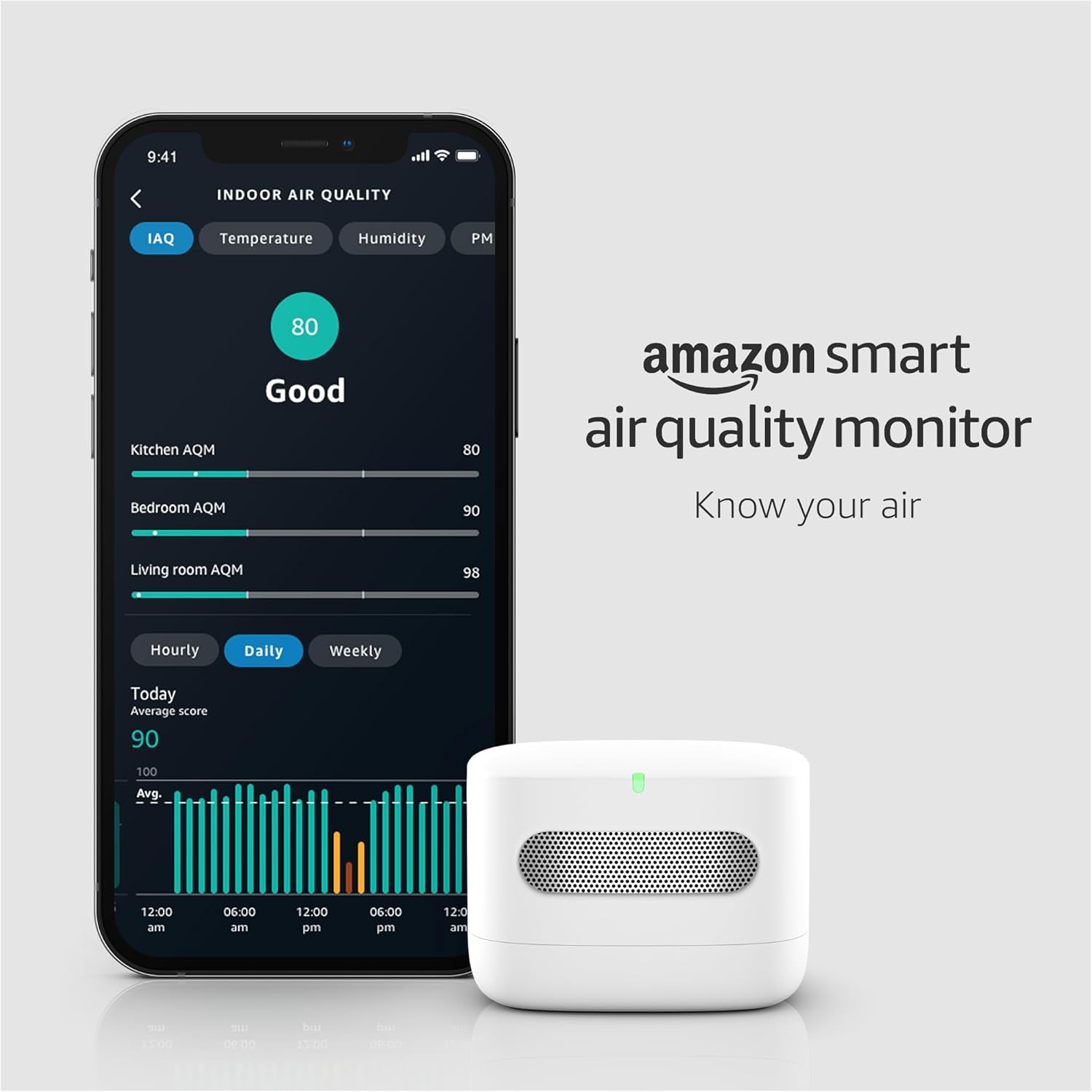
Right away, I’ll say this: this is not a lab tool. If you’re expecting super-precise scientific data down to the last microgram, this isn’t it. It’s more like a traffic light for your air: good, medium, bad. The detailed numbers are there in the Alexa app, but in daily life you mostly look at the colored LED and the overall score and decide if you should do something about it.
What pushed me to try it is the fact that it plugs into Alexa routines. I already have an Echo and a basic smart plug on my air purifier, so the idea was: bad air = purifier turns on, without me thinking about it. In practice, that actually works reasonably well, with a bit of tweaking. Setup was pretty quick, but you absolutely need the Alexa app; without it, the device is basically just a glowing cube.
Overall first impression: it’s a pretty solid little monitor for normal home use
Is it worth the money, or should you look elsewhere?
In terms of price, the Amazon Smart Air Quality Monitor usually sits in the lower to mid range compared to other indoor air monitors. There are cheaper no-name devices on Amazon, but a lot of them have questionable accuracy and clunky apps. There are also much more expensive monitors with CO2, radon, fancy screens, and more detailed analytics. This one sits somewhere in the middle: limited features, but integrated nicely into Alexa and from a big brand, which some people trust more.
For what you pay, you get: tracking of five main parameters, decent app graphs, Alexa routines, and a simple LED indicator. You don’t get: CO2 monitoring, radon, a battery, a screen, or compatibility with other smart home platforms. So if you need CO2 for office ventilation decisions, or you want a standalone screen device that doesn’t depend on an app, this is probably not the right choice.
Where it feels like good value is if you already have Echo devices and maybe a smart plug. Then you can actually use this to automate your purifier, fan, or dehumidifier and squeeze more benefit out of gear you already own. It also helps you avoid buying random chemical-heavy cleaners or doing dusty hobbies in closed rooms, because you can literally see the impact in the app.
If you’re on a tight budget and just want a rough idea of humidity and temperature, you can get a cheap hygrometer/thermometer for a fraction of the price. If you want serious air quality diagnostics, you’ll need to spend more on a higher-end monitor or professional testing. This Amazon monitor sits in that "good enough" zone: decent but nothing more. For the average person with Alexa at home who wants to keep an eye on indoor air without overcomplicating things, it’s fair value. For everyone else, there might be better options more tailored to what you actually need.
Small, discreet cube… if you don’t mind another white plastic gadget
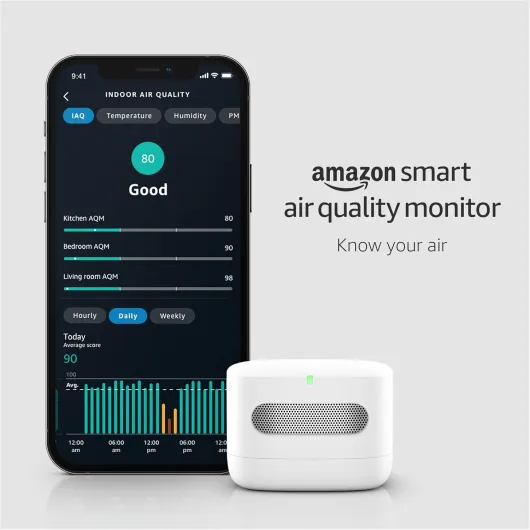
Design-wise, the Amazon Smart Air Quality Monitor is basically a small white cube (65 x 65 x 45 mm). It’s compact, light (around 120 g), and doesn’t scream for attention. If you already have Echo devices, it blends in with that same generic Amazon gadget look. It has a multicolor LED on the front that shows air quality status and some tiny vents for the sensors. No screen, no buttons to play with beyond a setup button on the back.
The footprint is small enough that you can throw it on a shelf, TV stand, or desk without rearranging your life. I tried it on a low shelf and then on a higher one; both worked fine. Just don’t hide it behind a stack of books or block the ventilation holes, or your readings will be off. The LED is clear enough: green for good, yellow for moderate, red for poor. At night it’s noticeable but not crazy bright; if you’re super sensitive to lights in a bedroom, it might annoy you, but in a living room it’s fine.
One thing I’m not a fan of: it still uses micro-USB instead of USB‑C. That’s just outdated at this point. It’s powered by a small 5W adapter (included) and a cable, so you’ll need a free outlet nearby. There’s no battery, so you can’t just move it around casually unless you unplug and replug it each time. Not a huge deal, but it does mean you’ll probably pick one spot and leave it there.
The build feels like basic plastic, which is exactly what it is: recycled thermoplastic with a rubber base. It doesn’t feel premium, but it also doesn’t feel cheap or fragile. You’re not handling it much anyway; you set it up once and forget it. Overall, the design is functional and discreet, not stylish or fancy. If you want something that looks like a high-end gadget, this isn’t it. If you just want a small box that quietly does its job, it’s fine.
How well it actually monitors air (and reacts to real life)
In daily use, I’d say the performance is good enough for home use, but you have to keep your expectations realistic. The specs say things like ±20% for PM2.5, ±30% for CO, etc. That’s not ultra-precise, but for a cheap consumer monitor, it’s pretty normal. What matters more is how quickly it reacts and whether the trends make sense—and on that front, it does pretty well.
Concrete examples: when I fried food and got a bit of smoke, the PM2.5 value jumped and the LED turned yellow within a few minutes. When I used a strong cleaner in the bathroom, the VOC level spiked and I got a "poor air quality" in the app and on my Echo device. After opening windows and letting things air out, I watched the readings slowly go back down, and the LED returned to green. Same behavior when I sanded a small wooden piece in another room; even from a floor away, the particle readings climbed a bit.
As for temperature and humidity, they seemed to line up pretty closely with another digital thermometer/hygrometer I own. So for those two, I actually trust it quite a bit. For CO and VOC, I treat it more as a "heads up" rather than absolute truth. If I ever saw a weirdly high CO reading, I’d double-check with a dedicated CO alarm, not rely only on this thing. Amazon is clear that it’s not a replacement for a proper safety detector, and I agree with that.
The app graphs are handy if you like to dig into data. You can see spikes during cooking, cleaning, or when you have guests over (more people, more stuff in the air). For me, it helped confirm that my air purifier is actually doing something: I’d see PM2.5 go up, the purifier kick in (through a routine), and then the value drop. Overall, the performance is consistent and reactive enough for a normal user who wants awareness and basic automation, not lab results.
What this thing actually does (and doesn’t do)
On paper, the Amazon Smart Air Quality Monitor tracks five things: PM2.5 (fine particles), VOCs (volatile organic compounds), carbon monoxide (CO), humidity, and temperature. In the Alexa app, that all gets turned into a single air quality score plus individual graphs for each value. Day to day, Alexa just tells you "air quality is good" or "moderate" or "poor". You can ask an Echo, check your phone, or glance at the LED: green, yellow, or red.
In practice, the monitor is more of a trend and alert tool than a precise measuring instrument. For example, when I cooked something in a pan and got a bit of smoke, I saw the PM2.5 jump and the LED go yellow pretty fast. Same thing when I sprayed some cleaner in the kitchen: VOCs went up, Alexa called the air quality "poor" for a while, and then it slowly went back to normal after I opened a window. So it reacts, and that’s what you actually want at home: see when something changed, not obsess over exact numbers.
Where people sometimes get confused is with CO vs CO2 and radon. This thing measures CO (carbon monoxide), not CO2, and it’s clearly not meant to replace a dedicated CO alarm. Think of it as an extra warning layer, not your only protection. Same for radon: it doesn’t do radon at all, and it’s not meant to. If you need serious radon testing or CO safety, buy proper dedicated devices and treat this as a comfort/awareness tool, not life-or-death gear.
So, overall: the monitor gives you a decent idea of how "clean" or "polluted" your indoor air is at any given time, plus a history in the Alexa app. It’s good for awareness and habits (like opening windows more, changing how you clean, using your purifier smarter). If you expect lab-grade precision or a full health diagnosis from it, you’re going to be disappointed. As a regular home gadget, it’s fine and fairly straightforward.
Does it actually help you breathe better, or just feed you numbers?
On its own, the monitor doesn’t clean anything, obviously. Its job is to make you change your behavior: open a window, turn on a fan, use fewer harsh chemicals, run an air purifier more often, etc. In that sense, it’s effective if you actually pay attention to it. If you ignore the LED and never open the Alexa app, then it’s just another gadget collecting dust.
In my case, it did change a few habits. For example, I used to clean with some stronger products in a closed bathroom. After watching the VOC reading go into the red and stay there for a while, I started opening the window and turning on the fan before I spray anything. Same for cooking: now I run the range hood more and open a window if I see PM2.5 climbing. It’s not that I suddenly became paranoid about air quality, but the monitor made the problem visible, which is the whole point.
Where it becomes more useful is when you tie it into Alexa routines. I set a simple one: if air quality drops to "poor" for a certain time, turn on a smart plug connected to my air purifier. It’s not perfect—you sometimes get a delay—but for long cooking sessions or days with outside smoke, it helps keep things under control without me babysitting it. Another routine idea is to get a voice alert or phone notification when CO or VOCs jump above a level, which is handy if you’re in another room.
So in terms of effectiveness, I’d say: it helps you make smarter decisions about ventilation and cleaning, but only if you’re willing to respond to what it tells you. It won’t magically fix bad air, and it won’t replace proper safety equipment. For someone with allergies, sinus issues, or sensitivity to chemicals, it can be a useful tool. If you don’t care about data and never look at your phone, you might find it pretty meh.
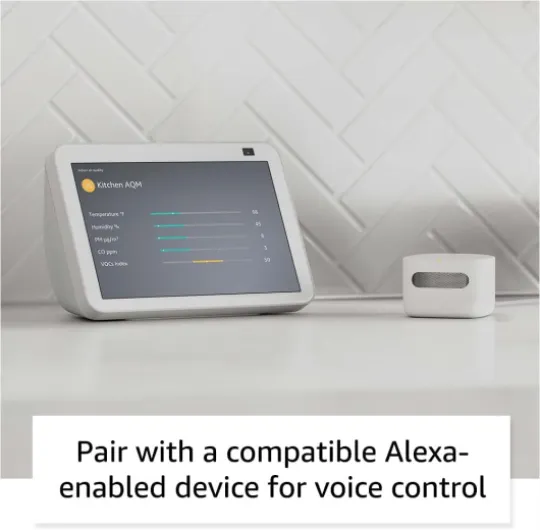
Alexa integration: convenient if you’re in the ecosystem, useless if you’re not
This device is very clearly built for people who already use Alexa and Echo devices. Setup is done entirely through the Alexa app, and you need at least the 2021.16 version. It connects via 2.4 GHz Wi‑Fi and Bluetooth for initial setup. For me, the pairing went smoothly: plugged it in, the app spotted it, a couple of taps, and it was online in under 10 minutes. If you’ve set up an Echo before, it feels very similar.
Once it’s connected, the Alexa app gives you a dashboard with the overall air quality score and the five individual metrics. You can look at the history, see when certain events happened (like cleaning, cooking, or a dusty hobby), and build routines. The routines are the main reason to get this versus some generic monitor that just has a small screen. You can do stuff like:
- Turn on an air purifier when air quality is "poor"
- Send a notification when CO or VOCs spike
- Use an Echo Show to display real-time values
That said, if you don’t use Alexa, I would skip this product. Yes, the LED changes color without the app, but you lose 90% of the value: no history, no notifications, no routines, no way to see exact numbers. It’s basically a three-color light at that point. Also, it doesn’t work with Google Home or Apple HomeKit, so if you’re in those ecosystems, this is not a good fit.
Stability-wise, it stayed connected fine on my 2.4 GHz network. I didn’t have random disconnects, but if your Wi‑Fi is flaky, be prepared for occasional gaps in data. Overall, the app experience is decent and practical, but only if you’re comfortable living inside the Amazon ecosystem. If you hate that idea or don’t want a smart home, you’ll find it overkill and too dependent on the app.
Pros
- Tracks 5 useful parameters (PM2.5, VOCs, CO, humidity, temperature) with clear LED and app
- Integrates well with Alexa for routines, notifications, and voice checks
- Compact, discreet design and easy setup for anyone already using Echo devices
Cons
- Requires Alexa app and ecosystem to be really useful; almost pointless without it
- No CO2 or radon monitoring and does not replace a proper CO alarm
- No battery or screen, uses outdated micro-USB, and only works on 2.4 GHz Wi‑Fi
Conclusion
Editor's rating
The Amazon Smart Air Quality Monitor is a simple, practical gadget if you’re already living in the Alexa world. It tracks the basics (PM2.5, VOCs, CO, humidity, temperature), reacts sensibly to real-life stuff like cooking and cleaning, and plugs nicely into routines so your air purifier or fan can kick in automatically when the air gets worse. The LED and app make it easy to understand at a glance, and you don’t need to be a data nerd to get value out of it.
It’s not perfect, though. There’s no CO2 or radon, no battery, and no screen. Accuracy is consumer-level, not professional. It absolutely does not replace a dedicated CO alarm, and if you don’t use Alexa, it’s basically reduced to a colored light with limited usefulness. The design is plain, the micro-USB port feels dated, and you’re locked into the Amazon ecosystem.
If you have Echo devices, care a bit about indoor air, and want something to nudge you into better habits or automate your purifier, this monitor is a pretty solid choice for the price. If you’re looking for serious environmental monitoring, or you’re in the Google/Apple camp, I’d look at other brands. Overall, it’s a good value home gadget for casual monitoring and basic automation, not a pro tool or universal solution.