Summary
Editor's rating
Is it worth the money compared to a normal HEPA purifier?
Tall, skinny, and pretty discreet
Long-term use and cleaning: where it wins and where it’s annoying
How it actually performs with dust, smell, and allergies
What this thing actually is (and what it’s not)
Silent operation vs real-world air cleaning: trade-offs
Pros
- Very quiet operation – basically silent in normal use
- No replacement filters needed, just manual cleaning of blades
- Low power consumption (12W) so you can run it 24/7 cheaply
Cons
- Less effective than a strong HEPA purifier for serious allergies or heavy smoke
- Needs regular, somewhat fiddly cleaning of blades and internal wire to stay effective

Specifications
View full product page →| Brand | Ionic Pro |
| Color | Black |
| Product Dimensions | 7.5"D x 28.5"W x 9.5"H |
| Floor Area | 500 Square Feet |
| Noise Level | 55 Decibels |
| Controller Type | Button Control |
| Wattage | 12 watts |
| UPC | 012301513981 804993479474 031111369137 999992446906 601000826333 732233489177 640206341127 806792017789 895321000897 041113863861 800011259561 732233490869 |
A silent air purifier that doesn’t need filters… but there’s a catch
I’ve been using the Ionic Pro Turbo (TA550) in my living room for a few weeks now, mainly because I was tired of noisy HEPA units and constantly buying new filters. I’ve got a cat, some light cooking smells, and a bit of dust from an older house, so the air isn’t terrible, but it’s far from perfect. I wanted something I could just plug in and forget about for the most part, without another subscription-style filter expense.
The first thing that stood out is how quiet it is. When they say it’s basically silent, they’re not lying. If there’s any background noise (TV, conversation, traffic outside), you don’t hear it at all. That’s a big difference from fan-based purifiers that hum all day. At first, I honestly thought it wasn’t doing anything because there’s no strong airflow, just a faint breeze if you put your hand right on the outlet.
After a couple of days, I noticed the room smelled a bit fresher, especially in the morning. Not like perfume or anything, just less stale. The other concrete sign it’s actually working is the collection blades: they get dirty fast. After a week in a 400 sq ft room with a cat, the blades had a solid gray film on them. So yeah, it’s grabbing stuff from the air, but it means cleaning is part of the deal.
Overall, my first impression is: it’s a low-maintenance, low-noise purifier if you’re okay with doing some manual cleaning instead of swapping filters. It’s not magic, it won’t fix a heavily smoky or super dusty place overnight, but for normal home use it does a decent job. Just don’t expect the same raw particle removal you get from a serious HEPA machine, because this works differently and you can feel that in real-world use.
Is it worth the money compared to a normal HEPA purifier?
In terms of value, the Ionic Pro Turbo sits in an interesting spot. Upfront, the price is usually in the same range as many entry to mid-level HEPA purifiers. The big difference is no replacement filters. If you’ve ever owned a HEPA unit, you know the filters can easily cost half or more of the purifier price every year or two, especially if you’re using it constantly. With this one, your only “cost” is your time and some paper towels or cloths with a bit of water or rubbing alcohol.
So if you plan to run a purifier 24/7 and keep it for several years, this model can be good value purely because you’re not stuck buying consumables. For a family with multiple rooms, that adds up. On the flip side, you’re trading off some raw performance and speed for that low running cost. A good HEPA unit will usually handle fine particles and allergens more aggressively, and if you’re willing to pay for filters, that might be worth it for you.
Another factor: energy use. At only 12 watts, you can literally leave it on all the time with almost no impact on your power bill. That’s a real plus compared to some bigger HEPA machines that can pull 50–100+ watts on high. If you like the idea of set-it-and-forget-it, at least in terms of energy, this one fits that profile.
So, value-wise, I’d say: good deal if you want low ongoing costs and quiet operation, and you’re okay with moderate performance and some hands-on cleaning. If you’re super picky about air quality, have bad allergies, or want modern features like air quality sensors and app control, you’ll probably be happier spending more on a newer HEPA model and just accepting the filter costs as part of the package.
Tall, skinny, and pretty discreet
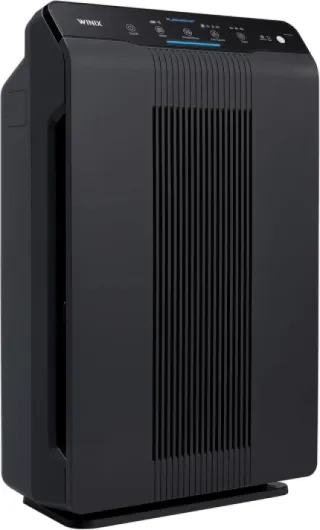
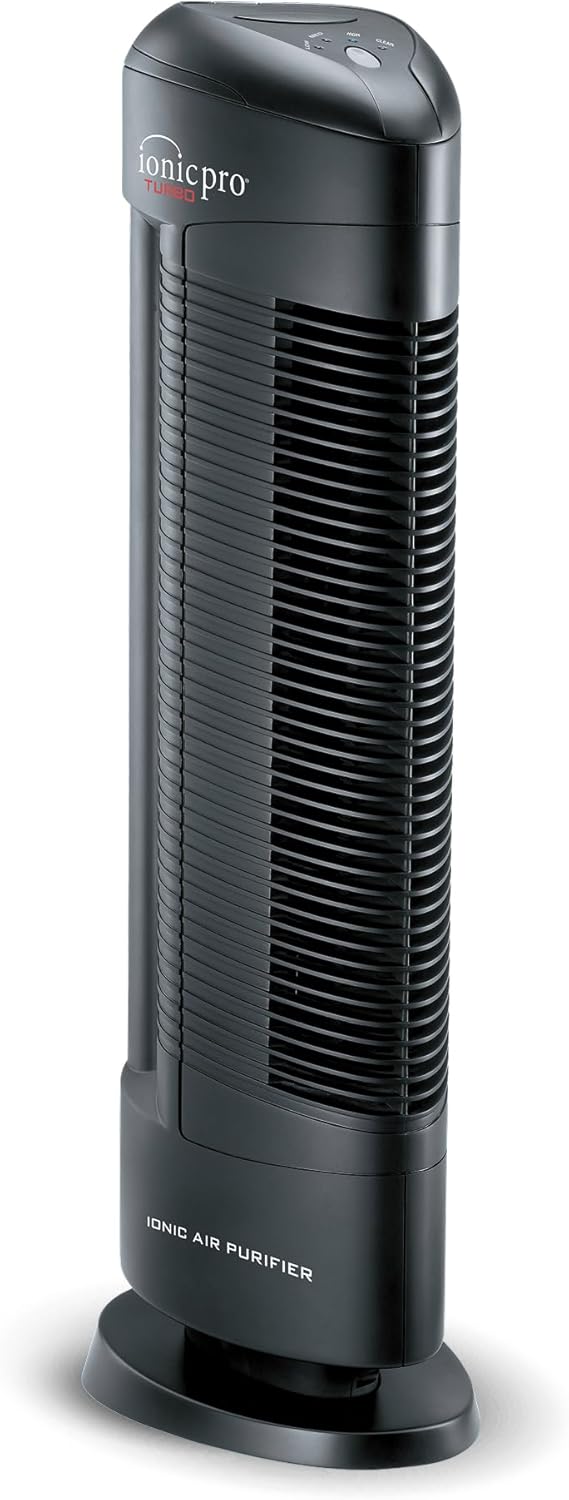
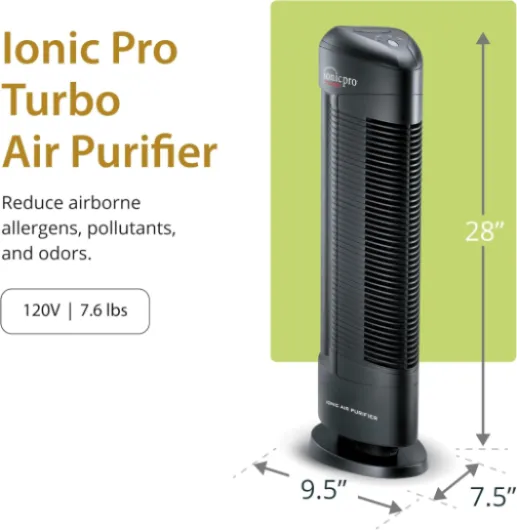
Design-wise, the Ionic Pro Turbo is basically a tall black tower: 28.5 inches high, about 7.5 inches deep, and 9.5 inches wide. It’s narrow enough to slide into a corner or next to a TV stand without drawing much attention. The look is pretty basic – matte black plastic, some vents on the sides, and a simple control panel with buttons and indicator lights. It doesn’t scream “premium”, but it doesn’t look cheap either. It’s just… there, which is fine for an appliance that’s supposed to sit in a corner 24/7.
At 7.8 pounds, it’s light enough to move around easily. I’ve dragged it between my living room and bedroom with one hand without any trouble. There’s no handle, which would’ve been nice, but the weight and shape make it easy enough to grab from the top. The tower design is actually practical: it has a small footprint, so you don’t lose floor space like you do with some boxy purifiers.
The control panel is simple: on/off, speed selection, and indicator lights (including a red light when it wants cleaning). No screen, no app, no smart features. Personally, I’m fine with that. I just want to turn it on and let it run. That said, if you’re into connected devices and air quality readouts, this one is old-school. It’s been around for years, and you can feel that in the design – it’s more 2005 than 2025.
In daily use, the discreet design and silence are the big positives. I can put it behind a chair and forget it’s there. The downside is the plastic body does attract dust on the outside, and the vents can look dirty if you don’t wipe them occasionally. But overall, for the price and age of the model, I’d say the design is practical and neutral. Nothing fancy, but it fits into a normal home without clashing with anything.
Long-term use and cleaning: where it wins and where it’s annoying
Durability seems to be one of the strong points of this model, and that matches the older Amazon reviews: people talk about units running 5–6 years or more. The design is simple – no complex motor, no thick fan blades – so there’s not much to break mechanically. From what I’ve seen and read, the main “wear and tear” issue is actually just dirt buildup on the blades and the internal wire. If you stay on top of cleaning, the unit tends to keep running without much drama.
Now, the cleaning routine is both the strength and the annoyance. Strength, because you don’t buy filters. Annoyance, because you need to get your hands dirty. Every 1–2 weeks (depending on how dusty your place is), you slide out the blades, wipe them with a damp cloth or rubbing alcohol, dry them well, and then clean the thin wire in the back. If you do this properly, the unit goes back to being silent and effective. If you half-ass it, you’ll get buzzing, little zaps, or the red light telling you it wants more cleaning.
One thing I don’t love: there are no easy replacement blade cartridges widely available. It would be nice to have a second set so you can clean one and use the other, but I couldn’t find official ones. So you’re stuck waiting for the blades to dry fully. The manual says 24 hours; in practice, if you wipe them down with alcohol and a dry cloth, a few hours usually works, but you’re still without the purifier during that time.
Overall, I’d rate durability as pretty solid for the price and age of the design. The body doesn’t feel fragile, the buttons are basic but fine, and the internal tech is simple enough to last. Just understand that durability here is tied to maintenance. If you’re the type of person who never cleans anything until it breaks, this will probably start acting up and you’ll blame the product, when in reality it just needs regular care.
How it actually performs with dust, smell, and allergies
In terms of performance, I tested it mainly in a 350–400 sq ft living room with one cat, carpet, and a small adjacent kitchen. I left it running on high 24/7 for a couple of weeks. After around 2–3 days, I started to notice less lingering cooking smell after frying food. Before, the oil smell would hang around until the next morning; with the Ionic Pro running, it was noticeably weaker by bedtime. It doesn’t erase strong odors instantly, but it shortens how long they stick around.
On dust, the effect is a bit more subtle. It doesn’t make dusting unnecessary – my TV stand and shelves still collect dust – but surfaces seemed to stay clean slightly longer. The more obvious sign is on the collection blades themselves. After a week, they were coated with a black/gray film and some fuzz, especially near the top. That’s stuff that would have otherwise stayed in the air or settled on furniture. So, it does trap particles, just not as aggressively as a good HEPA unit with a strong fan.
For allergies, I’d call the effect moderate. I don’t have severe allergies, but I do get a bit of morning congestion. With this running in the bedroom for a few nights, I did wake up feeling a bit less stuffy, but it wasn’t a night-and-day difference like when I use a strong HEPA purifier with a true HEPA filter. If you have serious pollen or dust allergies, I’d treat this as a support unit, not your only line of defense.
One thing to mention: this is an ionizer, so you may occasionally smell a slight “after-rain” or ozone-like scent if you’re close to it, especially just after cleaning. In my case, it was mild and not bothersome, and it actually made the room feel fresher. But if you’re sensitive to that kind of smell or very concerned about ozone, this type of tech might not be your first choice. Overall, performance is solid for normal home use – good for odors and general freshness, decent for dust, just okay for heavy allergy control.
What this thing actually is (and what it’s not)
On paper, the Ionic Pro Turbo (TA550) sounds pretty strong: covers up to 500 sq ft, uses only 12 watts, and doesn’t need replacement filters. It’s an ionic air purifier, which means it charges particles in the air and pulls them onto metal collection blades inside the tower. So instead of swapping out HEPA filters, you slide out the blades and wipe them down. That’s the basic idea, and in practice, that’s exactly how it behaves.
The brand pushes things like “removes 99.9% of irritants” and mentions dust, pollen, pet dander, smoke particles, and odors. In real life, I’d say it does noticeably help with odors and light dust, but I wouldn’t rely on it alone for serious allergy sufferers or heavy smoke. Compared to my mid-range HEPA purifier, this one doesn’t make the room feel as “crisp” during allergy season, but the air definitely feels less stuffy and cooking smells clear faster than with no purifier at all.
The 3-speed settings are a bit funny, because there’s no fan noise and barely any airflow, so switching between speeds doesn’t feel like much. I basically leave it on high all the time. According to the specs, it can cycle air in a 500 sq ft room three times per hour, but that’s on paper. In practice, I’d say it’s better suited for a bedroom or medium living room rather than a giant open space, especially if you’re expecting fast cleanup of strong smells or smoke.
So in simple terms: this is a quiet ionizer tower that slowly cleans the air and reduces smells, not a high-powered HEPA box that aggressively sucks in air. If you buy it with that in mind, it’s easier to be happy with it. If you expect it to behave like a big fan-based purifier, you’ll probably think it’s underwhelming at first.
Silent operation vs real-world air cleaning: trade-offs
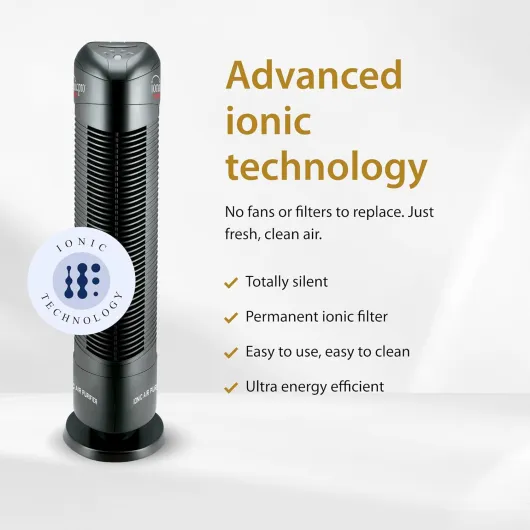
The big selling point here is the silent, filterless operation, and that’s exactly where the trade-offs show up. Because there’s no big fan blasting air through a dense filter, you don’t get that strong instant-clean feeling. Instead, the Ionic Pro works slowly and quietly in the background. If you’re patient and you let it run all the time, the room air does feel lighter and less stuffy over a few days. If you expect it to clear a smoky room in an hour, you’ll be disappointed.
One concrete test I did: I burned some toast on purpose and let the room get that classic burnt smell. With the Ionic Pro running and a window cracked slightly, the smell faded noticeably faster than with just the window alone. It still took a while (we’re talking a couple of hours, not 20 minutes), but the difference was clear enough to notice. Same for pet odors: the litter box smell in the next room was less obvious when I walked into the living room.
On the downside, because it relies on ionization, it doesn’t give you hard numbers like CADR (clean air delivery rate) that many HEPA units proudly display. You have to judge by feel and by how dirty the blades get. Also, when the blades and internal wire get dirty, the effectiveness drops and the unit can start making little crackling or buzzing noises. That’s your cue to clean it. If you ignore that, performance goes down and the noise gets annoying. So its effectiveness is tightly linked to how often you clean it.
In short, it’s effective enough for everyday odor control and a general improvement in air quality, but it’s not a powerhouse. If you’re mainly bothered by smells, light dust, and mild irritants, it gets the job done. If you’re looking for hospital-grade filtration or you live with heavy smokers, this isn’t going to replace a serious HEPA system.
Pros
- Very quiet operation – basically silent in normal use
- No replacement filters needed, just manual cleaning of blades
- Low power consumption (12W) so you can run it 24/7 cheaply
Cons
- Less effective than a strong HEPA purifier for serious allergies or heavy smoke
- Needs regular, somewhat fiddly cleaning of blades and internal wire to stay effective
Conclusion
Editor's rating
Overall, the Ionic Pro Turbo (TA550) is a pretty solid choice if your priorities are silence, low energy use, and not having to buy filters all the time. It does a decent job of freshening up a medium-sized room, cutting down on lingering cooking smells, pet odors, and general stuffiness. The dirty blades after a week are proof that it’s actually catching dust and particles, even if it doesn’t feel as aggressive as a big fan-based purifier.
Where it falls short is raw filtration power and convenience for people who hate maintenance. It’s not on the same level as a strong HEPA unit for serious allergies or smoke, and you need to commit to cleaning the blades and internal wire regularly. If you skip that, performance drops and the unit starts making noises that will drive you crazy. Also, the design is a bit old-school: no smart features, no air quality readout, just basic buttons.
If you live in a normal home with light to moderate dust, maybe a pet or two, and you mainly want fresher-smelling air with minimal noise and running cost, this is a good fit. If you or someone in your house has heavy allergies, asthma, or you’re dealing with strong smoke or pollution, I’d treat this more as a secondary unit and still invest in a proper HEPA purifier as your main workhorse.