
Summary
Editor's rating
Value: who should actually spend this much on an air purifier
Design: big, slim, and looks like it belongs in a modern apartment
Energy use and daily running costs (no battery, but power matters)
Build quality, filters, and how it feels over time
Performance: air actually feels cleaner, and the numbers back it up
What you actually get out of the box
Effectiveness for allergies, dust, and everyday living
Pros
- Cleans large rooms quickly and keeps PM2.5 levels low even during smoke or cooking
- Very quiet on low to medium speeds with solid build quality and stable casing
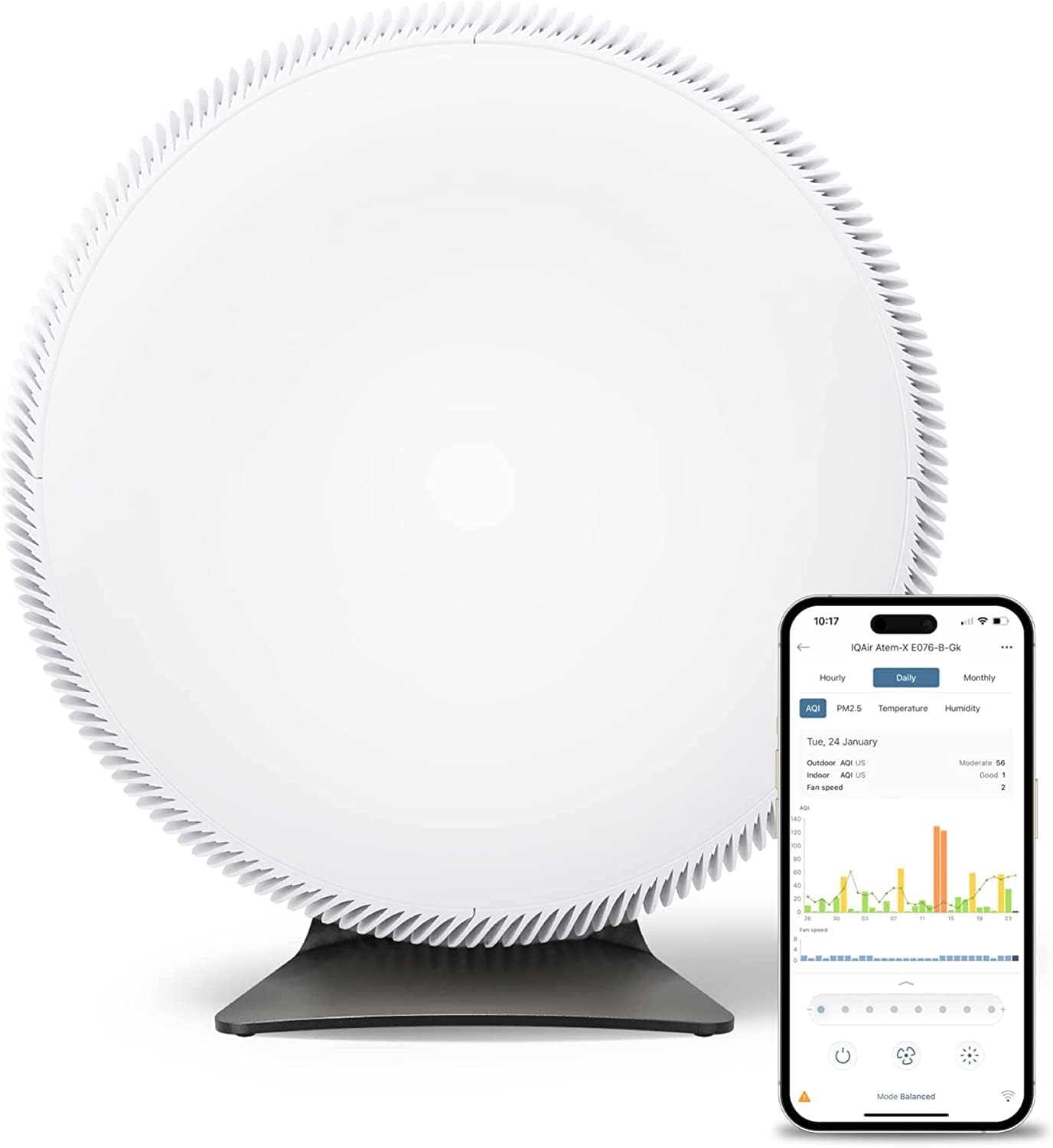
- Useful app with real-time PM2.5, CO2, temperature, and humidity plus smart modes
Cons
- High upfront price and expensive replacement filters
- App lacks some basic automation features like custom threshold-based on/off

Specifications
View full product page →| Brand | IQAir |
A serious purifier for people who actually care about air quality
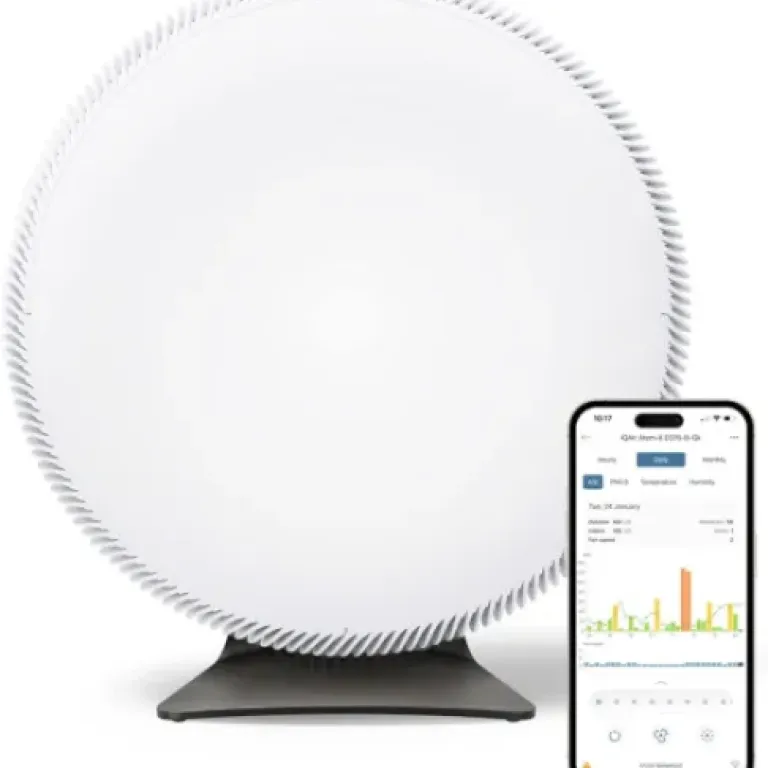
I’ve been using the IQAir Atem X in a big open-plan living room plus kitchen area, roughly 900–1000 sq ft, in a city with regular pollution spikes and seasonal wildfire smoke. I already own cheaper purifiers from brands like Levoit and Coway, so I wasn’t exactly starting from zero. I bought this knowing it was expensive, and I wanted to see if the higher price actually translated into cleaner air and less hassle, or if it was just paying for a fancy app and the “Swiss/German engineering” label.
From day one, the main thing that stood out was how quiet it is for the amount of air it moves. On the lower speeds, it basically fades into the background. On higher speeds, you hear airflow, but it’s not that harsh, whiny fan noise you get with cheaper units. It’s more of a steady whoosh. I could still watch TV at normal volume with it ramped up when the AQI was bad outside.
The other obvious thing: the built-in sensors and app actually changed how I use it. With my older purifiers, I’d just leave them on medium and forget about them. With the Atem X, I found myself checking PM2.5 and CO2 levels in the app, and tweaking smart mode based on what was going on (cooking, guests over, windows open, etc.). It’s nerdy, but it also made it clear when the air was actually bad versus just paranoia.
It’s not perfect though. The price is steep, and filter replacements are not cheap either. The app is good but still missing some basic automation that cheaper brands already offer, like turning on/off based on custom thresholds. And if you don’t care about live air quality numbers or smart features, you’re definitely paying for things you might never touch. So overall: it feels like proper, high-end hardware, but you need to really care about air quality to justify it.
Value: who should actually spend this much on an air purifier
Let’s be blunt: the Atem X is not cheap. You can buy two or three decent mid-range purifiers for the price of one of these. So the question is not “is it good?” – it is – but “is it good enough to justify the cost for you personally?” In my opinion, if you live in a small place with mostly clean outdoor air and no major allergy or asthma issues, this is probably overkill. A solid $200–$300 unit will get you 70–80% of the way there for a lot less money.
Where the Atem X starts to make sense is if you have a large open space (up to 1000–1500 sq ft that you actually use as one area), live in a city with regular pollution or wildfire smoke, or have serious allergy/asthma concerns. In those cases, the combination of high airflow, quiet operation, and accurate sensors with app control does justify paying more. It’s also one of the few big purifiers that doesn’t look like a clunky industrial box, which matters if it’s going in your main living room.
Filter costs are the other big part of value. You’re looking at higher upfront and ongoing spend than with most Amazon bestsellers. But if you factor in longer filter life (12–24 months vs. 4–6 months on many cheaper models) and stronger performance in large spaces, it’s not as crazy as it looks at first glance – still expensive, but not totally unreasonable if air quality is a priority for you.
So in terms of value, I’d rate it as: good value for people who really need strong, reliable filtration in big rooms, and pretty poor value if you’re just casually worried about dust and want something “nice to have.” If budget is tight, I’d go with a cheaper brand. If you’re okay paying more for cleaner air, better build, and smart features you’ll actually use, the Atem X earns its place, but it’s definitely a considered purchase, not an impulse buy.
Design: big, slim, and looks like it belongs in a modern apartment
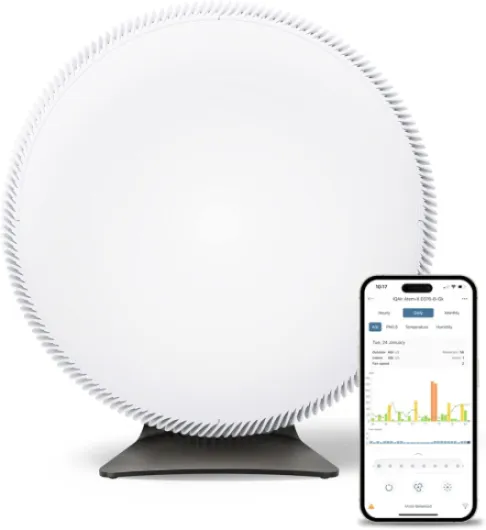
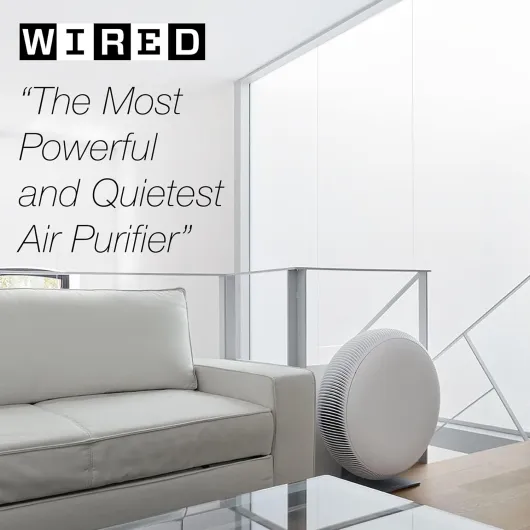
Design-wise, the Atem X sits in that zone where it doesn’t draw a ton of attention, but it also doesn’t look cheap. It’s a big square-ish panel with a slim depth (about 10 inches), so from the side it doesn’t eat too much space. Against a wall, it looks more like a flat appliance or a slim radiator than a typical boxy purifier. If you care what your living room looks like, this is one of the few large purifiers that doesn’t scream “industrial machine.”
The color I had is the standard light finish, and the plastics and overall build feel solid. No creaks, no weird gaps, and the fit-and-finish is clearly better than my cheaper units. The air outlet is on top and angled, and it actually matters: even without oscillation, the airflow spreads around the room nicely. You don’t need to sit directly in front of it to feel it, and it avoids blasting you in the face if you’re nearby.
One neat touch is the light projection behind the unit that shows air quality. It’s not mandatory, but it’s a quick visual cue: you walk by, glance at the light color, and you know if the air is good or not. At night, it’s not blinding, but if you’re super sensitive to light when sleeping, you’d probably park this in a living area rather than directly next to your bed. There’s also a stand with optional casters that snaps on securely. It doesn’t feel wobbly or cheap, and rolling it around doesn’t feel like the base will pop off.
On the downside, it is still a big object. If your room is small or already crowded, this is going to be a noticeable presence. Also, there’s no fancy design flourish or metal body – it’s mostly plastic, just better executed than budget brands. Personally, I liked that it looks like a practical appliance and not some futuristic sculpture, but if you want something tiny and discreet, this is not it.
Energy use and daily running costs (no battery, but power matters)
There’s no battery in the Atem X, so you’re tied to a wall outlet at all times, which is normal for something this size. What matters more here is power draw and how much it costs to run the thing. The listed maximum wattage is around 215W, but that’s at full blast. In normal day-to-day use on low or medium speeds, it draws a lot less. I plugged it into a simple power meter for a few days and saw typical consumption between roughly 25–80W when in smart mode and not constantly on max.
If you run it 24/7 on a moderate setting, you’re looking at a few dollars a month in electricity, depending on your local rates. If you regularly hit max for wildfire smoke or heavy pollution days, it’ll spike higher during those hours, but that’s not usually all day. Compared to running an AC unit, the purifier is still relatively light. It’s also Energy Star certified, which doesn’t change your life, but at least means it’s not a total power hog for what it does.
There’s no backup battery or anything to keep it going during power cuts, so if your area has outages and you really need constant filtration, you’d have to pair it with a separate UPS or battery backup. For most people, that’s overkill. For me, it’s not a big deal – when power’s out, I’ve got bigger problems than PM2.5.
Overall, I’d say energy use is reasonable for a large-room purifier with this kind of airflow. If you’re super cost-conscious and like to leave things on high all the time, then yes, your bill will reflect that. But with smart mode and sensible use, it’s in line with what I’d expect for this size. No nasty surprises, just remember that running it 24/7 is a commitment in both electricity and filter wear.
Build quality, filters, and how it feels over time
Durability-wise, the Atem X gives the impression of being built to last. The plastics are thick, the panels don’t flex much, and nothing rattles, even when the fan is on higher speeds. I’ve moved it around quite a bit – up and down stairs, across different floors – and the casing and base still feel solid. The caster base snaps in firmly and doesn’t feel like it’s going to snap off if you hit a door threshold at an angle.
The filters are the big long-term cost. IQAir claims 12–24 months of filter life depending on usage and pollution levels. The unit uses smart filters with RFID chips, so it tracks actual usage and captured pollutants, not just time. In the app, you can see estimated remaining life in percentage, which is more helpful than a simple timer. After a few weeks of daily use in a moderately polluted city, my filter life dropped only a few percent, which suggests you can realistically get well over a year if your air isn’t terrible all the time.
Filter replacements are not cheap though. This is one of those products where the initial cost is high, and the ongoing cost is also higher than budget brands. You’re paying for HyperHEPA-level filtration and big surface area. If you’re the type who hates recurring costs, that might annoy you. On the flip side, if the filter really lasts 1–2 years with heavy use, the yearly cost balances out somewhat compared to cheaper units that burn through smaller filters every 4–6 months.
As for long-term electronics reliability, I obviously can’t test years in a short period, but IQAir has a track record with their other models, and this doesn’t feel flimsy. The Wi-Fi connection has been stable, the buttons respond properly, and the sensors haven’t gone haywire. So my impression is: it feels like something that should easily handle several years of daily use, but you need to be okay with the ongoing filter investment.
Performance: air actually feels cleaner, and the numbers back it up
Performance is where the Atem X justifies most of its price. I tested it in a large living room/kitchen combo with a separate cheap PM2.5 meter, plus the built-in sensors and app. In normal city conditions (outdoor AQI 60–90), it took my indoor PM2.5 from the mid-20s down to low single digits in about 30–45 minutes on a higher fan setting. When cooking or when someone burned food in the oven, the indoor AQI would spike (sometimes 120–150), and with the Atem X on max, it would drop back under 15 in around 20–30 minutes.
During a smoky day from nearby fires, with outdoor AQI over 150, I closed the windows and let the Atem X run. The app showed indoor AQI staying under 20 most of the time, while my cheaper purifier in the bedroom struggled to keep that room under 40. Subjectively, the air in the Atem X room felt less stuffy, and the smell of smoke was much weaker. It’s not magic – you still smell heavy smoke a bit when you open doors – but it clearly reduced it to a tolerable level faster than my other units.
The automatic smart mode is actually useful. The unit ramps up fan speed when it detects higher PM2.5 or CO2 and then calms down when things improve. I left it in smart mode most of the time, on the “Balanced” or “Max” smart profile. It meant I didn’t babysit it constantly. For daily life (cooking, guests, opening windows for a bit), the Atem X reacted quickly enough to keep things under control. It’s not instant, but you can watch the numbers improve steadily.
Noise-wise, on low to medium speeds, it’s very quiet – more of a background airflow sound than a motor whine. I could sleep with it on a lower setting easily. On max, you’re definitely aware of it, but for the amount of air it’s moving, it’s reasonable. If you’re used to small desktop purifiers, max will feel loud, but if you’ve tried other large-room units, this one is on the quieter side. Overall, in terms of cleaning power plus noise balance, it’s pretty solid and clearly better than the cheaper stuff I’ve used.

What you actually get out of the box
Out of the box, the Atem X is pretty straightforward: you get the purifier fully assembled with filters already installed, the power cord, a simple manual, and the base with optional casters. No tools needed, no messing around with filter bags or weird plastic wraps. You basically snap the base on, plug it in, and you’re up and running in a couple of minutes. Compared to some purifiers where you need to open three panels and unwrap multiple filters, this is much more plug-and-play.
The unit is fairly big: about 27 inches tall and wide, and 10 inches deep. It’s clearly built for large rooms, not for tucking under a desk. The weight (around 24 pounds) is noticeable, but with the casters attached, you can roll it between rooms without much effort. I tried moving it between my living room and bedroom a few times, and it wasn’t a pain, which matters if you don’t want to buy multiple units.
The control panel on the device itself is simple: physical buttons, not some weird touch-strip guessing game. You can change fan speeds, modes, and basic settings right on the unit without touching the app. That’s important, because if the app or Wi-Fi act up, the purifier is still fully usable. The display on the front is minimal and doesn’t scream for attention, which I appreciated in the evening when the lights are low.
In terms of positioning, it’s designed to sit flat against a wall, which is handy in a smaller apartment or a room where you don’t want something sticking out into the space. I set mine against a wall near the kitchen, and the footprint felt manageable for the size. Overall, the presentation is very much “serious appliance” rather than a plastic gadget. It feels like something that’s meant to stay in one place for years, not a seasonal throwaway purchase.
Effectiveness for allergies, dust, and everyday living
In terms of real-world effectiveness, not just specs, the Atem X did make a noticeable difference in how the room felt over a couple of weeks. I deal with mild dust and pollen allergies, and usually in spring and early summer I wake up with a slightly stuffy nose and itchy eyes if the windows have been open. With the Atem X running in the main living area and a smaller purifier in the bedroom, my symptoms were clearly reduced. I still had some mild irritation on heavy pollen days, but less than usual, and I wasn’t reaching for antihistamines as often.
Dust buildup on furniture was slower too. Before, I’d see a visible light layer on dark shelves after three or four days. With the Atem X running pretty much 24/7 at low to medium speeds, it took closer to a week before I felt the need to dust. It’s not like the house becomes a dust-free bubble, but there was a clear difference in how often I had to clean surfaces, especially near the unit. That lines up with what other users say about less dust and pet dander floating around.
Odor control is decent. It’s not a dedicated odor killer, but for cooking smells, pet smells, and some mustiness from a damp day, it did a good job. I have a dog that likes to sleep on the couch; usually after a rainy walk, the living room smells like wet dog for a while. With the Atem X on a higher setting, that smell faded faster than it used to with my older purifier, usually within an hour or so. Same story with light cooking odors. Strong, oily cooking still lingers a bit, but it’s clearly reduced.
For mold and more serious stuff, I can’t scientifically verify all the claims about viruses and bacteria, but I will say this: the basement in my place has a slightly damp feel and occasional musty whiff. I rolled the Atem X down there for a few days, and the air felt less heavy, and guests with known allergies didn’t start sniffling like they sometimes do down there. So while I can’t measure microbes, the overall comfort level improved. So in practice: it does the job for allergies, dust, general air quality, and everyday smells, but don’t expect it to fix structural moisture problems or replace basic cleaning and ventilation.
Pros
- Cleans large rooms quickly and keeps PM2.5 levels low even during smoke or cooking
- Very quiet on low to medium speeds with solid build quality and stable casing
- Useful app with real-time PM2.5, CO2, temperature, and humidity plus smart modes
Cons
- High upfront price and expensive replacement filters
- App lacks some basic automation features like custom threshold-based on/off
Conclusion
Editor's rating
Overall, the IQAir Atem X is a serious air purifier aimed at people who really care about air quality in larger spaces. In my use, it cleaned the air quickly and consistently, handled cooking spikes and bad outdoor AQI much better than my cheaper purifiers, and did it without sounding like a jet engine. The built-in sensors and app are actually useful, not gimmicks: seeing PM2.5 and CO2 in real time changes how you run the unit and when you decide to ramp it up. Build quality feels solid, and the design fits nicely against a wall without making the room look like a lab.
On the flip side, the price is high, and the filters are not cheap either. If you just want “some” air cleaning in a small bedroom, this is overkill. The app, while good, is missing some obvious automation features like custom threshold-based on/off, which is annoying given the cost. And if you don’t care about data or smart features, you’re paying for stuff you might barely touch. So this is not for everyone.
I’d say the Atem X makes sense for: people with allergies or asthma in cities or wildfire-prone areas, anyone with a big open-plan living area who wants quiet but strong filtration, and folks who actually like monitoring air quality data. People who should skip it: budget-conscious buyers, those in small apartments with decent outdoor air, or anyone who just wants a simple plug-and-forget purifier without caring about sensors or apps. For the right user, it’s a pretty solid long-term tool for cleaner air; for the wrong user, it’s just an expensive box that runs on low all day.