
Summary
Editor's rating
Value for money: where it shines and where it doesn’t
Design: compact and clean, but not thought through perfectly
Daily use and noise: can you live with it running?
Build quality and filter lifespan in real life
Performance: how well it actually cleans the air
What you actually get with the MA-25
Pros
- Compact and lightweight, easy to move between rooms
- H13 HEPA filtration that clearly reduces dust and odors in small to medium spaces
- Quiet on low/medium speeds and simple, straightforward controls
Cons
- No air quality sensor or auto mode, everything is manual
- Ongoing cost of replacement filters can add up if you run it a lot
- Front airflow and cord placement limit where you can put it and how you direct the air

Specifications
View full product page →| Brand | Medify Air |
Small box, noticeable difference
I’ve been using the Medify MA-25 in a small apartment with a cat, city pollution, and the usual cooking smells. I didn’t expect miracles from a purifier this size, but I wanted something simple that I could move between bedroom and living room without dragging a huge tower around. I mainly bought it for dust, cat dander, and to help when the air quality goes bad in summer.
First thing to say: you do feel the difference in the room, especially if you’re sensitive to dust or smells. After a couple of hours on medium in my bedroom, the air feels less stuffy and my morning sneezing dropped quite a bit. It’s not like stepping into a lab, but it’s clearly cleaner than without it. On high, it clears cooking odors and that slightly stale apartment smell faster than I expected for a unit this small.
Day to day, it’s kind of a set-and-forget device. Hit the power, pick a speed, and that’s it. No app, no fancy sensors, just a basic touch panel. Depending on what you want, that’s either a plus (less to fiddle with) or a minus (no air quality readout, no auto mode). I mostly leave it on speed 1 or 2 and only touch it when I move it to another room.
Overall, it’s a pretty solid little purifier if you’re focused on one room or a small open space and you don’t care about smart features. It’s not perfect, there are some design quirks and the ongoing cost of filters isn’t nothing, but in terms of actually cleaning the air, it gets the job done better than a lot of cheap no-name units I’ve tried before.
Value for money: where it shines and where it doesn’t
On the price side, the MA-25 sits in that mid-range consumer zone: cheaper than the big-name premium purifiers with apps and sensors, but pricier than the random no-brand stuff. For what it offers (H13 HEPA, dual filters, decent CADR for small/medium rooms), I’d say the base unit is fairly priced. You get solid filtration, low-ish noise, and a compact footprint without paying for smart features you might not care about.
The catch is the filter cost. If you actually follow the 3–4 month replacement guideline with genuine filters, that adds up over a year. If you’re in a relatively clean environment and only run it part-time, you can stretch filters longer, which helps. But if you’re in a polluted city, deal with wildfire smoke, or run it 24/7 for allergies, be prepared for regular filter purchases. That’s not unique to Medify—most HEPA purifiers have this issue—but it’s something to factor in when comparing it to slightly more expensive units that might have cheaper filters or longer lifespans.
What you don’t get at this price: no air quality sensor, no app, no automatic mode. If those matter to you, there are other brands and models that offer them, sometimes for not much more money. On the flip side, if you just want a straightforward purifier that you can trust to clean the air without connecting to Wi-Fi or fiddling with settings, this is more appealing.
So in terms of value, I’d call it good but not outstanding. You’re paying for a compact, effective purifier with a strong HEPA spec and decent build, plus a lifetime warranty if you stay within their ecosystem. You’re not paying for smart features or fancy design. If you’re okay with manual control and ongoing filter costs, it’s a pretty solid deal. If you hate recurring expenses or want more features for the same money, you might want to compare it with other models before committing.
Design: compact and clean, but not thought through perfectly
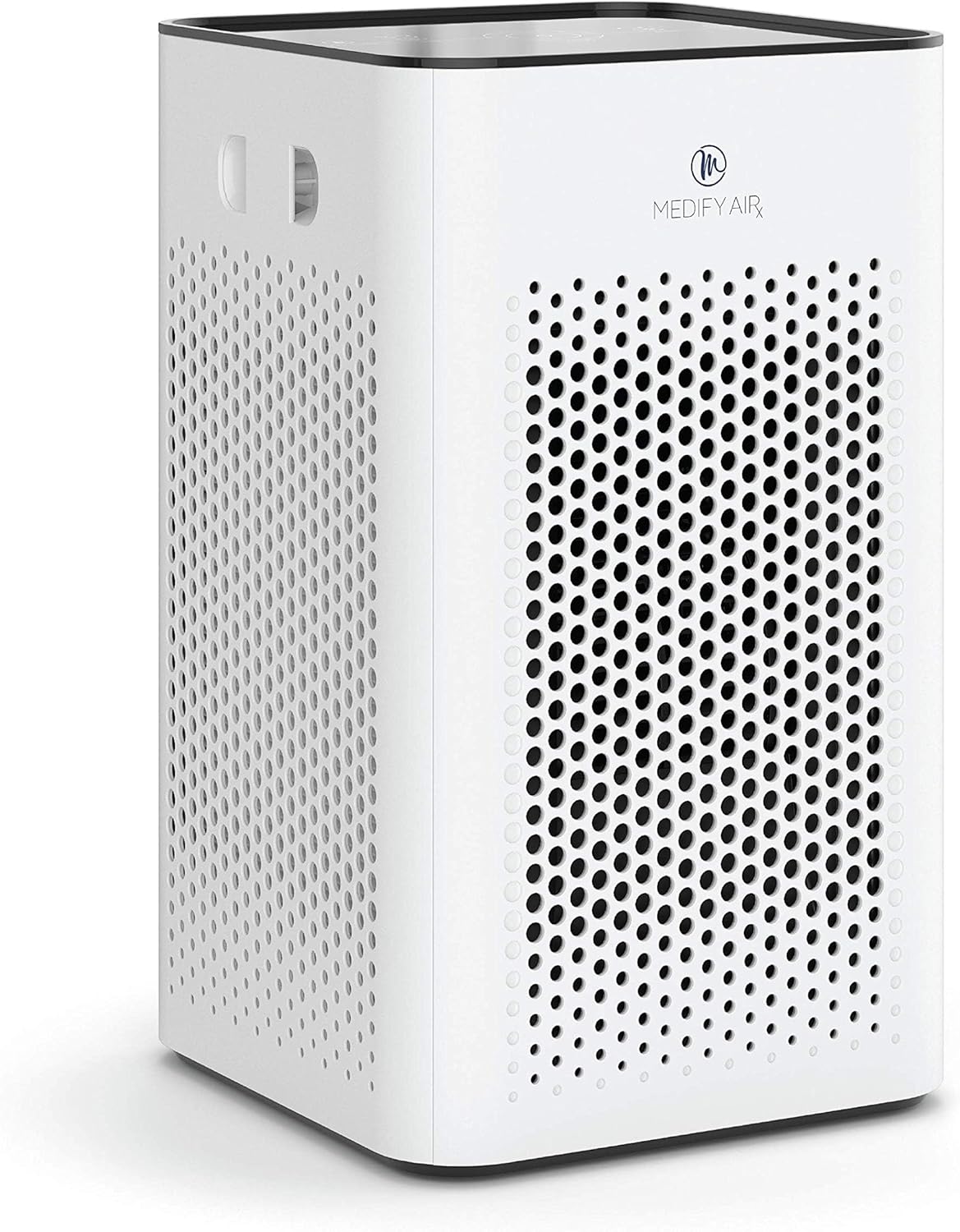
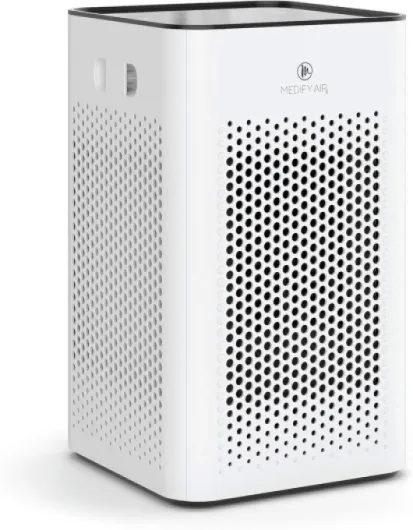
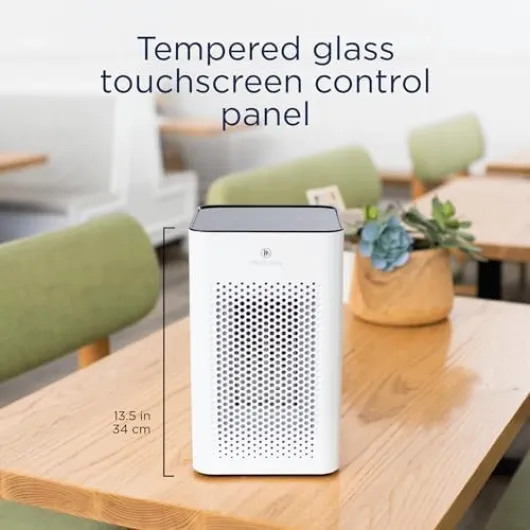
Physically, the MA-25 is pretty compact: about 8 x 8 inches at the base and 13.5 inches tall. It’s basically a small white box that doesn’t scream for attention, which I like. It blends in next to a nightstand or under a window. The style is simple and modern enough that it doesn’t look cheap, but it’s clearly designed to be functional more than decorative. If you want a purifier that doubles as decor, this isn’t that, but it doesn’t look bad either.
The air intake is on the sides and the output is straight out the front. That’s good in the sense that it pulls air from both sides using dual filters, but the front-facing output is a bit annoying in practice. If you put it near your bed or on a desk and you’re directly in front of it, you’ll feel a constant stream of air on you, which isn’t always what you want. There’s no way to angle the airflow upward, and the vent is fixed, so if you prefer the air going up and circulating more, you’ll probably end up doing what I did: slightly tilting the unit using a book or a small wedge.
One design choice that bugs me: the power cord placement. It plugs into the back, and the way the vents are laid out, you can’t really push it flush against a wall. You need about 2 inches of clearance all around so it can breathe properly. In a tight room, that’s a bit of wasted space. Also, the control panel is on the top, which is practical to reach, but it means you can’t put anything on top of the unit. The size makes it very tempting to use as a mini shelf for a book or a phone, but if you do, you’re blocking the controls and probably some airflow.
Another detail: the indicator lights are built into the buttons. There is a dim/sleep mode that turns the brightness way down, which is fine for me in the bedroom, but if you’re super sensitive to any light at night, you might still notice a small glow. When it’s off, the power button blinks slowly, which is honestly unnecessary and a bit annoying. To fully kill that light, you have to unplug it. So, design-wise, it’s mostly practical, but you can tell they didn’t think through every little usability annoyance.
Daily use and noise: can you live with it running?
In day-to-day use, the MA-25 is easy to live with, as long as you’re okay with a bit of fan noise. On the lowest setting, I barely notice it after a few minutes. It’s quieter than most cheap box fans or older purifiers I’ve tried. I can sleep with it next to the bed on speed 1 without it bothering me. If anything, it feels like very soft white noise. On speed 2, I can still watch TV or work without it being distracting, but you know it’s on.
Speed 3 is more of a “I’m doing something now” mode. It’s noticeably louder, more like a small desk fan on high. I wouldn’t keep it on that mode during a phone call or if I need quiet, but I don’t mind blasting it for 20–30 minutes after cooking or if the outside air is bad. If you’re super sensitive to noise, you’ll probably just stick to the first two speeds most of the time.
The touch controls react well; no need to tap five times. The child lock is handy if you have kids who love pressing buttons, and it also stops pets from messing with it if they step on the top. One slightly annoying thing: because the lights are integrated into the buttons, you can’t just slap tape over them without making the controls annoying to use. Sleep mode does dim them a lot, which for me is enough, but if you’re the kind of person who covers every LED in your bedroom, you’ll grumble a bit.
In terms of overall comfort, I like that it’s light and portable. At about 7.3 pounds, I can easily grab it with one hand and move it from living room to bedroom. I end up doing that a lot: high in the kitchen after cooking, then into the bedroom on low at night. No handle, but it’s small enough that it’s not a big deal. So from a usability standpoint, it’s simple and mostly hassle-free, with the main compromise being that you don’t have smart features or super clever light controls.
Build quality and filter lifespan in real life
Build-wise, the MA-25 feels like decent mid-range plastic. It doesn’t feel premium, but it also doesn’t feel like it’ll crack if you bump it. I’ve moved it around a lot, bumped it with a vacuum, and had a cat brush against it, and nothing has loosened or rattled so far. The side panels that cover the filters clip on and off with a simple pinch mechanism. They don’t feel super heavy-duty, but they lock in securely enough that I’m not worried about them falling off on their own.
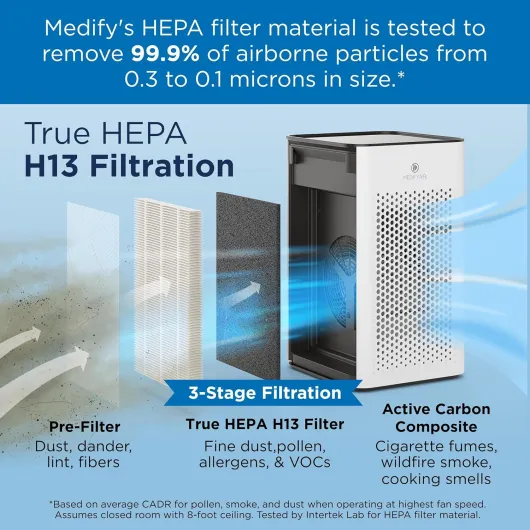
As for filters, the official line is about 2,500 hours, roughly 3–4 months if you run it constantly. In practice, if you’re running it part-time (like 8–12 hours a day), you can stretch that. Some users mention going closer to a year, especially in cleaner areas or if they vacuum the outer layer regularly. In my case, with a cat and city dust, after about 4–5 months of regular use, the filter looks pretty gray and I feel better swapping it. The fact that it’s a dual-filter design means it catches a lot, but it also means you really do need to stay on top of replacements if you want it to perform well.
One small concern is the long-term reliability of the touch panel and lights. I’ve seen reports (and one of the reviews mentions) that a timer light can fail after a year or so. That doesn’t kill the whole unit, but it’s the kind of minor defect that reminds you this isn’t a high-end machine. So far, mine is fine, but I haven’t hit the multi-year mark yet. On the positive side, Medify advertises a lifetime warranty as long as you use their genuine filters, so at least on paper there’s some backing if something major fails.
Overall, I’d say durability feels okay for the price: it’s not built like a tank, but it also doesn’t feel fragile. Treat it like a small appliance, don’t drop it, clean it occasionally, and it should hold up. Just budget for filters as an ongoing cost, because that’s where you’ll spend money over time, not on the main unit itself.
Performance: how well it actually cleans the air
In terms of pure performance, it does what I wanted: less dust, fewer smells, easier breathing. In my bedroom, dust on surfaces builds up slower when I leave it running a few hours each day on speed 2. Before, I’d see that visible layer on dark furniture in 2–3 days; now it’s more like 4–5 days before it’s really noticeable. Not a scientific test, but enough to say it’s doing something. My morning congestion also eased up. I still have allergies, but I wake up less stuffy when this has been running in the room.
For odors, it’s decent. When I cook something with a strong smell (onions, fish, or anything that tends to linger), I move it closer to the kitchen and crank it to speed 3 for 20–30 minutes. It doesn’t erase the smell instantly, but it cuts that heavy lingering odor way faster than just opening a window. Same with general apartment mustiness after a few days of closed windows: run this on medium for a couple of hours and the air feels less stale. For smoke (from outside wildfires drifting in), it definitely helps reduce that smoky smell, but if the air quality outside is very bad, you’ll still notice some smell unless you seal the place up pretty well.
Noise-wise, the performance is tied to the fan speed. On speed 1, it’s very quiet, like a soft hum you forget about. On speed 2, it’s a normal fan noise that works as background sound or light white noise. On speed 3, it’s clearly loud enough that you notice it, but it’s not unbearable. I personally don’t sleep with it on high; I only use that setting for quick cleanups. If you like white noise, you might actually enjoy speed 3. If you want silence, stick to speed 1 at night.
One thing missing is any kind of air quality sensor or auto mode. There’s no color ring, no PM2.5 reading, nothing. You just have to trust it’s working or go by your nose and your allergies. For the price, I would have liked at least a basic air quality indicator. That said, for a simple manual unit, the actual air cleaning performance feels solid, especially in the small to medium rooms it’s clearly meant for.
What you actually get with the MA-25
Out of the box, you get the purifier itself (already assembled), the H13 HEPA filter pre-installed, and a quick start guide. No tools, no weird setup. You literally pull off the side covers, remove the plastic from the filters, pop them back in, and plug it in. Took me under five minutes, including double-checking the manual once. For people who hate overcomplicated gadgets, this is straightforward.
The unit is rated for up to 825 sq ft in one hour, but realistically, I’d say it’s best for bedrooms, home offices, nurseries, and maybe a small living room. In my roughly 250–300 sq ft bedroom, it feels more than enough. In an open 600–700 sq ft living/dining area, it still helps, but you don’t get that same quick “wow the air feels different” effect unless you leave it on higher speed for a while.
Controls are simple: touch buttons on top for power, 3 fan speeds, timer (0–8 hours), sleep mode (dims lights and lowers noise), and a child lock. There’s also a filter replacement indicator that lights up after around 2,500 hours. No remote, no app, no auto mode based on air quality. It’s very much a manual unit. If you want something that adjusts itself based on sensors, this isn’t it.
On paper, the big selling point is the True HEPA H13 filter rated down to 0.1 microns. That basically means it catches a lot of fine particles: allergens, smoke, pet dander, dust, etc. I obviously can’t lab-test that, but compared to cheaper filters I’ve used, my allergy symptoms and dust buildup on furniture are noticeably reduced when I run this several hours a day. For the price bracket, it feels like a decent balance of performance and simplicity, as long as you accept the ongoing cost of replacing filters every few months if you run it a lot.
Pros
- Compact and lightweight, easy to move between rooms
- H13 HEPA filtration that clearly reduces dust and odors in small to medium spaces
- Quiet on low/medium speeds and simple, straightforward controls
Cons
- No air quality sensor or auto mode, everything is manual
- Ongoing cost of replacement filters can add up if you run it a lot
- Front airflow and cord placement limit where you can put it and how you direct the air
Conclusion
Editor's rating
Overall, the Medify MA-25 is a solid, no-nonsense air purifier for small to medium rooms. It’s compact, easy to use, and actually makes the air feel cleaner, especially if you’re dealing with dust, pet dander, or light to moderate odors. Noise levels are manageable, especially on the lower two speeds, and the H13 HEPA filter seems to do its job well. If you just want something you can plug in, set to speed 1 or 2, and forget about for a few hours, it fits that role nicely.
It’s not perfect. The lack of an air quality sensor or auto mode means you’re always guessing a bit about how hard it should be working. The design has a few annoyances: front-facing airflow you can’t angle, a power cord that forces it away from walls, and indicator lights that never fully disappear unless you unplug it. And the ongoing cost of genuine filters is something you really need to budget for if you run it a lot.
I’d recommend this to people who want a straightforward, compact purifier for a bedroom, nursery, dorm room, or small living room, and who don’t care about apps or fancy displays. It’s also a decent option for pet owners and city dwellers who mainly want less dust and fewer lingering smells. If you’re super picky about design, want complete darkness in your bedroom, or expect smart features and detailed air quality data, you should probably look elsewhere or step up to a more advanced model.