
Summary
Editor's rating
Value for money: overkill or smart buy?
Boxy, metal, and very obviously a tool, not decor
Build quality and durability after several heavy uses
Performance: how well it actually kills odors (and how fast)
What you actually get and what this thing is (and isn’t)
Effectiveness on different odors: mold, pets, smoke, and random funk
Pros
- Very strong ozone output that actually reduces stubborn odors in basements, cars, and rental rooms
- Simple, robust metal build with an easy mechanical timer and carry handle
- Good coverage for larger spaces and faster treatment times compared to small consumer units
Cons
- Too powerful for small rooms if you’re not careful with run times, and requires strict safety precautions
- Looks and feels like an industrial tool, not a home decor-friendly purifier
- Doesn’t replace basic cleaning or humidity control, so you still need to deal with the root causes of odors

Specifications
View full product page →| Brand | Amgwhhoo |
A heavy‑duty smell killer, not a fancy air purifier
I bought this Amgwhhoo ozone generator because I was tired of chasing musty basement smell with candles, sprays, and those tiny plug‑in purifiers that barely do anything. This is not that kind of product at all. It’s basically a smell nuke: you clear the room, set the timer, leave, and let it do its thing. If you’re looking for a gentle, always‑on air purifier to run while you watch TV, this is the wrong machine.
In my case, I used it on a damp basement, an old smoker’s car, and a spare room that had some dog odor baked into the carpet. I treated each space separately over about a week. I followed the warnings pretty strictly: no people, no pets, windows closed during treatment, then airing out for at least an hour or more. The ozone smell is real and pretty harsh if you walk in too soon.
Right away, the main thing I noticed is that it actually removes odors instead of just covering them up. After a basement session, that classic wet-dog / concrete stink was mostly gone after the first run and almost completely gone after the second. Same story with the car: that old smoke smell that never left with regular cleaning finally calmed down a lot. It’s not magic, but it’s clearly more effective than the usual gadgets.
Overall, this is a pretty serious tool. It’s not perfect, and it’s overkill for small bedrooms if you’re not careful with the timer. But if you’ve got stubborn smells in a basement, crawlspace, rental unit, or car, it actually gets the job done. Just don’t treat it like a casual air freshener—you really do have to respect the safety side of it.
Value for money: overkill or smart buy?
On value, it really depends on how bad your odor problems are and how often you plan to use it. This is not a fancy brand with a big name, but you’re paying mainly for high output (80,000–100,000 mg/h) and a metal body, not for design or smart features. Compared to small 5,000–10,000 mg/h ozone units, this one costs more, but it also works faster and covers much larger spaces. If you’ve got a big basement, a smelly crawlspace, or you deal with rental units, that extra power actually matters.
For a regular apartment with minor cooking smells, this would probably be overkill. In that case, a cheaper, smaller unit or even a normal HEPA purifier might make more sense. But if you’re like me and you’re dealing with very stubborn smells—musty basement, old smoke in a car, pet odors soaked into carpets—then I’d say the price is justified. I would have spent the same amount on a couple of weak gadgets that don’t really solve the root problem.
The running costs are low: it doesn’t use a ton of electricity per session, and there are no filter subscriptions. Down the line you may need to clean or replace the ozone plate, but that’s standard for this kind of machine. The real “cost” is the hassle of using it safely: clearing the room, waiting outside, airing out afterward. If you’re okay with that routine, then the value is pretty good.
So overall, for someone with serious odor issues in larger spaces, I’d call it good value for money. It’s not the cheapest option, but it actually does the job it claims. If your odor problems are light or occasional, though, you could probably save money and go for something smaller and less intense.
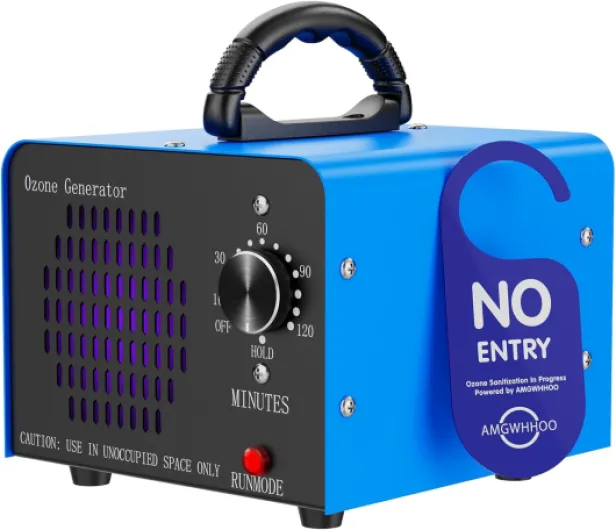
Boxy, metal, and very obviously a tool, not decor
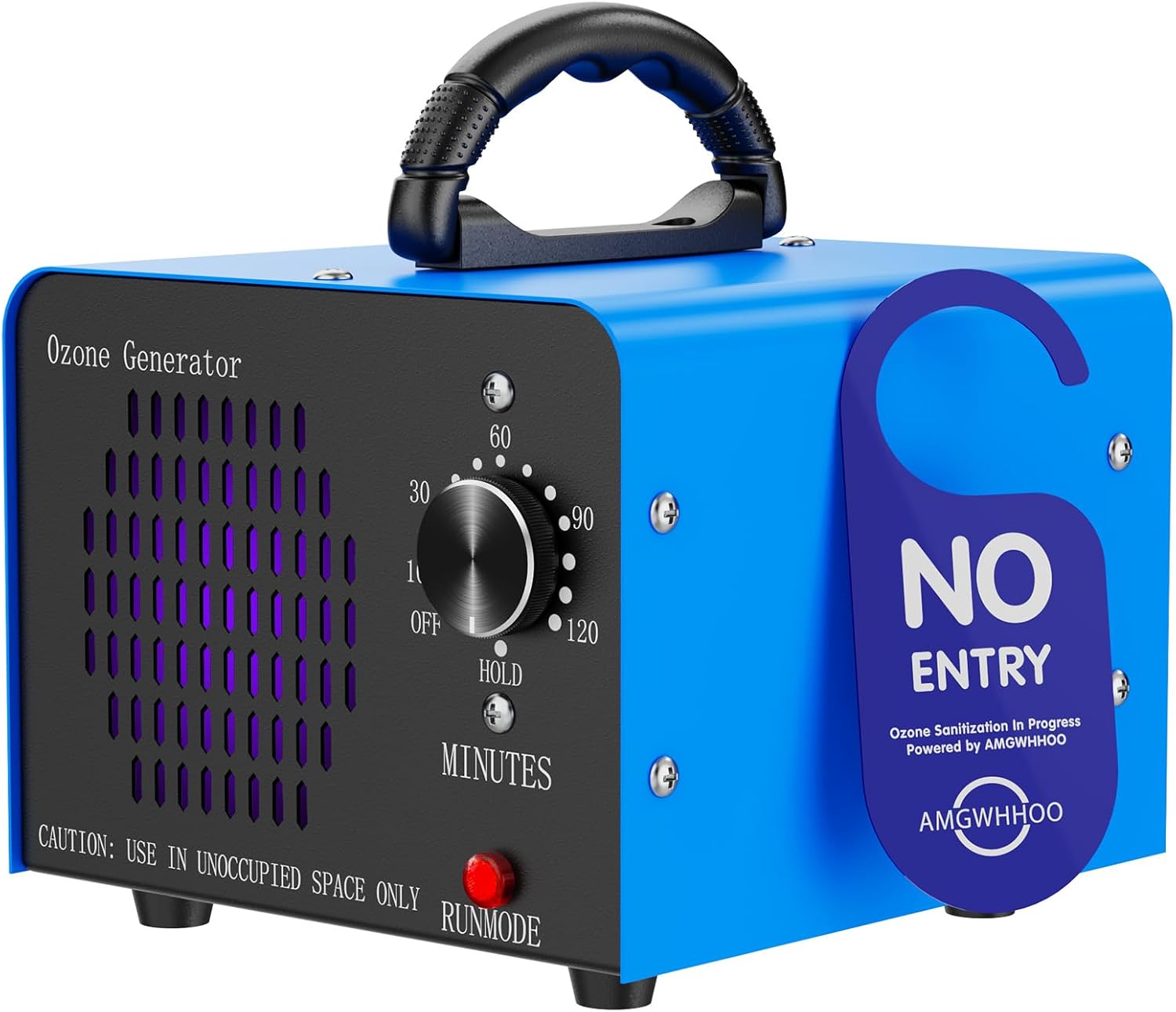
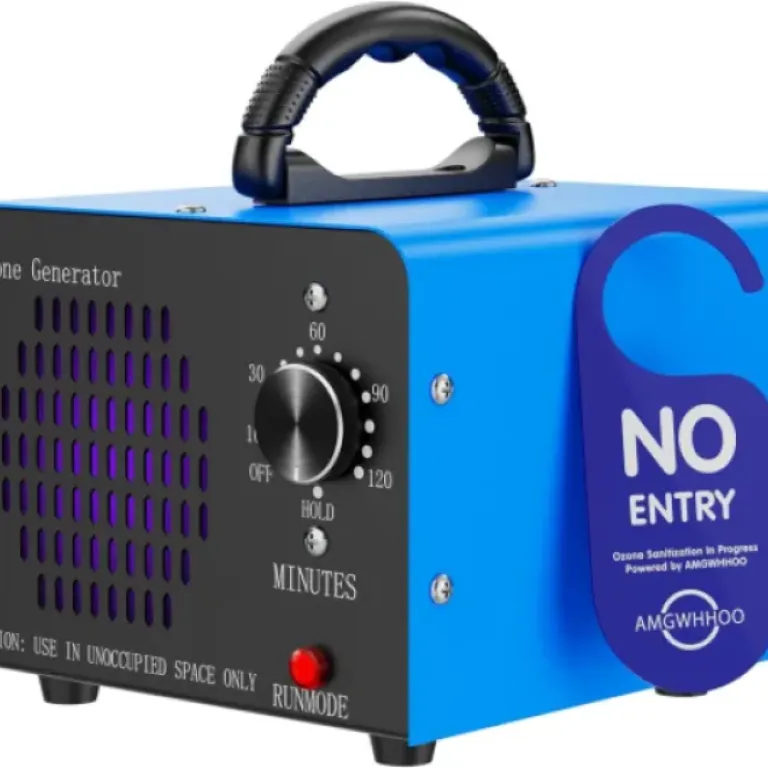
Design-wise, this thing is pretty basic. It’s a blue metal box with a handle on top, a big vent and fan on one side, and the controls on the front. If you’re expecting something sleek that blends into your living room, forget it. It looks like a piece of workshop equipment, which honestly fits what it’s meant to do. The listed dimensions (roughly 5.9"D x 6.69"W x 7.77"H) are accurate, and the weight feels about right at just over 4 pounds. It’s light enough to carry with one hand without feeling flimsy.
The handle has a non-slip coating, which I appreciated when I was moving it between the basement, garage, and car. You can easily place it on the floor, a table, or a shelf. I usually set it somewhere with good airflow, not jammed into a corner. The fan pulls air in and pushes ozonated air out, so it needs a bit of breathing room. It’s not silent, but at 38 dB it’s more of a steady low hum. Since you’re not supposed to be in the room while it runs, the noise isn’t really a problem.
The controls are as simple as they look in the product description: one mechanical timer dial and a power switch. No digital display, no remote, no Wi‑Fi. Personally, I liked that. Less to fiddle with, and less stuff that can glitch out. The timer has clear markings and a pretty firm click feel when you turn it, so you can set it without guessing. There’s usually a light indicator so you can see from a distance if it’s running, which is handy when you walk by and want to confirm it’s still on.
If I had to nitpick, I’d say the design is functional but not pretty. The blue metal casing looks a bit cheap, but it also feels like it can take a few bumps. I wouldn’t toss it around, but it doesn’t feel fragile either. For what it’s supposed to do—sit in a smelly room and pump out ozone—this design is perfectly fine. Just don’t expect it to win any style awards.
Build quality and durability after several heavy uses
In terms of durability, it feels more like a workshop tool than a delicate home gadget. The casing is all metal, the handle is firmly attached, and the fan doesn’t rattle or wobble. I’ve moved it around quite a bit—basement, garage, different floors of the house, plus in and out of the car—and nothing has loosened or started making weird noises. The weight gives it a solid feel without being a pain to carry.
I’ve done about a dozen full sessions so far, some of them longer runs of 60–90 minutes. The unit doesn’t get excessively hot; it gets warm around the vents, which is normal, but never to the point where I was worried. The fan still sounds the same as day one, and the timer dial hasn’t gotten sloppy. It still has a firm click when you set the time, and it hasn’t stuck or misfired yet.
Long term, the main thing with ozone generators is usually the ozone plate and general maintenance. This model doesn’t come with a fancy maintenance kit, but the construction is simple enough that I’m not too worried. You’ll eventually need to clean or replace the internal plate depending on how often you use it, but that’s standard for this type of machine. For occasional home and light commercial use—like monthly basement treatments or the odd rental cleanup—I don’t see any big durability red flags.
If you plan to run it constantly in a professional setting (like cleaning apartments every day), you might want to keep an eye on it more closely or have a backup unit. But for regular home use, the build feels good enough. It’s not pretty, but it feels like it can take some use and keep going, which is what matters here.
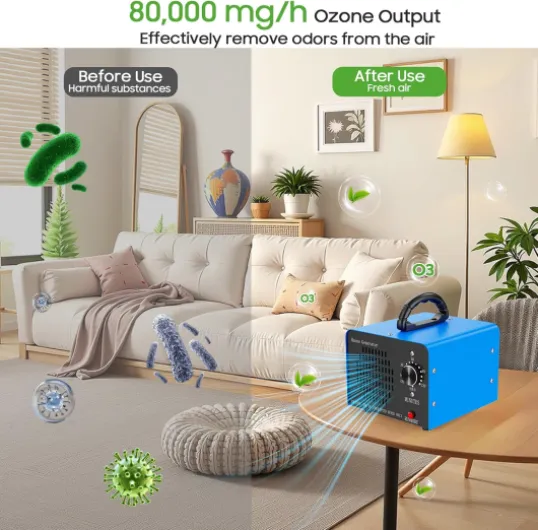
Performance: how well it actually kills odors (and how fast)
Performance is where this unit earns its keep. I ran it in three main scenarios: a musty basement (roughly 1,000–1,200 sq ft), a mid‑size sedan that previously belonged to a smoker, and a spare bedroom with old dog smell in the carpet. In all three cases, it clearly reduced odors after one session, and in two of them the smell was almost gone after a second round. It’s not magic, but it’s strong enough that you notice a real difference, not just a light improvement.
For the basement, I did a 60‑minute session with all doors and windows closed, then aired it out for about 2 hours. When I walked back in, there was that sharp ozone scent at first, but the underlying musty smell was already much weaker. I repeated the process the next day for another 60 minutes. After that, the basement smelled more neutral—kind of like an empty, clean room rather than a damp cave. It didn’t fix the humidity problem obviously, but it cut the long‑standing odor to a level where a dehumidifier and normal cleaning could handle the rest.
In the car, I went lighter: about 30 minutes with the windows up and the AC system set to recirculate, then left the doors open for a good hour afterward. The old smoker smell was heavily reduced after just that one session. Not 100% gone, but easily 80–90% better. I did a second shorter run a few days later, and at that point the car smelled mostly like nothing, which is exactly what I wanted. No fake perfume, just neutral air.
Compared to smaller ozone units I’ve borrowed in the past (around 10,000 mg/h), this one is clearly more aggressive. You don’t need to run it as long, and you definitely have to respect the strength. For small rooms, I’d actually recommend shorter, repeated sessions rather than cranking it up for a full hour, because it really is quite powerful. Overall, in terms of raw odor removal, I’d rate the performance as very solid. It does what it claims, as long as you also deal with the underlying moisture or dirt sources and follow the safety guidelines.
What you actually get and what this thing is (and isn’t)
Out of the box, you get the ozone generator unit itself, a power cord, and a basic manual. No extra filters, no app, no fancy features. It’s literally a metal box with a fan, an ozone plate inside, and a mechanical timer knob on the front. The model I got is labeled 80,000 mg/h on the box, but the listing itself talks about 100,000 mg/h and up to 7,000 square feet. Either way, it’s clearly on the high-output side compared to the little 5,000–10,000 mg/h units you see everywhere.
The controls are simple: one main timer dial and an on/off switch. The timer is old‑school, like an analog oven timer, which I actually liked because there’s less to break. You can set it for shorter runs in small spaces or crank it up for a big basement or crawlspace. The manual hammers home the safety stuff: no people, pets, or plants in the room; close off the space; then ventilate after. To be honest, if you don’t respect that, this is not the product for you.
In practice, I used it like this: close all windows and doors in the target room, set the dial (usually 30–60 minutes for a room, 1–2 hours for the basement), leave the house or at least stay on another floor, then come back, open everything up, and let it air out for another hour or two. After that, the ozone smell fades and you can check if the original odor is gone or just reduced. Most times, one session did most of the job, and a second session finished it off.
So overall, the presentation is very straightforward. No nonsense, no extra features. It’s basically sold as a high-capacity odor removal tool for home and light commercial use, and that’s exactly what it feels like: a practical, slightly aggressive machine meant to be used occasionally, not something that lives quietly in your living room.

Effectiveness on different odors: mold, pets, smoke, and random funk
Effectiveness depends a bit on what kind of odor you’re dealing with and how stubborn it is. From my tests and a couple of runs for friends, here’s roughly how it did on different smells:
- Musty / moldy basement: Big improvement after 1–2 sessions, especially when combined with cleaning and a dehumidifier.
- Pet odors (dog in carpet, litter box area): Very noticeable drop in smell, but you still need to clean fabrics and litter properly.
- Cigarette / smoke: Cuts the lingering smell a lot, but nicotine‑stained surfaces still need to be wiped down.
- General funk (old food, trash smell, rental unit odors): Usually gone after one decent run.
In the basement, the ozone handled that heavy, long‑term must smell better than any spray or regular air purifier I’ve tried. It didn’t cure the moisture issue, obviously, but it knocked the odor down to something manageable. For the pet room, I did a 30‑minute session while the pets were out, then aired it out for 2 hours. The dog smell in the carpet and fabric furniture dropped a lot, but I still had to vacuum and use an enzyme cleaner in a few spots. So, it helps a lot, but it’s not a substitute for basic cleaning.
Smoke smell is where I was most impressed. The rental car I tested it on had that deep, old-ashtray smell that never goes away with regular air fresheners. After a 30‑minute ozone treatment and good ventilation, the air smelled way more neutral. You could still find a hint of smoke if you stuck your nose right in the seats, but for normal use, it was basically fine. I’d say this machine is very effective as a finishing step after physical cleaning: wash surfaces, vacuum, maybe shampoo carpets, then run the ozone to kill what’s left.
If you expect it to fix everything with zero effort, you’ll be disappointed. But if you treat it as a strong extra tool on top of cleaning and humidity control, it’s pretty solid. Just remember: remove the source of the odor as much as possible first, then use ozone to handle the leftovers. Used that way, it does its job very well.
Pros
- Very strong ozone output that actually reduces stubborn odors in basements, cars, and rental rooms
- Simple, robust metal build with an easy mechanical timer and carry handle
- Good coverage for larger spaces and faster treatment times compared to small consumer units
Cons
- Too powerful for small rooms if you’re not careful with run times, and requires strict safety precautions
- Looks and feels like an industrial tool, not a home decor-friendly purifier
- Doesn’t replace basic cleaning or humidity control, so you still need to deal with the root causes of odors
Conclusion
Editor's rating
After using this Amgwhhoo ozone generator across a basement, car, and a couple of smelly rooms, my take is pretty simple: it’s a strong, no-frills odor removal tool that actually works, as long as you respect the safety rules and don’t expect it to solve moisture or dirt by itself. The build is basic but solid, the controls are straightforward, and the output is clearly on the powerful side. It’s not something you leave on in the background—it’s more like a power tool you bring out when things really stink.
If you’ve got a musty basement, rental units that smell like smoke or pets, or a car with long‑term odors, this machine makes sense. It can cut those smells down in one or two sessions instead of you fighting them for months with candles and sprays. On the downside, it’s probably too strong for tiny rooms unless you’re careful with the timer, and it’s not a decorative gadget you’ll be proud to display. Also, if you hate the idea of clearing a room and airing it out each time, the whole process will feel annoying.
So who should get it? People with real, persistent odor problems in bigger spaces—homeowners with basements or crawlspaces, landlords, folks dealing with smoke or heavy pet smells. Who should skip it? Anyone just wanting a nice everyday air purifier or a light fresh scent. For serious odor cleanup, though, it’s a pretty solid piece of gear for the price.