
Summary
Editor's rating
Is it worth the money compared to other dehumidifiers?
Tall, slim, and not hideous, but that tiny tank is a joke
Build quality, warranty, and what worries me long term
Humidity control and noise: how it actually behaves day to day
What you actually get with this 80-pint ‘4,500 sq.ft.’ unit
Does it actually dry out a basement? Yes – with a couple of caveats
Pros
- Very good dehumidifying performance for basements and medium-large spaces when properly sized
- Noticeably lower power draw (~280W) compared to many older 70–80 pint units
- Quieter operation with mostly fan noise and minimal compressor clatter
Cons
- Small 1.45-gallon tank fills quickly; continuous drain is basically mandatory in humid spaces
- Realistic coverage is less than the advertised 4,500 sq.ft., especially in closed-off rooms

Specifications
View full product page →| Brand | AEOCKY |
Basement finally stopped smelling like a wet sock
I picked up the AEOCKY RHEA-001 because my basement was sitting around 60–65% humidity all summer, cardboard boxes going soft, that classic musty smell, and my older unit (a noisy, power-hungry Frigidaire) finally died. I wanted something that actually pulled water, didn’t roar like a jet, and didn’t crush my power bill. This one kept coming up in searches, and the Energy Star 2025 thing plus all the talk about lower wattage convinced me to try it.
Out of the box, I set it up in a roughly 1,000–1,200 sq.ft. basement, unfinished, with a concrete floor and some storage. So, not anywhere near the 4,500 sq.ft. they advertise, but honestly I prefer oversizing a dehumidifier instead of running a small one at full blast all day. I’ve been running it for a few weeks now, mostly in auto mode with a continuous drain hose into a floor drain.
First impression: it’s definitely quieter than the old Frigidaire and the Hisense I had before that. You still hear it, it’s not silent, but it’s more like a steady fan noise than a rattling compressor. Humidity dropped from the low 60s to about 48–50% in the first couple of days and has stayed there, even after a few rainy days. So on the basic job of drying the air, it gets the job done.
It’s not perfect though. The water tank is tiny for a unit rated at 80 pints/day, so if you don’t use the hose, you’ll be emptying it constantly. The manual has the usual weird wording, and the interface could be clearer in a few spots. But in day-to-day use, it’s pretty solid: set your target, hook up the hose, and mostly forget it. That’s basically what I wanted.
Is it worth the money compared to other dehumidifiers?
Price-wise, the AEOCKY RHEA-001 usually sits in the mid-to-upper range for 70–80 pint class dehumidifiers. It’s not the cheapest you can find, but it also doesn’t hit the top premium prices of some big-name brands. For what you’re paying, you’re basically getting three things: lower power use, quieter operation, and a 3-year coverage. If you plan to run it many hours a day during humid months, those first two points matter more than saving a few bucks upfront.
Compared to my old 500+ watt units, the rough math is this: if you’re saving around 4–6 kWh per day during heavy use, and your electricity is, say, $0.15/kWh, that’s about $0.60–$0.90/day. Over a full muggy season, it adds up. If you run it a lot or year-round in a basement, you’re easily looking at tens of dollars per month saved compared to a really inefficient unit. Over a couple of years, that can basically pay for the price difference versus a cheaper, hungrier model.
On the downside, the small tank means that if you don’t have a drain or somewhere to run a hose, this becomes a bit less attractive because you’ll be manually emptying it far too often. In that case, a slightly less efficient unit with a bigger built-in tank might be more practical. Also, if your space is small—like a single bedroom or a tiny apartment—this is overkill and you can save money with a smaller dehumidifier that’s easier to move and store.
Overall, I’d say the value is good for medium to large damp spaces where you can use the hose and actually take advantage of the better efficiency. If you’re just running it occasionally, or you’re in a very mild climate, the extra features and Energy Star 2025 badge won’t matter as much. But for a basement that needs regular drying, I’m comfortable saying it’s worth the asking price, especially if your power rates are high and you care about noise levels.

Tall, slim, and not hideous, but that tiny tank is a joke
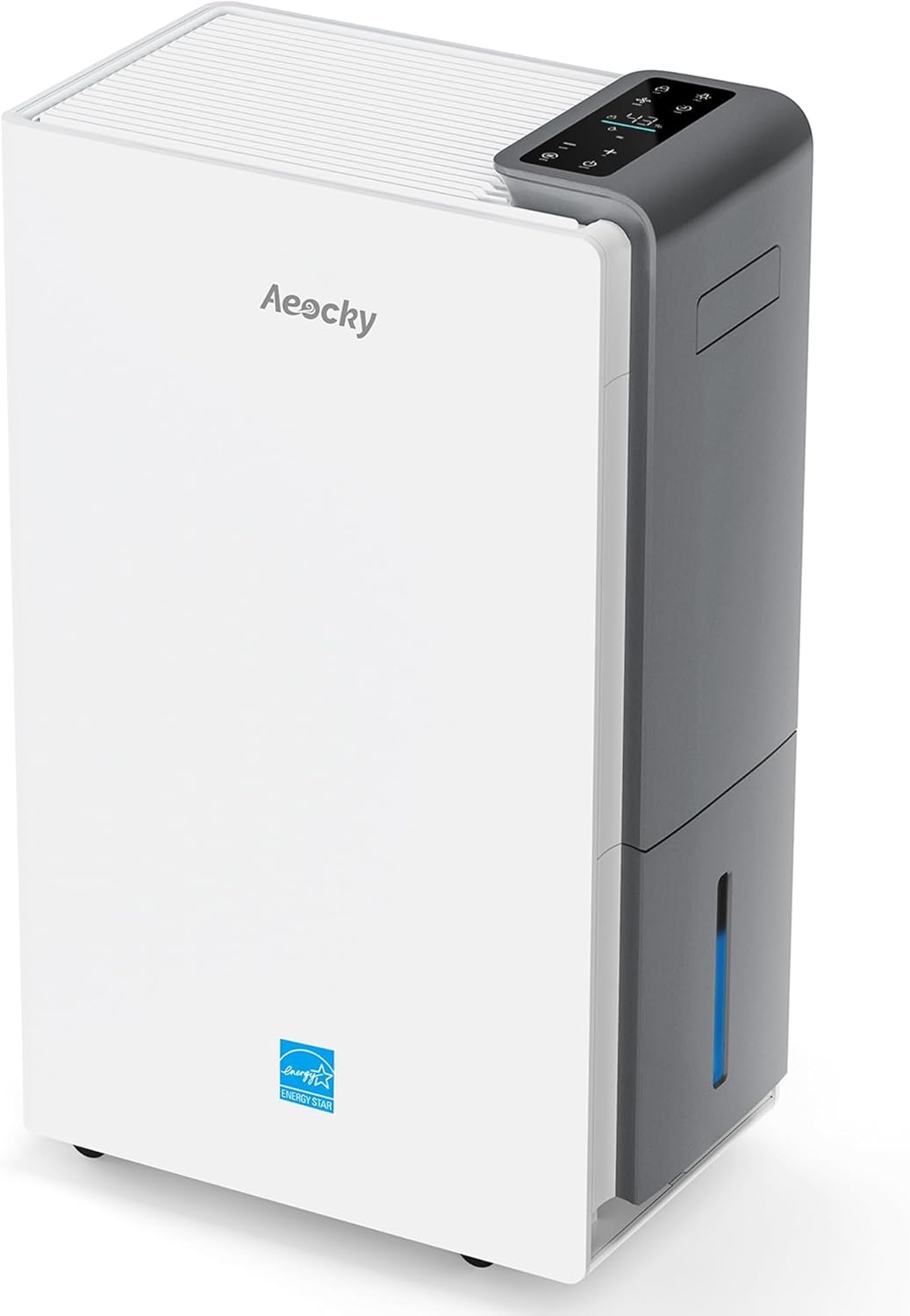
Physically, this thing is taller and slimmer than most older dehumidifiers I’ve owned. The footprint is roughly 14.5" deep by 8.7" wide and about 24" tall. That narrow width is actually nice in a crowded basement—easy to tuck between shelves or next to the water heater. It has swivel casters pre-installed, and a hidden handle, so moving it around is simple, even on a rough-ish concrete floor. At around 31–35 lbs, it’s not feather-light, but definitely lighter than some chunky units I’ve dragged around.
The control panel on top is basic but readable. Big humidity number in the middle, mode icons, and touch buttons. The multi-color ambient light is more gimmick than anything, but it does make it easy to see if the unit is on and roughly what it’s doing when the room is dim. The screen is bright enough without lighting up the whole room, which I liked. My only complaint is the typical “translated manual” feel—some labels and explanations could be clearer, but you figure it out after a day.
The main design issue for me is the 1.45-gallon tank on a unit that can pull 80 pints/day in ideal conditions. In practice, when my basement was really humid the first week, it filled up fast—several times a day. It does shut off automatically when the tank is full, so no overflow problem, but if you’re not using a drain hose you’ll be babysitting it. For a big unit, the tank feels like an afterthought. It’s fine as a backup or if humidity is mild, but not if you’re actually pushing the machine.
Noise-wise, the design with the rotor compressor and bigger fan does pay off. On the lowest fan level, it’s more like white noise than a clunky machine. Even at full tilt, it’s quieter than my old Frigidaire on low. You can still hear airflow, but the compressor itself is barely noticeable. So as a piece of hardware sitting in the corner, it blends in pretty well visually and acoustically, as long as you set up a proper drain and don’t have to fuss with the bucket all the time.
Build quality, warranty, and what worries me long term
Build quality feels decent but not bulletproof. The outer shell is mostly plastic with some metal inside where it matters. It doesn’t feel flimsy when you roll it around, and there’s no rattling or loose panels out of the box. The bucket slides in and out smoothly, and the casters haven’t jammed or fallen off on my rough concrete floor. The rotor compressor setup is supposed to be lighter and less prone to wear than older piston designs; I can’t verify that long term yet, but it does run smoothly.
One encouraging thing is the 3-year coverage, which is longer than what I had on my older units. I also saw at least one user review where the company actually replaced a unit that failed after a while, so they do seem to honor the warranty when something goes wrong, especially if it was likely shipping damage. That’s reassuring, because these things run a lot of hours and failures usually happen after the first heavy season.
On the flip side, it’s still a Chinese-manufactured appliance with the usual small concerns: thin-ish plastic in some areas, a water tank that doesn’t feel like it would enjoy being dropped, and a manual that doesn’t inspire a ton of confidence with its translation. Nothing feels like it’s about to snap, but it also doesn’t feel like some heavy-duty commercial unit. It’s clearly built for home use, not a construction site.
After a few weeks of pretty much nonstop use, I haven’t noticed any performance drop, weird noises, or error codes. The fan and compressor sound the same as day one. If they really did stick with copper tubing inside instead of cheaper aluminum, that should help with longevity, especially if you move it around or it gets bumped. My honest take: it should be fine for a few years of normal household use, especially with the Energy Star efficiency reducing stress on the compressor. But like any dehumidifier, I’d keep the receipt and register the warranty, because this category is notorious for units dying right after the standard 1-year mark.

Humidity control and noise: how it actually behaves day to day
Performance-wise, the RHEA-001 is solid where it counts. I started with a basement sitting around 60–65% humidity. With the unit set to 45–50% and running 24/7 at first, it brought the space down to about 48–50% in roughly 36–48 hours. That’s with some rain outside and a not-very-sealed old house foundation. Once things stabilized, I switched it to auto mode, and it now cycles on and off enough to hold roughly 50–55% without me touching it. That’s good enough to stop that damp smell and keep cardboard and fabrics from feeling clammy.
The auto mode and built-in humidistat seem reasonably accurate. I checked it against a separate digital hygrometer, and it was usually within 2–3% RH, sometimes off by 5% at most. The machine doesn’t overshoot badly: it pulls down to the target, then rests for a bit, instead of constantly hunting. That’s better than some cheap dehumidifiers that either never shut off or bounce between too dry and too humid. Millisecond-level detection sounds like marketing fluff, but end result is: it holds a steady range pretty well.
On the noise front, it’s one of the quieter compressor units I’ve used. The fan is the main thing you hear, like a medium-speed box fan in the next room. The compressor doesn’t clank or buzz, and there isn’t much vibration. If you’re using it in a bedroom you’ll still hear it, but in a basement, living room, or hallway it fades into the background. I could easily watch TV in the room above without cranking the volume.
One thing to keep in mind: that 80 pints/day spec is under hot and very humid lab conditions (95°F, 95% RH). In a normal basement around 70–75°F and 55–65% humidity, you’re not going to see a full 80 pints. That’s normal for every brand, not just AEOCKY. In real use, it still pulls a steady stream of water through the drain hose, and the floor and walls feel drier over time. So in practice, it does what I expected from a unit in this size class, just a bit more quietly and using less power.
What you actually get with this 80-pint ‘4,500 sq.ft.’ unit
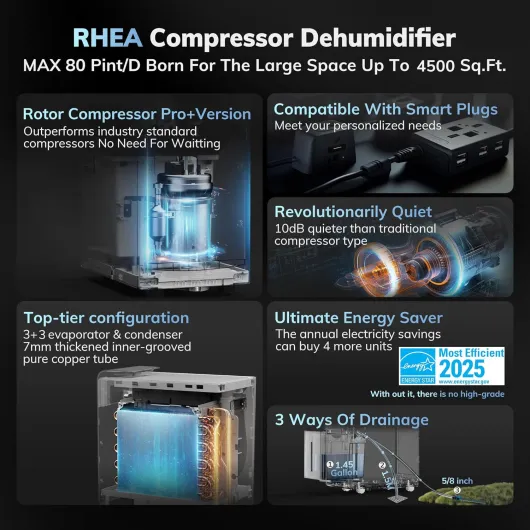
On paper, the AEOCKY RHEA-001 is an 80 pint/day compressor dehumidifier rated for up to 4,500 sq.ft., with Energy Star “Most Efficient 2025” status and a claimed 280W power draw. In real life, think of it as a medium-to-large capacity unit that’s best suited for a full basement, a damp main floor, or a small house if you keep doors open. I’d personally use it for 800–2,000 sq.ft. if you want strong performance, not 4,500 sq.ft. unless your place is only mildly humid.
You get the unit itself, a short clear drain hose, and a garden hose adapter hidden in the bucket. The hose is fine if you’re close to a drain or sink; otherwise you’ll want a longer standard garden hose. There’s a digital display on top showing current humidity, basic buttons (mode, timer, up/down, etc.), and some ambient light color stuff that I honestly don’t care much about but it does help you see the panel in the dark.
Modes are pretty straightforward: auto, set humidity, continuous, a sort of smart dry, plus sleep mode. I mostly used auto and manual % setting. The unit shows current humidity and lets you set between 40–80%. For my basement I settled on 50% as a good balance. It also has a child lock which is handy if you’ve got kids pressing every button they see.
In terms of expectations: it does not magically dry a giant house overnight, but for a typical basement or a couple of connected rooms, it feels properly sized. The Energy Star angle is actually noticeable on the power meter: compared to my old 500+ watt unit, this one really does sip less power while keeping humidity at similar levels. So the product page isn’t totally full of hot air, but you still need to be realistic about space size and ventilation.
Does it actually dry out a basement? Yes – with a couple of caveats
In terms of pure dehumidifying effectiveness, I’d call this unit “very capable, as long as you set it up right.” When I first turned it on, the bucket filled in a few hours, which tells you it’s actually pulling moisture. After switching to the continuous drain into my floor drain, it started running non-stop the first couple of days, then gradually cycled less often as the basement dried out. Cardboard boxes that felt slightly soft dried out, and that faint musty smell backed off noticeably after about a week.
Where it really shines is when you compare power draw versus results. My previous Hisense unit pulled around 540W and still ran a ton. This one pulls about 280W when running, and it doesn’t need to run all the time once the space is under control. Using a power monitor, my old setup used around 10+ kWh/day in peak summer; the AEOCKY is closer to 4–6 kWh/day for the same space and comfort level. That’s not some tiny difference—you can see it clearly on the bill if you run it a lot.
The downside: if you’re trying to dry a very large area or multiple closed-off rooms, don’t expect miracles. Like any dehumidifier, it works best when air can circulate freely. In my case, one open basement space worked great. When I shut doors to a back room, humidity in that room stayed a few points higher unless I added a fan to push air around. So if you have a chopped-up floor plan, think about using fans or maybe two smaller units instead of one big one stuck in a corner.
Also, in cooler conditions (around low 60s °F), it still runs, but the dehumidifying rate drops, which is normal for compressor units. The defrost function seems to do its job; I never saw it freeze solid or shut down permanently, but you can hear it cycle sometimes. Overall, if your goal is “keep a basement or medium-large room in the 45–55% range without babysitting it,” this unit handles that well. Just don’t expect it to dry your whole house through closed doors or fix serious water intrusion problems on its own.
Pros
- Very good dehumidifying performance for basements and medium-large spaces when properly sized
- Noticeably lower power draw (~280W) compared to many older 70–80 pint units
- Quieter operation with mostly fan noise and minimal compressor clatter
Cons
- Small 1.45-gallon tank fills quickly; continuous drain is basically mandatory in humid spaces
- Realistic coverage is less than the advertised 4,500 sq.ft., especially in closed-off rooms
Conclusion
Editor's rating
After living with the AEOCKY RHEA-001 for a few weeks, my take is pretty straightforward: it’s a quiet, efficient dehumidifier that handles a damp basement well, with a couple of practical annoyances you need to plan around. It pulls moisture out of the air at a good rate, holds humidity in a comfortable range without constant fiddling, and doesn’t blast your ears or your power bill in the process. The rotor compressor and Energy Star 2025 efficiency aren’t just marketing; you can actually see the difference on a power meter and hear it in how tame the noise is compared to older units.
The main downsides are the undersized water tank and the usual “this is rated for 4,500 sq.ft. but don’t take that literally” situation. If you don’t have a floor drain or somewhere to run a hose, expect to empty the bucket multiple times per day in a very humid space. And if you’re hoping one unit will magically fix humidity in a big, chopped-up house through closed doors, you’ll be disappointed. It’s best used in a basement, open-plan floor, or a couple of connected rooms with decent airflow.
I’d recommend this to someone who has a damp basement or medium-large room, wants something quieter than the usual clunky models, and is willing to set up continuous drainage. If you live in a small apartment, or you only need a dehumidifier a few days a year, it’s probably more than you need. But if your dehumidifier runs for months at a time, this is a pretty solid balance of performance, noise, and running costs, backed by a better-than-average warranty.